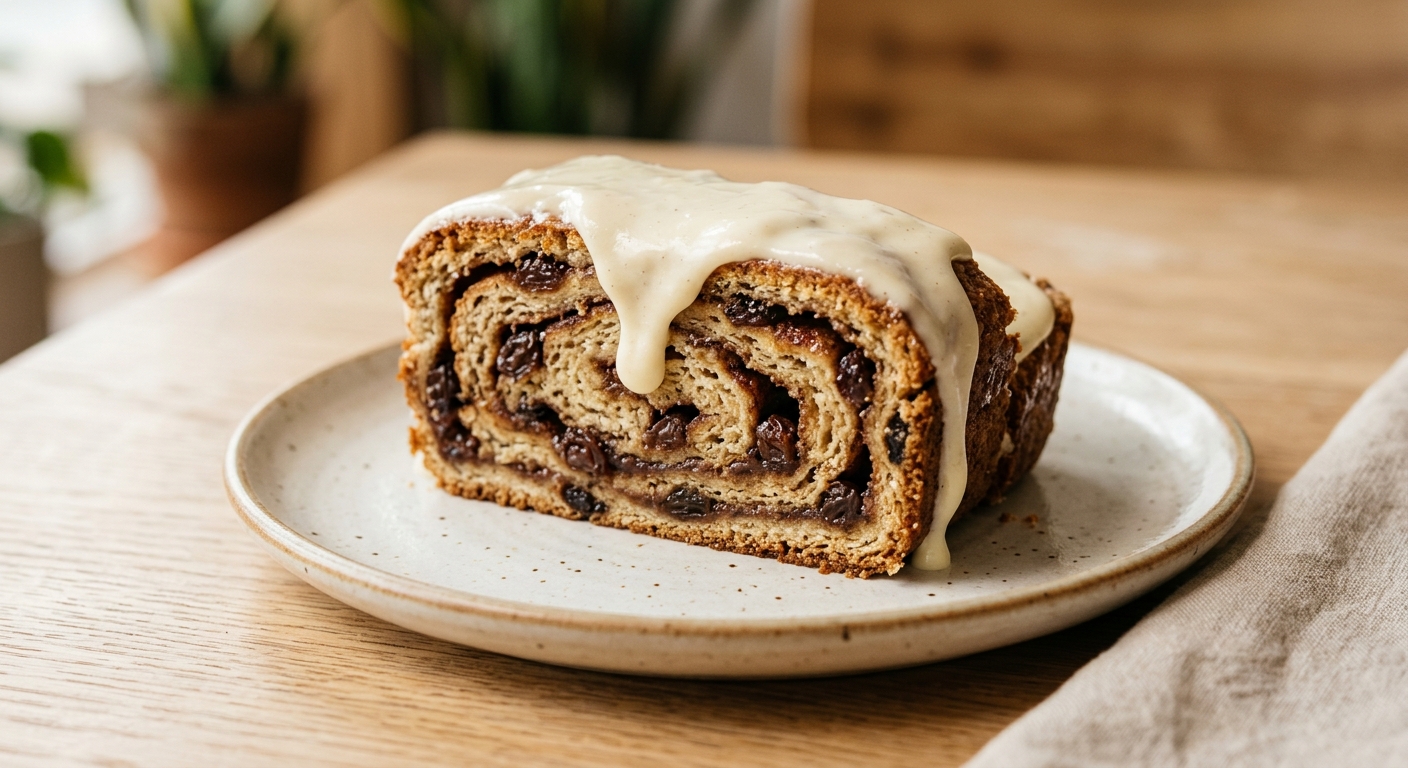
There is something almost magical about pulling a swirled loaf from the oven, that ribbon of dark cinnamon sugar curling through a cloud of soft, golden bread. This cinnamon raisin swirl loaf is the kind of bake that feels deeply nostalgic, the sort of thing you imagine cooling on a grandmother’s counter, wrapped in a clean dish towel with the windows fogged from the oven’s warmth. Every slice reveals a dramatic spiral of spiced filling studded with plump, jammy raisins, and the cream cheese glaze drizzled over the top adds just the right amount of richness and tang to make it feel truly special.
What sets this loaf apart from most cinnamon swirl breads is the enriched dough: a generous amount of butter, a splash of whole milk, and one egg give the crumb a soft, tender, almost brioche-like quality without being too rich to enjoy at breakfast. The filling is built on both brown sugar and a touch of honey, which keeps it moist and prevents that dreaded gap between the swirl and the bread. A careful rolling technique, pressing the filling firmly and pinching the seam tightly, ensures the spiral holds its shape all the way through baking. The cream cheese glaze, spiked with vanilla and lemon zest, is poured on warm so it soaks slightly into the top crust rather than sitting like a hard shell.
This is a medium-difficulty bake, mostly because it involves a yeasted dough, but do not let that put you off. If you have made bread even once before, you will feel right at home here. The dough is forgiving and easy to handle, and the recipe walks you through every stage clearly. It is ideal for a relaxed weekend morning when you have a couple of hours to enjoy the process, and it rewards you with enough bread to serve a small crowd or to last beautifully through the week.
Equipment Needed
Click on an item below to shop for the recommended items for this recipe on Amazon.
As an Amazon Associate, we earn from qualifying purchases.
12
Ingredients
- 360 gbread flour (about 3 cups, spooned and leveled), plus extra for dusting
- 7 ginstant yeast (1 standard packet, 2.25 tsp)
- 30 ggranulated sugar (about 2.5 tbsp)
- 5 gColima Sea SaltMicroplastic Free Salt (about 1 tsp)
- 180 mlwhole milk, warmed to 110°F (43°C) (about 3/4 cup)
- 1 largeegg, at room temperature
- 56 gunsalted butter, softened (4 tbsp or half a stick)
- 150 graisins (about 1 cup), soaked in hot water for 10 minutes and patted dry
- —For the Cinnamon Filling:
- 80 glight brown sugar, packed (about 6 tbsp)
- 12 gground cinnamon (about 2 tbsp)
- 1 tbsphoney
- 28 gunsalted butter, very soft but not melted (2 tbsp)
- —For the Cream Cheese Glaze:
- 85 gfull-fat cream cheese, at room temperature (3 oz)
- 80 gpowdered sugar, sifted (about 2/3 cup)
- 3 tbspwhole milk or heavy cream, plus more to thin as needed
- 0.5 tsppure vanilla extract
- 0.5 tspfinely grated lemon zest
Ingredient Substitutions
Instructions
- Make the dough: In the bowl of a stand mixer fitted with the dough hook, combine the bread flour, instant yeast, sugar, and salt. Whisk briefly to combine. Add the warm milk and the egg. Mix on low speed for 2 minutes until a shaggy dough forms, then increase to medium and knead for 5 minutes. Add the softened butter one tablespoon at a time, waiting for each piece to be fully incorporated before adding the next. Continue kneading on medium speed for 6 to 8 minutes more, until the dough is smooth, elastic, and slightly tacky but not sticky. It should clear the sides of the bowl and pass the windowpane test (stretch a small piece thin enough to see light through without tearing).
- First rise: Lightly oil a large bowl, place the dough inside, and cover tightly with plastic wrap or a damp kitchen towel. Let rise in a warm spot until doubled in size, about 1 hour to 1 hour 15 minutes. A slightly warm oven (turn on briefly then off) or a spot near a warm stove works well.
- Make the filling: In a small bowl, combine the brown sugar, cinnamon, honey, and softened butter. Mix with a fork until you have a thick, spreadable paste. Pat the soaked and dried raisins dry thoroughly with paper towels.
- Shape the loaf: Lightly flour your work surface. Gently punch down the risen dough and turn it out. Roll it into a rectangle approximately 12 inches wide by 9 inches tall (30x23cm). Spread the cinnamon filling evenly over the entire surface, leaving a 1/2-inch (1.5cm) border at the far short edge. Scatter the raisins evenly over the filling and press them down lightly with your hands so they stick. Starting from the short edge closest to you, roll the dough into a tight, even log. Pinch the seam firmly all along the bottom to seal.
- Second rise: Grease a 9×5-inch (23x13cm) loaf pan well with butter or non-stick spray. Place the log seam-side down in the pan. Cover loosely with oiled plastic wrap and let rise until the dough crowns about 1 inch (2.5cm) above the rim of the pan, about 45 to 60 minutes.
- Preheat your oven to 350°F (175°C) about 20 minutes before baking. Bake the loaf for 35 to 40 minutes, until deep golden brown on top. If the top is browning too quickly after 25 minutes, tent loosely with aluminum foil. The internal temperature should read 190°F to 195°F (88 to 90°C) on an instant-read thermometer. This is the most reliable doneness check.
- Cool and glaze: Let the loaf cool in the pan for 10 minutes, then turn it out onto a wire cooling rack. Let it cool for at least 20 minutes before glazing (glazing too soon will make the glaze disappear completely into the bread). Make the glaze by beating the cream cheese with powdered sugar until smooth, then whisk in the milk, vanilla, and lemon zest until pourable. Drizzle generously over the warm loaf and let it set for 5 minutes before slicing.
- Prepare and rise the dough exactly as in Steps 1 through 3 of the oven method, including making the filling and soaking the raisins.
- Shape the loaf: Roll and fill the dough exactly as in the oven method (Step 4). Line a 6-quart oval slow cooker insert with a sheet of parchment paper, leaving overhang on the long sides to act as handles. Place the shaped log seam-side down in the center of the slow cooker. Cover and let the dough rise in the slow cooker (with it turned off) for 30 to 40 minutes, until noticeably puffed.
- Cook on High: Place two folded paper towels under the slow cooker lid before closing it. This absorbs condensation and prevents water from dripping onto the dough, which would create a gummy, damp top. Cook on High for 2 to 2.5 hours. The loaf is done when it feels set and springy in the center and an instant-read thermometer inserted into the center reads 190°F (88°C).
- Broil for color: Carefully lift the loaf out using the parchment handles and transfer it to a rimmed baking sheet. Broil on the top rack of your oven for 3 to 5 minutes, watching closely, until the top is golden and lightly caramelized. Do not walk away during this step.
- Glaze and serve: Transfer to a wire rack and cool for 20 minutes. Make the cream cheese glaze as described in the oven method and drizzle over the loaf before slicing.
- Prepare and rise the dough exactly as in Steps 1 and 2 of the oven method. Make the filling and soak the raisins.
- Shape the loaf: Roll and fill the dough as in the oven method (Step 4). Place seam-side down in a well-greased loaf pan that fits your air fryer basket. If a standard 9×5-inch pan does not fit, divide the dough in half and use two small loaf pans, or shape into a round by tucking the ends of the log underneath to form a compact oval.
- Second rise: Cover loosely with oiled plastic wrap and let rise until the dough has puffed about 1 inch above the rim of the pan, 40 to 50 minutes.
- Air fry: Preheat your air fryer to 320°F (160°C) for 3 minutes. Lower the pan carefully into the basket. Bake for 28 to 32 minutes. Check at 20 minutes: if the top is already deep golden, lay a small piece of foil loosely over the pan for the remaining time. The loaf is done when an instant-read thermometer reads 190°F to 195°F (88 to 90°C) in the center.
- Cool and glaze: Remove from the air fryer and cool in the pan for 10 minutes. Turn out onto a rack, cool 20 minutes more, then drizzle with the cream cheese glaze as described in the oven method. The crust will be noticeably crisper, which makes for a beautiful contrast with the soft swirled interior.
Nutrition Per Serving
Per 1 serving (makes one 9×5-inch loaf, about 12 generous slices)
Why This Recipe Works
Bread flour is chosen here over all-purpose for a reason: its higher protein content (around 12 to 13%) builds more gluten strands during kneading, giving the dough the elasticity and strength needed to hold a tight swirl without the layers separating or splitting open during baking. The enrichments, butter, milk, and egg, tenderize that gluten network just enough to produce a crumb that is soft and pull-apart rather than chewy like a lean sandwich loaf. Adding the butter gradually, one tablespoon at a time after the gluten has already begun developing, is a technique borrowed from brioche-making. If you add all the butter at once too early, it coats the flour proteins before they can properly bond, and you end up with a greasy, slack dough that never fully comes together.
Soaking the raisins in hot water before baking is a small step with a big impact. Dried raisins are hygroscopic, meaning they will actively pull moisture from the dough as it bakes if you add them dry. This can leave patches of gummy, underbaked crumb around each raisin. A 10-minute soak plumps them so they are already hydrated, and patting them dry prevents excess water from interfering with the dough’s texture. The honey in the filling works alongside the brown sugar to keep the swirl moist and tacky, which is what helps it fuse to the surrounding dough during baking rather than creating a gap. A gap typically forms when the filling is too dry, causing it to shrink away from the dough as the bread expands in the oven.
If your loaf comes out with a large hollow gap between the swirl and the crumb, there are two likely causes: the filling was spread too thickly or unevenly, or the dough was rolled too loosely. Always roll firmly and press the filling down before rolling. If the cinnamon flavor seems muted after baking, that is normal. Heat diminishes cinnamon’s volatile aromatics somewhat, which is why the recipe uses a full 2 tablespoons. Blooming the cinnamon by mixing it into the softened butter and sugar paste rather than sprinkling it dry also maximizes its flavor impact in every bite.
Baker’s Tips
- Use an instant-read thermometer to check doneness. A beautiful golden top can be deceiving and the inside may still be doughy. Pull the loaf at 190 to 195°F (88 to 90°C) internal temperature for a perfectly baked crumb every time.
- Bring the butter, egg, and milk to room temperature before starting. Cold ingredients slow yeast activity and prevent the butter from incorporating smoothly into the dough.
- The windowpane test is your best guide for proper kneading: stretch a golf-ball-sized piece of dough between your fingers. If it stretches thin enough to see light through without tearing, the gluten is sufficiently developed.
- Do not skip drying the soaked raisins. Wet raisins add unwanted moisture to the filling and can cause the swirl to become soggy or slide during rolling.
- When rolling the log, work from one short end and roll toward the other, keeping the tension even and firm throughout. A loose roll is the most common cause of gaps in the final swirl.
- If your kitchen is cool (below 68°F or 20°C), proof the dough in your oven with just the oven light on. The gentle warmth from the bulb creates an ideal proofing environment without any risk of overheating.
- Glaze the loaf while it is still warm but not hot. Warm bread is porous enough to let some of the glaze soak in slightly, which adds flavor, but if the loaf is fresh from the oven the glaze will simply melt away entirely.
Variations
- Cardamom and orange: Replace the cinnamon with 1 tbsp ground cardamom and add 1 tsp finely grated orange zest to the filling. Swap the lemon zest in the glaze for orange zest.
- Nutty swirl: Scatter 60g of roughly chopped toasted pecans or walnuts over the filling along with the raisins for added crunch and richness.
- Chocolate chip and cinnamon: Replace the raisins with 100g of mini dark chocolate chips. Do not soak them. The result is a dessert-leaning loaf with a melty chocolate and cinnamon ribbon.
- Apple cinnamon: Replace the raisins with 1 small apple (about 100g), peeled, finely diced, and sauteed in 1 tsp butter until slightly softened. Pat dry before scattering over the filling.
- Maple glaze: Skip the cream cheese glaze entirely and whisk together 60g powdered sugar with 3 tbsp pure maple syrup and a pinch of cinnamon for a lighter, more rustic finish.
Troubleshooting & FAQ
There is a big gap between the swirl filling and the bread inside my loaf. What went wrong?
My dough is sticky and not coming together properly. Should I add more flour?
My loaf is golden brown on top but still gummy or undercooked inside. What happened?
The dough did not rise at all during proofing. What went wrong?
The cream cheese glaze turned out lumpy. How do I fix it?
Storage & Make-Ahead
- Storage: Store the glazed loaf loosely covered at room temperature for up to 2 days. After that, refrigerate in an airtight container or bag for up to 5 days. Slices can be toasted directly from the refrigerator. To freeze, slice the cooled, unglazed loaf, place parchment paper between slices, and freeze in a zip-lock bag for up to 3 months. Glaze after thawing.
- Make-Ahead: The dough can be made through the first rise, then covered and refrigerated overnight (up to 16 hours). The cold dough is actually easier to roll and shape. Allow it to come to room temperature for 30 minutes before rolling, then continue with the shaping and second rise, which will take slightly longer (60 to 75 minutes) from cold. The cream cheese glaze can be made up to 3 days ahead and stored in an airtight jar in the refrigerator. Whisk well and add a splash of milk to loosen before using.