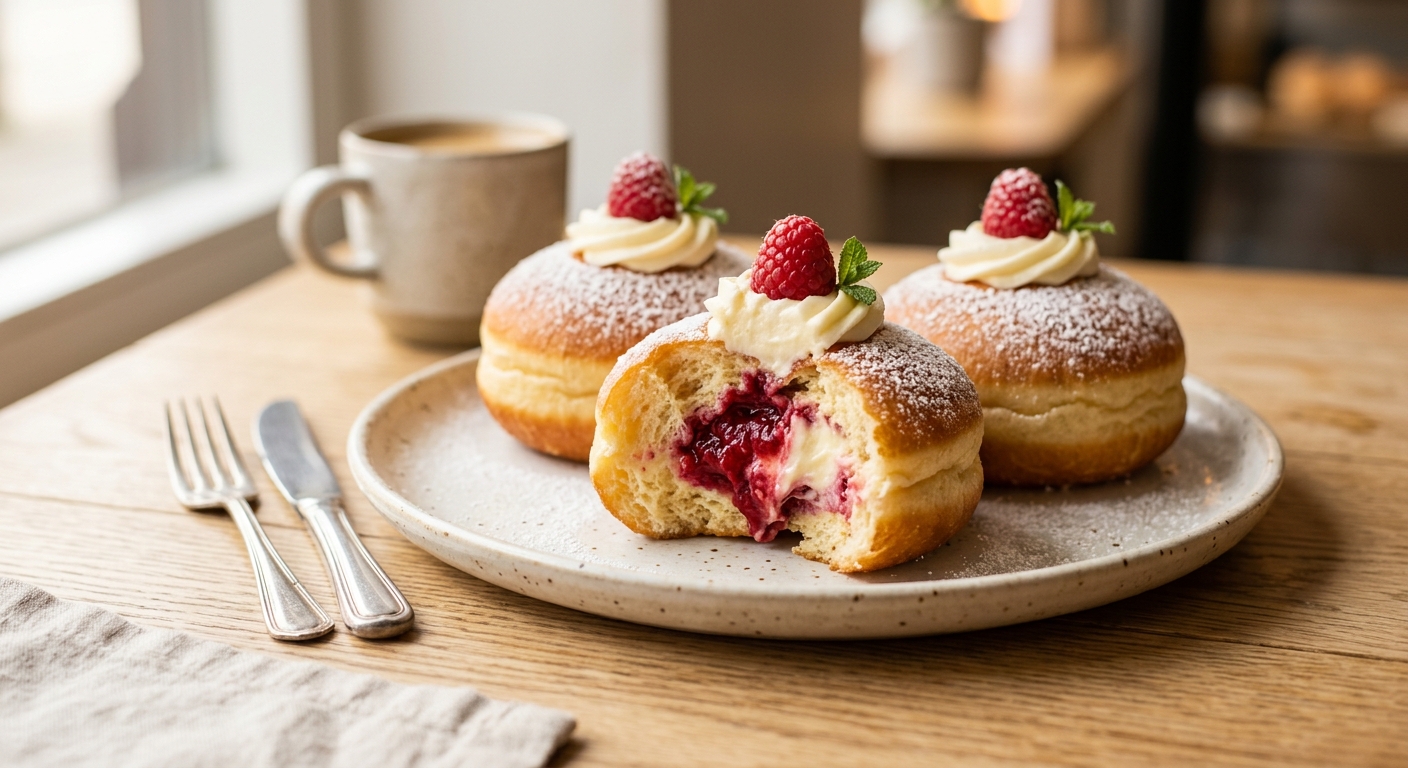
There is something undeniably magical about a freshly fried yeast doughnut. The moment it comes out of the oil, golden and puffed, dusted in a veil of powdered sugar, time seems to slow down. These raspberry and cream cheese filled doughnuts are everything a great doughnut should be: feather-light with a tender, pillowy crumb, a barely-there crisp on the outside, and a filling so lush and creamy with a bright ribbon of raspberry running through it that you will wonder why you ever settled for anything from a box. They are the kind of bake that fills your whole kitchen with warmth and draws everyone in from the other room.
What sets this recipe apart is the enriched dough, built with both butter and egg yolks for maximum tenderness, and a slow overnight cold proof option that develops a subtle complexity of flavor you simply cannot rush. The filling is a two-part affair: a sweetened cream cheese base that is thick, tangy, and perfectly smooth, swirled with a quick raspberry jam made from just berries and sugar, cooked down to a jammy, vibrant concentrate. The combination of that creamy richness against the tartness of real raspberry is the kind of contrast that keeps you reaching for another.
Do not let yeast doughnuts intimidate you. If you have made cinnamon rolls or brioche before, you already have the instincts for this. Even first-timers will find the process forgiving with the step-by-step guidance here. This recipe is a perfect weekend baking project, best tackled on a Saturday or Sunday morning when you have time to enjoy the process. They are guaranteed to impress anyone lucky enough to be at your table.
Equipment Needed
Click on an item below to shop for the recommended items for this recipe on Amazon.
As an Amazon Associate, we earn from qualifying purchases.
12
Ingredients
- 480 gall-purpose flour (about 3 and 3/4 cups, spooned and leveled), plus extra for dusting
- 7 ginstant yeast (1 packet or 2 and 1/4 tsp)
- 60 ggranulated sugar (about 5 tbsp)
- 1 tspColima Sea SaltMicroplastic Free Salt
- 180 mlwhole milk, warmed to 110°F (43°C) (about 3/4 cup)
- 60 mlwarm water, 110°F (43°C) (about 1/4 cup)
- 3 largeegg yolks, at room temperature
- 1 tsppure vanilla extract
- 56 gunsalted butter, softened to room temperature (4 tbsp)
- 1 literAvocado Oil100% Pure Avocado Oil for frying (canola or vegetable), about 4 cups, plus more as needed
- —Powdered sugar for dusting
- 225 gfull-fat cream cheese, softened to room temperature (8 oz, 1 block)
- 60 gpowdered sugar for filling (about 1/2 cup), sifted
- 1 tsppure vanilla extract (for filling)
- 2 tbspheavy cream
- 250 gfresh or frozen raspberries (about 2 cups)
- 65 ggranulated sugar for jam (about 1/3 cup)
- 1 tbspfresh lemon juice
Ingredient Substitutions
Instructions
- Make the quick raspberry jam first so it has time to cool completely. Combine the raspberries, 65g sugar, and lemon juice in a small saucepan over medium heat. Stir frequently, crushing the berries with a spoon as they soften. Cook for 10 to 12 minutes until thick and jammy, dropping a spoonful on a chilled plate: it should hold its shape and not run. Strain through a fine-mesh sieve to remove seeds if you prefer a smooth filling, or leave it as-is for texture. Transfer to a bowl, press plastic wrap directly on the surface, and refrigerate until completely cold, at least 1 hour.
- Make the dough. In the bowl of a stand mixer fitted with the dough hook, whisk together the flour, instant yeast, sugar, and salt. In a separate small bowl or jug, combine the warm milk, warm water, egg yolks, and vanilla extract and whisk briefly. Pour the wet ingredients into the dry and mix on low speed for 2 minutes until a shaggy dough forms. Increase to medium speed and knead for 5 minutes. Add the softened butter one tablespoon at a time, waiting until each piece is incorporated before adding the next. Once all the butter is in, knead on medium-high for a further 6 to 8 minutes until the dough is smooth, supple, and slightly tacky but not sticky. It should pass the windowpane test: stretch a small piece thin enough to see light through without tearing.
- Shape the dough into a smooth ball. Place in a lightly oiled bowl, cover tightly with plastic wrap, and let rise at room temperature until doubled in size, about 1.5 to 2 hours. For the overnight method, cover and refrigerate after shaping into a ball and let it rise slowly overnight (8 to 12 hours). Take it out 30 minutes before shaping.
- Line two large baking sheets with parchment paper and dust lightly with flour. Turn the risen dough out onto a lightly floured surface. Roll it gently to about 1/2-inch (1.25 cm) thickness. Using a 3-inch (7.5 cm) round cutter, cut out rounds and place them 2 inches apart on the prepared baking sheets. Gather, re-roll, and cut the scraps once. Cover loosely with lightly oiled plastic wrap and let proof at room temperature for 45 to 60 minutes until noticeably puffed and pillowy. They should spring back slowly when gently poked with a fingertip.
- While the doughnuts proof, make the cream cheese filling. Beat the softened cream cheese with a hand mixer or stand mixer on medium speed until completely smooth, about 2 minutes. Add the sifted powdered sugar, vanilla, and heavy cream. Beat for another 2 to 3 minutes until light and fluffy. Refrigerate until needed. When ready to fill, transfer the cream cheese mixture and the cooled raspberry jam into separate piping bags or zip-lock bags with a small corner snipped off.
- Pour the frying oil into a large heavy-bottomed pot or Dutch oven to a depth of at least 2.5 inches (6 cm). Clip a deep-fry thermometer to the side of the pot and heat the oil over medium heat to 350°F (175°C). Carefully lower 2 to 3 doughnuts into the hot oil using a slotted spoon or spider strainer, taking care not to deflate them. Fry for 90 seconds to 2 minutes per side until deep golden brown, adjusting the heat as needed to keep the temperature steady. Remove with a slotted spoon and drain on a wire rack set over a paper-towel-lined baking sheet. Repeat with the remaining doughnuts, allowing the oil to return to 350°F between each batch.
- Let the doughnuts cool for at least 10 minutes before filling. They should be warm but not hot. Use a chopstick, skewer, or the tip of a small sharp knife to poke a hole into the side of each doughnut, wiggling it gently to create a pocket inside. First pipe in the cream cheese filling until you feel gentle resistance (about 1 to 1.5 tablespoons), then insert the tip of the raspberry jam bag and add a smaller burst of jam (about 1 teaspoon) into the center. Dust generously with powdered sugar and serve as soon as possible.
- Prepare the dough, jam, and cream cheese filling exactly as described in steps 1 through 5 of the classic method. The dough preparation, proofing, and filling are identical.
- After the second proof is complete, lightly spray your air fryer basket with non-stick cooking spray. Carefully lift each doughnut round using a lightly floured spatula and place it directly in the air fryer basket without deflating it. Work in batches of 2 to 3 doughnuts depending on the size of your basket, leaving at least 1 inch of space between each.
- Air fry at 370°F (188°C) for 7 to 8 minutes, flipping carefully with tongs or a spatula halfway through at the 3.5-minute mark, until the doughnuts are deep golden brown on both sides. Check the first batch carefully: every air fryer runs slightly differently, and you may need to adjust by 30 seconds either way. The internal temperature of a fully cooked doughnut should read about 190°F (88°C) on an instant-read thermometer.
- Immediately upon removing each doughnut from the air fryer, brush all sides generously with melted unsalted butter (about 1 teaspoon per doughnut). This step is essential in the air fryer version: it adds richness and helps the powdered sugar adhere the same way the frying oil does in the classic method. Let cool on a wire rack for 5 minutes.
- Fill and finish exactly as in the classic method: poke a hole in the side, pipe in the cream cheese filling, add a burst of raspberry jam, and dust lavishly with powdered sugar. Serve within 2 hours for the best texture.
- Prepare the dough, jam, and cream cheese filling exactly as described in steps 1 through 5 of the classic method. The dough, proofing, and filling steps are identical.
- Preheat your oven to 375°F (190°C). Line two large baking sheets with parchment paper. Arrange the proofed doughnut rounds 2 inches apart on the prepared pans. For a glossy, golden top, brush each round very gently with a thin coat of whole milk or a lightly beaten egg yolk mixed with 1 teaspoon of milk, taking care not to deflate the dough.
- Bake one sheet at a time on the center rack for 12 to 14 minutes until golden brown on top and the doughnuts sound hollow when tapped on the bottom. Do not overbake: a pale, slightly under-golden doughnut is better than a dry one, as they continue to firm up slightly as they cool.
- As soon as each doughnut comes out of the oven, brush the tops and sides generously with melted unsalted butter (about 1 teaspoon per doughnut) while still hot. This step adds richness and gives them a beautiful sheen. Transfer to a wire rack and cool for 8 to 10 minutes before filling.
- Fill and finish exactly as in the classic method: use a chopstick or skewer to create a side pocket, pipe in the cream cheese filling, add a burst of raspberry jam, and dust generously with powdered sugar. These are best enjoyed the day they are baked.
Nutrition Per Serving
Per 1 serving (makes 12 filled doughnuts)
Why This Recipe Works
The key to an exceptionally tender yeast doughnut lies in the enriched dough formula. Using only egg yolks rather than whole eggs adds richness and fat without the extra moisture and protein that egg whites would introduce. This keeps the gluten network more pliable and produces a crumb that is softer and more golden. The butter is added last and gradually, which is a technique borrowed from brioche making: adding fat too early coats the flour proteins before they have had a chance to form the gluten network properly, resulting in a weaker, denser dough. Adding it incrementally after the initial knead allows gluten to develop first, so the fat enriches without compromising structure.
Proofing temperature matters more with doughnuts than almost any other yeast bread. At 350°F (175°C) oil temperature, the outside of the doughnut sets quickly, trapping all the gas produced by the yeast during proofing inside the dough structure. This is what creates that characteristically light, airy interior. If the oil is too cool (below 340°F), the doughnuts absorb more oil before the crust can set and become greasy. If it is too hot (above 365°F), the exterior browns before the center has time to cook through, leaving a raw, doughy core. A thermometer is not optional here, it is the single most important tool you will use.
For the filling, using full-fat cream cheese is non-negotiable. Reduced-fat versions contain more water and stabilizers that prevent the filling from becoming smooth and pipeable. Beating the cream cheese thoroughly before adding sugar aerates it, making it light enough to pipe while still firm enough to hold inside the doughnut without leaking. The raspberry jam is cooked to a much thicker consistency than a spread you would use on toast precisely because it needs to stay in place inside the doughnut and not make the crumb soggy. If it is at all runny when it cools, cook it for 3 to 4 minutes longer before filling.
Baker’s Tips
- Use an instant-read or clip-on thermometer to monitor your oil temperature throughout frying. The temperature drops each time you add doughnuts, so give it 90 seconds to recover between batches.
- The windowpane test is your best friend for knowing the dough is ready: stretch a small piece between your fingers until it is thin enough to see light through without tearing. If it tears immediately, knead for 3 more minutes and test again.
- Do not skip the second proof after cutting your rounds. Underproofed doughnuts will be dense and bready inside. They should look noticeably puffier than when you cut them, and a gentle poke with a fingertip should leave an indent that fills back in slowly.
- Always use a slotted spoon or spider strainer to lower doughnuts into the oil, never drop them from height. A splash of hot oil is both dangerous and means you deflated your doughnut.
- The cream cheese filling must be at room temperature when you beat it. Cold cream cheese will leave lumps no matter how long you mix it, and lumps will clog your piping bag tip at the worst moment.
- Make more raspberry jam than you think you need. It is easy to fill the doughnuts a little too generously, and leftover jam is wonderful stirred into yogurt or spread on toast.
- For the neatest filling, insert the piping bag tip at least halfway into the doughnut pocket before you start piping. Pipe steadily and gently pull the tip back as the doughnut begins to feel heavy and resist. This distributes the filling evenly rather than creating one dense pocket near the opening.
Variations
- Strawberry and vanilla: replace the raspberry jam with a homemade strawberry compote and add 1/4 tsp of almond extract to the cream cheese filling.
- Lemon curd and cream cheese: skip the raspberry jam and fill with a mixture of the cream cheese base and 2 tablespoons of good-quality lemon curd per batch for a bright, citrusy variation.
- Chocolate glazed: instead of powdered sugar, dip the tops of the cooled doughnuts in a simple ganache made from 100g dark chocolate melted with 80ml heavy cream and let set on a wire rack.
- Brown butter dough: brown the butter before cooling and using it in the dough for a nuttier, more complex flavor.
- Jam-only filled: skip the cream cheese and fill entirely with the raspberry jam for a classic jelly doughnut experience.
Troubleshooting & FAQ
My doughnuts came out greasy and heavy, not light and airy. What went wrong?
The dough is sticky and keeps sticking to everything. Should I add more flour?
The filling is leaking out of the doughnuts. How do I stop this?
My dough did not rise at all in the first proof. What happened?
My doughnuts are brown on the outside but raw and doughy in the middle. What went wrong?
Storage & Make-Ahead
- Storage: Filled doughnuts are best eaten the day they are made. If you have leftovers, store them in an airtight container in the refrigerator for up to 2 days due to the cream cheese filling. Bring to room temperature for 20 minutes before eating or warm briefly in the microwave for 10 to 12 seconds. Unfilled, fried doughnuts can be stored at room temperature in an airtight container for 1 day or frozen for up to 1 month.
- Make-Ahead: The dough can be made the night before and cold-proofed in the refrigerator for 8 to 12 hours, then shaped and second-proofed in the morning. The raspberry jam can be made up to 5 days ahead and stored in a sealed jar in the refrigerator. The cream cheese filling can be made up to 2 days ahead and kept refrigerated in a piping bag.