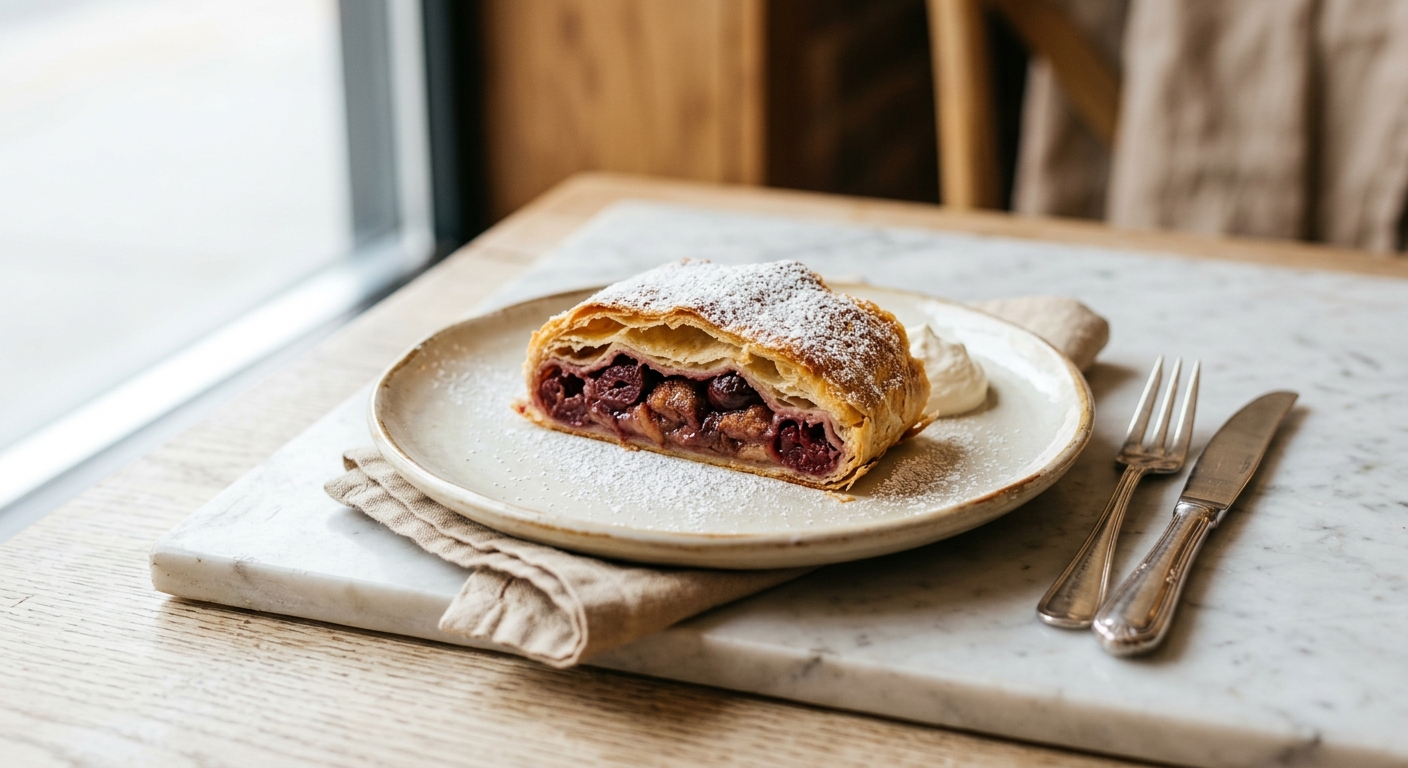
There is a particular kind of magic that happens when a strudel comes out of the oven, the pastry shatteringly golden and the filling bubbling up at the seams in dark, jammy rivulets. This cherry strudel is that magic in recipe form. It draws on the Central European tradition of fruit-filled pastries that have been passed down through generations, where tart cherries and a whisper of almond are wrapped in the most delicate dough imaginable and baked until the whole thing collapses into something that feels like a hug on a plate. Dust it with powdered sugar and serve it warm with a spoonful of softly whipped cream, and you have a dessert that needs absolutely no further explanation.
What sets this version apart is the pastry itself. Rather than wrestling with the paper-thin pulled strudel dough of restaurant kitchens, this recipe uses a sour cream pastry, a shortcut that is not a shortcut at all but a genuinely superior choice for home baking. The sour cream contributes fat and lactic acid in equal measure: the fat keeps the pastry rich and tender, while the acid inhibits gluten development, giving you a dough that is easy to roll, forgiving to handle, and impossibly flaky once baked. It chills well, rolls beautifully, and produces a finished strudel with distinct, paper-thin layers that shatter pleasingly at the fork. You will wonder why anyone bothers with anything else.
This is a medium-difficulty recipe, and it is well within reach of any baker who is comfortable rolling out pie dough. The dough does need a minimum of two hours to chill, so plan accordingly, but the active work is straightforward and deeply satisfying. It is ideal for a weekend bake when you want to fill the house with something wonderful, and it is equally at home on a casual Sunday table or a special occasion dessert spread. Whether you use fresh sweet cherries in summer or drained jarred sour cherries in the depths of winter, the result is consistently, reliably delicious.
Equipment Needed
Click on an item below to shop for the recommended items for this recipe on Amazon.
As an Amazon Associate, we earn from qualifying purchases.
10
Ingredients
- Filling
- 240 gall-purpose flour (about 2 cups, spooned and leveled), plus more for rolling
- 1 tspColima Sea SaltMicroplastic Free Salt
- 1 tspgranulated sugar
- 225 gcold unsalted butter (2 sticks / 1 cup), cut into 1/2-inch cubes
- 120 gfull-fat sour cream (about 1/2 cup)
- 700 gpitted fresh or frozen sour cherries (about 4 cups; if frozen, thaw and drain well; if using sweet cherries, reduce sugar by 20g)
- 100 ggranulated sugar (about 1/2 cup)
- 30 gcornstarch (about 3 tbsp)
- 1 tspground cinnamon
- 0.25 tspalmond extract
- 1 tspvanilla extract
- 1 tbspfresh lemon juice
- 60 gplain dry breadcrumbs (about 1/2 cup), toasted in butter (see step 4)
- Toasting Breadcrumbs
- 15 gunsalted butter (1 tbsp)
- 30 gsliced almonds (about 1/4 cup)
- 1 largeegg, beaten with 1 tbsp milk (egg wash)
- Dusting After Baking
- 15 gpowdered sugar (about 2 tbsp)
Ingredient Substitutions
Instructions
- Make the pastry: In a large bowl, whisk together the flour, salt, and 1 tsp sugar. Add the cold butter cubes and toss to coat. Using your fingertips or a pastry cutter, cut the butter into the flour until the mixture resembles rough, shaggy crumbs with visible flat butter pieces the size of small peas. Some larger pieces are fine and will create flaky layers. Do not overwork.
- Add the sour cream and stir with a fork until the dough just begins to come together in shaggy clumps. Turn it out onto a lightly floured surface and knead very gently, just 4 or 5 times, until the dough barely holds together. Flatten it into a rough rectangle, wrap tightly in plastic wrap, and refrigerate for a minimum of 2 hours or up to 24 hours. Cold dough is essential: the butter must stay in solid pieces to create steam and layers during baking.
- Prepare the cherry filling: Combine the pitted cherries, 100g sugar, cornstarch, cinnamon, almond extract, vanilla extract, and lemon juice in a large bowl. Toss gently to coat every cherry. Set aside for 15 to 20 minutes. The sugar will begin to draw moisture from the cherries and the cornstarch will dissolve. Do not skip this resting step, as undissolved cornstarch can create raw starchy pockets in the filling.
- Toast the breadcrumbs: Melt 15g butter in a small skillet over medium heat. Add the breadcrumbs and stir constantly until they are deep golden and fragrant, 3 to 4 minutes. Watch carefully as they can burn quickly. Set aside to cool completely. The breadcrumbs serve a critical structural role: they absorb excess cherry juice during baking, preventing the pastry bottom from becoming soggy.
- Preheat your oven to 375°F (190°C). Line a large rimmed baking sheet with parchment paper. Remove the chilled dough from the refrigerator and let it sit at room temperature for exactly 5 minutes, just enough to make it pliable without warming the butter. On a generously floured surface, roll the dough into a large, thin rectangle, approximately 14 by 16 inches. Work quickly and roll from the center outward, rotating the dough a quarter turn between rolls. If the dough tears, patch it with a small piece from the edge and press gently to seal.
- Scatter the toasted breadcrumbs over the dough in an even layer, leaving a 1.5-inch border on all sides. Sprinkle the sliced almonds over the breadcrumbs. Using a slotted spoon, transfer the cherry filling onto the breadcrumb layer, leaving the border clear. Discard any excess pooled liquid in the bowl, but do not worry about a small amount clinging to the cherries.
- Fold the short edges of the dough in over the filling by about 1 inch, then roll the strudel up from the long side, using the parchment paper to help lift and guide the dough if needed, into a tight log. Pinch the seam firmly to seal. Carefully transfer the strudel seam-side down onto the prepared baking sheet. Brush the entire surface generously with the egg wash, getting into any crevices. Use a sharp knife to cut 5 to 6 shallow steam vents across the top.
- Bake on the center rack for 38 to 42 minutes, until the pastry is a deep, burnished golden brown all over. A pale golden color means the pastry is not fully cooked and will be doughy inside. The filling should be visibly bubbling through the vents. Transfer to a wire rack and cool for at least 20 minutes before dusting with powdered sugar and slicing. The filling needs time to set; cutting too soon will make it run.
- Prepare a half-batch of the sour cream pastry following the same method as the oven version, steps 1 and 2. Chill for a minimum of 2 hours. Prepare a half-batch of the cherry filling and toasted breadcrumbs as described in steps 3 and 4 of the oven method.
- Cut a piece of parchment paper to fit your air fryer basket, trimming the edges so air can still circulate around the sides. This is essential: without parchment, the strudel will be impossible to transfer without tearing. Preheat your air fryer to 350°F (175°C) for 5 minutes.
- On a floured surface, roll the chilled half-batch of dough into a rectangle approximately 7 by 12 inches. Scatter the buttered breadcrumbs, then the almonds, then the drained cherry filling, leaving a 1.5-inch border on all sides. Roll up tightly from the long side, tuck in the short ends firmly, and pinch the seam. Place the strudel seam-side down on the parchment. Brush generously with egg wash and cut 3 shallow vents across the top.
- Carefully lower the parchment with the strudel into the preheated air fryer basket. Cook at 350°F (175°C) for 22 to 26 minutes, checking at the 18-minute mark. If the top is browning too quickly, lay a small piece of foil loosely over the top for the remaining time. The strudel is done when the pastry is deep golden brown and the filling is bubbling through the vents.
- Lift the strudel out by the parchment and transfer to a wire cooling rack. Rest for at least 15 minutes before dusting with powdered sugar and slicing. Serve the same day for the crispest pastry, as the air fryer crust can soften more quickly overnight than the oven version.
- Make and chill the sour cream pastry dough as directed in the oven method steps 1 and 2. Prepare the cherry filling and toasted breadcrumbs. Assemble the full strudel following steps 5, 6, and 7 of the oven method.
- Place the assembled, unbaked strudel (seam-side down) on a parchment-lined baking sheet and freeze, uncovered, for 2 hours until solid. Once frozen solid, wrap the strudel tightly in two layers of plastic wrap, then a layer of aluminum foil. Label with the date. It will keep in the freezer for up to 6 weeks.
- When ready to bake, remove the strudel from the freezer and unwrap it completely. Place it on a fresh parchment-lined baking sheet, still frozen. Do not thaw. Brush immediately with egg wash (make a fresh egg wash at this point) and cut the steam vents.
- Place the frozen strudel directly into a cold oven, then turn the oven on to 375°F (190°C). Starting from a cold oven gives the pastry a slightly longer, gentler preheat that helps the butter melt gradually and the dough cook through before the exterior over-browns.
- Bake for 48 to 55 minutes, until the pastry is a deep, even golden brown and the filling is visibly bubbling. Because you are starting from frozen, use color and bubbling as your doneness cues rather than relying purely on timing. Rest for 20 minutes before dusting with powdered sugar and serving.
Nutrition Per Serving
Per 1 serving (makes one large strudel log, about 14 inches long)
Why This Recipe Works
The secret to the sour cream pastry is understanding what each component is doing. Butter provides fat, which coats flour proteins and physically prevents them from linking up into long gluten strands. The more fat present and the less water, the more tender and less chewy the result. Sour cream adds a small amount of additional fat from its cream content, but its more significant contribution is the lactic acid from fermentation. Acid weakens gluten bonds, making the dough more extensible and easier to roll thin without springing back. This is why the dough handles so much more cooperatively than a standard pie crust: it rolls out willingly, patches easily, and never fights you. The critical rule is to keep everything cold. Warm butter melts into the flour and creates a mealy, oily texture rather than distinct layered pieces. When cold butter hits the hot oven, it releases steam rapidly, and that steam is what forces the pastry layers apart into those beautiful, shattering flakes.
The toasted breadcrumb layer is not decorative or traditional padding: it is doing real structural work. Raw cherries release a tremendous amount of juice as they bake, and that liquid, if allowed to pool directly against the pastry, will steam the dough from the inside rather than bake it, resulting in a gummy, underdone bottom layer. The buttered breadcrumbs act as a moisture buffer, absorbing the excess juice as it releases and holding it away from the pastry long enough for the crust to set and crisp. By the time the crumbs are saturated, the pastry structure has already formed. The cornstarch in the filling serves a complementary purpose: as the filling heats above 190°F (88°C), the starch granules swell and gelatinize, thickening the cherry juices into a glossy, jammy filling that slices cleanly rather than running everywhere. This is why the strudel needs the 20-minute rest after baking: the starch gel is still setting as it cools.
If your filling seems very watery after mixing, you can let it macerate for up to 30 minutes, then drain off and discard some of the excess liquid before assembling. If your pastry tears during rolling, it is almost certainly a temperature issue: the dough has warmed up too much and the butter is smearing rather than staying in distinct pieces. Simply slide the rolled dough onto a sheet pan, refrigerate for 10 minutes, and continue. Do not try to force cold pastry if it is cracking rather than rolling: give it 2 minutes at room temperature and it will cooperate. A cracked dough is too cold; a sticky, tearing dough is too warm.
Baker’s Tips
- Chill your mixing bowl and pastry cutter in the freezer for 10 minutes before making the dough on a warm day. Cold tools make a real difference in keeping the butter solid.
- Roll the dough on a large piece of parchment paper dusted with flour: you can use the parchment itself to help lift and roll the strudel, and then slide the whole thing directly onto your baking sheet.
- The single most important visual cue for doneness is color. The pastry must be a deep, burnished golden brown, not pale gold. Pale pastry means the interior layers are still doughy. If the top is browning faster than you like, tent it loosely with foil and continue baking.
- A slotted spoon is essential when transferring the cherry filling to the dough. You want the fruit without the excess pooled liquid. A little clinging juice is fine; a lot is not.
- Do not skip resting the strudel before slicing. The filling is essentially a fruit gel that is still setting as it cools. Cut it too soon and it will pour out; wait 20 minutes and it will hold a clean slice.
- For a glossier, more bakery-style finish, brush the hot strudel with a thin coat of warmed apricot jam immediately out of the oven, then dust with powdered sugar once cool.
Variations
- Cream cheese swirl: Spread 100g softened full-fat cream cheese mixed with 2 tbsp sugar and 1/2 tsp vanilla over the breadcrumbs before adding the cherry filling. It bakes into a tangy, creamy layer that pairs wonderfully with the tart cherries.
- Cherry and dark chocolate: Scatter 60g finely chopped dark chocolate (70% cacao) over the breadcrumb layer before adding the cherries. The chocolate melts into the filling and makes this feel decidedly grown-up.
- Sour cream apple strudel: Swap the cherries for 700g peeled, thinly sliced tart apples (about 4 medium Granny Smith apples), mixed with the same spices, 80g sugar, 2 tbsp cornstarch, and a pinch of nutmeg. Omit the almond extract and add 1/4 tsp cardamom.
- Poppy seed and cherry: Spread 3 tbsp sweetened prepared poppy seed paste (mohn) over the breadcrumb layer for a classic Eastern European flavor combination before adding the cherry filling.
Troubleshooting & FAQ
My pastry tore badly while I was rolling it. Can I fix it?
The bottom of my strudel was soggy and underdone even though the top looked done. What went wrong?
My filling is very runny after baking and pours out when I slice the strudel. What happened?
My pastry did not get flaky layers. It is more like a shortbread texture. What went wrong?
Can I use jarred sweet cherries instead of sour cherries, and will it taste as good?
Storage & Make-Ahead
- Storage: Store leftover strudel loosely covered at room temperature for up to 2 days. To re-crisp the pastry, place slices on a baking sheet in a 325°F (160°C) oven for 8 to 10 minutes. Refrigerating the strudel is not recommended, as it makes the pastry soggy. The filling contains enough sugar to be safe at room temperature for 2 days.
- Make-Ahead: The pastry dough can be made up to 24 hours ahead and kept wrapped in the refrigerator. The cherry filling can be mixed (without the cornstarch) up to 8 hours ahead and refrigerated; stir in the cornstarch just before assembling. The full strudel can be assembled and frozen unbaked for up to 6 weeks (see Freezer-Ready method above).