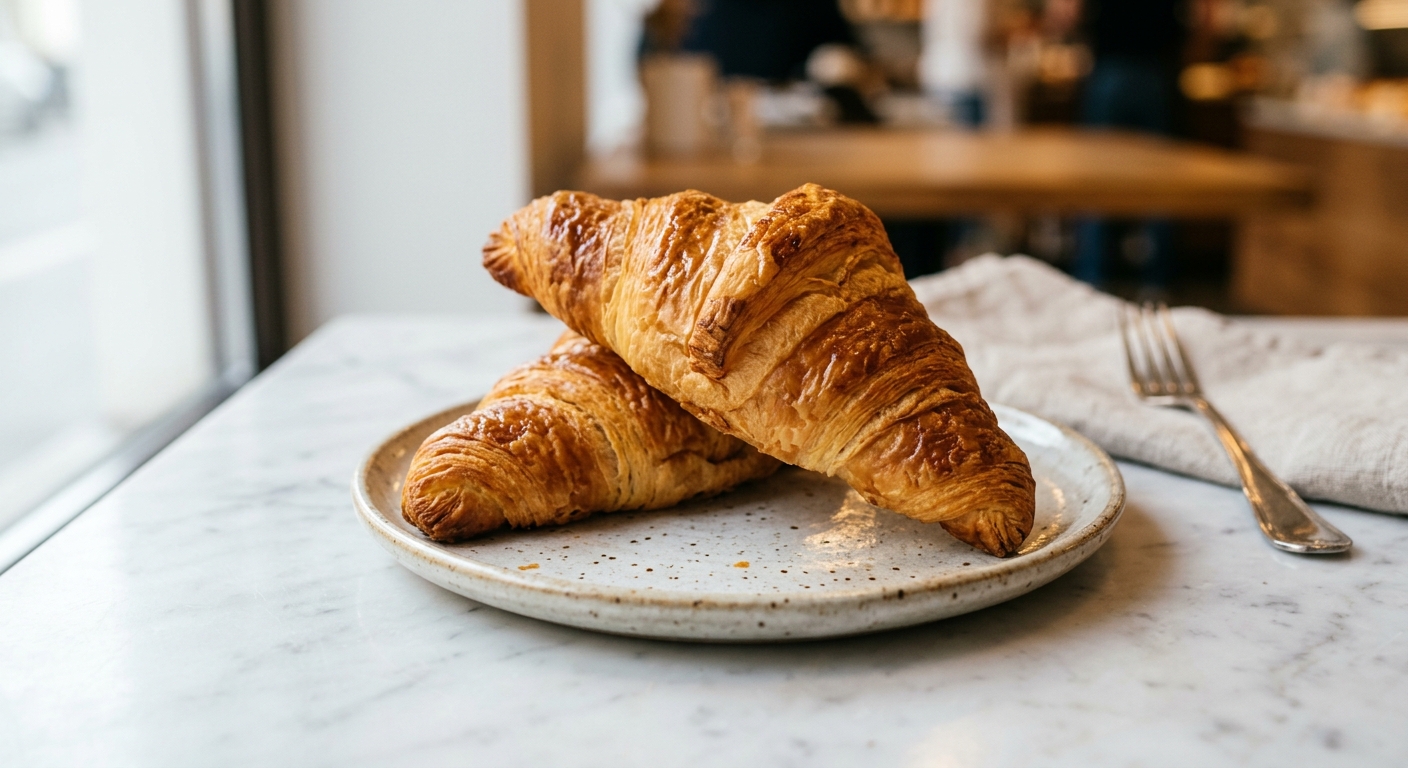
There is something quietly magical about pulling a tray of golden Gipfeli from the oven on a slow weekend morning. The smell alone, all warm butter and toasted pastry, has a way of making even an ordinary Tuesday feel like a special occasion. Gipfeli are a staple of Swiss bakeries and breakfast tables, sold alongside strong coffee and enjoyed without any particular fuss, simply because they are that good on their own. They have a gentle snap when you break them open, a honeycomb interior of fine, layered crumb, and a flavor that is rich without being heavy, buttery without being greasy.
What sets this recipe apart from a standard French croissant is the texture and the technique. Swiss Gipfeli use a slightly enriched dough with a touch of sugar and a small amount of cream, which gives the finished pastry a more tender, close crumb compared to the more open, shattery layers of a classic croissant. The lamination process here uses the same principle of folding cold butter into dough to create hundreds of distinct layers, but the result is firmer, more structured, and just a little more forgiving for home bakers tackling laminated dough for the first time. The addition of a small amount of yeast means the layers puff beautifully in the oven, while the enriched dough keeps everything cohesive and easy to handle.
This is an intermediate recipe. It takes time and patience, mostly in the form of resting and chilling the dough between folds, but none of the individual steps are difficult once you understand what you are looking for. This recipe is perfect for dedicated home bakers who want to learn laminated dough, for anyone who has eaten a Swiss Gipfeli and thought they could never make one at home, and for weekend bakers who enjoy a project that rewards careful attention. Plan for most of the work to happen across two days, with the baking itself being a deeply satisfying final step.
Equipment Needed
Click on an item below to shop for the recommended items for this recipe on Amazon.
As an Amazon Associate, we earn from qualifying purchases.
12
Ingredients
- Dough)
- 500 gall-purpose flour or bread flour (about 4 cups, spooned and leveled), plus extra for dusting
- 10 gColima Sea SaltMicroplastic Free Salt (about 1 and 3/4 tsp)
- 40 ggranulated white sugar (about 3 tbsp)
- 7 ginstant yeast (about 2 and 1/4 tsp, or one standard sachet)
- 280 mlwhole milk, cold (about 1 cup plus 2 tbsp)
- 60 mlheavy cream, cold (about 1/4 cup)
- 30 gunsalted butter, softened (about 2 tbsp
- Butter Block)
- 250 gunsalted European-style butter, very cold (about 1 cup plus 1 tbsp
- 1 largeegg
- 2 tbspwhole milk (for egg wash, mixed with the egg)
Ingredient Substitutions
Instructions
- Make the dough: In the bowl of a stand mixer fitted with the dough hook, combine the flour, salt, sugar, and instant yeast. Add the cold milk and cold cream and mix on low speed for 2 minutes until the dough just comes together. Add the 30g softened butter and increase to medium speed. Knead for 5 to 6 minutes until the dough is smooth and slightly tacky but not sticky. It should pass the windowpane test, stretching thin without tearing. Shape into a rectangle, wrap tightly in plastic wrap, and refrigerate for at least 1 hour, or overnight.
- Make the butter block: Place the 250g cold European butter between two sheets of parchment paper. Using a rolling pin, pound and roll it into a flat 7-inch (18cm) square, about 1cm thick. The butter should be pliable but still very cold, bending without cracking but not warm or soft. If it softens too much, refrigerate for 15 minutes. It should feel like cold clay.
- Laminate the dough (first lamination): On a lightly floured surface, roll the chilled dough into a 14-inch (35cm) square. Place the butter block in the center, rotated 45 degrees like a diamond. Fold the four corners of dough over the butter like an envelope, pinching all seams tightly to seal the butter completely inside. Press gently with the rolling pin to flatten slightly.
- Roll and fold (Letter fold 1): Roll the dough package out into a long rectangle, approximately 8 by 24 inches (20 by 60cm), working gently and steadily from the center outward. If the butter breaks through, dust the spot with a little flour and continue. Fold the dough into thirds like a business letter (fold one end to the center, then the other end on top). This is your first fold. Wrap in plastic and refrigerate for 30 to 45 minutes.
- Roll and fold (Letter folds 2 and 3): Remove the dough and repeat the rolling and letter-fold process twice more, chilling for 30 to 45 minutes between each fold. After the third fold, wrap the dough and refrigerate for at least 4 hours, or ideally overnight. This long rest relaxes the gluten and firms the butter layers for clean, distinct sheets.
- Shape the Gipfeli: On a lightly floured surface, roll the laminated dough into a large rectangle about 4mm thick, approximately 10 by 30 inches (25 by 75cm). Using a sharp knife or pizza cutter, cut the dough into long isosceles triangles with a base of about 4 inches (10cm). Cut a small 1cm notch in the center of each triangle base. This notch makes rolling easier and helps the Gipfeli curve. Gently stretch each triangle slightly lengthwise, then roll from the base toward the tip, keeping even tension. Place on a parchment-lined baking sheet with the tip tucked underneath, and curve the ends inward slightly to form the classic crescent shape.
- Proof the Gipfeli: Loosely cover the shaped Gipfeli with plastic wrap and let them proof at room temperature (68 to 72°F or 20 to 22°C) for 1.5 to 2 hours. They should look visibly puffier and jiggle gently when you shake the pan. Do not let them over-proof or the layers will blur. If your kitchen is warm, proof for closer to 1.5 hours.
- Bake: Preheat your oven to 400°F (200°C) with a rack in the center. Whisk together the egg and 2 tbsp milk. Gently brush each Gipfeli with egg wash, being careful not to let the wash drip down the cut sides (this can seal the layers and prevent proper rise). Bake for 18 to 22 minutes until deep golden brown. Rotate the pan once halfway through. Let cool on the pan for 10 minutes before transferring to a wire rack. They are best eaten warm or within a few hours of baking.
- Prepare the dough and complete all three lamination folds exactly as in the oven method. After the final overnight refrigerator rest, shape the Gipfeli into their crescent shapes as described above.
- Freeze before proofing: Place the shaped but unproofed Gipfeli on a parchment-lined baking sheet in a single layer and freeze uncovered for 1 to 2 hours until solid. Once frozen solid, transfer them to a zip-top freezer bag or airtight container with parchment between layers. They will keep for up to 1 month.
- Overnight thaw and proof: The evening before you want to bake, remove the number of Gipfeli you need and arrange them on a parchment-lined baking sheet. Cover loosely with plastic wrap and refrigerate overnight (8 to 10 hours). During this time they will thaw and slowly proof in the cold, developing excellent flavor. In the morning, remove them from the refrigerator 30 minutes before baking to take the chill off. They should look puffier and jiggle gently when the pan is moved.
- Apply egg wash and bake: Preheat your oven to 400°F (200°C). Whisk the egg with 2 tbsp whole milk and gently brush each Gipfeli, avoiding the cut sides. Bake for 22 to 26 minutes (a few minutes longer than fresh, since the dough starts colder) until they are a deep, even golden brown. Rotate the pan once at the halfway point.
- Cool briefly and serve: Let the Gipfeli rest on the pan for 10 minutes, then transfer to a wire rack. Serve warm. The freezer method produces results that are nearly indistinguishable from fresh-made, with layers that are just as defined and a crumb just as tender.
Nutrition Per Serving
Per 1 serving (makes 12 Gipfeli (each about 80g before baking))
Why This Recipe Works
The magic of a Gipfeli lies in lamination, the process of folding cold butter repeatedly into dough to create hundreds of distinct, alternating layers of fat and gluten. When the pastry hits the heat of the oven, the water in the butter (even high-fat European butter contains around 16 to 18% water) rapidly turns to steam. That steam has nowhere to go except upward, forcing the thin layers of dough apart and creating the characteristic lift and flakiness. Keeping the butter cold at every stage is not a suggestion but a structural requirement: if the butter softens and blends into the dough rather than staying in discrete sheets, you lose the layers entirely and end up with a dense, brioche-like roll instead of a laminated pastry.
The enrichment in this dough, the cream and the touch of sugar alongside the small amount of softened butter worked into the base dough, serves a different purpose than the laminating butter. These additions tenderize the gluten structure by coating some of the flour proteins before they can fully develop, resulting in the finer, more compact crumb that is characteristic of a Swiss Gipfeli as opposed to a more open-crumbed French croissant. The relatively modest amount of yeast and the cold fermentation (that long refrigerator rest) allow flavor compounds to develop slowly, producing depth without any yeasty heaviness.
If your layers are not visible when you cut a baked Gipfeli open, the most common cause is butter that melted during lamination and was absorbed into the dough. Watch for a few warning signs: the dough and butter should always feel distinctly separate and cold as you roll. If the surface of the dough starts to look greasy or the butter squirts out rather than rolling flat, stop immediately and refrigerate for 20 minutes before continuing. Rushing the chilling steps is the single most common reason home bakers lose their layers. Patience between folds is the technique.
Baker’s Tips
- Temperature is everything. Your kitchen should ideally be cool (below 68°F or 20°C) when laminating. If your kitchen is warm, do the lamination steps in two short sessions and chill aggressively between them.
- Use a ruler. Consistent dimensions when rolling ensure even layers and uniform Gipfeli that bake at the same rate. It takes 30 extra seconds and makes a real difference.
- The butter block should feel like cold clay. If it cracks and shatters when you try to roll it, it is too cold and will break through the dough. Let it sit at room temperature for 5 minutes and try again.
- Do not stretch the dough as you roll. Use even, steady pressure from the center outward. Aggressive stretching tears the gluten network and can burst the butter layers.
- Brush the egg wash gently and only on the top surface. If egg wash drips down the sides and seals the cut layers together, the Gipfeli will not open and puff properly during baking.
- Look for the right proof: the shaped Gipfeli should be visibly larger, feel light and airy, and wobble gently when you shake the pan. A poke with a fingertip should spring back slowly. If it springs back instantly, they need more time. If the indent stays, they are over-proofed.
- Bake on a preheated surface if possible. A hot baking stone or a preheated heavy baking sheet placed beneath your pan gives the Gipfeli a stronger initial burst of bottom heat, helping them rise faster and more dramatically.
Variations
- Chocolate filled Gipfeli: Place a small piece (about 10g) of good dark chocolate at the base of each triangle before rolling. The chocolate melts into a soft, bittersweet center.
- Almond cream Gipfeli: Spread a thin layer of frangipane (almond cream) over each triangle before rolling. After baking, brush with a light sugar syrup and scatter sliced almonds on top before baking.
- Ham and cheese: Place a thin slice of Gruyere and a sliver of cooked ham at the base of each triangle for a savory breakfast Gipfeli. Omit the sugar from the dough or reduce to 1 tsp.
- Whole wheat variation: Replace up to 100g of the all-purpose flour with whole wheat flour for a slightly nuttier, more rustic Gipfeli. Expect a slightly denser crumb.
Troubleshooting & FAQ
My Gipfeli are not flaky and look more like bread rolls. What went wrong?
The butter kept breaking through the dough as I rolled. How do I prevent this?
My Gipfeli spread flat in the oven instead of puffing up. Why?
The inside of my Gipfeli is doughy even though the outside is browned. What happened?
Can I make the dough by hand instead of with a stand mixer?
Storage & Make-Ahead
- Storage: Gipfeli are best eaten the day they are baked. Store leftovers uncovered or loosely wrapped at room temperature for up to 1 day (airtight storage softens the crust). To refresh, place in a 350°F (175°C) oven for 5 to 6 minutes. Do not refrigerate, as this stales pastry quickly. Baked Gipfeli can be frozen in an airtight bag for up to 3 weeks and reheated from frozen at 350°F (175°C) for 8 to 10 minutes.
- Make-Ahead: The dough can be made through all three lamination folds and refrigerated (after the final rest) for up to 24 hours before shaping. Shaped but unproofed Gipfeli can be frozen for up to 1 month and slow-proofed in the refrigerator overnight before baking (see Freeze and Bake method above). This is strongly recommended for most home bakers.