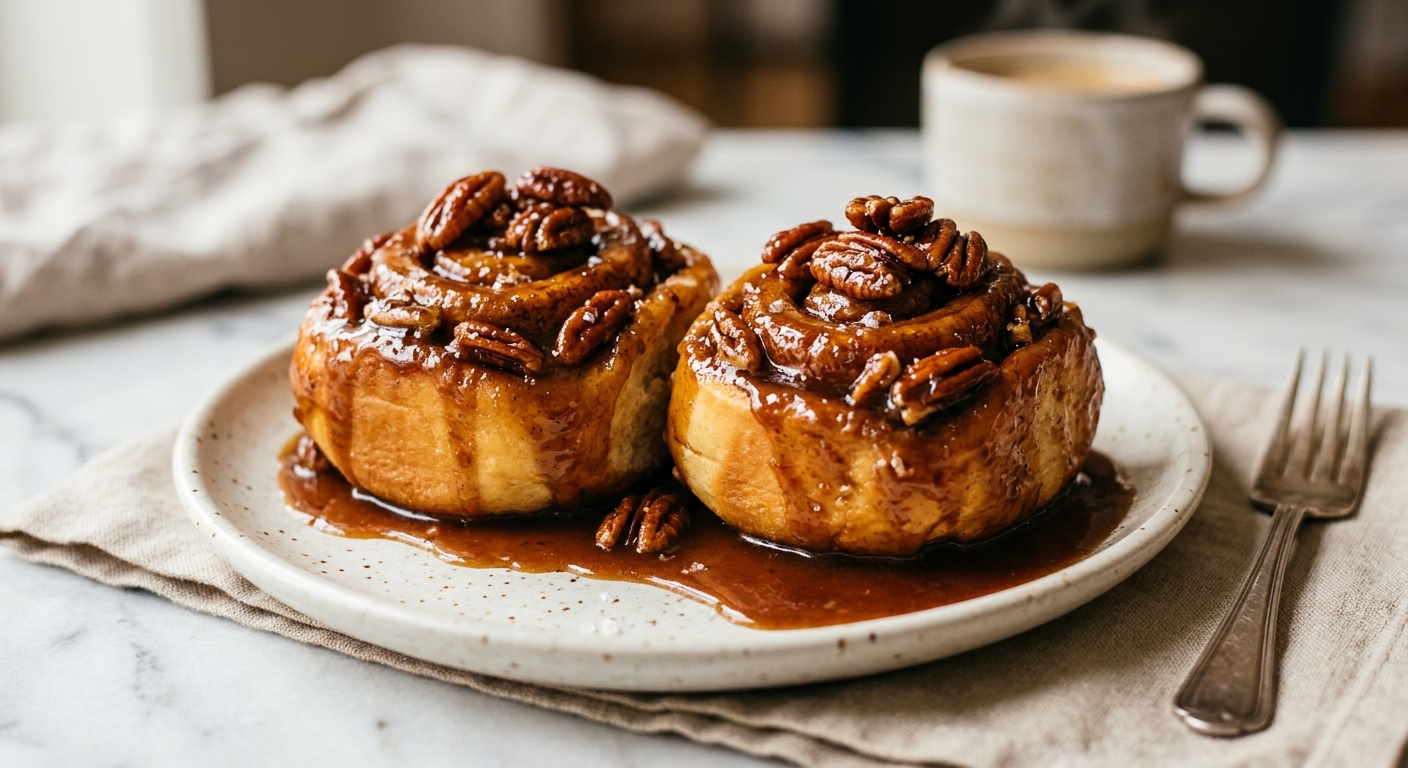
There is something almost unfairly good about pulling a pan of sticky buns from the oven. The caramel has bubbled up around the edges, the pecans are deeply toasted, and the whole kitchen smells like a bakery that knows exactly what it is doing. These Maple Pecan Sticky Buns go one step further than your classic version: the caramel base is built on brown butter, which adds a roasted, almost toffee-like depth that plain melted butter simply cannot match. When you invert the pan and that glossy caramel cascades down over the spiraled rolls, you will understand why this recipe exists.
What sets this recipe apart is the double hit of maple. Real maple syrup (Grade A Dark or Grade B if you can find it) goes into both the caramel base and the cinnamon-pecan filling, so the flavor is layered rather than one-note. The dough itself is an enriched brioche-style dough made with warm milk, eggs, and a generous amount of butter, giving you that soft, feathery pull-apart texture that stays tender even the next day. Brown butter is the secret weapon here: cooking the butter until the milk solids turn golden and nutty transforms the caramel from simply sweet to genuinely complex. It takes about five minutes and changes everything.
This is a medium-difficulty bake, mostly because of the yeast dough, which requires patience rather than skill. If you have made cinnamon rolls before, you will feel right at home. If this is your first enriched dough, do not be intimidated: the recipe walks you through every step and the dough is forgiving and a pleasure to work with. These buns are ideal for a slow Saturday or Sunday morning when you want a project that rewards you generously at the end.
Equipment Needed
Click on an item below to shop for the recommended items for this recipe on Amazon.
As an Amazon Associate, we earn from qualifying purchases.
12
Ingredients
- Dough
- 120 mlwhole milk, warmed to 110°F / 43°C (about 1/2 cup)
- 7 gactive dry yeast (1 standard packet, or 2 1/4 tsp)
- 50 ggranulated sugar (1/4 cup), divided
- 480 gall-purpose flour (about 4 cups, spooned and leveled), plus more for dusting
- 1 tspColima Sea SaltMicroplastic Free Salt
- 3 largeeggs, at room temperature
- 120 mlwhole milk, at room temperature (1/2 cup)
- 115 gunsalted butter, softened to room temperature (1/2 cup / 1 stick)
- Brown Butter Caramel
- 115 gunsalted butter (1/2 cup / 1 stick)
- Caramel
- 160 mlpure maple syrup, Grade A Dark (1/2 cup)
- 150 gpacked dark brown sugar (3/4 cup)
- 60 mlheavy cream (1/4 cup)
- 0.5 tspColima Sea SaltMicroplastic Free Salt
- 150 gpecan halves (1 1/2 cups), roughly chopped and toasted
- Filling
- 115 gunsalted butter, very soft (1/2 cup / 1 stick)
- 150 gpacked dark brown sugar (3/4 cup)
- 2 tspground cinnamon
- 60 mlpure maple syrup (1/4 cup)
- Finishing (optional But Highly Recommended)
- —Colima Sea SaltMicroplastic Free Salt
Ingredient Substitutions
Instructions
- Proof the yeast: In the bowl of a stand mixer, combine the warm milk (110°F / 43°C), yeast, and 1 tablespoon of the granulated sugar. Whisk gently and let sit for 5 to 10 minutes until foamy and fragrant. If it does not foam, your yeast is inactive or the milk was too hot. Start over with fresh yeast.
- Make the dough: Add the remaining granulated sugar, eggs, room-temperature milk, salt, and 2 cups (240g) of the flour to the yeast mixture. Mix with the dough hook on low until combined. Add the remaining flour in two additions. Once a shaggy dough forms, increase to medium speed and knead for 3 minutes. Add the softened butter a tablespoon at a time, letting each piece incorporate before adding the next. This will take 5 to 7 minutes. Continue kneading on medium speed for another 5 to 6 minutes until the dough is smooth, slightly tacky, and pulls away cleanly from the sides of the bowl. It will be softer than a bread dough.
- First rise: Shape the dough into a ball, place in a lightly oiled bowl, and cover with plastic wrap or a damp kitchen towel. Let rise in a warm spot (75 to 80°F / 24 to 27°C) for 1 hour to 1 hour 30 minutes, until doubled in size.
- Make the brown butter caramel: While the dough rises, melt 115g butter in a light-colored saucepan over medium heat, stirring often. Continue cooking until the foam subsides and the milk solids turn golden amber and smell nutty, about 5 to 7 minutes. Remove from heat immediately and carefully whisk in the maple syrup, dark brown sugar, heavy cream, and salt. Return to medium heat and stir until the sugar dissolves and the mixture is smooth and glossy, about 2 minutes. Pour into an ungreased 9×13-inch baking pan and spread evenly. Scatter the toasted pecans evenly over the caramel. Set aside to cool and firm up slightly.
- Make the filling: In a small bowl, beat together the very soft butter, brown sugar, cinnamon, and maple syrup until a smooth paste forms. Set aside.
- Shape the buns: Turn the risen dough onto a lightly floured surface and press gently to deflate. Roll into a rectangle approximately 18×12 inches, with a long edge facing you. Spread the filling evenly over the dough, going all the way to the edges. Starting from the long edge closest to you, roll the dough tightly into a log. Pinch the seam to seal. Using unflavored dental floss or a sharp serrated knife, cut the log into 12 equal pieces, each about 1.5 inches wide.
- Second rise: Arrange the rolls cut-side up over the pecan caramel in the baking pan. Cover loosely with plastic wrap and let rise for 45 to 60 minutes until puffy and the rolls are touching. Alternatively, cover and refrigerate overnight for a slow second rise (see Make-Ahead notes).
- Bake: Preheat your oven to 350°F (175°C). Place the pan on the middle rack and bake for 28 to 32 minutes, until the tops are deep golden brown and the caramel is actively bubbling around the edges. An instant-read thermometer inserted into the center of a roll should read 190 to 195°F (88 to 91°C).
- Invert: Let the buns cool in the pan for exactly 5 minutes (no longer, or the caramel will set and stick). Run a butter knife around the edges of the pan. Place a large rimmed baking sheet or serving platter firmly over the pan, then flip in one confident motion. Lift off the pan slowly, letting the caramel drizzle down. Sprinkle with flaky sea salt if using. Serve warm.
- Follow the oven method through step 6 (shaping the buns and placing them in the pan over the caramel and pecans). Complete all prep the evening before.
- Cover the pan tightly with plastic wrap and refrigerate for 8 to 16 hours. The cold slows the yeast dramatically, allowing a long, slow fermentation that enhances flavor. Do not let them go beyond 16 hours or the yeast may begin to exhaust.
- The next morning, remove the pan from the refrigerator and let it sit at room temperature, still covered, for 60 to 90 minutes. The rolls need to wake up, puff, and come to room temperature before baking. They are ready when they look visibly risen and feel slightly jiggly when you gently shake the pan.
- Preheat your oven to 350°F (175°C) while the rolls finish their room-temperature rest.
- Uncover and bake on the middle rack for 28 to 32 minutes, until deep golden on top and the internal temperature of the center roll reads 190 to 195°F (88 to 91°C). The caramel should be actively bubbling.
- Rest for 5 minutes, then invert onto a large rimmed platter or baking sheet. Drizzle any caramel left in the pan over the top, sprinkle with flaky sea salt, and serve immediately.
- Prepare one-third of the full recipe: make the dough as directed (this is easiest in a large bowl with a hand mixer and dough hook, or kneaded by hand for 10 minutes). Let rise until doubled, about 1 hour.
- Make a scaled-down brown butter caramel (use 40g butter, 55ml maple syrup, 50g brown sugar, 20ml heavy cream, and a pinch of salt) and pour into a greased 6-inch round cake pan. Scatter 50g of toasted chopped pecans over the caramel.
- Roll the dough to a 12×6-inch rectangle, spread with the filling (40g soft butter, 50g brown sugar, 3/4 tsp cinnamon, 20ml maple syrup), and roll up from the long edge. Cut into 4 to 6 rounds. Arrange cut-side up in the pan over the caramel. Cover and let rise for 45 minutes until puffy.
- Preheat your air fryer to 325°F (163°C) for 3 minutes. Place the pan in the basket. To prevent the tops from over-browning before the centers cook through, tent loosely with a small piece of foil for the first 10 minutes, then remove the foil.
- Air fry for 15 to 18 minutes total, until the tops are deep golden and the internal temperature of the center bun reads 190°F (88°C). The lower temperature is important here: air fryers circulate very hot, dry air and sticky buns need gentler heat to cook evenly through their thick centers.
- Rest the pan for 5 minutes, then invert onto a plate. The caramel will be very hot. Sprinkle with flaky salt and serve warm.
Nutrition Per Serving
Per 1 serving (makes 12 large sticky buns in a 9×13-inch pan)
Why This Recipe Works
Enriched doughs like this one contain eggs, butter, and milk, which do several important things simultaneously. The fats from butter and egg yolks coat the gluten strands, limiting how long they grow and making the final crumb tender and fine rather than chewy. The proteins and sugars in milk and eggs also encourage deep golden browning through the Maillard reaction and caramelization. Adding the butter gradually during kneading, rather than all at once, is essential: too much fat added too soon prevents gluten from developing properly, and you end up with a greasy, dense dough that never holds its structure. Taking the time to work the butter in piece by piece is what gives you that impossibly soft, layered texture.
The brown butter caramel works because of the Maillard reaction happening to the milk solids in the butter. When butter is heated past the point of melting, the water evaporates and the proteins and lactose in the milk solids begin to toast and transform, producing hundreds of new flavor compounds including nutty, caramel-like pyrazines and furans. This makes brown butter taste far more complex than plain melted butter. When you then build a caramel on top of it with brown sugar and maple syrup, you are stacking layers of Maillard flavors rather than working with a single-note sweetness. Placing the caramel on the bottom of the pan before baking means the rolls baste in it as they cook, and inverting them at the end ensures the caramel stays glossy and fluid rather than becoming a hard candy layer.
The 5-minute rest before inverting is not arbitrary. Fresh from the oven, the caramel is liquid and extremely hot. If you invert immediately, it runs off the buns and pools on the platter. Waiting the full 5 minutes allows the caramel to begin setting just enough to cling beautifully to the rolls. Waiting longer than 10 minutes is the opposite problem: the caramel can set so firmly that the pecans stick permanently to the pan. Set a timer and trust it.
Baker’s Tips
- Use a kitchen thermometer to check the milk temperature. Milk above 120°F (49°C) will kill the yeast; below 100°F (38°C) it may not activate fully. 110°F (43°C) is the sweet spot.
- Toast the pecans before using them, even if they say pre-toasted on the bag. Spread them on a dry baking sheet at 350°F (175°C) for 7 to 8 minutes until fragrant. Toasting deepens their flavor and keeps them from tasting flat against the sweet caramel.
- Use dental floss to cut the rolls, not a knife if possible. Slide a long piece of unflavored floss under the log, cross the ends over the top, and pull. This cuts cleanly without compressing the spiral, and you will get perfectly shaped rolls every time.
- The dough is ready when it passes the windowpane test: stretch a small piece gently between your fingers. If you can stretch it thin enough to see light through it without it tearing, the gluten is properly developed.
- If your kitchen is cold, create a warm proofing environment by turning your oven on to its lowest setting for 5 minutes, then turning it off. Place the covered dough inside to rise. The residual warmth is ideal.
- Do not skip the heavy cream in the caramel. It stabilizes the sugar and prevents crystallization, keeping the caramel smooth and pourable even after baking.
- Grade A Dark (formerly Grade B) maple syrup has a more robust, complex maple flavor than lighter grades, and it holds up much better against the strong flavors of brown butter and dark brown sugar. It is worth seeking out.
Variations
- Bourbon Brown Butter: Add 2 tablespoons of good bourbon to the caramel after removing the brown butter from the heat, before adding the maple syrup. The alcohol mostly cooks off, leaving a warm, smoky depth.
- Apple Cinnamon: Spread a layer of finely diced sauteed apples (2 medium apples cooked with 1 tbsp butter, 1 tbsp brown sugar, and 1/2 tsp cinnamon until just tender) over the filling before rolling. Drain any excess liquid first so the dough does not become soggy.
- Cardamom Orange: Replace the cinnamon in the filling with 1.5 tsp ground cardamom and add 1 tablespoon of finely grated orange zest. Use orange blossom honey in place of the maple syrup in the filling for a fragrant, floral result.
- Nut-Free: Omit the pecans entirely and increase the caramel by adding an extra 2 tablespoons of maple syrup. The buns are still beautiful without the nuts.
Troubleshooting & FAQ
My dough is not coming together and seems too sticky. Should I add more flour?
My yeast foamed, but my dough barely rose. What went wrong?
The caramel stuck to the pan and I cannot get the buns out after inverting. Help!
The tops of my buns are dark but the center roll is still doughy inside. What should I do?
My overnight buns did not puff up much after coming out of the fridge. Are they ruined?
Storage & Make-Ahead
- Storage: Store leftover sticky buns in an airtight container at room temperature for up to 2 days, or refrigerate for up to 5 days. Reheat individual buns in the microwave for 20 to 30 seconds, or in a 300°F (150°C) oven for 8 to 10 minutes covered with foil. Do not store at room temperature for longer than 2 days due to the egg-enriched dough.
- Make-Ahead: The dough can be made through the first rise, punched down, wrapped tightly, and refrigerated for up to 24 hours before rolling and shaping. The assembled, unbaked rolls (in the pan with caramel) can be refrigerated overnight for 8 to 16 hours and baked fresh the next morning (see Overnight Make-Ahead method). The brown butter caramel can be made up to 5 days ahead and stored in the refrigerator; rewarm gently before pouring into the pan.