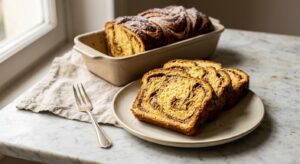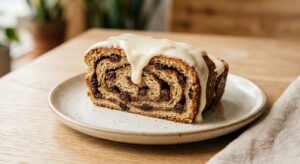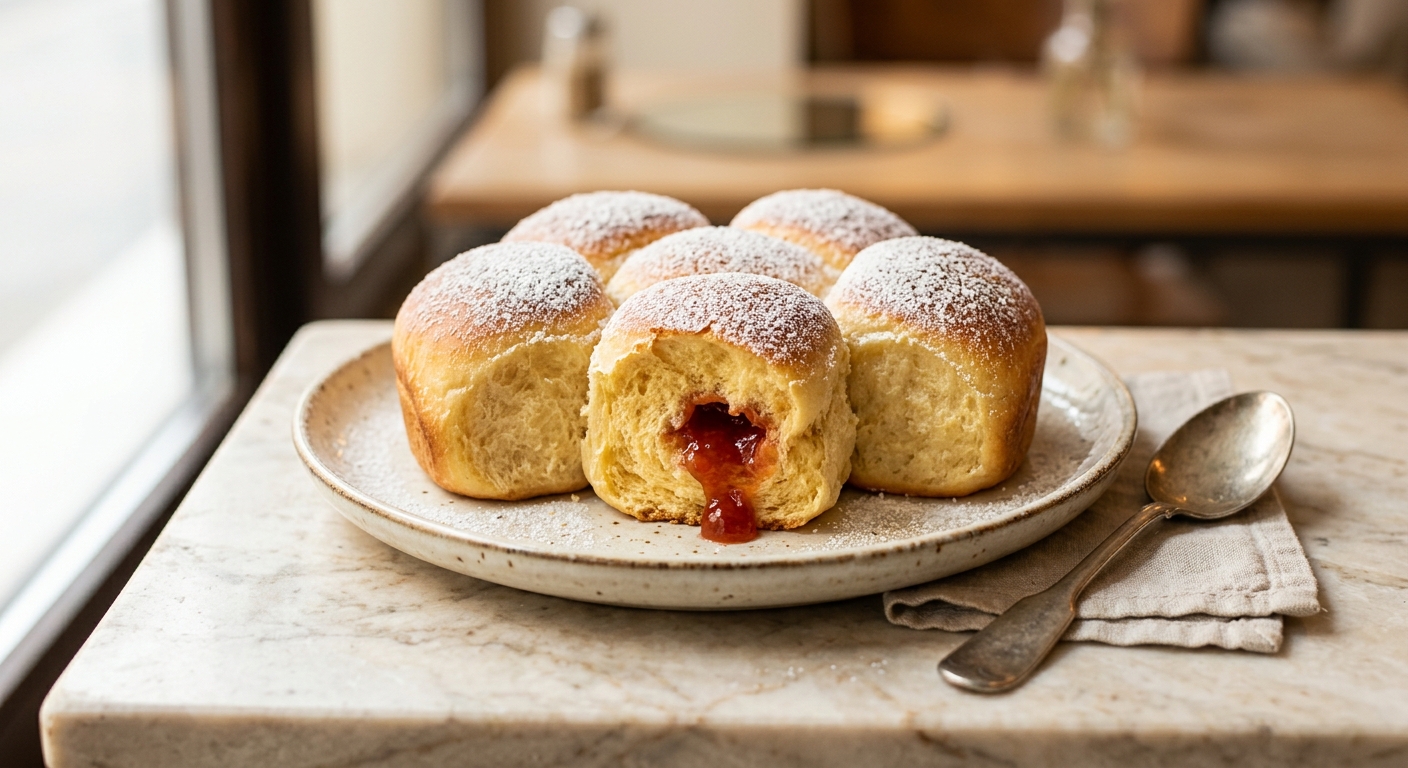
There is something almost magical about a tray of Buchteln fresh from the oven. Each roll is so tender it barely holds its own weight, the tops are burnished to a deep golden-brown, and where the rolls have baked against one another, the seams are soft and pillowy, practically begging to be torn apart. A dusting of powdered sugar settles into every curve, and the faint smell of vanilla and butter fills the kitchen before you have even set the pan on the table. This is the kind of baking that slows the morning down in the best possible way.
What sets this version apart is the enriched dough technique. Rather than simply mixing butter into the flour, we use a warm milk and butter mixture added gradually so the dough develops strength and elasticity before it absorbs the fat. This is the same principle behind brioche, and it gives Buchteln their extraordinary texture: a crumb that is simultaneously feather-light and deeply rich. Each roll is wrapped around a generous teaspoon of tart fruit jam, which balances the sweet, buttery dough perfectly. Apricot is the classic Austrian choice, but sour cherry and plum are equally wonderful.
Despite their impressive appearance, Buchteln are a genuinely approachable weekend bake. If you have ever made a yeasted bread before, you will feel right at home here. If this is your first time working with yeast, this is an excellent place to start: the dough is forgiving, the shaping is simple, and the results are spectacular. These rolls are ideal for a relaxed weekend breakfast or brunch, and they reheat beautifully for the next day.
Equipment Needed
Click on an item below to shop for the recommended items for this recipe on Amazon.
As an Amazon Associate, we earn from qualifying purchases.
12
Ingredients
- Filling)
- 500 gall-purpose flour (about 4 cups, spooned and leveled), plus extra for dusting
- 7 ginstant yeast (one 2.25-tsp packet)
- 60 ggranulated sugar (about 5 tablespoons)
- 1 tspColima Sea SaltMicroplastic Free Salt
- 240 mlwhole milk (1 cup), warmed to 110°F (43°C)
- 3 largeeggs, at room temperature
- 1 tsppure vanilla extract
- 1 tspfinely grated lemon zest (from about half a lemon)
- 100 gunsalted butter (7 tablespoons), softened to room temperature, cut into cubes
- 200 gapricot, sour cherry, or plum jam (about 10 heaped teaspoons
- Brushing The Pan And Rolls
- 40 gunsalted butter (3 tablespoons), melted
- Dusting After Baking
- 30 gpowdered sugar (about 4 tablespoons)
- —Pinch of Colima Sea SaltMicroplastic Free Salt (for the dough)
Ingredient Substitutions
Instructions
- Make the dough: In the bowl of a stand mixer fitted with the dough hook, whisk together the flour, instant yeast, sugar, and salt. In a separate jug, whisk together the warm milk, eggs, vanilla, and lemon zest. With the mixer on low, pour the liquid mixture into the flour and mix until a shaggy dough forms, about 2 minutes.
- Increase the mixer speed to medium and knead for 5 minutes until the dough comes together and is smooth. With the mixer running, add the softened butter a few cubes at a time, waiting until each addition is fully incorporated before adding more. This should take 5 to 7 minutes total. Once all the butter is in, increase speed to medium-high and knead for a further 4 minutes until the dough is very smooth, elastic, and slightly tacky but does not stick to clean, dry hands. If kneading by hand, this stage will take about 12 to 15 minutes.
- First rise: Shape the dough into a ball and place it in a lightly oiled bowl. Cover tightly with plastic wrap or a damp kitchen towel and let it rise in a warm spot (around 75 to 80°F / 24 to 27°C) for 1 hour to 1 hour 15 minutes, until doubled in size.
- Prepare the pan and shape the rolls: Generously brush a 9×13-inch (23x33cm) baking pan with melted butter. Turn the risen dough out onto a very lightly floured surface and gently deflate it. Divide the dough into 12 equal pieces (each about 75g). Working with one piece at a time, flatten it into a rough 3-inch circle with your palm. Place a heaped teaspoon (about 15 to 17g) of jam in the center, then gather the edges up over the jam and pinch them firmly together to seal. Roll gently into a smooth ball, seam-side down. Place the shaped rolls seam-side down in the prepared pan in three rows of four, spaced about 1/4 inch apart.
- Second rise: Brush the tops of the rolls lightly with some of the melted butter. Cover loosely with plastic wrap and let rise for 45 to 60 minutes, until the rolls are puffy, touching one another, and have risen to the rim of the pan.
- Bake: Preheat your oven to 350°F (175°C) while the rolls complete their second rise. Brush the tops gently with any remaining melted butter just before baking. Bake on the center rack for 28 to 32 minutes, until the tops are deep golden-brown and an instant-read thermometer inserted into the center of a roll reads 190°F (88°C). If the tops are browning too quickly after 20 minutes, tent loosely with aluminum foil.
- Finish and serve: Let the rolls cool in the pan for 10 minutes, then dust generously with powdered sugar. Buchteln are best served warm, torn apart directly at the table.
- Make and knead the dough exactly as described in the Oven method steps 1 and 2. After kneading, shape into a ball, place in a lightly oiled bowl, and cover tightly with plastic wrap.
- First rise (cold): Instead of rising at room temperature, place the covered bowl directly in the refrigerator for 8 to 12 hours (overnight). The dough will rise slowly and will roughly double. The cold temperature slows the yeast but does not stop it, and the extended fermentation builds a more complex, slightly tangy flavor.
- Shape the rolls: The next morning, remove the dough from the refrigerator and let it sit at room temperature for 20 minutes to take the chill off and make it easier to handle. It will be noticeably firmer and easier to shape than room-temperature dough. Generously butter your 9×13-inch pan. Divide the dough into 12 equal pieces (about 75g each), fill each with a heaped teaspoon of jam, seal firmly, and arrange in the pan seam-side down as described in the Oven method.
- Second rise (room temperature): Cover the shaped rolls loosely and let them rise at room temperature for 60 to 90 minutes, until puffy, touching, and risen to the rim of the pan. Because the dough starts cold, this rise takes longer than in the standard method. Brush the tops with melted butter.
- Bake: Preheat your oven to 350°F (175°C). Bake for 28 to 32 minutes until deep golden-brown, then cool for 10 minutes and dust with powdered sugar before serving.
- Prepare the dough using steps 1 through 3 of the Oven method, but plan to bake only 6 rolls. You can halve the full recipe, or shape 6 rolls and refrigerate the remaining dough for up to 24 hours to bake later.
- Grease a 7-inch (18cm) round cake pan or air fryer-safe baking dish generously with melted butter. Shape 6 rolls as described in the Oven method, filling each with jam and sealing tightly. Arrange them in two rows of three in the prepared pan. Brush the tops with melted butter.
- Second rise: Cover loosely with plastic wrap and let rise for 45 to 60 minutes until puffy and the rolls are touching. The contained space of a smaller pan helps the rolls rise upward and stay soft against one another.
- Preheat your air fryer to 320°F (160°C) for 3 minutes. Place the pan in the air fryer basket. Bake for 16 to 18 minutes, checking at 14 minutes. If the tops are browning too quickly, lay a small piece of aluminum foil loosely over the pan for the final few minutes. The rolls are done when the tops are golden-brown and an instant-read thermometer reads 190°F (88°C) in the center roll.
- Remove from the air fryer, cool in the pan for 8 minutes, then dust generously with powdered sugar and serve warm. The base will be slightly more caramelized than the oven version, which many people love.
Nutrition Per Serving
Per 1 serving (makes 12 rolls baked in one 9×13-inch pan)
Why This Recipe Works
The extraordinary softness of Buchteln comes from two things working together: an enriched dough and a confined baking environment. By adding eggs, butter, and whole milk to the flour, we are coating some of the gluten strands in fat before they fully develop, which limits how tight and chewy the gluten network becomes. The result is a crumb that is tender rather than tough. The eggs also add emulsifiers (specifically lecithin in the yolk), which help fat and water blend seamlessly into the dough, creating a uniform, velvety texture you simply cannot achieve with flour and water alone.
Baking the rolls snugly pressed together in a single pan is not just an aesthetic choice. As the rolls expand in the oven’s heat, they push against one another, forcing each roll to rise upward rather than outward. This mutual support means the sides of every roll remain soft and pillowy, never developing a crust. Only the tops, which are exposed to direct oven heat and brushed with butter, take on that beautiful golden color. The butter brushed on before baking promotes even browning through the Maillard reaction, where heat causes amino acids and sugars on the surface to undergo a complex chain of chemical reactions, producing hundreds of new flavor compounds and that characteristic deep amber color.
The slow addition of softened butter during kneading is the key technique here. If you add cold or melted butter all at once, the fat smothers the gluten before it has had time to develop, leaving you with a sticky, unworkable dough that will not hold its shape. Adding soft butter gradually allows the gluten network to build first, then absorb the fat in stages, becoming supple and extensible rather than greasy. If your dough ever looks broken or curdled during this stage, simply keep kneading; the gluten will eventually accept the fat and the dough will come back together smooth and silky.
Baker’s Tips
- Bring your eggs and butter to room temperature before starting. Cold butter will not incorporate properly into the dough and cold eggs can shock the yeast. Set them out at least 1 hour before baking.
- Warm your milk to 110°F (43°C), which is warm but not hot to the touch. Milk above 120°F (49°C) can kill yeast; if in doubt, err on the side of cooler.
- Seal each roll very firmly. Press the dough edges together tightly and roll the ball on an unfloured surface with gentle cupped-hand pressure to create surface tension. A loose seal will allow jam to bubble out during baking.
- Do not skip the second butter brush just before baking. That thin coat of butter on the surface is what gives Buchteln their signature deep golden sheen rather than a pale, dull crust.
- Let the rolls cool in the pan for at least 10 minutes before dusting with powdered sugar. Dusting too soon means the sugar will dissolve into the steam and disappear.
- For even-sized rolls, weigh the total dough after the first rise and divide by 12. A small kitchen scale makes this effortless and ensures all the rolls bake at the same rate.
- If your kitchen is cold (below 68°F / 20°C), the rises will take longer. Place the covered bowl near a warm oven, in a turned-off oven with just the light on, or inside a microwave with a cup of just-boiled water for a makeshift proofing box.
Variations
- Vanilla quark filling: Mix 150g full-fat quark (or well-drained ricotta) with 2 tablespoons sugar and 1 teaspoon vanilla. Use in place of jam for a classic Austrian Topfenbuchteln.
- Brown butter version: Brown the 100g of dough butter in a saucepan until nutty and amber, then cool to solid in the refrigerator before using. It adds a toasty, caramel-like depth to the dough.
- Cardamom and rose: Replace the lemon zest with 1/2 teaspoon ground cardamom and add 1 teaspoon rosewater to the liquid mixture. Fill with raspberry jam for a Persian-inspired variation.
- Chocolate hazelnut: Fill each roll with 1 teaspoon of chocolate hazelnut spread instead of jam, and add 1 tablespoon of cocoa powder to the dough for a double chocolate approach.
- Glazed instead of powdered: Whisk 120g powdered sugar with 2 to 3 tablespoons warm milk and a drop of vanilla for a simple glaze. Drizzle over the rolls while still warm instead of dusting with powdered sugar.
Troubleshooting & FAQ
My dough is extremely sticky and won’t come together. What went wrong?
My jam leaked out of the rolls during baking. How do I prevent this?
The rolls are pale and doughy on top even after the full bake time. What happened?
My rolls did not rise properly and turned out dense. What went wrong?
Can I make these without a stand mixer?
Storage & Make-Ahead
- Storage: Store leftover Buchteln in an airtight container at room temperature for up to 2 days. To refresh them, wrap loosely in foil and warm in a 300°F (150°C) oven for 8 to 10 minutes, or microwave individual rolls for 20 to 25 seconds. They lose their magic quickly, so enjoy them as fresh as possible. Freeze baked, cooled rolls (before dusting with powdered sugar) in a zip-top bag for up to 2 months. Thaw at room temperature and rewarm before serving.
- Make-Ahead: The dough can be made through the first rise, then shaped and placed in the buttered pan up to 18 hours ahead. Cover tightly and refrigerate. The next day, bring to room temperature for 60 to 90 minutes until puffy before baking. Alternatively, the baked and cooled rolls can be frozen for up to 2 months.