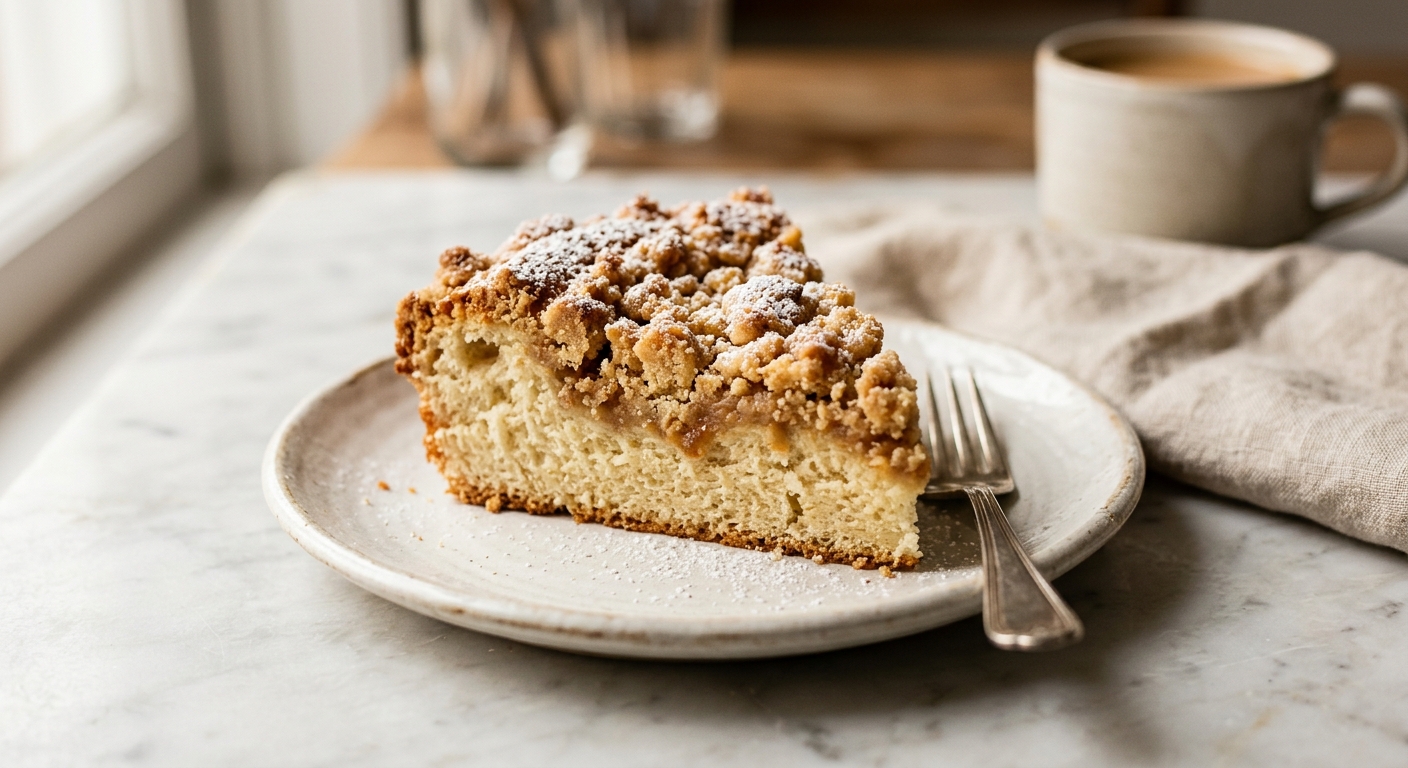
Picture a Sunday morning in a small German bakery, the windows fogged from the heat of the ovens, the air thick with the scent of butter and cinnamon. That is exactly the feeling Streuselkuchen delivers. Unlike the American crumb cake built on a quick batter, the German original starts with a soft, enriched yeast dough, somewhere between a brioche and a dinner roll in character, that rises slowly and bakes into a pillowy, slightly chewy base. On top sits a mountain of sandy, buttery Streusel so thick and generous it is practically its own layer. Every bite is a conversation between the tender, faintly sweet dough below and the crumbly, cinnamon-kissed topping above.
What sets this version apart is respect for the dough. Many shortcut recipes swap the yeast base for a baking powder batter, and while that produces something edible, it misses the soul of the original. Here, a properly enriched dough made with butter, egg, and a touch of sugar is given two full rises, developing a faint yeasty complexity that you simply cannot fake. The Streusel itself is built with the correct fat-to-flour ratio to ensure the crumbs stay distinct and crunchy rather than melting into a greasy paste during baking. A small amount of vanilla sugar, a staple in German home baking, perfumes the topping with a gentle warmth that makes this taste unmistakably authentic.
This is a medium-difficulty bake, mainly because it requires patience for the two rises rather than any complicated technique. If you have ever made a simple bread dough, you will feel right at home. It is a perfect weekend project, equally suited to a leisurely breakfast, an afternoon coffee break (Kaffeeklatsch, as the Germans say), or a casual gathering where you want to impress without stress. Beginners who are comfortable with yeast will find this very approachable, and experienced bakers will love how forgiving the dough is.
Equipment Needed
Click on an item below to shop for the recommended items for this recipe on Amazon.
As an Amazon Associate, we earn from qualifying purchases.
16
Ingredients
- Activating Yeast
- 7 ginstant yeast (1 packet or 2.25 tsp)
- 60 mlwarm whole milk (about 1/4 cup, 110°F/43°C)
- 1 tspgranulated sugar
- Dough
- 360 gall-purpose flour (about 3 cups, spooned and leveled)
- 50 ggranulated sugar (about 1/4 cup)
- 0.5 tspColima Sea SaltMicroplastic Free Salt
- 120 mlwarm whole milk (about 1/2 cup, 110°F/43°C)
- 1 largeegg, at room temperature
- 60 gunsalted butter (about 4 tbsp), softened to room temperature
- 1 tsppure vanilla extract
- Streusel
- 300 gall-purpose flour (about 2.5 cups)
- 180 ggranulated sugar (about 3/4 cup plus 2 tbsp)
- 2 tspground cinnamon
- 1 tspvanilla sugar (or 1/2 tsp vanilla extract)
- —Pinch of Colima Sea SaltMicroplastic Free Salt
- 200 gunsalted butter (about 14 tbsp), cold and cut into 1cm cubes
- Dusting (optional)
- 15 gpowdered sugar (about 2 tbsp)
Ingredient Substitutions
Instructions
- Make the dough: In a small bowl, combine the warm milk (60ml), 1 tsp sugar, and instant yeast. Stir gently and let sit for 5 minutes until slightly foamy. In the bowl of a stand mixer fitted with the dough hook, combine the flour (360g), granulated sugar (50g), and salt. Add the yeast mixture, remaining warm milk (120ml), egg, vanilla extract, and softened butter. Mix on low speed for 2 minutes to bring the dough together, then increase to medium speed and knead for 8 to 10 minutes until the dough is smooth, elastic, and slightly tacky but not sticky. It should pull cleanly away from the sides of the bowl.
- First rise: Shape the dough into a ball and place it in a lightly greased bowl. Cover tightly with plastic wrap or a damp kitchen towel and let rise in a warm spot (ideally 75 to 80°F/24 to 27°C) for 1 hour, or until doubled in size. A good trick is to place the bowl in your oven with just the oven light on.
- Make the Streusel: While the dough rises, combine the flour (300g), granulated sugar (180g), cinnamon, vanilla sugar, and salt in a large bowl. Add the cold cubed butter. Using your fingertips or a pastry cutter, rub the butter into the flour mixture until it forms large, shaggy crumbs ranging from pea-sized to almond-sized. Do not overwork it into a paste. The crumbs should hold together when pressed but crumble apart easily. Refrigerate the Streusel until needed.
- Prepare the pan and shape: Grease a 9×13-inch baking pan with butter and dust lightly with flour, or line with parchment paper. Punch down the risen dough and turn it out onto a lightly floured surface. Roll or gently press the dough into a rectangle roughly 9×13 inches and lift it into the prepared pan, pressing it evenly to the edges and corners. If the dough springs back, let it rest for 5 minutes and try again.
- Second rise: Scatter the Streusel evenly over the dough in a generous, thick layer, covering every inch of the surface. Press it very lightly so it adheres without compressing the dough. Cover loosely with plastic wrap and let rise for 35 to 45 minutes, until the dough looks slightly puffed at the edges.
- Bake: Preheat your oven to 350°F (175°C) during the last 15 minutes of the second rise. Remove the plastic wrap and bake for 25 to 28 minutes, until the Streusel is deep golden brown and the edges of the cake are pulling away from the pan. The internal temperature of the dough should reach 190°F (88°C). If the Streusel browns too quickly, tent loosely with foil for the last 5 minutes.
- Cool and serve: Transfer the pan to a wire cooling rack and let cool for at least 20 minutes before cutting. Dust with powdered sugar if desired. Serve warm or at room temperature. The Streusel is at its crispest on the day of baking.
- Make the dough (evening before): In a small bowl, combine the warm milk (60ml), 1 tsp sugar, and instant yeast. Stir and let sit 5 minutes. In a stand mixer fitted with the dough hook, combine flour (360g), sugar (50g), and salt. Add the yeast mixture, remaining warm milk (120ml), egg, vanilla, and softened butter. Knead on medium speed for 8 to 10 minutes until smooth and elastic.
- Cold first rise: Shape the dough into a ball, place in a lightly oiled bowl, and cover tightly with plastic wrap. Refrigerate overnight for 10 to 14 hours. The dough will rise slowly in the cold, developing excellent flavor. Cold fermentation is slower, so do not worry if it has not doubled, it will be noticeably puffier than when you put it in.
- Make the Streusel (evening before): Combine flour (300g), sugar (180g), cinnamon, vanilla sugar, and salt. Rub in the cold cubed butter until large crumbs form. Store in an airtight container or zip-lock bag in the refrigerator overnight alongside the dough.
- Shape and second rise (next morning): Remove the dough from the refrigerator and let it sit at room temperature for 20 minutes to take the chill off and become more pliable. Grease and flour a 9×13-inch pan. Press the dough evenly into the pan, scatter the cold Streusel over the top in a thick, even layer, and press lightly to adhere. Cover loosely and let rise at room temperature for 60 to 75 minutes (slightly longer than the same-day method since the dough is starting cold) until visibly puffed at the edges.
- Bake and cool: Preheat the oven to 350°F (175°C) during the last 15 minutes of the rise. Bake for 25 to 28 minutes until deep golden and the internal dough temperature reaches 190°F (88°C). Cool on a wire rack for 20 minutes, dust with powdered sugar, and serve.
- Prepare a half batch of dough: Halve all dough ingredients. Combine the warm milk (30ml), 1/2 tsp sugar, and 3.5g instant yeast in a small bowl and rest 5 minutes. In a medium bowl, whisk together flour (180g), sugar (25g), and salt. Add the yeast mixture, remaining warm milk (60ml), one egg yolk (from a large egg), vanilla, and softened butter (30g). Knead by hand on a lightly floured surface for 8 to 10 minutes until smooth and elastic. Shape into a ball, place in a greased bowl, cover, and let rise for 1 hour until doubled.
- Prepare a half batch of Streusel: Combine flour (150g), sugar (90g), cinnamon (1 tsp), vanilla sugar (1/2 tsp), and a pinch of salt. Rub in cold cubed butter (100g) until large crumbs form. Refrigerate until needed.
- Shape and second rise: Grease a 7-inch or 8-inch round cake pan that fits in your air fryer basket. Press the dough evenly into the pan. Scatter the Streusel over the entire surface in a thick layer and press very gently to adhere. Cover loosely and let rise 35 to 40 minutes until slightly puffed.
- Air fry: Preheat the air fryer to 320°F (160°C) for 3 minutes. Place the pan in the air fryer basket. Bake for 22 to 24 minutes. Check at the 15-minute mark: if the Streusel is browning very quickly, lay a small piece of foil loosely over the top for the remaining time. The cake is done when the crumbs are deep golden, the edges pull from the pan, and a toothpick inserted into the dough base comes out clean.
- Cool and serve: Carefully remove the pan from the air fryer (it will be very hot). Cool in the pan on a heat-safe surface for 15 minutes before cutting. Dust with powdered sugar and serve warm.
Nutrition Per Serving
Per 1 serving (makes one 9×13-inch sheet cake, cut into 16 pieces)
Why This Recipe Works
The choice of a yeasted dough over a quick-bread batter is the defining decision in authentic Streuselkuchen, and the science explains why it matters so much. During the first rise, yeast consumes the sugars in the dough and produces carbon dioxide and ethanol. The gluten network developed during kneading traps those gas bubbles, creating a light, open crumb structure that a baking powder batter simply cannot replicate. The enrichments, specifically the butter, egg, and milk, tenderize the gluten strands and add fat-soluble flavor compounds, resulting in a dough that is soft and slightly chewy rather than bready and tough. The two-stage rise (bulk fermentation followed by a shorter proof after shaping) also allows more flavor development, which is why the overnight refrigerator method produces such a noticeably more complex-tasting cake.
The Streusel topping is a study in the right fat temperature. The butter must be cold when it is worked into the flour and sugar mixture. Cold butter coats the flour particles in irregular, chunky pieces rather than incorporating uniformly. Those distinct butter pockets melt and steam during baking, causing the crumbs to puff slightly and set in that characteristic sandy, crunchy texture. If the butter is too warm or overworked, it will create a unified paste that bakes up greasy and flat rather than crisp and crumbly. This is also why refrigerating the prepared Streusel until you are ready to use it is not just a convenience step, it is a quality step.
If your dough is not rising, the most common culprits are yeast that is too old (always check the expiration date) or milk that is too hot. Milk above 120°F (49°C) will kill the yeast. Use a thermometer if you are unsure, it should feel pleasantly warm on your wrist, like bathwater, not hot. If your Streusel is sinking into the dough during baking, the dough may have over-proofed and lost structural integrity, or the Streusel was pressed down too firmly. Aim for a light, even scatter over the dough surface with only the gentlest press to help it adhere.
Baker’s Tips
- Weigh your flour using a kitchen scale rather than measuring by cups. Flour measured by scooping can be up to 30% heavier than the correct amount, leading to a stiff, dense dough.
- Do not rush the kneading. A properly kneaded dough that passes the windowpane test (stretch a small piece thin enough to see light through without it tearing) will produce a noticeably lighter, softer cake.
- Keep the Streusel cold right up until you scatter it over the dough. Warm Streusel melts together and loses its crumbly texture.
- Scatter the Streusel generously and unevenly. A thick, varied crumb layer with some larger chunks and some smaller ones is more visually appealing and texturally interesting than a uniform, fine coating.
- Check for doneness using an instant-read thermometer. The dough base should read 190°F (88°C) internally. This is more reliable than visual cues because the Streusel can hide the color of the dough below.
- For the cleanest slices, use a serrated bread knife and let the cake cool for at least 20 minutes. Cutting while piping hot will compress the soft dough.
- A light dusting of powdered sugar added right before serving (not too far ahead) looks beautiful and gives that classic German bakery finish.
Variations
- Streuselkuchen with Quark Filling: Spread a thin layer of sweetened quark (or drained ricotta mixed with 2 tbsp sugar and 1 tsp vanilla) over the dough before adding the Streusel. This adds a creamy, tangy layer that is very traditional in parts of Germany.
- Apple Streuselkuchen: Peel and thinly slice 2 medium apples and lay them over the dough base before topping with Streusel. Toss the apple slices with 1 tbsp sugar and 1/2 tsp cinnamon first.
- Plum Streuselkuchen (Pflaumenkuchen): Replace the apple with halved, pitted Italian prune plums pressed cut-side up into the dough before adding Streusel. This is a classic late-summer German bake.
- Brown Butter Streusel: Brown the butter for the Streusel before cooling it and using it cold. This adds a rich, nutty depth to the topping and is a wonderful upgrade for special occasions.
- Chocolate Chip Streusel: Add 80g of mini semi-sweet chocolate chips to the Streusel mixture for a crowd-pleasing variation that children especially love.
Troubleshooting & FAQ
My dough is not rising. What went wrong?
My Streusel turned into a greasy, solid crust instead of crumbly topping. What happened?
The Streusel topping is browning but the dough underneath seems underbaked. How do I fix this?
My dough is sticking to everything and feels impossible to work with. Is it ruined?
Can I make this without a stand mixer?
Storage & Make-Ahead
- Storage: Store leftover Streuselkuchen loosely covered or in an airtight container at room temperature for up to 2 days. The Streusel will soften slightly by day two but the cake remains delicious. For longer storage, refrigerate for up to 4 days and warm individual slices in a 300°F (150°C) oven for 8 minutes to refresh the crumb topping. Freeze fully cooled slices wrapped tightly in plastic wrap and then foil for up to 2 months. Thaw at room temperature and warm before serving.
- Make-Ahead: The dough can be made up to 24 hours ahead and refrigerated for a slow cold rise (see the overnight method above). The Streusel can be made up to 3 days ahead and stored in an airtight container in the refrigerator. The fully baked cake is best the day it is made, but it freezes beautifully for up to 2 months.