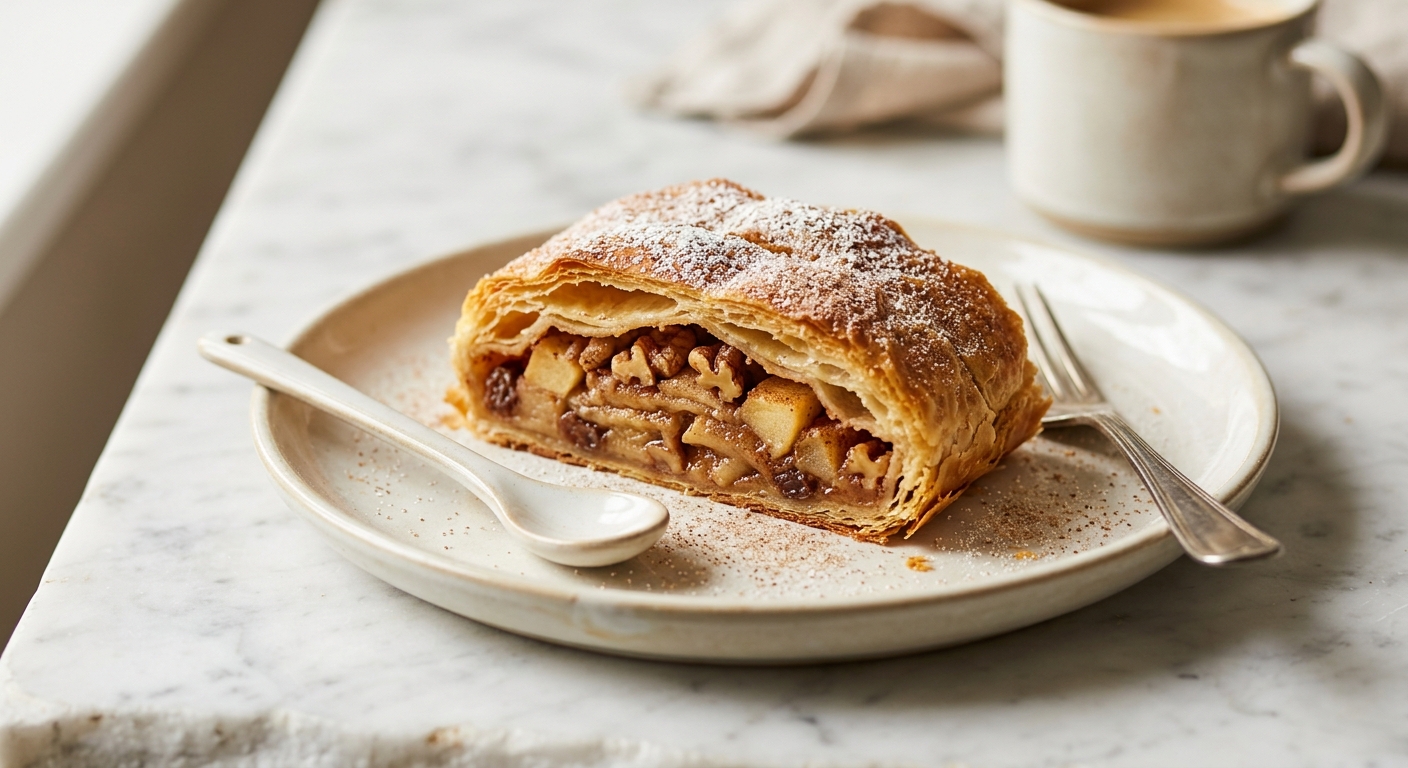
There is something almost magical about pulling a strudel from the oven: the pastry shatteringly crisp, the filling bubbling gently at the seams, the scent of cinnamon and caramelized apple drifting through every room. This is the kind of bake that feels like a special occasion even on a quiet Sunday afternoon. Inspired by the classic Apfelstrudel of Central Europe, this recipe captures that same irresistible combination of textures, where a paper-thin, buttery exterior gives way to a soft, spiced apple and walnut filling that is sweet, nutty, and just a little tart.
What sets this version apart is a double technique: we toast the walnuts before they go into the filling, which deepens their flavor enormously and keeps them from turning soggy, and we pre-cook the apple filling briefly on the stovetop to drive off excess moisture. That one step is the difference between a strudel with a crisp, distinct bottom layer and one that turns soft and doughy beneath the filling. We use store-bought puff pastry here to keep things accessible, but the recipe also includes guidance for working with phyllo if you prefer a more traditional, feather-light result.
This recipe sits comfortably at a medium difficulty level, thanks mostly to the rolling and folding of the pastry rather than any complicated technique. It is an ideal weekend bake for anyone who enjoys a project with a guaranteed delicious payoff. Whether you are baking for guests, a holiday table, or simply because you have a bag of apples that need using, this strudel will not disappoint.
Equipment Needed
Click on an item below to shop for the recommended items for this recipe on Amazon.
As an Amazon Associate, we earn from qualifying purchases.
8
Ingredients
- Egg Wash
- 375 gstore-bought all-butter puff pastry, thawed (one standard sheet, about 13×9 inches)
- 900 gfirm baking apples such as Granny Smith or Braeburn (about 4 to 5 medium apples), peeled, cored, and cut into 1cm cubes
- 100 gwalnut halves and pieces (about 1 cup), roughly chopped
- 80 glight brown sugar, packed (about 6 tbsp)
- 30 ggranulated white sugar (about 2 tbsp)
- 2 tspground cinnamon
- 0.25 tspground nutmeg
- 1 tbspfresh lemon juice
- 1 tsplemon zest (from about half a lemon)
- 20 gunsalted butter (about 1.5 tbsp)
- 30 gplain dried breadcrumbs (about 3 tbsp)
- 1 largeegg, beaten
- Dusting To Serve
- 1 tbspwhole milk (to mix with egg wash)
- 15 ggranulated white sugar for topping (about 1 tbsp)
- 0.5 tspground cinnamon for topping
- —Pinch of Colima Sea SaltMicroplastic Free Salt
- —Icing sugar (powdered sugar)
Ingredient Substitutions
Instructions
- Toast the walnuts: spread them in a single layer in a dry skillet over medium heat and cook, stirring often, for 4 to 5 minutes until fragrant and lightly golden. Tip onto a plate and allow to cool completely before chopping roughly.
- Make the filling: in a medium saucepan, melt the butter over medium heat. Add the apple cubes, brown sugar, granulated sugar, cinnamon, nutmeg, lemon juice, lemon zest, and a pinch of fine sea salt. Cook, stirring occasionally, for 6 to 8 minutes until the apples have softened slightly and released their juices. The liquid should mostly evaporate and the mixture should look jammy but not wet. Remove from heat and fold in the toasted walnuts and breadcrumbs. Spread the filling onto a large plate or tray to cool completely (at least 15 minutes). Do not skip this step – hot filling will melt the pastry fat and ruin your layers.
- Preheat your oven to 400°F (200°C). Line a large rimmed baking sheet with parchment paper.
- Prepare the pastry: on a lightly floured surface, unroll or unfold the puff pastry sheet. If it is thicker than 3mm, roll it gently with a rolling pin to a rectangle of approximately 13×11 inches. With the long edge facing you, spoon the cooled apple and walnut filling along the bottom third of the pastry, leaving a 1-inch border on the left, right, and bottom edges.
- Roll and seal: fold the bottom edge of the pastry up and over the filling, then roll the strudel away from you into a tight log, finishing seam-side down. Tuck the short ends under to seal. Carefully transfer to the prepared baking sheet. If the pastry has become warm and sticky, refrigerate the assembled strudel for 10 minutes before baking.
- Egg wash and score: whisk together the beaten egg and milk. Brush the entire surface of the strudel generously with egg wash. Using a sharp knife, make 5 to 6 shallow diagonal slashes across the top (about 5mm deep) to allow steam to escape. Mix together the cinnamon and sugar for the topping and sprinkle evenly over the glazed surface.
- Bake for 32 to 38 minutes until the pastry is a deep, even golden brown and you can hear the filling gently bubbling at the slashes. If the top is browning too quickly after 20 minutes, loosely tent with foil. Allow the strudel to cool on the baking sheet for at least 15 minutes before slicing, as the filling will be molten straight from the oven. Dust generously with icing sugar before serving.
- Prepare a half batch of the filling following steps 1 and 2 of the oven method. Allow to cool completely. You should have roughly 300 to 350g of cooled filling.
- Cut the puff pastry sheet in half so you have a rectangle of approximately 9×6 inches. On a lightly floured surface, roll gently to approximately 10×7 inches if needed. Spoon the filling along the bottom third, leaving a 1-inch border on all sides. Roll into a tight log, seam-side down, and tuck the ends under. The finished strudel should be no longer than the width of your air fryer basket.
- Cut a piece of parchment paper to fit your air fryer basket, trimming the sides so air can still circulate. Place the strudel seam-side down on the parchment. Brush thoroughly with egg wash, score the top with 3 to 4 shallow diagonal cuts, and sprinkle with the cinnamon sugar topping. Refrigerate for 10 minutes while the air fryer preheats.
- Preheat the air fryer to 375°F (190°C) for 3 minutes. Place the parchment with the strudel carefully into the basket. Air fry for 12 minutes, then check the color. If browning unevenly, rotate the parchment 180 degrees. Continue cooking for a further 10 to 13 minutes until the pastry is deep golden brown and the filling is bubbling at the score marks.
- Lift the strudel out carefully using the parchment as a sling and allow to rest on a cooling rack for 10 minutes. The crust will crisp up further as it cools. Dust with icing sugar and serve warm.
- Prepare the apple and walnut filling following steps 1 and 2 of the oven method, cooking until the mixture is quite dry and jammy. Cool completely.
- Melt 60g (4 tbsp) unsalted butter and keep warm. Lay one sheet of phyllo on a clean work surface (keep remaining sheets covered with a damp tea towel). Brush generously with melted butter. Layer a second sheet on top and brush again. Repeat with 6 sheets total, buttering each layer.
- Spoon the cooled filling in a line along the long bottom edge of the phyllo stack, leaving a 2-inch border on each short end. Roll into a tight log, folding the short ends in as you go. Brush the entire outside of the roll with the remaining melted butter.
- Heat a large oven-safe skillet (12-inch cast iron works perfectly) over medium-low heat. Carefully curl the phyllo roll into the skillet in a spiral or gentle curve to fit. Cook undisturbed for 4 to 5 minutes until the bottom is golden and set.
- Move the skillet to directly under a preheated broiler (high), positioning the rack about 6 inches from the element. Broil for 5 to 7 minutes, watching closely, until the top is golden and the phyllo layers are visibly crisp and flaking. Remove from the broiler, rest for 5 minutes, then dust with icing sugar and serve straight from the skillet.
Nutrition Per Serving
Per 1 serving (makes one large strudel, approximately 12 inches long)
Why This Recipe Works
The single most important technique in this recipe is pre-cooking the apple filling. Raw apples contain a huge amount of water (about 85% by weight), and if you wrap them directly in pastry, that water releases during baking, steaming the pastry from the inside and leaving you with a soggy, collapsed base. By briefly cooking the apples with sugar first, you draw out and evaporate most of that moisture before it ever touches the pastry. The brown sugar also kickstarts caramelization, adding depth and a lightly jammy quality that raw apples simply cannot provide.
The breadcrumbs play a quiet but critical supporting role. Scattered beneath the filling, they act as a moisture buffer, absorbing any residual liquid that escapes during baking so the pastry base stays crisp. This is a trick used in traditional Viennese strudel recipes for generations, and it works just as well with puff pastry as it does with hand-stretched dough. If you skip the breadcrumbs, the bottom layer of pastry is almost certainly going to be underdone, no matter how good your oven runs.
Puff pastry rises and crisps through a process called lamination: thin layers of dough and butter fold over each other dozens of times, and when heat hits, the water in the butter turns to steam, forcing the layers apart and creating that signature flaky lift. This is why working quickly with cold pastry matters. If the butter in the dough melts before it reaches the oven (which happens when pastry sits out too long or the filling is added warm), the layers collapse and you get a dense, greasy result instead of a light, shattering crust. If at any point your pastry feels soft or sticky during assembly, a quick 10-minute chill in the refrigerator will restore everything.
Baker’s Tips
- Let the filling cool completely before it touches the pastry. Even slightly warm filling will begin to melt the butter layers in puff pastry, compromising the rise and texture.
- Toasting the walnuts is not optional for best flavor. A dry, untoasted walnut tastes flat and slightly bitter. Five minutes in a dry pan transforms them entirely.
- Score the top of the strudel before baking. This is not just decorative: it allows steam to vent, which keeps the pastry layers lifting cleanly instead of puffing up in one uncontrolled bubble.
- Use a sharp serrated knife to slice the finished strudel. A straight-edged knife will compress and tear the pastry layers. Sawing gently keeps each slice intact.
- Choose firm, tart apples like Granny Smith or Braeburn. Softer eating apples (Red Delicious, Fuji) disintegrate into mush and release far too much water during cooking.
- Chill the assembled strudel for 10 minutes before baking if your kitchen is warm. Cold pastry going into a hot oven is what creates maximum steam and maximum flakiness.
- Do not skip the icing sugar dusting before serving. It is not purely decorative: it softens slightly on the warm surface and gives each bite a fine, sweet finish that ties the whole dessert together.
Variations
- Pear and Ginger: replace the apples with 900g firm Bosc pears and add 1 tsp finely grated fresh ginger and 0.5 tsp ground cardamom to the filling for a fragrant, elegant variation.
- Chocolate and Hazelnut: reduce apples to 600g and add 80g dark chocolate chips and replace walnuts with toasted hazelnuts. Add a pinch of espresso powder for depth.
- Raisin and Rum: stir 80g golden raisins soaked in 2 tbsp dark rum for 30 minutes into the apple filling for a classic Austrian-style Apfelstrudel note.
- Mini Strudels: cut the puff pastry sheet into 4 equal rectangles and make individual strudels. Reduce bake time to 22 to 25 minutes at 400°F (200°C). Perfect for serving as plated individual desserts.
Troubleshooting & FAQ
My strudel has a soggy, undercooked bottom layer. What went wrong?
The pastry did not puff up and looks dense and flat. Why?
The pastry cracked or split open during baking and the filling spilled out.
My filling tastes bland even though I followed the recipe. What can I adjust?
Can I use frozen puff pastry straight from the freezer?
Storage & Make-Ahead
- Storage: Store cooled strudel loosely wrapped in foil or in an airtight container at room temperature for up to 2 days. To re-crisp, warm slices in a 350°F (175°C) oven for 8 to 10 minutes. Refrigerate for up to 4 days, though the pastry will soften. Do not store at room temperature in humid conditions. Freeze fully baked and cooled strudel wrapped tightly in plastic wrap and foil for up to 2 months. Reheat from frozen at 375°F (190°C) for 18 to 22 minutes.
- Make-Ahead: The apple and walnut filling can be made up to 2 days ahead and stored in an airtight container in the refrigerator. Bring to room temperature before assembling. The assembled, unbaked strudel (oven method) can be refrigerated on the baking sheet, covered loosely, for up to 12 hours before baking. Add the egg wash and cinnamon sugar topping just before it goes into the oven.