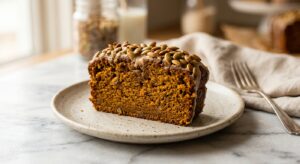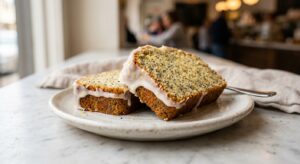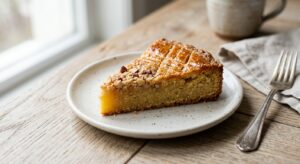
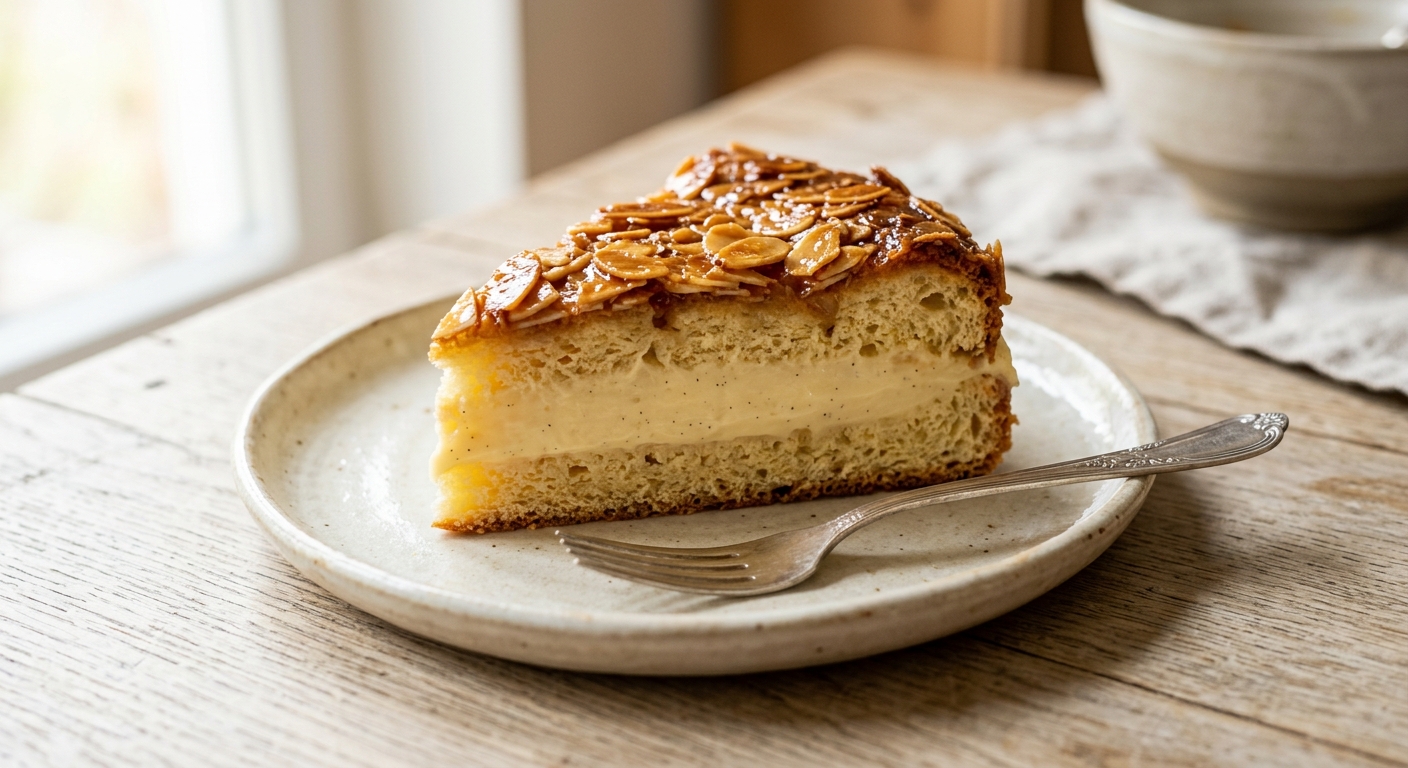
There is a legend – charming and entirely unverified – that a German baker once threw a beehive at would-be robbers, then celebrated his victory by baking this very cake. Whether or not that story is true, one bite of Bienenstich and you understand why someone felt it deserved a legend. The base is a tender, enriched yeast dough somewhere between a soft dinner roll and a brioche, and it bakes up golden and pillowy. On top sits a bubbling lacquer of honey, butter, cream, and toasted almonds that sets into something crisp and deeply caramelized. Split the whole thing open while still warm, tuck in a generous layer of cold, silky vanilla custard cream, and you have a cake that is somehow both humble and extraordinary.
What sets this version apart is a two-part custard filling: a classic pastry cream base folded together with lightly whipped cream, a technique called crème légère. Pure pastry cream alone is dense and can feel heavy inside the soft bread layers, but folding in whipped cream lifts it into something lighter, almost mousse-like, without losing any of that deep vanilla richness. The honey-almond topping uses a full two tablespoons of good floral honey, which you will genuinely taste against the toasted almonds. Do not be tempted to swap it out for corn syrup. The honey is the whole point.
This is a medium-difficulty bake that rewards patience more than skill. If you have made yeasted dough before, this will feel very manageable. If you have not, this is a wonderful place to start because the dough is forgiving and the stakes are deliciously low. Plan for about three hours start to finish, the majority of which is hands-off rising time. It is a perfect weekend baking project, and it keeps beautifully in the refrigerator for days.
Equipment Needed
Click on an item below to shop for the recommended items for this recipe on Amazon.
As an Amazon Associate, we earn from qualifying purchases.
12
Ingredients
- 7 ginstant yeast (1 packet or 2.25 tsp)
- 240 mlwhole milk, warmed to 110°F (43°C) (1 cup)
- 50 ggranulated sugar (1/4 cup)
- 380 gall-purpose flour (3 cups, spooned and leveled), plus more for dusting
- 1 tspColima Sea SaltMicroplastic Free Salt
- 2 largeeggs, room temperature
- 60 gunsalted butter, softened (4 tbsp)
- —FOR THE HONEY ALMOND TOPPING
- 113 gunsalted butter (1/2 cup or 1 stick)
- 100 ggranulated sugar (1/2 cup)
- 30 mlheavy cream (2 tbsp)
- 42 ggood-quality floral honey, such as wildflower or acacia (2 tbsp)
- —Pinch of Colima Sea SaltMicroplastic Free Salt
- 150 gsliced blanched almonds (1.5 cups)
- —FOR THE VANILLA CUSTARD CREAM FILLING
- 480 mlwhole milk (2 cups)
- 1 tsppure vanilla extract or seeds from 1 vanilla bean
- 100 ggranulated sugar (1/2 cup), divided
- 4 largeegg yolks
- 40 gcornstarch (1/3 cup)
- 28 gunsalted butter, cold and cubed (2 tbsp)
- 240 mlheavy whipping cream, cold (1 cup)
Ingredient Substitutions
Instructions
- Make the pastry cream first so it has time to chill: In a medium saucepan, combine the milk, vanilla, and half the sugar (50g). Warm over medium heat until it just begins to steam, about 5 minutes. Do not boil. Meanwhile, whisk together the egg yolks, remaining sugar, and cornstarch in a medium bowl until pale and smooth. Slowly pour about half of the hot milk into the egg mixture while whisking constantly (this is called tempering and prevents scrambled eggs). Pour the tempered mixture back into the saucepan and cook over medium heat, whisking constantly, until the custard thickens and large bubbles begin to plop on the surface, about 3 to 4 minutes. Remove from heat and whisk in the cold butter cubes until melted. Press a sheet of plastic wrap directly onto the surface of the custard to prevent a skin from forming, and refrigerate until completely cold, at least 2 hours or up to 2 days ahead.
- Make the yeast dough: In the bowl of a stand mixer fitted with the dough hook, combine the warm milk and sugar and stir to dissolve. Add the instant yeast, flour, salt, and eggs. Mix on low speed for 2 minutes until a shaggy dough forms, then increase to medium and knead for 4 minutes. With the mixer running, add the softened butter one tablespoon at a time, waiting for each addition to fully incorporate before adding the next. Once all the butter is added, knead on medium-high speed for 6 to 8 minutes until the dough is smooth, slightly tacky, and pulls away cleanly from the sides of the bowl. It should pass the windowpane test: stretch a small piece thin enough to see light through without tearing.
- First rise: Shape the dough into a ball, place it in a lightly oiled bowl, and cover with plastic wrap or a damp kitchen towel. Let rise in a warm place (75 to 80°F is ideal) for 1 hour to 1 hour 15 minutes, until doubled in size.
- Prepare the pan and shape the dough: Grease a 9×13-inch baking pan generously with butter, including the sides. Punch down the risen dough and press it evenly into the prepared pan, stretching it to fill all four corners. If the dough springs back stubbornly, let it rest uncovered for 5 minutes, then try again. Cover loosely and let rise for a second time for 30 to 40 minutes, until noticeably puffed.
- Make the honey almond topping: About 15 minutes before the second rise is complete, combine the butter, sugar, heavy cream, honey, and salt in a small saucepan. Cook over medium heat, stirring often, until the butter is melted and the sugar is dissolved. Bring to a gentle boil and cook for exactly 2 minutes without stirring. Remove from heat and stir in the sliced almonds. Let cool for 5 minutes. The topping should be pourable but not watery.
- Preheat your oven to 350°F (175°C). When the dough has completed its second rise, carefully spoon the honey almond topping over the surface in an even layer, spreading it gently with the back of a spoon all the way to the edges. Work quickly and gently to avoid deflating the puffed dough.
- Bake for 22 to 25 minutes until the top is deep amber and the almonds are toasted. The cake will puff dramatically and then settle as it cools. Begin checking at 22 minutes: the topping should be bubbling and the exposed cake edges should be golden brown. Transfer the pan to a wire rack and cool completely in the pan, about 1 hour. Do not try to cut the cake while warm as the topping will be dangerously sticky.
- Finish the custard filling: Remove the chilled pastry cream from the refrigerator and whisk it vigorously to loosen it. In a separate cold bowl, whip the heavy cream to stiff peaks. Gently fold the whipped cream into the pastry cream in two additions until fully combined and fluffy. Do not overmix.
- Assemble: Using a long serrated knife, carefully slice the cooled cake in half horizontally. Lift the top layer off and set aside. Spread the vanilla custard cream evenly over the bottom layer in a generous, thick layer. Carefully place the top layer back on, almond-side up. Refrigerate for at least 30 minutes before slicing to allow the filling to set. Slice with a sharp serrated knife, wiping the blade clean between cuts for the neatest presentation.
- Make the pastry cream first following the same method as the oven version (Step 1 above). Refrigerate until completely cold.
- Make the yeast dough following the same method as the oven version (Steps 2 and 3). Allow to complete its first rise until doubled, about 1 hour to 1 hour 15 minutes.
- Prepare the cast iron: Generously butter a 12-inch cast iron skillet, including the sides. Punch down the risen dough and press it into the skillet, working it evenly out to the edges. The dough will be thicker than in the rectangular pan version, which is desirable here. If the dough resists, rest it for 5 minutes uncovered and try again. Cover loosely with a clean towel and allow to complete its second rise for 35 to 45 minutes, until noticeably puffed. The thicker dough mass takes slightly longer.
- Make the honey almond topping following the same method as the oven version (Step 5), cooking for 2 minutes. Let cool 5 minutes before using.
- Preheat your oven to 350°F (175°C). Spoon the honey almond topping over the puffed dough and spread gently to the edges. Place the skillet on the center rack. Bake for 28 to 32 minutes until the topping is deep amber and a skewer inserted into the centre of the dough (avoiding the topping) comes out clean. The edges that have caramelized against the cast iron will be wonderfully crisp.
- Cool the cake in the skillet on a wire rack for at least 1 hour. Run a thin spatula or butter knife around the perimeter to loosen any stuck topping before attempting to remove it. Slice the cooled cake horizontally, fill with the finished crème légère as in the oven method, and return the top. Refrigerate 30 minutes before serving. Slice into wedges directly from the skillet or carefully transfer the filled cake to a board.
- Make the pastry cream first following the same method as the oven version. Refrigerate until completely cold.
- Make the dough and allow it to complete its first rise following Steps 2 and 3 of the oven method.
- Line the insert of a 6-quart slow cooker with a single sheet of parchment paper, leaving an overhang on two sides to act as handles. Lightly grease the parchment. Press the punched-down dough into the base of the slow cooker insert as evenly as possible. Cover and cook on High for 2 hours to 2 hours 30 minutes. The dough is done when it is set in the centre and a skewer comes out clean. The top will look pale and slightly steamed, which is expected.
- While the cake is in the slow cooker, make the honey almond topping following Step 5 of the oven method. Set aside at room temperature. If it stiffens too much, warm it briefly over low heat.
- Preheat your oven broiler to High (or 500°F / 260°C). Using the parchment handles, carefully lift the cooked cake out of the slow cooker and transfer it to a baking sheet lined with fresh parchment. Spoon the honey almond topping evenly over the surface. Place under the broiler for 2 to 3 minutes, watching constantly, until the almonds are golden and the topping is bubbling. The line between perfectly caramelized and burned is narrow here, so do not walk away.
- Transfer to a wire rack and cool completely, at least 1 hour. Finish the custard cream, slice the cake horizontally, fill, and refrigerate 30 minutes before serving as described in the oven method.
Nutrition Per Serving
Per 1 serving (makes one 9×13-inch sheet cake or one 10-inch round cake)
Why This Recipe Works
The enriched yeast dough in Bienenstich sits at a careful intersection of bread and pastry. The fat from butter and eggs coats the gluten strands as they form, which limits gluten development just enough to produce a crumb that is tender and cake-like rather than chewy. The sugar not only sweetens the dough but also helps it brown and feeds the yeast during fermentation. Using instant yeast (rather than active dry) means you can add it directly to the dry ingredients without proofing, which streamlines the process, though both will produce the same result given appropriate time. The two-rise method is important: the first rise allows flavor to develop through fermentation, while the second rise in the pan (called proofing) ensures the structure is fully inflated before heat sets it in the oven.
The honey almond topping works through a process of rapid sugar caramelization and crystallization control. Cooking the butter, sugar, honey, and cream together creates a mixture similar to a soft caramel. Boiling it for exactly two minutes evaporates enough water to raise the sugar concentration, so when it bakes on top of the dough it sets into a crisp, brittle sheet rather than staying soft and sticky. The honey plays a dual role: it contributes flavor, and because honey contains invert sugars (fructose and glucose), it actually helps prevent the topping from crystallizing into a grainy texture. The almonds toast directly in this caramel during baking, taking on a deep, nutty flavor that raw almonds placed on top could never achieve.
Folding whipped cream into the chilled pastry cream to make crème légère is a classic pastry technique with real purpose. Pastry cream on its own is thick, starchy, and a little dense, which can feel heavy sandwiched inside a bread cake. When you fold in whipped cream, you are introducing millions of tiny air bubbles that literally lighten the structure, giving you a filling that is airy enough to be generous but still holds its shape when the cake is sliced. The key to success is making sure the pastry cream is fully cold before folding, as warm custard will deflate the whipped cream immediately. If your pastry cream is lumpy after chilling, whisk it firmly for 30 seconds and it will smooth right out before you fold in the cream.
Baker’s Tips
- Temperature matters for the dough: milk that is too hot (above 115°F / 46°C) will kill the yeast. Use an instant-read thermometer if you are unsure, or simply test with your wrist – it should feel warmly comfortable, not hot.
- The windowpane test tells you when the dough is ready: take a small piece and stretch it slowly between your fingers. If it stretches thin enough to be slightly translucent without tearing, the gluten is fully developed. If it tears immediately, knead for 2 more minutes and test again.
- Resist the urge to add more flour if the dough feels sticky. Enriched yeasted doughs are naturally tacky, and adding too much flour will produce a dry, dense cake. Lightly flour your hands if needed, but let the dough be a little sticky.
- Cool the honey almond topping for the full 5 minutes before spreading. If it is too hot it will deflate your risen dough immediately. If it is too cold it will be stiff and tear the dough. It should pour slowly off the spoon like a loose caramel sauce.
- Slice the cake with a long serrated knife using a gentle sawing motion and very light downward pressure. The caramel topping is the trickiest part to cut cleanly. Warming the knife in hot water and wiping it dry between each cut makes a dramatic difference.
- For the neatest filling, chill the assembled cake for at least 30 minutes before slicing. This firms up the custard cream and prevents it from squeezing out the sides when you cut.
Variations
- Chocolate almond version: Add 2 tbsp good-quality cocoa powder to the custard base along with the cornstarch, and finish with 60g finely chopped dark chocolate stirred into the hot custard off the heat for a chocolate pastry cream filling.
- Cardamom and orange: Add 1 tsp ground cardamom to the dough and 1 tbsp finely grated orange zest to both the topping and the custard cream for a Scandinavian-inspired variation.
- Mini individual cakes: Divide the dough among a greased 12-cup muffin tin, filling each cup halfway. Top each with a teaspoon of honey almond mixture and bake at 350°F for 16 to 18 minutes. Slice and fill each one individually for elegant single-serve portions.
- Raspberry jam layer: Spread a thin layer of good raspberry jam on the bottom cake layer before adding the custard cream. The tartness cuts beautifully through the sweet topping.
Troubleshooting & FAQ
My dough did not rise at all during the first rise. What went wrong?
My honey almond topping burned on top but the cake is not fully baked yet.
My pastry cream is lumpy after I take it out of the refrigerator. Is it ruined?
The custard filling is oozing out of the sides when I slice the cake. What can I do?
The dough is sticking to my hands and the pan constantly. Do I need more flour?
Storage & Make-Ahead
- Storage: Store assembled cake covered in the refrigerator for up to 4 days. The custard filling requires refrigeration. For best texture, bring individual slices to room temperature for 15 to 20 minutes before eating. The unfilled, baked cake base (with topping) can be stored wrapped at room temperature for 1 day. Freezing the assembled cake is not recommended as the custard filling weeps on thawing, but the unfilled baked cake base can be frozen for up to 1 month.
- Make-Ahead: The pastry cream can be made up to 2 days ahead and stored with plastic wrap pressed directly on its surface in the refrigerator. The cake base (baked with topping, unfilled) can be baked 1 day ahead and kept wrapped at room temperature. Fill and refrigerate the assembled cake up to 8 hours before serving for the best texture.