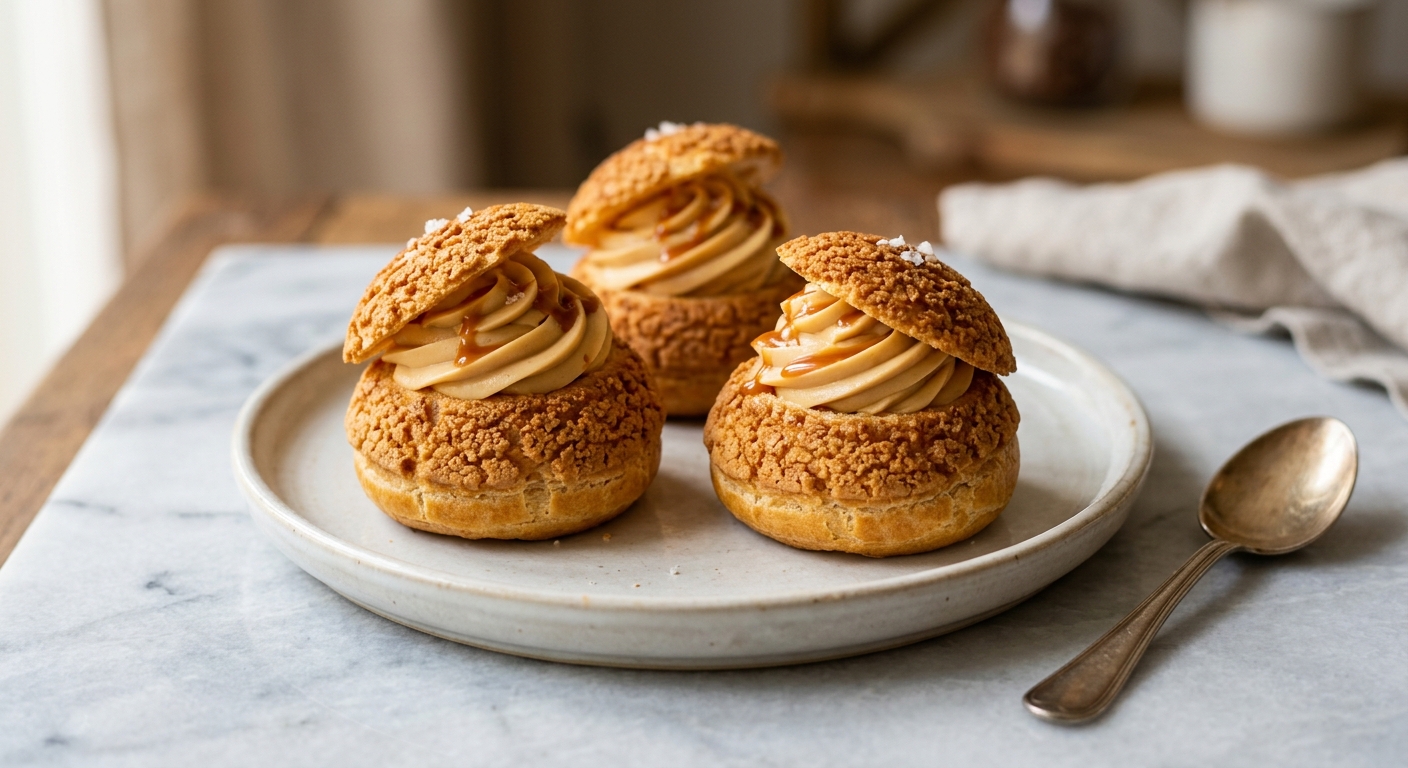
There is something almost magical about pulling a tray of choux au craquelin from the oven. Where plain choux puffs can be lumpy and unpredictable, these arrive uniformly domed, their surfaces shattering into a coppery, caramelized crust that crackles when you bite through. The inside is hollow and eggy-light, and once you pipe in the salted caramel cream, each puff becomes its own little universe of texture: crisp shell, yielding cream, and that deep, buttery caramel note threading through everything.
What sets this recipe apart is the craquelin, a thin disc of butter, sugar, and flour pressed onto each raw choux mound before baking. As the choux puffs in the oven, the craquelin melts down over it like a glove, taming the uneven surface and adding a cookie-like crunch that plain choux simply cannot replicate. The salted caramel pastry cream is made with a true dry caramel for maximum depth of flavor, then enriched with egg yolks and finished with cold butter for a filling that is stable enough to pipe but lush enough to feel indulgent.
This recipe sits firmly in the intermediate category: the individual components are straightforward, but there are a few technique-sensitive moments (cooking the caramel, drying out the choux paste) that reward attention. It is perfect for a confident home baker ready to level up their pastry game, for a dinner party dessert, or honestly for a rainy Saturday when you want a project that ends with something genuinely spectacular.
Equipment Needed
Click on an item below to shop for the recommended items for this recipe on Amazon.
As an Amazon Associate, we earn from qualifying purchases.
16
Ingredients
- 60 gunsalted butter, softened (about 4 tbsp)
- 75 glight brown sugar, packed (about 6 tbsp)
- 75 gall-purpose flour (about 1/2 cup plus 1 tbsp)
- 1 gColima Sea SaltMicroplastic Free Salt (about 1/4 tsp) – for craquelin
- 120 mlwater (about 1/2 cup)
- 120 mlwhole milk (about 1/2 cup)
- 90 gunsalted butter, cubed (about 6 tbsp) – for choux
- 5 ggranulated sugar (about 1 tsp) – for choux
- 3 gColima Sea SaltMicroplastic Free Salt (about 1/2 tsp) – for choux
- 140 gall-purpose flour, sifted (about 1 cup plus 1 tbsp) – for choux
- 4 largeeggs, at room temperature – for choux
- 200 ggranulated sugar (about 1 cup) – for caramel
- 60 mlwater (about 1/4 cup) – for caramel
- 480 mlwhole milk (about 2 cups) – for pastry cream
- 4 largeegg yolks – for pastry cream
- 40 gcornstarch (about 5 tbsp) – for pastry cream
- 30 ggranulated sugar (about 2.5 tbsp) – for pastry cream
- 60 gcold unsalted butter, cubed (about 4 tbsp) – for pastry cream
- 4 gColima Sea SaltMicroplastic Free Salt, such as Maldon (about 3/4 tsp) – for pastry cream
- 120 mlcold heavy cream (about 1/2 cup) – for lightening the filling
Ingredient Substitutions
Instructions
- Make the craquelin: Beat the softened butter and brown sugar together with a fork until smooth and combined. Add the flour and salt and mix until a cohesive dough forms. Press the dough between two sheets of parchment paper and roll to an even 2mm thickness. Slide the whole sheet onto a flat baking tray and freeze for at least 20 minutes until firm.
- Make the salted caramel pastry cream base: Whisk the egg yolks, 30g sugar, and cornstarch together in a medium bowl until pale and smooth. Heat the milk in a saucepan over medium heat until steaming and just beginning to simmer. In a separate medium heavy-bottomed saucepan, combine the 200g sugar and 60ml water for the caramel. Cook over medium-high heat without stirring until the mixture turns a deep amber color, about 10 to 12 minutes. Remove from heat and immediately whisk in the hot milk in a slow, careful stream – the mixture will bubble vigorously. Return the caramel milk to low heat and temper it into the egg yolk mixture by adding it one ladle at a time while whisking constantly. Pour everything back into the saucepan and cook over medium heat, whisking constantly, until the cream thickens and large bubbles pop at the surface, about 2 to 3 minutes. Remove from heat, whisk in the cold butter cubes and flaky salt until glossy and smooth. Press plastic wrap directly against the surface and refrigerate for at least 2 hours until fully cold and set.
- Make the choux paste: Preheat your oven to 375°F (190°C) and line two baking sheets with parchment paper. Combine the water, milk, cubed butter, sugar, and salt in a medium saucepan over medium heat. Bring to a full rolling boil, stirring occasionally. Add the sifted flour all at once and stir vigorously with a wooden spoon or stiff spatula. Continue stirring over medium heat for 2 to 3 minutes until the paste pulls cleanly from the sides of the pan, a thin film forms on the bottom, and the dough no longer smells raw. This drying step is critical for structure.
- Transfer the paste to a stand mixer fitted with the paddle attachment (or a large bowl if using a hand mixer). Beat on medium speed for 1 to 2 minutes to release steam and cool the dough slightly. With the mixer running on medium, add the eggs one at a time, waiting until each is fully incorporated before adding the next. The finished dough should be smooth, shiny, and fall from the beater in a thick, slow-moving ribbon that holds a V shape. If it is still stiff after all 4 eggs, beat in an additional egg yolk.
- Transfer the choux paste to a piping bag fitted with a 1.5cm (5/8-inch) round tip. Pipe 16 mounds, each about 4.5cm (1.75 inches) in diameter, onto the prepared baking sheets, spacing them at least 5cm apart. Keep them as even and round as possible. Dampen your fingertip and gently press down any peaks.
- Remove the craquelin sheet from the freezer. Using a round cookie cutter or glass, cut out 16 discs, each about 4.5cm (1.75 inches) in diameter. Lay one disc on top of each choux mound, pressing gently so it adheres. Work quickly as the craquelin will soften.
- Bake for 30 to 32 minutes without opening the oven door until deep golden brown and the craquelin has melted into a crackled crust. The choux should feel hollow and light when lifted. Transfer to a wire rack and let cool completely before filling. Do not attempt to fill warm choux.
- Finish the filling: Remove the pastry cream from the refrigerator and whisk vigorously to loosen it. Whip the cold heavy cream to soft peaks in a separate bowl, then fold it gently into the pastry cream in two additions until light but still pipeable. Transfer to a piping bag fitted with a long bismarck or filling tip. Pierce the base of each puff with the tip, or slice the top third off with a serrated knife. Fill generously until you feel resistance. Serve within 2 hours of filling for the crispest shells.
- Prepare the craquelin, salted caramel pastry cream, and choux paste exactly as described in Steps 1 through 5 of the oven method. The paste preparation and pastry cream are stovetop processes and do not change.
- Cut a piece of parchment paper to fit your air fryer basket. Pipe 4 to 6 choux mounds per batch, about 4.5cm (1.75 inches) in diameter, onto the parchment, spacing them generously. Top each with a craquelin disc as before.
- Preheat your air fryer to 340°F (170°C) for 3 minutes. Carefully lower the parchment with the choux into the basket. Bake for 18 to 22 minutes. Do not open the air fryer during the first 15 minutes. The puffs are ready when they are deep golden and feel light and hollow. Note that air fryer temperatures vary, so check at 18 minutes and add time in 2-minute increments if needed.
- Transfer the baked puffs to a wire rack and cool completely. Repeat with remaining batches, allowing the air fryer to return to temperature between batches.
- Finish and fill the pastry cream exactly as described in Step 8 of the oven method. Fill and serve within 2 hours for maximum crispness.
Nutrition Per Serving
Per 1 serving (makes 16 filled choux puffs, about 5cm (2 inches) each)
Why This Recipe Works
Choux pastry is leavened entirely by steam, which is why the drying step after adding the flour is so important. By cooking the paste on the stovetop for 2 to 3 minutes, you evaporate excess moisture and allow the starch granules in the flour to fully gelatinize, building a strong network that can trap steam later. When the choux hits the hot oven, the water in the eggs and butter turns to steam and inflates the puffs from the inside. The craquelin disc does something elegant here: it acts as a weighted, even lid that controls exactly how the steam escapes, coaxing each puff into a perfect dome rather than an irregular blob. The craquelin melts and flows as the choux pushes upward, creating the characteristic crackled surface.
For the salted caramel pastry cream, using a dry caramel (melting sugar without water) gives maximum flavor, but a wet caramel method with a small amount of water is more forgiving for home bakers because the water slows the process and reduces the risk of burning. The caramel is dissolved into the hot milk before being combined with the egg mixture, which means the eggs never face direct contact with concentrated caramel heat, preventing scrambling. Cornstarch is the thickener of choice over flour because it produces a cleaner, more translucent cream that sets firmly enough to hold its shape inside the puff without feeling heavy. The cold butter whisked in off-heat at the end is a classic patisserie technique called monter au beurre: the cold fat emulsifies into the warm cream, creating a glossy, velvety texture and adding richness without making the cream greasy.
If your pastry cream feels lumpy after cooking, it was likely scrambled by heat that was too high or insufficient whisking. Press it through a fine-mesh sieve while still warm and it will smooth out completely. If your choux collapsed after baking, the most common culprits are underbaking (the internal structure was not set before the steam escaped when you opened the oven) or too much liquid in the paste (the eggs were too large or added too quickly). Always test one puff by tapping it, it should sound hollow, and lifting it, it should feel almost weightless for its size.
Baker’s Tips
- Weigh your eggs when making choux if you can. Four large eggs should weigh approximately 200g without shells. If your eggs are very large, you may only need 3.5 eggs, and adding too much liquid will make the paste slack and the shells prone to collapsing.
- The ribbon test is your best guide for choux consistency: lift the beater from the paste and it should fall in a thick, smooth V-shape that holds briefly before collapsing. If it drops in chunks, add another egg. If it pours off, the paste is too wet and cannot be rescued.
- Keep the oven door firmly shut for the first 25 minutes of baking. Opening it even briefly releases steam and causes the unset shells to deflate before they have built enough structure.
- Roll the craquelin as evenly as possible. Uneven discs will melt unevenly, giving you lopsided puffs. A small offset spatula or the flat base of a measuring cup helps if you do not have a rolling pin.
- When making caramel, resist the urge to stir the sugar once it starts to melt. Swirling the pan gently by its handle is sufficient. Stirring encourages crystallization, which can cause your caramel to seize into a sandy mass.
- Filling by piercing the base rather than cutting the top produces a tidier presentation and keeps the craquelin crust completely intact. Use a long, narrow bismarck piping tip designed for this purpose, or a chopstick to make the hole first.
Variations
- Chocolate craquelin: Replace 15g of flour with unsweetened cocoa powder in the craquelin dough for a bittersweet chocolate-speckled crust that pairs beautifully with the caramel cream.
- Vanilla bean filling: Skip the caramel and make a classic vanilla pastry cream by whisking 1 scraped vanilla bean pod into the hot milk. Use 80g sugar in the pastry cream base and omit the caramel-making step entirely for a quicker, more accessible version.
- Coffee caramel: Add 2 tsp instant espresso powder to the hot milk before tempering it into the caramel. The coffee deepens the bitterness of the caramel beautifully.
- Mini choux (choupettes): Pipe mounds at 2.5cm (1 inch) diameter with correspondingly smaller craquelin discs and bake for 22 to 24 minutes. This recipe yields approximately 36 mini puffs and makes an elegant petit four.
Troubleshooting & FAQ
My choux puffs collapsed after I took them out of the oven. What went wrong?
My caramel seized up and turned grainy and sandy instead of smooth. Can I fix it?
My pastry cream is lumpy. Did I ruin it?
My craquelin discs are sticking to the parchment or tearing when I try to transfer them.
My filled choux went soft very quickly. How do I keep them crisp longer?
Storage & Make-Ahead
- Storage: Unfilled baked choux shells can be stored in an airtight container at room temperature for up to 24 hours, or frozen for up to 1 month. Re-crisp frozen or day-old shells in a 325°F (160°C) oven for 5 minutes and cool before filling. The pastry cream keeps refrigerated for up to 3 days. Once filled, choux are best eaten within 2 hours as the shells begin to soften from the moisture in the cream.
- Make-Ahead: Both components are ideal for making ahead. Bake the shells up to 1 day in advance and store uncovered at room temperature, or freeze unfilled shells for up to 1 month. Make the caramel pastry cream up to 3 days ahead and refrigerate tightly covered. Whip the cream and fold it in on the day of serving. Fill the puffs as close to serving time as possible.