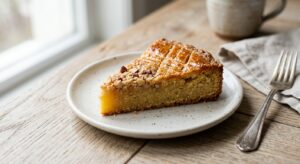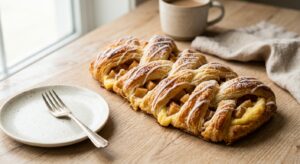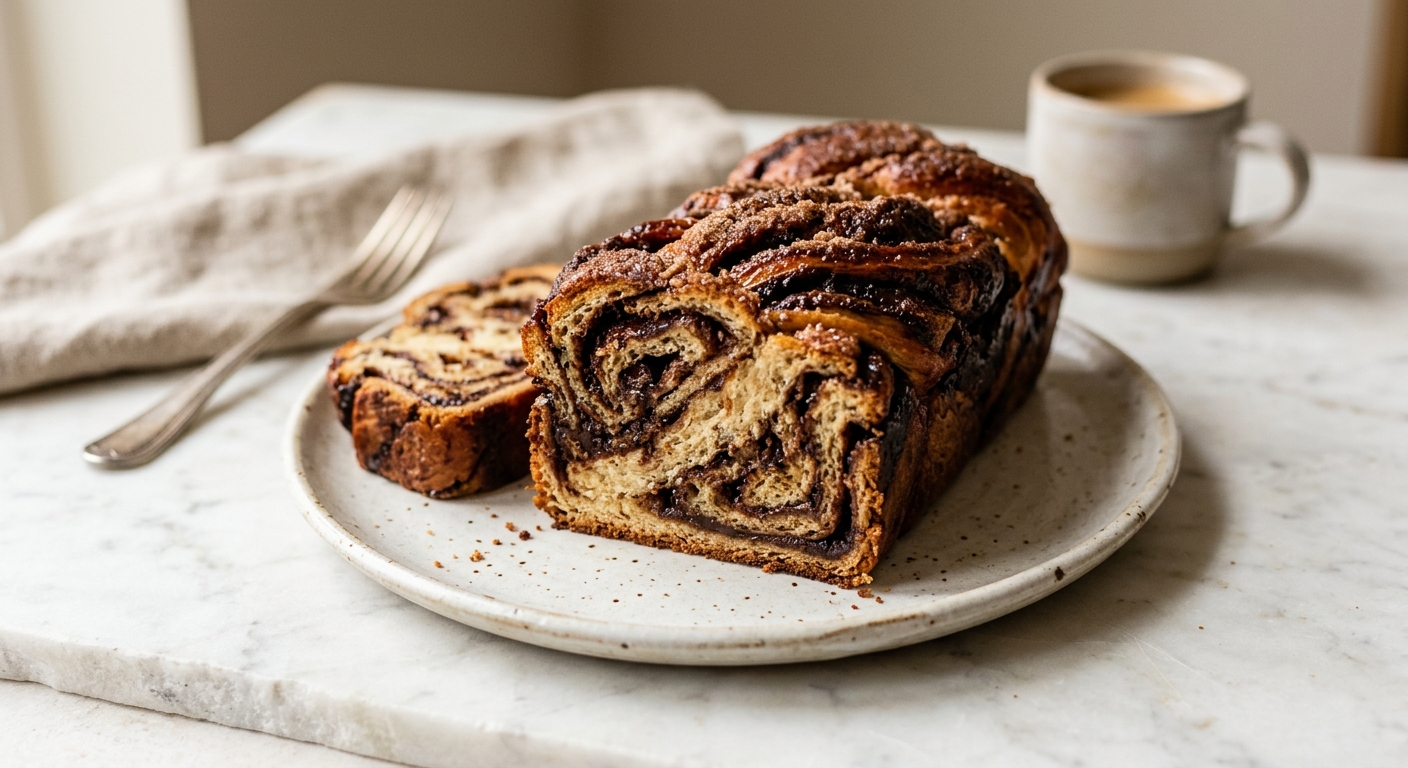
There is a moment, just after you pull a babka from the oven and brush it with warm sugar syrup, when the whole kitchen smells like a Viennese bakery and time slows down just a little. The crust is deep amber and slightly tacky, the swirls of chocolate and cinnamon are just visible through the twisted layers, and if you can resist cutting into it for a full twenty minutes, you will be rewarded with the most magnificent, feathery crumb you have ever pulled apart with your hands. This is that babka. The kind that disappears from the counter before it has a chance to cool.
What sets this version apart is a double-hit of cinnamon: ground cinnamon is worked directly into the enriched dough itself, and then a generous layer of dark chocolate and bloom-spiced cinnamon filling is spread across the rolled sheet before twisting. The filling uses chopped dark chocolate rather than chips or cocoa powder alone, which creates pockets of melted richness rather than a uniform paste. A finishing soak of simple sugar syrup is not optional here. It is the technique that gives babka its signature glossy crust and keeps the loaf moist for days, so please do not skip it.
This recipe sits firmly in the medium difficulty range. The dough requires an overnight cold proof, which actually makes your life easier by spreading the work across two days, and the shaping, while impressive-looking, follows a simple twist technique that even first-time babka bakers can master. This is a perfect weekend bake, a holiday centerpiece, or an extremely good reason to invite people over for brunch.
Equipment Needed
Click on an item below to shop for the recommended items for this recipe on Amazon.
As an Amazon Associate, we earn from qualifying purchases.
12
Ingredients
- Warmth)
- 420 gbread flour (about 3.5 cups, spooned and leveled), plus extra for dusting
- 7 ginstant yeast (about 2.25 tsp, one standard packet)
- 50 ggranulated sugar (about 3.5 tbsp)
- 1.5 tspground cinnamon
- 1 tspColima Sea SaltMicroplastic Free Salt
- 180 mlwhole milk, warmed to 110°F (43°C) (about 3/4 cup)
- 3 largeeggs, at room temperature
- 115 gunsalted butter, softened to room temperature and cut into 1-inch cubes (about 1/2 cup or 1 stick)
- 150 gdark chocolate (60 to 70% cacao), finely chopped (about 1 cup)
- 85 gunsalted butter (about 6 tbsp)
- 60 gpowdered sugar, sifted (about 1/2 cup)
- 2 tbspunsweetened Dutch-process cocoa powder
- 1.5 tspground cinnamon
- 0.25 tspColima Sea SaltMicroplastic Free Salt
- —Pinch of cayenne pepper (optional
- Syrup
- 100 ggranulated sugar (about 1/2 cup)
- 80 mlwater (about 1/3 cup)
Ingredient Substitutions
Instructions
- Make the dough: In the bowl of a stand mixer fitted with the dough hook, combine the bread flour, instant yeast, granulated sugar, cinnamon, and salt. Whisk briefly by hand to combine. Add the warm milk and eggs. Mix on low speed for 2 minutes until a shaggy dough forms, then increase to medium and mix for 5 minutes until the dough is smooth and begins to pull away from the sides of the bowl.
- Add the butter: With the mixer running on medium-low, add the softened butter cubes one or two at a time, waiting until each addition is mostly incorporated before adding the next. This process takes about 8 to 10 minutes. Once all the butter is in, increase speed to medium-high and mix for 4 to 5 more minutes until the dough is very smooth, elastic, and slightly tacky but not sticky. It should pass the windowpane test: stretch a small piece gently and it should become thin and translucent without tearing.
- First proof: Form the dough into a smooth ball, place it in a lightly oiled bowl, and cover tightly with plastic wrap. Refrigerate for at least 10 hours and up to 16 hours. This slow cold fermentation develops flavor and makes the dough much easier to roll.
- Make the chocolate-cinnamon filling: Combine the chopped dark chocolate and butter in a heatproof bowl. Microwave in 30-second bursts, stirring between each, until fully melted and smooth. Stir in the powdered sugar, cocoa powder, cinnamon, salt, and cayenne if using. Let the filling cool to a thick, spreadable consistency (about 20 to 30 minutes at room temperature, or 10 minutes in the refrigerator). It should be the texture of soft peanut butter.
- Shape the babka: Grease a 9×5-inch loaf pan and line it with a strip of parchment paper that overhangs on the two long sides (this creates handles for lifting the loaf out). Remove the cold dough from the refrigerator. On a lightly floured surface, roll it out into a rectangle roughly 14 inches wide by 18 inches long, with the longer edge facing you. Spread the chocolate filling evenly over the entire surface, leaving a 1/2-inch border along the far long edge. Roll the dough tightly toward you into a log, then pinch the seam firmly to seal.
- Twist: Using a sharp knife or bench scraper, cut the log in half lengthwise, exposing the layers. With the cut sides facing up, cross one half over the other to form an X, then continue crossing the two strands over each other (like braiding with two strands) to create a twisted log. Tuck the ends under and carefully transfer the twist into the prepared loaf pan, cut sides still facing up.
- Second proof and bake: Cover the pan loosely with plastic wrap and let it proof at room temperature until the dough has puffed visibly and springs back slowly (but not all the way) when gently pressed, about 1.5 to 2 hours depending on your kitchen temperature. While the dough proofs, preheat your oven to 350°F (175°C). Bake the babka for 38 to 42 minutes, until deeply golden brown. An instant-read thermometer inserted into the center should read 190°F (88°C).
- Make the syrup and finish: While the babka bakes, combine the sugar and water in a small saucepan over medium heat. Stir until the sugar dissolves, then bring to a brief simmer and remove from heat. As soon as the babka comes out of the oven, brush the entire surface generously with warm syrup. Use all of it. Let the babka cool in the pan for at least 20 minutes before lifting it out using the parchment handles. Wait a full additional 20 minutes before slicing.
- Prepare the dough and filling following steps 1 through 4 of the Oven method exactly. The dough, filling, and shaping process are identical.
- Shape and fit: Grease a 7×3-inch loaf pan or 6-inch round cake pan that fits inside your air fryer basket, and line it with parchment. Shape the babka twist as described in steps 5 and 6 of the Oven method, but scale the dough into two smaller portions if needed to fit your pan. Transfer the twist into the prepared pan, cut sides up.
- Second proof: Cover loosely with a sheet of plastic wrap and proof at room temperature for 1.5 to 2 hours, until visibly puffed and slowly spring-back when pressed. Meanwhile, make the sugar syrup as described in the Oven method.
- Preheat your air fryer to 320°F (160°C) for 5 minutes. Loosely tent the top of the pan with a small piece of foil to prevent the surface from browning too quickly in the first half of baking.
- Air fry: Place the pan in the basket and cook for 15 minutes with the foil tent in place. Remove the foil, then continue cooking for 13 to 17 more minutes, until the top is deep golden brown and an instant-read thermometer reads 190°F (88°C). If the top is browning faster than expected, re-tent loosely with foil.
- Brush generously with the warm syrup immediately upon removing from the air fryer. Cool in the pan for 20 minutes before unmolding, then allow an additional 20 minutes before slicing. The crust will be noticeably crispier than the oven version, which many people prefer.
- Prepare the dough and filling following steps 1 through 4 of the Oven method exactly. The dough, filling, and cold proof are identical.
- Shape and prepare the insert: Cut a wide strip of parchment paper and lay it across the inside of your slow cooker insert, pressing it up the sides and leaving several inches of overhang to act as handles. Lightly grease the parchment. Shape the babka twist as described in steps 5 and 6 of the Oven method, then carefully lower it into the lined insert, cut sides up. The twist can be shaped into an oval or slightly curved to fit if needed.
- Second proof: Place the slow cooker lid on top, but prop it open slightly with a folded kitchen towel or wooden chopstick to allow steam to escape. Let the babka proof in the turned-off slow cooker for 1.5 to 2 hours, until visibly puffed.
- Cook: Remove the towel or chopstick, set the lid back on, and cook on High for 2 to 2.5 hours. The babka is done when it has set and an instant-read thermometer inserted into the center reads 190°F (88°C). The bottom and sides will be lightly set; the top will look pale and matte.
- Broil for color (strongly recommended): Preheat your oven broiler to High. Using the parchment handles, lift the babka out of the slow cooker and transfer it to a foil-lined baking sheet. Broil 4 to 5 inches from the element for 2 to 3 minutes, watching constantly, until the top is golden brown and caramelized.
- Finish: Brush immediately and generously with the warm sugar syrup. Let cool for at least 20 minutes before slicing. The crumb will be exceptionally soft and moist using this method.
Nutrition Per Serving
Per 1 serving (makes one 9×5-inch loaf, serving 10 to 12)
Why This Recipe Works
The key to babka’s extraordinary pull-apart texture is an enriched dough built on the principles of brioche. By adding eggs, butter, and milk to a yeast dough, you are replacing some of the water with fat and protein, which shortens the gluten strands and produces a crumb that is tender and feathery rather than chewy and bread-like. The butter is added last, after the gluten network has already formed, because fat coats and inhibits gluten development. If you added it too early, you would interfere with structure before it had a chance to build. The slow, cold overnight proof does double duty: it firms up the butter inside the dough, making it dramatically easier to roll without tearing, and it allows the yeast to work slowly at low temperature, producing a deeper, more complex flavor through gradual fermentation.
The sugar syrup is a non-negotiable finishing step, and here is why it matters scientifically: as the babka bakes, moisture evaporates from the surface, creating a firm and slightly dry crust. The hot syrup brushed on immediately after baking is absorbed into that crust while both are still hot, replacing lost moisture and locking it in as the loaf cools. The dissolved sugar also raises the boiling point of the surface water, which is why syrup-brushed babka stays moist for days rather than hours. If your babka seems dry the next day, you either did not use enough syrup or waited too long after baking to apply it.
If your twist unravels in the oven, the dough was likely under-proofed when baked, causing it to spring aggressively and push the layers apart, or the filling was too warm and slippery when you rolled. Always let the chocolate filling cool to a thick, spreadable consistency before using it, and make sure your dough log is rolled tightly with no air pockets before you cut and twist. If the bottom of your loaf is pale and underdone, your oven runs cool or the pan is too light-colored; try placing the pan on a preheated baking sheet to help transfer heat from below.
Baker’s Tips
- Keep the dough cold throughout shaping. If it becomes soft, sticky, or hard to work with at any point during rolling or twisting, slide it onto a baking sheet and refrigerate for 15 minutes before continuing.
- Use a sharp serrated knife or a very sharp chef’s knife to cut the log lengthwise. A dull blade will drag and compress the layers rather than cutting cleanly.
- Do not skip lining the pan with parchment overhang. Chocolate filling has a way of caramelizing and sticking, and those parchment handles will save the loaf.
- If your kitchen is cooler than 70°F (21°C), the final proof may take up to 2.5 hours. Be patient and look for visual cues: the dough should look puffed and feel airy when gently pressed, not dense and cold.
- The internal temperature test is the most reliable doneness check for enriched doughs. Pull the babka at 190°F (88°C). Below that and the crumb will be gummy; above 200°F (93°C) and it can dry out.
- Use the best quality dark chocolate you can afford for the filling. Since it is the dominant flavor, it matters. A 65% to 70% bar (chopped, not chips) gives the best balance of bitterness and melt.
Variations
- Halva and tahini swirl: Replace the chocolate filling with a mixture of 100g tahini, 80g crumbled halva, 2 tbsp honey, and 1 tsp cinnamon. The nutty, sesame-forward result is extraordinary.
- Raspberry and white chocolate: Swap the dark chocolate filling for 100g melted white chocolate, 3 tbsp raspberry jam, and 1 tsp vanilla. Omit the cocoa powder and cayenne. The pink-swirled loaf is stunning for spring brunch.
- Cardamom and pistachio: Add 1 tsp ground cardamom to the dough in place of cinnamon, and fill with 60g chopped toasted pistachios, 60g melted butter, 50g brown sugar, and 1 tsp cardamom. A Scandinavian-inspired variation with deep, floral warmth.
- Mini babkas: Divide the shaped twist into two equal portions and bake in two 8×4-inch loaf pans. Reduce oven bake time to 28 to 32 minutes. Perfect for gifting.
Troubleshooting & FAQ
My dough is still very sticky after adding all the butter. Is something wrong?
My chocolate filling leaked out during baking and burned on the bottom of the pan. What happened?
The babka looks done on the outside but the inside is gummy or doughy when I slice it.
My babka did not rise much during the final proof. What went wrong?
The swirls in my sliced babka are not very visible. How do I get more dramatic layers?
Storage & Make-Ahead
- Storage: Store the cooled babka tightly wrapped in plastic wrap or in an airtight container at room temperature for up to 3 days. For longer storage, wrap individual slices in plastic wrap and freeze for up to 2 months. Thaw at room temperature or toast lightly from frozen for the best texture.
- Make-Ahead: The enriched dough can be made through the first proof and refrigerated for up to 24 hours before shaping. The chocolate-cinnamon filling can be made up to 3 days ahead and stored in the refrigerator; bring to a spreadable room-temperature consistency before using. The fully baked and cooled loaf also freezes beautifully for up to 2 months.