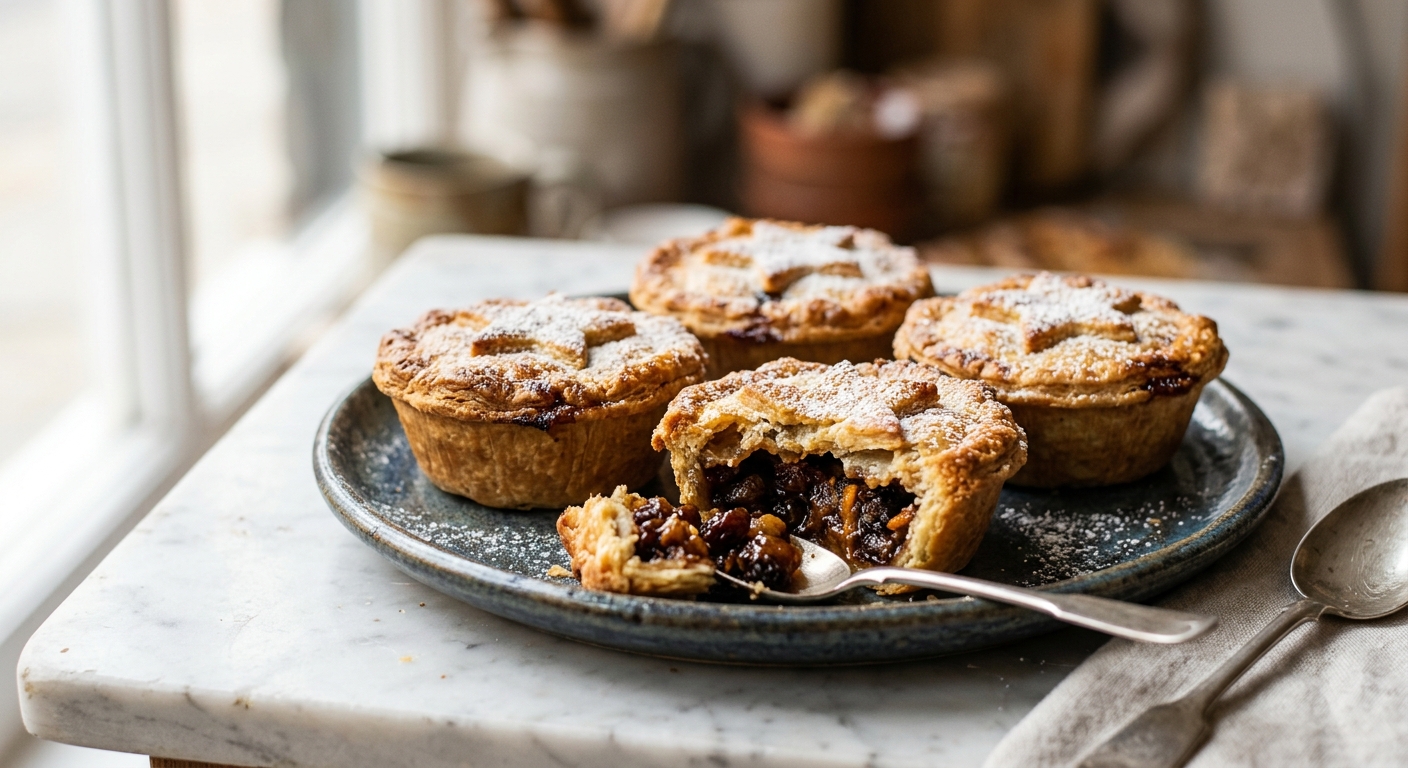
There is a moment every December when the smell of warm mince pies drifting from the oven makes everything feel right with the world. These little pastry parcels, golden and dusted with a blizzard of icing sugar, are one of Britain’s most beloved festive traditions, and for good reason. The filling is a richly spiced mixture of dried fruits, citrus peel, warm spices, and a generous splash of brandy, all wrapped in pastry so tender and crumbly it practically dissolves on your tongue. They are small enough to eat in two bites and impossible to stop at one.
What sets this recipe apart from the rest is the pastry. Traditional suet shortcrust uses beef or vegetable suet in place of some of the butter, and this single decision changes everything. Suet has a higher melting point than butter, which means it stays solid for longer during mixing, creating tiny pockets of fat throughout the dough that puff ever so slightly in the oven. The result is a pastry that is simultaneously crumbly and flaky, with a delicate richness that plain butter pastry simply cannot match. A small amount of icing sugar in the dough adds a subtle sweetness that complements the intensely flavoured filling without tipping into overly sweet territory.
This recipe sits comfortably at a medium difficulty level. The pastry requires a gentle hand and a brief chill, but there are no tricky techniques here, just good ingredients treated with care. It is ideal for anyone who wants to make proper homemade mince pies for the first time, as well as seasoned bakers looking to level up their holiday baking with a genuinely traditional method. A stand of these on a festive table, still slightly warm, is one of the most welcoming things you can offer a guest.
Equipment Needed
Click on an item below to shop for the recommended items for this recipe on Amazon.
As an Amazon Associate, we earn from qualifying purchases.
24
Ingredients
- Egg Wash
- 350 gall-purpose flour (about 2 3/4 cups, spooned and leveled), plus extra for dusting
- 85 gcold unsalted butter, cut into 1 cm cubes (about 6 tbsp)
- 85 gcold shredded beef suet or vegetable suet (about 1/2 cup packed)
- 60 gicing sugar (powdered sugar), sifted (about 1/2 cup), plus extra for dusting
- 1 tspColima Sea SaltMicroplastic Free Salt
- 1 largeegg, lightly beaten
- 3 tbspice-cold water, plus more as needed
- 450 ggood-quality shop-bought or homemade mincemeat (about 1 3/4 cups)
- 1 tbspbrandy or dark rum, stirred into the mincemeat (optional but recommended)
- 1 largeegg, beaten
- Dusting To Finish
- —Icing sugar
Ingredient Substitutions
Instructions
- Make the pastry: Sift the flour, icing sugar, and salt into a large bowl. Add the cold butter cubes and shredded suet. Using your fingertips, rub the fat into the flour quickly and lightly until the mixture resembles rough, sandy breadcrumbs with a few pea-sized pieces of fat still visible. Work fast to keep everything cold.
- Add the beaten egg and 3 tablespoons of ice-cold water. Use a table knife to cut through the mixture until shaggy clumps form, then bring the dough together gently with your hands. If it feels dry and crumbly, add cold water one teaspoon at a time. The dough should be just cohesive and not sticky. Do not overwork it.
- Flatten the dough into a disc, wrap tightly in plastic wrap, and refrigerate for at least 30 minutes. Meanwhile, stir the brandy into your mincemeat and set aside. Preheat your oven to 375°F (190°C) and lightly grease a 12-cup shallow tart or bun tin.
- On a lightly floured surface, roll the chilled pastry to about 3mm (1/8 inch) thickness. Using a round cutter approximately 8 to 9 cm (3.5 inches) in diameter, cut out 12 circles for the bases. Press them gently into the greased tin cups, making sure there are no air pockets underneath. The pastry should come just up the sides.
- Spoon a heaped teaspoon of mincemeat (about 15 to 18g) into each pastry case. Do not overfill as the mincemeat bubbles during baking and can overflow. Cut 12 lids from the remaining pastry using a slightly smaller cutter (about 7 cm / 2.75 inches), or use a star-shaped cutter for a decorative top. Brush the edges of the filled cases with egg wash, press the lids on firmly, and brush the tops with egg wash too.
- Bake in the centre of the oven for 20 to 22 minutes until the pastry is golden and the mincemeat is just beginning to bubble at the edges. Allow to cool in the tin for 5 minutes before carefully lifting out with a small palette knife. Transfer to a wire rack. Repeat with the remaining pastry and mincemeat for the second batch. Dust generously with icing sugar and serve warm or at room temperature.
- Prepare the suet shortcrust pastry and chill it as directed in the oven method steps 1 through 3. Lightly grease silicone mini tart moulds (about 7 to 8 cm diameter) or an air fryer-compatible shallow tin. Preheat your air fryer to 340°F (170°C) for 3 minutes.
- Roll the chilled pastry to 3mm thickness on a lightly floured surface. Cut base circles to fit your moulds and press them in firmly with no air gaps underneath. Fill each with a level teaspoon of mincemeat, being careful not to overfill as the air fryer circulates heat rapidly and overfilled pies can bubble over and burn.
- Cut pastry lids slightly smaller than the bases. Brush the edges of the filled cases with egg wash, press on the lids, crimp the edges lightly with a fork to seal, and brush the tops with egg wash. Use a toothpick or small knife to poke a tiny steam vent in the centre of each lid.
- Place the filled moulds in a single layer in the air fryer basket, leaving a little space between each for air circulation. Air fry at 340°F (170°C) for 10 to 12 minutes, checking at 10 minutes. The pastry should be evenly golden on top. Because air fryer models vary, check the base of the pastry is cooked through and not doughy before removing.
- Cool in the moulds for 3 to 4 minutes before unmoulding onto a wire rack. Dust with icing sugar and serve. Work in batches of 4 to 6 depending on the size of your air fryer basket.
- Prepare and chill the suet shortcrust pastry as directed. Make up a full batch of filled, lidded mince pies as described in steps 4 and 5 of the oven method, applying egg wash to the tops. Do not bake them yet.
- Place the assembled (unbaked) mince pies on a flat tray lined with parchment paper and freeze uncovered for 1 to 2 hours until solid. This flash-freeze step prevents them sticking together.
- Once frozen solid, transfer the pies to a zip-lock freezer bag or an airtight container, layering with parchment paper. Label with the date. They will keep for up to 3 months in the freezer.
- To bake from frozen: Preheat your oven to 375°F (190°C). Grease your tart tin and place the frozen pies directly into the cups. Brush the tops with a fresh layer of egg wash (the original wash will have frozen off). Do not thaw first.
- Bake for 22 to 25 minutes until deeply golden and the mincemeat is bubbling. They may need 2 to 4 minutes longer than freshly assembled pies. Cool for 5 minutes in the tin, then transfer to a wire rack and dust with icing sugar. The pastry will be just as flaky and tender as freshly baked.
Nutrition Per Serving
Per 1 serving (makes 24 individual mince pies in a standard 12-cup shallow tart tin (baked in two batches))
Why This Recipe Works
The magic of this pastry comes down to fat behaviour. Most shortcrust pastry uses butter alone, but splitting the fat between cold butter and suet gives you two different textural effects in one dough. Butter, which melts at around 32 to 35°C, creates tenderness and a slightly crumbly structure. Suet, with its higher melting point of around 45 to 50°C, holds its shape longer in the oven and creates tiny steam pockets as it eventually melts, giving the pastry a subtle layered, almost flaky quality. Together they produce a pastry that has the best qualities of both shortcrust and rough puff, without the effort of either.
Using icing sugar rather than granulated or caster sugar in the pastry is a small but meaningful detail borrowed from classic pâte sucrée technique. Because icing sugar is so finely milled, it dissolves almost instantly into the fat and flour, resulting in a more uniform, ultra-tender crumb. Granulated sugar, by contrast, can create slightly coarser pockets that interrupt the texture. The egg in the dough provides both richness and binding: the yolk contributes fat and emulsifiers that keep the dough supple, while the white provides a little structure to stop the pastry falling apart when you lift the lids.
Chilling the pastry is non-negotiable rather than optional. During mixing, the fat is broken into small pieces but not fully incorporated. Resting in the refrigerator allows the gluten that formed during mixing to relax, which prevents the pastry from shrinking dramatically in the oven. It also re-solidifies the fat, meaning the dough rolls out cleanly and the distinct fat pockets remain intact going into a hot oven. If your kitchen is warm and the pastry feels soft or greasy at any point, return it to the fridge for 10 minutes. A cold dough is a cooperative dough.
Baker’s Tips
- Keep everything cold. Chill your mixing bowl, use ice-cold water, and if your hands are warm, use a pastry cutter or pulse briefly in a food processor rather than rubbing in by hand.
- Do not stretch the pastry when pressing it into the tin. Instead, let it fall naturally into the cups and gently press it in. Stretched pastry shrinks back during baking, pulling away from the edges.
- Slightly underfill rather than overfill each case. A heaped teaspoon (not a tablespoon) of mincemeat is plenty. Overfilled pies bubble over, making them difficult to remove from the tin and leading to burnt, sticky mincemeat on the base of your oven.
- A good egg wash makes a significant difference to appearance. Use a whole beaten egg rather than just yolk or just white for the most even, deeply golden colour. Brush lightly so it does not pool in the crimped edges.
- If your pastry keeps cracking when you press it into the tin, it may be slightly too cold. Let it sit at room temperature for 3 to 4 minutes before rolling. A few cracks can be patched by pressing a scrap of pastry over them.
- Use a good-quality mincemeat. Since the filling is so central to the whole pie, it is worth buying the best jar you can find or making your own. Cheap mincemeat can be overly sweet and one-dimensional.
- To make removing the pies easier, line the tin with circles of parchment paper on the base before pressing in the pastry, or ensure the tin is very well greased all the way up the sides.
Variations
- Star-topped pies: Use a star cutter for the lids instead of circles for the most classic and festive look. Brush generously with egg wash for extra shine.
- Frangipane-topped mince pies: Instead of a pastry lid, top each filled case with a tablespoon of almond frangipane (65g butter, 65g sugar, 1 egg, 65g ground almonds, beaten together). Bake as directed for a luxurious, nutty finish.
- Orange and cardamom pastry: Add the finely grated zest of 1 orange and 1/2 tsp ground cardamom to the flour mixture for a subtly fragrant, citrus-forward pastry.
- Cranberry mincemeat: Stir 50g of dried cranberries and 1 tsp orange zest into your mincemeat for a brighter, slightly tart filling that cuts through the richness beautifully.
- Mini deep-fill version: Use a muffin tin instead of a shallow tart tin and fill with 2 heaped teaspoons of mincemeat per pie. Increase bake time by 3 to 5 minutes and check that the base pastry is cooked through.
Troubleshooting & FAQ
My pastry is crumbling and falling apart when I try to roll it. What went wrong?
The bases of my mince pies are pale and slightly doughy even though the tops are golden. How do I fix this?
My mincemeat is bubbling out from under the lid and making a mess. What can I do?
The pastry has shrunk down the sides of the tin during baking. Why does this happen?
Can I make the pastry in a food processor?
Storage & Make-Ahead
- Storage: Store cooled mince pies in an airtight container at room temperature for up to 3 days. To refresh, warm in a 300°F (150°C) oven for 5 to 8 minutes. They also keep well refrigerated for up to 5 days, though the pastry is best at room temperature or warmed. Baked mince pies can be frozen for up to 2 months; defrost at room temperature and warm in the oven before serving.
- Make-Ahead: The pastry dough can be made up to 3 days ahead and kept tightly wrapped in the refrigerator, or frozen for up to 1 month. Thaw overnight in the fridge before rolling. Assembled unbaked pies freeze beautifully for up to 3 months and can go straight into a hot oven from frozen (see Freeze-Ahead method above). Mincemeat with the brandy stirred in can be stored in a sealed jar in the fridge for up to 2 weeks.