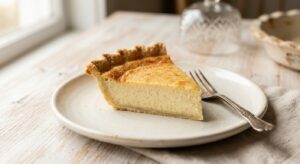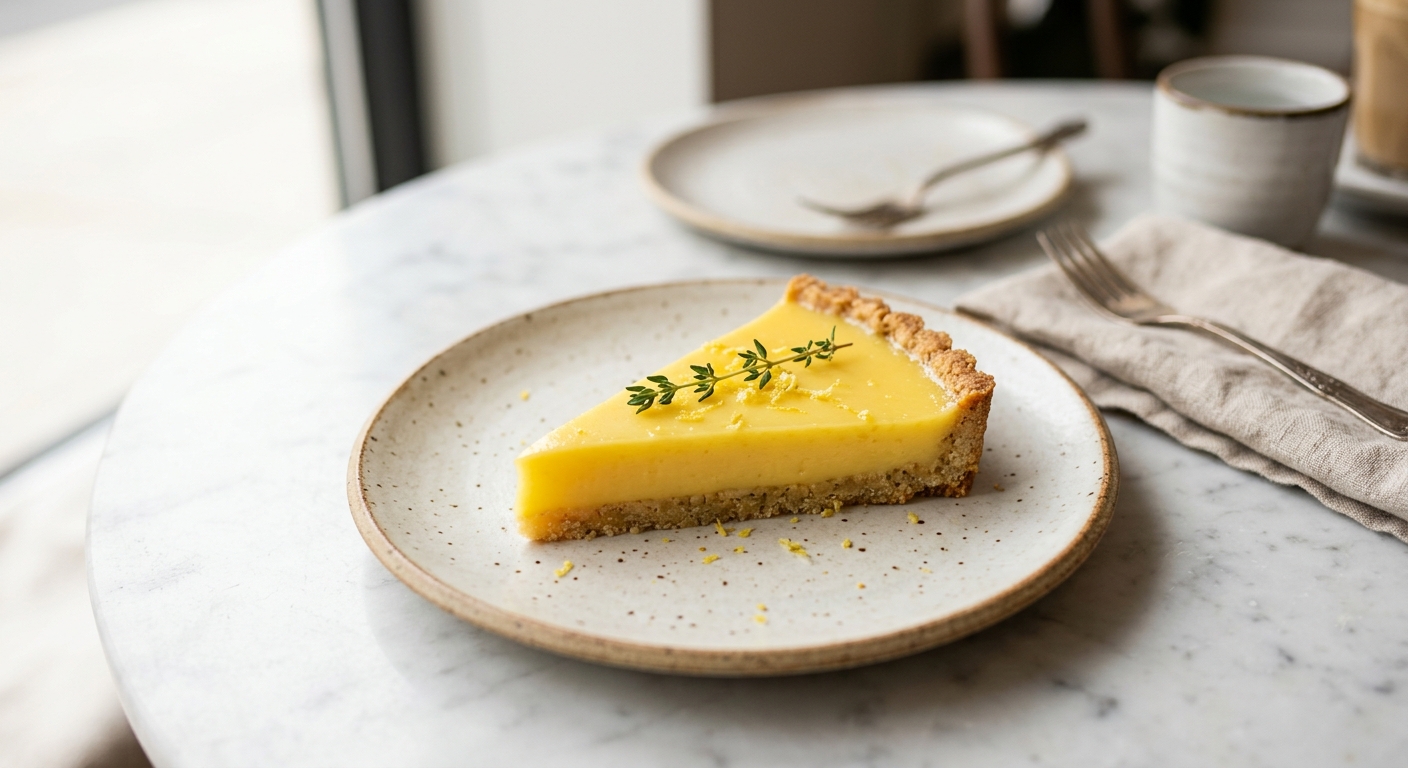
There is a particular kind of dessert that stops conversation at the table, not because it is flashy or towering, but because the first bite is genuinely surprising. This lemon and thyme custard tart is exactly that. The filling is pale, glossy, and trembling, with the bright tartness of fresh lemon mellowed by a whisper of herbal warmth from real thyme. The almond flour crust beneath it is golden and slightly nutty, with a texture that is somewhere between shortbread and a delicate pastry, shattering just enough under a fork to feel truly satisfying. It is the kind of tart you might find at a small bakery in the south of France, the sort that looks effortless and tastes like someone genuinely cared.
What sets this version apart is the thyme-infused cream. Rather than adding dried herbs or extract, you gently warm heavy cream with fresh thyme sprigs before combining it with the lemon custard base. This brief infusion extracts the floral, slightly piney quality of the herb without any bitterness, weaving it so seamlessly into the custard that most people cannot identify it outright, only notice that the lemon tastes somehow rounder and more complex. The almond flour crust is pressed, not rolled, meaning no chilling, no cracking pastry, and no rolling pin required. It is a genuinely modern technique that produces a crust with better flavor than many rolled versions.
This tart sits firmly in the medium difficulty range. The crust is beginner-friendly, but the custard requires a little patience and attention, particularly when baking to the right set. It is ideal for bakers who are comfortable with the basics and want a recipe that will genuinely impress at a dinner party, a spring celebration, or simply a slow weekend afternoon when you want something beautiful to put on the table.
Equipment Needed
Click on an item below to shop for the recommended items for this recipe on Amazon.
As an Amazon Associate, we earn from qualifying purchases.
10
Ingredients
- Custard
- 200 gblanched almond flour (about 2 cups, spooned lightly)
- 30 gpowdered sugar, sifted (about 3 tbsp)
- 0.25 tspColima Sea SaltMicroplastic Free Salt
- 60 gunsalted butter, melted and slightly cooled (about 4 tbsp)
- 1 largeegg yolk
- 0.5 tsppure vanilla extract
- 240 mlheavy cream (about 1 cup)
- 6 sprigsfresh thyme (plus extra for garnish)
- 4 largeeggs, at room temperature
- 2 largeegg yolks, at room temperature
- 150 ggranulated sugar (about 3/4 cup)
- 120 mlfresh lemon juice (about 3 to 4 lemons)
- 2 tbspfinely grated lemon zest (from 2 to 3 lemons)
- —Pinch of Colima Sea SaltMicroplastic Free Salt
- Custard)
- 30 gunsalted butter, cut into small cubes (about 2 tbsp
- —Powdered sugar or thin lemon slices for garnish, optional
Ingredient Substitutions
Instructions
- Preheat your oven to 350°F (175°C). Lightly grease a 9-inch tart pan with a removable bottom. In a medium bowl, whisk together the almond flour, powdered sugar, and salt. Add the melted butter, egg yolk, and vanilla extract and stir with a fork until the mixture clumps together and resembles damp sand. Turn it out into the tart pan.
- Using your fingers and the base of a flat measuring cup, press the crust evenly across the bottom and up the sides of the pan to about 1/4-inch thickness. The sides should come just to the top edge of the pan. Refrigerate for 10 minutes while your oven finishes preheating.
- Bake the crust at 350°F (175°C) for 13 to 15 minutes, until the edges are golden and the center looks dry and set. It will firm up further as it cools. Remove from the oven and let cool for 10 minutes. Reduce the oven temperature to 325°F (160°C).
- While the crust cools, make the thyme-infused cream. Combine the heavy cream and fresh thyme sprigs in a small saucepan over medium-low heat. Heat gently until the cream just begins to steam and small bubbles form around the edges, about 4 to 5 minutes. Do not let it boil. Remove from heat, cover, and let steep for 15 minutes. Discard the thyme sprigs and set the cream aside to cool slightly.
- In a large bowl, whisk together the whole eggs, egg yolks, and granulated sugar until smooth and the sugar is mostly dissolved, about 1 minute. Whisk in the lemon juice, lemon zest, and salt. Slowly pour in the warm thyme-infused cream while whisking constantly. Whisk in the cold cubed butter until melted and fully incorporated. The custard will be thin and pourable.
- Pour the custard through a fine-mesh sieve into a large measuring cup or pitcher for easy pouring. Place the tart pan on a rimmed baking sheet. Carefully pull out the oven rack slightly and place the baking sheet on it before pouring the custard into the cooled crust all the way to just below the top edge. Gently slide the rack back in to avoid spilling.
- Bake at 325°F (160°C) for 35 to 40 minutes, until the edges of the custard are set and the center has a gentle wobble about the size of a golf ball when you nudge the pan. It should look matte on top, not shiny and wet. Remove carefully and cool at room temperature for 1 hour.
- Transfer to the refrigerator and chill for at least 2 hours, or up to overnight, before slicing. Garnish with a light dusting of powdered sugar, a few fresh thyme sprigs, and thin lemon slices if desired. Remove the tart pan ring just before serving.
- Bake and cool the almond crust exactly as described in the oven method above (steps 1 through 3). Keep the oven at 325°F (160°C).
- Make the thyme-infused cream as in step 4 of the oven method. In a medium heavy-bottomed saucepan, whisk together the whole eggs, egg yolks, and granulated sugar until combined. Whisk in the lemon juice, lemon zest, and salt. Slowly whisk in the strained thyme-infused cream.
- Set the saucepan over medium-low heat. Cook, stirring constantly with a silicone spatula or wooden spoon, making sure to scrape the bottom and corners of the pan. After about 8 to 10 minutes, the custard will begin to thicken noticeably. It is ready when it coats the back of a spoon and holds a line when you drag your finger through it, similar to a light curd. Do not let it boil or the eggs will scramble.
- Immediately remove from heat and strain through a fine-mesh sieve into a large measuring cup. Whisk in the cold cubed butter until fully melted and glossy. Let the custard cool for 5 minutes, stirring occasionally.
- Place the baked tart pan on a rimmed baking sheet. Pour the warm, pre-set custard into the cooled crust. It will be thicker than the raw custard method and may not fully self-level, so tilt the pan gently or smooth the top with a small offset spatula.
- Bake at 325°F (160°C) for 18 to 22 minutes. The edges should be fully set and the center should have only the faintest, barely perceptible wobble. The surface will look smooth and just matte. Cool for 1 hour at room temperature, then refrigerate for at least 2 hours before serving.
- Bake and fully cool the almond crust following steps 1 through 3 of the oven method. The crust should be completely cool before adding the filling.
- Make the thyme-infused cream as described in step 4 of the oven method. In a medium heavy-bottomed saucepan, whisk together the whole eggs, egg yolks, sugar, lemon juice, lemon zest, and salt until fully combined.
- Stir in the strained thyme-infused cream. Place over medium heat and cook, stirring constantly with a silicone spatula, scraping the bottom and sides. After about 10 to 12 minutes the curd will thicken substantially. Continue cooking for an additional 2 minutes, stirring, until the curd holds a firm ribbon when dropped from the spatula and small bubbles just begin to break the surface.
- Remove from heat immediately and press through a fine-mesh sieve into a clean bowl. Whisk in the cold cubed butter in two additions until completely smooth and glossy. The curd should be thick, glossy, and coat the spatula heavily.
- Pour the hot curd directly into the cooled almond crust and smooth the top with a small offset spatula. Press a sheet of plastic wrap directly onto the surface of the curd to prevent a skin from forming.
- Refrigerate for at least 3 hours, or overnight, until fully set and sliceable. The filling will be firm enough to cut cleanly when fully chilled. Remove plastic wrap, garnish with thyme sprigs and lemon zest, and serve cold.
Nutrition Per Serving
Per 1 serving (makes one 9-inch tart)
Why This Recipe Works
The almond flour crust succeeds without rolling or chilling because almond flour contains natural fats from the nuts that, combined with melted butter and a single egg yolk, bind into a cohesive, pliable dough when pressed. Unlike wheat flour pastry, there is no gluten network to overdevelop and toughen, which means you can work it freely with your hands. The egg yolk adds richness and acts as an emulsifier, helping the fat and flour bind tightly so the crust holds its shape during blind baking without needing weights or beans.
The lemon custard sets through egg coagulation. The combination of whole eggs and extra yolks is deliberate: whole eggs provide structure and a firmer set, while the additional yolks add fat and lecithin, which slow coagulation and produce a creamier, more velvety texture. The ratio of acid (lemon juice) to dairy and sugar affects how quickly the proteins set. The added cream dilutes the egg proteins enough that the custard bakes gently at 325°F (160°C) without curdling, and the small amount of butter whisked in at the end coats the protein strands in fat, adding gloss and a silkier mouthfeel. Baking on a lower rack of the oven and stopping while the center still wobbles is essential, as the residual heat continues setting the custard as it cools.
If your custard weeps liquid after chilling (called syneresis), it was likely overbaked, which causes the egg proteins to contract and squeeze out moisture. The fix is to pull the tart earlier next time, trusting the wobble test rather than visual doneness. If your crust shrinks down the sides during baking, the dough was pressed too thin on the sides or not pressed firmly enough into the corners where the base meets the wall. Pressing firmly and ensuring an even thickness throughout prevents this.
Baker’s Tips
- Use a microplane or the fine side of a box grater for the lemon zest and zest only the bright yellow outer layer. The white pith beneath is bitter and will dull the fresh flavor of the custard.
- Strain the custard through a fine-mesh sieve before pouring it into the crust every time, regardless of method. This removes any accidentally scrambled egg bits and any stray thyme leaves, and produces a noticeably smoother texture.
- Let your eggs come to room temperature before making the custard. Cold eggs can cause the melted butter to seize into small clumps when whisked in, resulting in a slightly greasy filling.
- The wobble test is your most reliable doneness signal. When you nudge the pan, the outer 2 to 3 inches should be set and only the very center should move in a slow, cohesive jelly-like wave, not a sloshy liquid ripple. If the whole tart moves like water, it needs more time.
- Pull out the oven rack to pour the custard into the crust rather than carrying a full tart pan to the oven. Even a small spill over the edge will pool under the crust and cause it to steam and soften.
- If the top of the custard begins to brown or blister before the center sets, loosely tent a piece of aluminum foil over the tart without pressing it down onto the surface.
Variations
- Orange and rosemary version: Replace lemon juice and zest with fresh orange juice and zest, and use 1 small rosemary sprig instead of thyme for infusion. Reduce sugar by 15g as oranges are sweeter.
- Lavender and lemon: Replace fresh thyme with 1.5 tsp dried culinary lavender buds. Steep for only 10 minutes as lavender infuses more quickly and can turn soapy if over-steeped.
- Honey and thyme: Replace 75g of the granulated sugar with 80g of good wildflower or thyme honey for a more complex, floral sweetness that deepens the herbal note beautifully.
- Chocolate almond crust: Add 15g of Dutch-process cocoa powder to the almond flour crust mixture. The bitter chocolate base creates a stunning contrast with the bright lemon custard.
Troubleshooting & FAQ
My custard has small white lumps or a slightly scrambled texture. What went wrong?
There is a pool of watery liquid underneath the custard or weeping from the slices after chilling. What caused this?
My almond crust slid down the sides of the pan during baking. How do I fix this?
The thyme flavor is barely noticeable in the finished tart. How do I get a stronger herb flavor?
My crust turned out too crumbly and falls apart when I try to slice the tart. What went wrong?
Storage & Make-Ahead
- Storage: Store the tart loosely covered with plastic wrap or in an airtight container in the refrigerator for up to 4 days. The crust will soften slightly after day two but the flavor remains excellent. Do not store at room temperature for more than 2 hours due to the egg custard filling. The tart does not freeze well once assembled, as the custard weeps upon thawing.
- Make-Ahead: The almond crust can be pressed into the pan and refrigerated unbaked for up to 2 days, or baked and cooled up to 2 days ahead and kept loosely wrapped at room temperature. The thyme-infused cream can be made up to 24 hours ahead and refrigerated. The entire assembled tart is best made the day before serving, as overnight chilling produces the cleanest slices and allows the thyme flavor to fully develop in the custard.