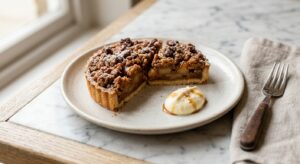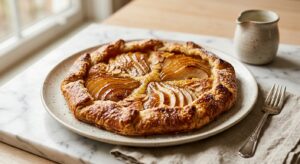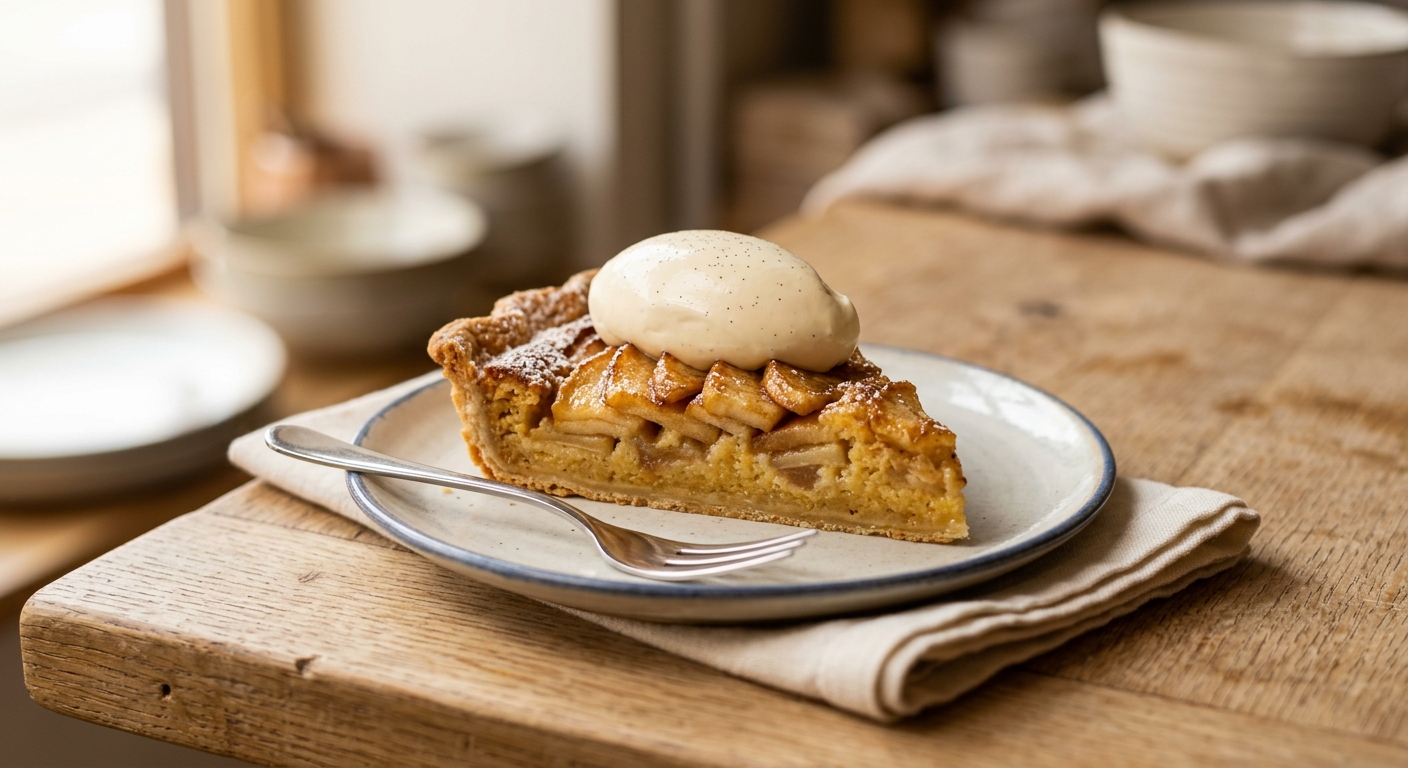
There is a particular kind of tart that exists in Norman farmhouses and boulangerie windows across Normandy, France, and once you have tasted it, no other apple dessert quite measures up. The Tarte Normande is not an apple pie in any conventional sense. It is something far more refined: thin, petal-like fans of apple nestled into a crisp, golden pastry shell and then blanketed in a rich, egg-and-cream custard that perfumes the kitchen with warm vanilla and the unmistakable floral warmth of Calvados apple brandy. It emerges from the oven slightly puffed, deeply golden, and impossibly fragrant.
What sets this version apart is the attention to two details that are often skipped in adapted recipes. First, the pastry is made with a high proportion of butter and a touch of almond flour, which gives it an almost shortbread-like crumb that holds up to the custard without going soggy. Second, the Calvados is not stirred into the custard and forgotten – it is also used to briefly macerate the apple slices, which draws out their juices and concentrates their flavor before they ever see the oven. The result is an apple filling that tastes deeply of apple, not just sweetness, and a custard that is creamy and set but never rubbery.
This tart sits comfortably in the medium difficulty range. You will need to make a pastry case from scratch and blind bake it, but neither step is complicated, and the whole process is wonderfully relaxed. It is ideal for a weekend bake when you have an unhurried afternoon, and it is absolutely the dessert to bring to a dinner party where you want to quietly impress everyone without appearing to have tried too hard.
Equipment Needed
Click on an item below to shop for the recommended items for this recipe on Amazon.
As an Amazon Associate, we earn from qualifying purchases.
8
Ingredients
- A More Tender Crumb
- 180 gall-purpose flour (about 1.5 cups, spooned and leveled)
- 30 galmond flour (about 3 tbsp)
- 25 gpowdered (icing) sugar (about 3 tbsp)
- 0.25 tspColima Sea SaltMicroplastic Free Salt
- 115 gunsalted butter, cold and cut into 1 cm cubes (about 8 tbsp or 1 stick)
- 1 largeegg yolk
- 30 mlice-cold water (about 2 tbsp), plus more if needed
- 750 gfirm, tart apples such as Granny Smith or Braeburn (about 3 large apples), peeled, cored, and thinly sliced to about 3 mm
- Macerating The Apples
- 30 mlCalvados apple brandy (about 2 tbsp)
- 20 ggranulated sugar (about 1.5 tbsp)
- 3 largeeggs, at room temperature
- Custard
- 80 ggranulated sugar (about 6 tbsp)
- 200 mlheavy cream (about 3/4 cup plus 1 tbsp)
- 80 mlwhole milk (about 1/3 cup)
- 45 mlCalvados apple brandy (about 3 tbsp)
- 1 tsppure vanilla extract
- 0.25 tspground cinnamon
- Dusting Before Serving
- —1 tbsp powdered sugar
Ingredient Substitutions
Instructions
- Make the pastry: In a large bowl, whisk together the all-purpose flour, almond flour, powdered sugar, and salt. Add the cold butter cubes and use your fingertips to quickly rub the butter into the flour until the mixture resembles coarse, sandy breadcrumbs with some pea-sized pieces remaining. This should take no more than 2 to 3 minutes. Speed matters here – you want the butter to stay cold.
- Add the egg yolk and drizzle in the cold water, one tablespoon at a time. Use a fork to bring the dough together, then switch to your hands and press it into a rough disc. It should just hold together without being sticky. If it crumbles, add cold water half a teaspoon at a time. Flatten into a disc, wrap in plastic, and refrigerate for at least 45 minutes or up to 24 hours.
- While the dough chills, macerate the apples: Toss the sliced apples with the 2 tbsp of Calvados and 1.5 tbsp granulated sugar in a bowl. Set aside for 20 to 30 minutes, tossing once halfway through. The apples will release juice and soften slightly. Drain them in a colander, pressing gently, and pat dry with paper towels. This step is important – excess moisture will make the custard watery.
- Preheat your oven to 375°F (190°C). On a lightly floured surface, roll the chilled dough out to a circle about 12 inches (30 cm) in diameter and 3 to 4 mm thick. Carefully drape it into a 9-inch (23 cm) fluted tart pan with a removable base, pressing it gently into the sides and corners. Trim the excess flush with the top of the pan. Prick the base all over with a fork (about 15 pricks). Chill the lined pan in the freezer for 15 minutes – this prevents shrinkage.
- Line the chilled pastry case with parchment paper and fill with baking weights or dried beans. Blind bake for 15 minutes, then remove the weights and parchment and bake for a further 5 minutes until the base is just dry and very pale golden. Remove from the oven and reduce the temperature to 325°F (165°C). Allow the pastry case to cool for 10 minutes before filling.
- Make the Calvados custard: In a medium bowl, whisk the 3 eggs and 80g granulated sugar together until combined and slightly pale. Add the heavy cream, whole milk, 3 tbsp Calvados, vanilla extract, and cinnamon. Whisk until smooth. Avoid whisking too vigorously – you do not want foam on the custard.
- Arrange the drained apple slices in the tart case in overlapping concentric circles or a fan pattern, starting from the outside edge and working inward. Pack them in fairly snugly, as they will shrink slightly during baking. Slowly and carefully pour the Calvados custard over the apples, filling the tart to just below the rim of the pastry. Some apple tips will poke above the custard – this is correct and creates the classic look.
- Bake at 325°F (165°C) for 30 to 35 minutes, until the custard is set around the edges but has a slight, gentle wobble in the very center when you nudge the pan – like a just-set creme brulee. It will continue to firm as it cools. Do not overbake or the custard will curdle and weep. Allow to cool completely in the pan on a wire rack, at least 1 hour, before removing the tart ring and dusting generously with powdered sugar to serve.
- Make and chill the pastry following steps 1 and 2 of the oven method. Blind bake the empty tart shell fully: line with parchment and baking weights at 375°F (190°C) for 15 minutes, remove weights, then bake a further 8 to 10 minutes until the base is golden and completely dry. Cool completely before filling.
- Cook the apple filling: Melt 1 tbsp unsalted butter in a large skillet over medium heat. Add the drained macerated apple slices (prepared as in step 3 of the oven method) and cook, turning gently with a spatula, for 5 to 7 minutes until just tender and lightly golden at the edges. Do not cook to mush – the slices should hold their shape. Remove from heat and allow to cool completely.
- Make the Calvados pastry cream: In a medium saucepan, heat the heavy cream and whole milk over medium heat until steaming and small bubbles form at the edges (do not boil). Meanwhile, in a bowl whisk together the 3 egg yolks (not whole eggs), 80g sugar, and 25g cornstarch (about 2 tbsp) until pale and thick. Slowly pour the hot cream mixture into the egg mixture in a thin stream, whisking constantly to temper it. Pour everything back into the saucepan.
- Cook the pastry cream over medium heat, stirring constantly with a wooden spoon or heatproof spatula, until it thickens considerably and large bubbles begin to plop through the surface, about 4 to 6 minutes. Remove from heat and stir in 2 tbsp Calvados, the vanilla extract, and cinnamon. Pour into a clean bowl, press plastic wrap directly onto the surface to prevent a skin, and refrigerate until cold and fully set, at least 1.5 hours.
- Assemble the tart: Whisk the chilled pastry cream briefly to loosen it, then spread it evenly into the cooled tart shell using an offset spatula. Arrange the cooled cooked apple slices decoratively on top, overlapping in concentric circles. Dust with powdered sugar just before serving, or brush the apples lightly with 2 tbsp warm apricot jam thinned with 1 tsp water for a shiny, patisserie-style glaze. Refrigerate for 30 minutes before slicing for the cleanest cuts.
Nutrition Per Serving
Per 1 serving (makes one 9-inch (23 cm) tart, serving 8)
Why This Recipe Works
The two-stage apple preparation, macerating and then thoroughly draining, is the most important technique in this recipe and it is easy to understand why it matters. Raw apple slices contain a high proportion of water. When heat is applied, that water is released into the tart filling. If the apples go into the custard unwilted and undrained, the result is a watery, split custard that pools at the bottom of the tart and a soggy pastry base. By macerating the apples in Calvados and sugar first, we draw out a significant amount of that liquid before baking, and by patting them dry, we remove even more. The apples that go into the tart are pre-softened and their free moisture has been dramatically reduced, meaning the custard can set cleanly around them.
The low baking temperature of 325°F (165°C) for the filled tart is deliberate and scientifically grounded. The custard filling is an egg-and-cream emulsion that sets through protein coagulation. Egg proteins begin to set at around 160 to 165°F (71 to 74°C), but if the temperature climbs above roughly 185°F (85°C), the proteins tighten too much and squeeze out water, causing the custard to curdle, weep, and develop an unpleasant, grainy texture. Baking low and slow means the oven heat reaches the custard gradually, allowing the proteins to set gently to a smooth, creamy consistency rather than overcooking. The slight wobble in the center when you remove the tart is not underbaking. It is the correct cue: the residual heat in the pan and filling will carry over and finish the set as it cools.
The almond flour in the pastry performs two roles. First, it interrupts the gluten network that forms when all-purpose flour is hydrated and worked. Gluten is what gives bread its chew, but in a tart shell, too much gluten development creates a tough, shrunken crust. Almond flour contains no gluten-forming proteins, so it physically separates gluten strands and keeps the crust tender and crumbly. Second, the fat in almond flour contributes to a richer, more flavorful pastry. Combined with the technique of keeping the butter cold and working quickly, this produces a shell that is crisp, short, and deeply buttery without being either hard or greasy.
Baker’s Tips
- Slice your apples to a consistent 3 mm thickness. A mandoline is the fastest and most reliable tool for this. Uneven slices mean some will be mushy while others are undercooked, and the overlapping fan pattern will be messy.
- Do not skip patting the macerated apples dry. Even after draining, the surface moisture on the slices is enough to affect the custard. A few gentle presses with paper towels makes a real difference.
- Tap the filled tart pan gently on the counter two or three times before placing it in the oven to pop any air bubbles in the custard and help it settle evenly around the apples.
- If the pastry edges are browning too quickly during the filled bake, loosely tent the tart with foil for the last 10 minutes, leaving the center open so the custard can continue to set and color.
- For the cleanest slices, allow the baked tart to cool completely (at room temperature for at least 1 hour) before cutting. A tart sliced too warm will allow the custard to run. A sharp, thin-bladed knife wiped clean between cuts will give you beautiful, patisserie-worthy slices.
- Serve the tart at room temperature or very slightly warm, never cold from the refrigerator. Cold dulls both the vanilla and the Calvados aromas, and the custard texture is less pleasant when chilled.
Variations
- Pear and Armagnac Tarte Normande: Replace the apples with firm Bosc pears and swap Calvados for Armagnac or Cognac. Follow the same method exactly. The result is floral, elegant, and deeply autumnal.
- Salted Caramel Apple Tarte: Before arranging the apple slices, spread 3 tbsp of thick salted caramel sauce across the base of the blind-baked shell. Proceed as normal. The caramel layer adds a butterscotch richness that is hard to resist.
- Almond Frangipane Base: For a more substantial tart, spread a thin layer of frangipane (60g soft butter, 60g almond flour, 60g sugar, 1 egg, beaten together) into the blind-baked shell before adding the apples. Reduce the custard by one-third to avoid overflow. Bake as directed, adding 5 minutes to the bake time.
- Spiced Winter Version: Add 0.25 tsp each of ground cardamom and ground nutmeg to the custard alongside the cinnamon. A small piece of star anise placed in the cream as it warms (and removed before mixing into eggs) adds a subtle anise note that feels festive and warming.
Troubleshooting & FAQ
My custard is watery and has not set properly. What went wrong?
My custard looks curdled and grainy with liquid pooling around the edges. What happened?
My pastry shrank dramatically in the pan during blind baking. How do I prevent this?
The bottom of my pastry case is soggy even after blind baking.
My apple slices are sinking to the bottom rather than sitting in the custard.
Storage & Make-Ahead
- Storage: Store the tart loosely covered in the refrigerator for up to 3 days. The pastry will soften slightly after the first day, which is natural. Bring to room temperature for 20 to 30 minutes before serving for the best flavor and texture. This tart does not freeze well once assembled, as the custard will weep on thawing.
- Make-Ahead: The pastry dough can be made up to 2 days ahead and refrigerated, or frozen for up to 1 month (thaw overnight in the refrigerator). The blind-baked tart shell can be made 1 day ahead and stored at room temperature, loosely covered. The fully assembled and baked tart can be made the day before serving and refrigerated overnight, making it an ideal dinner party dessert.