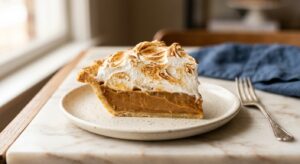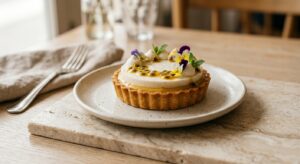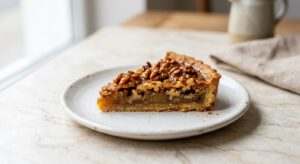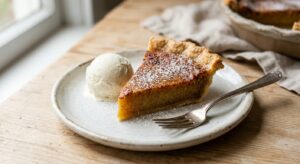
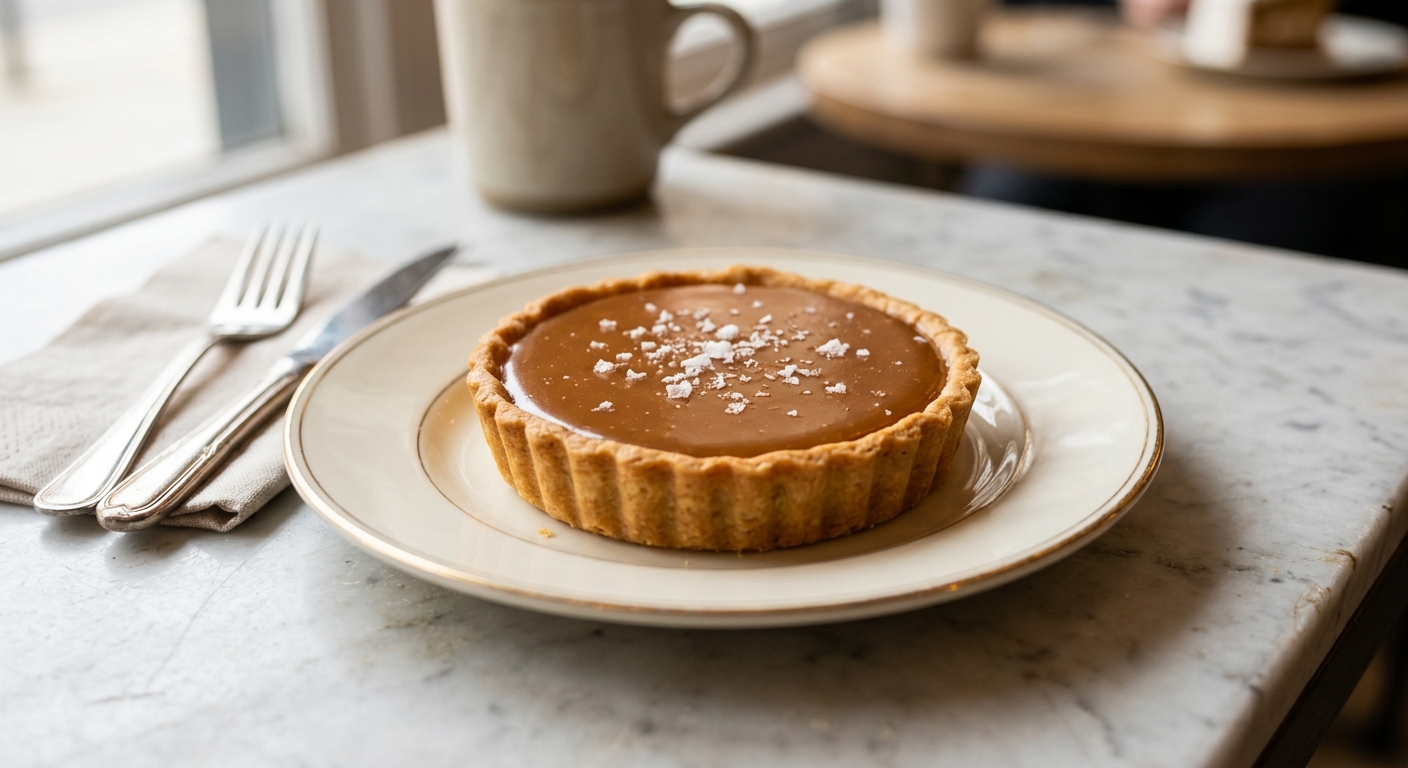
There is something almost magical about the moment sugar transforms into caramel. One minute it is a pale, crystalline thing, and the next it is a deep amber pool that smells of toffee, butterscotch, and something almost smoky. This Salted Caramel Tart captures that moment and sets it inside a shatteringly crisp shortcrust shell, topped with a flutter of flaky sea salt that makes every bite sing. It is elegant enough for a dinner party centrepiece, yet honest enough that you will find yourself sneaking slices straight from the fridge at midnight.
What sets this recipe apart is a dry caramel technique, where the sugar is melted without any water. It sounds intimidating, but it actually gives you more control and a deeper, more complex flavour than a wet caramel. The filling is finished with cold butter stirred in off the heat, which creates a silky, emulsified texture that is firm enough to slice cleanly yet melts the moment it hits your tongue. The shortcrust pastry is made with a high butter ratio and a touch of icing sugar for a tender, almost biscuit-like crumb that holds up beautifully to the soft filling.
This is a medium-difficulty recipe that rewards patience and a little confidence at the stove. If you have never made caramel before, read through the tips and troubleshooting sections before you begin. It is a wonderful project for a weekend afternoon, and it is perfect for anyone who loves the push and pull of sweet and salty, or who wants to build a genuine pastry skill they will use again and again.
Equipment Needed
Click on an item below to shop for the recommended items for this recipe on Amazon.
As an Amazon Associate, we earn from qualifying purchases.
10
Ingredients
- 200 gall-purpose flour (about 1 2/3 cups, spooned and leveled)
- 30 gicing sugar (powdered sugar, about 3 tbsp)
- 0.25 tspColima Sea SaltMicroplastic Free Salt
- 125 gunsalted butter, cold and cubed (about 9 tbsp)
- 1 largeegg yolk
- 2 tbspice-cold water, plus more if needed
- 300 ggranulated sugar (about 1 1/2 cups)
- 90 gunsalted butter, cut into small cubes and at room temperature (about 6 tbsp)
- 240 mlheavy cream, warmed (about 1 cup)
- 0.75 tspColima Sea SaltMicroplastic Free Salt
- 1 tsppure vanilla extract
- —Colima Sea SaltMicroplastic Free Salt (such as Maldon), for finishing
Ingredient Substitutions
Instructions
- Make the pastry: In a large bowl, whisk together the flour, icing sugar, and fine sea salt. Add the cold cubed butter and rub it into the flour using your fingertips until the mixture resembles coarse breadcrumbs with some pea-sized butter pieces remaining. Make a well in the centre, add the egg yolk and ice-cold water, and stir with a fork until the dough just begins to come together. Turn onto a lightly floured surface and press gently into a flat disc. Do not overwork it. Wrap in plastic wrap and refrigerate for at least 30 minutes.
- Roll and line the tin: On a lightly floured surface, roll the chilled dough to about 3mm (1/8 inch) thickness into a round roughly 30cm (12 inches) in diameter. Carefully roll the dough around your rolling pin and unroll it over a 9-inch (23cm) loose-bottomed tart tin. Press the dough gently into the corners and up the sides without stretching it. Trim the excess flush with the top of the tin. Prick the base all over with a fork. Refrigerate for another 20 minutes while you preheat the oven.
- Blind bake the shell: Preheat your oven to 190°C (375°F). Line the chilled pastry shell with a sheet of parchment paper and fill it with baking weights or dried beans, making sure to push them right to the edges. Bake for 15 to 20 minutes, until the edges are set and just beginning to turn golden. Remove the parchment and weights, and bake for another 8 to 10 minutes until the base looks dry, golden, and fully cooked. There should be no pale, raw-looking patches. Set aside to cool completely on a wire rack before filling.
- Make the dry caramel: Pour the granulated sugar in an even layer in a heavy-bottomed stainless steel or light-coloured saucepan (avoid non-stick). Place over medium heat and resist stirring. Once the edges begin to melt and turn amber, gently swirl the pan occasionally to even out the colour. Continue cooking until the entire sugar has melted to a deep amber, the colour of dark honey, between 175°C and 180°C (347°F and 356°F) if using a thermometer. Watch it carefully, as it goes from perfect to burnt very quickly.
- Build the caramel filling: Remove the pan from the heat immediately. Add the room-temperature butter cubes all at once and whisk vigorously. The mixture will bubble aggressively. Once the butter is fully incorporated, slowly pour in the warmed cream in a steady stream, whisking constantly. Return the pan to low heat and whisk for 1 to 2 minutes until perfectly smooth. Stir in the fine sea salt and vanilla extract. Let the caramel cool for 10 minutes, stirring occasionally.
- Fill and set: Pour the warm caramel filling into the cooled pastry shell. It will be very fluid. Allow the tart to sit at room temperature for 20 minutes, then refrigerate uncovered for at least 1.5 to 2 hours until the caramel is fully set and sliceable. Before serving, scatter flaky sea salt generously over the surface.
- Make the press-in crust: In a food processor, blitz 250g (about 9 oz) of digestive biscuits or graham crackers to fine crumbs (you should have about 2 cups). Transfer to a bowl and stir in 100g (7 tbsp) melted unsalted butter and a pinch of fine sea salt until the crumbs hold together when pressed between your fingers. If the mixture seems dry, add an extra tablespoon of melted butter.
- Form and chill the crust: Tip the crumb mixture into a 9-inch (23cm) loose-bottomed tart tin. Use the back of a spoon or the flat bottom of a glass to press the crumbs firmly and evenly across the base and up the sides. The sides especially need firm pressure to hold their shape. Place in the freezer for 20 minutes or the refrigerator for at least 45 minutes until completely firm.
- Make the dry caramel: Pour the granulated sugar in an even layer in a heavy-bottomed stainless steel saucepan. Place over medium heat without stirring. Once the edges begin to melt and turn amber, swirl the pan gently to distribute the heat. Cook until the sugar is fully melted and a deep, dark amber colour. Remove from the heat immediately.
- Build the caramel filling: Add the room-temperature butter cubes all at once and whisk vigorously through the vigorous bubbling. Pour in the warmed cream in a slow, steady stream, whisking constantly. Return to low heat and whisk for 1 to 2 minutes until smooth. Stir in the fine sea salt and vanilla. Cool for 15 minutes, stirring a few times.
- Fill and set: Remove the chilled crust from the fridge or freezer. Carefully pour the cooled caramel filling into the crust. Because the biscuit crust is more delicate than a baked shell, pour slowly and avoid pouring directly onto the sides. Refrigerate uncovered for at least 2 hours until fully set. Finish with flaky sea salt before serving.
Nutrition Per Serving
Per 1 serving (makes one 9-inch (23cm) tart)
Why This Recipe Works
The dry caramel method, melting sugar with no added water, works because it eliminates the risk of recrystallisation that can plague wet caramels. When you add water to sugar, you create a syrup that can seize and turn grainy if a single sugar crystal makes contact with the sides of the pan. In a dry caramel, there is no syrup stage to manage. The sugar melts directly and evenly when heat is applied. The key is patience and medium heat. High heat causes the outside to scorch before the centre melts. Swirling rather than stirring keeps undissolved sugar granules from seeding crystallisation in the already-melted portion.
Adding room-temperature butter off the heat is critical for a smooth emulsion. Cold butter hits the hot caramel unevenly and can cause the fat to separate. Warm butter incorporates smoothly, and its water content helps cool the caramel just enough to prevent the cream from boiling away violently when added. Warming the cream before adding it serves the same purpose: a dramatic temperature difference causes explosive bubbling and can seize the caramel. Gently warmed cream produces a controlled, workable reaction. The finished caramel sets firm enough to slice because the sugar concentration is high and the butter and cream together create a stable emulsion that firms as it cools.
The pastry relies on keeping the butter cold and handling the dough minimally. Cold butter coats the flour particles without fully absorbing into them, which means steam pockets form in the oven and create flaky, short layers. Overworking the dough develops gluten, which makes the pastry tough and prone to shrinking during baking. The icing sugar dissolves more readily than granulated sugar and contributes to a more tender, finely textured crumb, which is why pâte sucrée (the classic base for tarts) almost always calls for it. Pricking the base with a fork and blind baking with weights prevents the pastry from puffing and buckling before the filling is added.
Baker’s Tips
- Use a light-coloured or stainless steel saucepan for the caramel so you can accurately judge the colour of the sugar as it melts. Dark pans make it nearly impossible to see when you have hit the right shade of amber.
- Warm your cream before adding it to the caramel, either in a small saucepan or in the microwave for 45 seconds. This prevents the temperature shock that causes violent bubbling and potential seizing.
- Do not walk away from caramel. Once the sugar starts melting, stay at the stove. The window between perfect and burnt is less than a minute.
- If your pastry cracks when you roll it, let it sit at room temperature for 5 minutes. It is too cold. If it sticks, it is too warm. Return it to the fridge for 10 minutes.
- When pressing the pastry into the tart tin, use a small piece of excess dough as a tool to press the pastry neatly into the corners without thinning it.
- For perfectly clean slices, run a sharp knife under hot water, dry it, and slice. Repeat between each cut.
- Add the flaky salt just before serving rather than hours ahead. Salt draws out moisture and can dissolve into the surface of the caramel if left too long.
Variations
- Dark chocolate drizzle: Once the tart is set, drizzle 60g of melted dark chocolate (70% cacao) over the surface in thin ribbons before scattering the flaky salt.
- Espresso caramel: Whisk 1 tsp of instant espresso powder into the finished caramel along with the vanilla for a mocha-caramel depth that pairs beautifully with the salt.
- Brown butter shortcrust: Brown the 125g of pastry butter before cubing and chilling it completely solid in the fridge overnight. Use in place of regular cold butter for a nutty, toasty pastry flavour.
- Mini tarts: Divide the pastry and filling among twelve 3-inch (7.5cm) mini tart tins for individual servings. Blind bake for 12 minutes with weights, then 6 to 8 minutes uncovered.
Troubleshooting & FAQ
My caramel seized and turned into a grainy, lumpy mess. What went wrong?
My caramel filling is too runny and will not set firm in the tart.
My pastry shrank during blind baking and the sides slid down. How do I prevent this?
There is a layer of butter pooling on top of my caramel filling. What happened?
My pastry has a soggy, undercooked bottom even after blind baking.
Storage & Make-Ahead
- Storage: Store the tart loosely covered in the refrigerator for up to 4 days. The caramel filling will firm further as it chills, which actually makes it easier to slice. Bring individual slices to room temperature for 10 to 15 minutes before serving for the best texture. The tart does not freeze well once filled, as the caramel can weep and the pastry becomes soggy.
- Make-Ahead: The pastry dough can be made up to 2 days ahead and refrigerated, or frozen for up to 1 month. The blind-baked pastry shell can be baked up to 2 days ahead and stored at room temperature, loosely covered. The caramel filling can be made up to 3 days ahead, refrigerated in a jar, gently rewarmed until pourable, and then poured into the shell. The fully assembled tart can be made the day before serving.