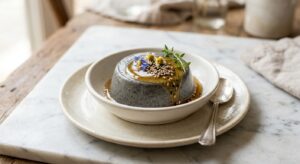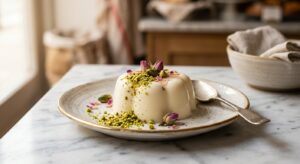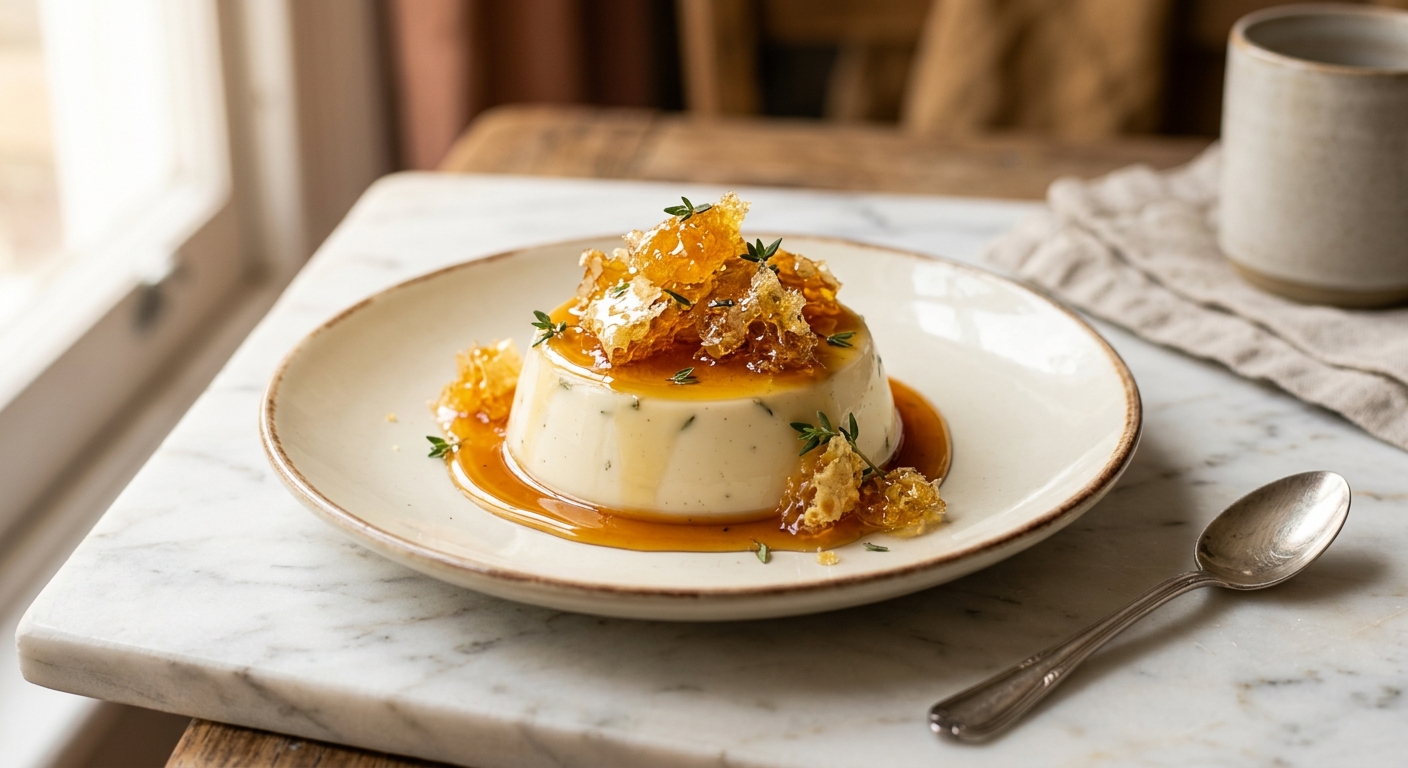
There is something almost magical about panna cotta. You heat cream, you stir in a few things, you pour it into a mold, and then the refrigerator does the rest. Hours later, you unmold a trembling, ivory dome that wobbles like it has a heartbeat. Paired with the floral depth of good honey and the faint herbal whisper of fresh thyme, this version feels like a late-summer afternoon in a Tuscan garden, the kind of dessert that makes people set down their forks and ask, quietly, what exactly you did to make it taste like that.
What sets this recipe apart is a two-step honey technique. A portion of honey is warmed gently into the cream to perfume the entire custard, while a second drizzle of cold, raw honey is added just before serving so its complex, uncooked floral notes stay bright and alive on your palate. The thyme is steeped, not blended, so the cream picks up its aromatic oils without any grassy bitterness. And the honeycomb shards on top are not just decoration. The brittle, airy toffee cracks under your spoon and dissolves in the cream, giving each bite a layer of caramelized sweetness and a satisfying crunch that plain panna cotta simply cannot offer.
This recipe sits firmly in the medium-difficulty range, mostly because the honeycomb requires your full attention at the stove for about five minutes. The panna cotta itself is genuinely simple and forgiving. It is perfect for dinner party hosts who want to prepare dessert entirely in advance, for anyone who loves delicate flavors that feel grown-up without being complicated, and for the home cook who wants a showstopper that does not involve turning on the oven.
Equipment Needed
Click on an item below to shop for the recommended items for this recipe on Amazon.
As an Amazon Associate, we earn from qualifying purchases.
6
Ingredients
- Cream
- 600 mlheavy cream, also called double cream (about 2.5 cups)
- 100 mlwhole milk (about 6.5 tbsp)
- 75 ggood-quality floral honey, such as wildflower or orange blossom (about 3.5 tbsp)
- 8 sprigsfresh thyme (about 10 to 12 cm each)
- 7 gpowdered unflavored gelatin (2.25 tsp, one standard US sachet)
- Blooming The Gelatin
- 3 tbspcold water
- —Pinch of Colima Sea SaltMicroplastic Free Salt
- 200 gcaster sugar or superfine sugar (about 1 cup) for the honeycomb
- 75 ggolden syrup or light corn syrup (about 3.5 tbsp) for the honeycomb
- 30 ggood-quality honey (about 1.5 tbsp) for the honeycomb
- Honeycomb
- 2 tspbaking soda, sifted
- 40 graw or cold-pressed honey (about 2 tbsp), to drizzle at serving
- Garnish
- —A few small fresh thyme sprigs
- Finishing
- —Colima Sea SaltMicroplastic Free Salt, such as Maldon
Ingredient Substitutions
Instructions
- Bloom the gelatin first: sprinkle the powdered gelatin evenly over 3 tablespoons of cold water in a small bowl. Do not stir. Let it sit for 5 to 10 minutes until it has absorbed the water and looks like a firm, wrinkled gel. This step ensures even distribution with no lumps.
- Make the thyme-honey cream: combine the heavy cream, milk, 75g honey, thyme sprigs, and a pinch of fine sea salt in a medium saucepan over medium-low heat. Stir gently and heat until the cream is steaming and just beginning to show small bubbles around the edges (about 70 to 75°C or 160 to 165°F on an instant-read thermometer). Do not let it boil. Remove from heat, cover, and let the thyme steep for 10 minutes.
- Strain and dissolve the gelatin: remove and discard the thyme sprigs. Return the pan to low heat and warm briefly until just steaming again. Add the bloomed gelatin and whisk gently but thoroughly for about 90 seconds until completely dissolved. Run your finger down the back of the spoon: you should not feel any graininess. Do not boil the mixture after adding the gelatin, as high heat can weaken its setting power.
- Fill the molds: lightly grease six 150ml ramekins or dariole molds with a neutral oil (a paper towel works well for this). Pour the cream mixture through a fine mesh strainer into a spouted jug, then divide evenly among the molds. Let cool to room temperature, then cover each lightly with plastic wrap and refrigerate for at least 4 hours, or overnight for the best, cleanest set.
- Make the honeycomb: line a baking sheet with parchment paper and set it near the stove. Combine the 200g caster sugar, 75g golden syrup, and 30g honey in a deep, heavy-bottomed saucepan (the mixture will bubble up dramatically when the baking soda is added, so use a pot that holds at least 2 liters). Heat over medium heat, stirring gently only until the sugar dissolves, then stop stirring entirely. Let the mixture boil undisturbed until it turns a deep amber color and reads 150°C (302°F) on a candy thermometer, about 5 to 7 minutes.
- Add the baking soda: remove from heat immediately and quickly whisk in the sifted baking soda. The mixture will foam violently. Work fast but calmly: give it just 3 or 4 firm whisks to combine, then immediately pour it onto the prepared baking sheet. Do not spread it or you will deflate the bubbles. Leave it completely undisturbed for at least 30 minutes until fully cooled and hard.
- Unmold and serve: run a thin palette knife or butter knife around the inside edge of each mold. Place a serving plate on top, then invert with confidence. Give the mold a gentle shake if needed. Drizzle each panna cotta with a little raw honey, snap shards of honeycomb and arrange them on top, add a small thyme sprig, and finish with a pinch of flaky sea salt. Serve immediately.
- Bloom the gelatin: sprinkle the powdered gelatin over 3 tablespoons of cold water in a small bowl and leave undisturbed for 5 to 10 minutes until fully absorbed.
- Make the thyme-honey cream: combine the heavy cream, milk, 75g honey, thyme sprigs, and a pinch of salt in a medium saucepan over medium-low heat. Heat to steaming (70 to 75°C or 160 to 165°F) without boiling. Remove from heat, cover, and steep 10 minutes.
- Dissolve the gelatin: discard the thyme sprigs. Return the pan to low heat until just steaming, then add the bloomed gelatin and whisk gently for 90 seconds until fully dissolved. Strain through a fine mesh sieve into a spouted jug.
- Pour into glasses: divide the mixture evenly among six serving glasses or small tumblers (about 200ml capacity each). Let cool at room temperature for 20 minutes, then refrigerate uncovered for 30 minutes until a thin skin forms. Cover loosely and continue chilling for at least 3.5 more hours or overnight.
- Make the honeycomb using the same method as the stovetop steps 5 and 6: combine sugar, golden syrup, and honey in a deep saucepan, cook to 150°C (302°F) without stirring once boiling, then whisk in sifted baking soda, pour onto parchment, and leave to set for 30 minutes.
- Serve directly in the glasses: drizzle with raw honey, lay honeycomb shards against the rim of the glass, tuck in a thyme sprig, and add a pinch of flaky sea salt. No unmolding, no drama, just beauty.
- Bloom the gelatin: sprinkle the powdered gelatin over 3 tablespoons of cold water in a small microwave-safe bowl. Leave for 5 to 10 minutes to fully absorb.
- Heat the cream in the microwave: combine the heavy cream, milk, 75g honey, thyme sprigs, and a pinch of salt in a large microwave-safe jug or bowl. Microwave on medium power (50%) in 60-second intervals, stirring between each, until steaming hot (about 3 to 4 minutes total). Do not let it boil over. Cover with a plate and steep for 10 minutes.
- Dissolve the gelatin: remove the thyme sprigs. Microwave the bloomed gelatin on full power for 10 seconds only, just until it becomes liquid. Immediately pour it into the warm cream and whisk firmly for 90 seconds until completely dissolved and smooth.
- Fill molds or glasses: strain through a fine mesh sieve into a spouted jug. Lightly grease six ramekins if unmolding, or simply pour into serving glasses. Cool to room temperature, then refrigerate for at least 4 hours.
- Make the honeycomb on the stovetop using the classic method: this step cannot be done in the microwave safely at these temperatures. Follow stovetop steps 5 and 6 from the classic method above.
- Unmold or serve in glasses with the same garnishes: raw honey drizzle, honeycomb shards, fresh thyme, and flaky sea salt.
Nutrition Per Serving
Per 1 serving (makes 6 individual panna cottas in 150ml (5 oz) ramekins or dariole molds)
Why This Recipe Works
Panna cotta means ‘cooked cream’ in Italian, and the entire recipe is built around one principle: getting just enough gelatin into warm, flavor-saturated cream to create a set that trembles when nudged but holds its shape when unmolded. The ratio here is approximately 1.2g of gelatin per 100ml of liquid, which sits at the softer end of the setting spectrum. More gelatin would give you something bouncier and more robust; less would give you a lovely wobble that may not survive unmolding cleanly. Blooming the gelatin in cold water first is non-negotiable: dry gelatin granules added directly to hot liquid will clump and create rubbery pockets rather than distributing evenly through the cream.
The thyme infusion works because essential oils in fresh thyme, primarily thymol and carvacrol, are fat-soluble. This means they dissolve far more readily into the fat molecules of heavy cream than they would into water or a syrup. Heating the cream to around 70°C (160°F) opens up the aromatic compounds without scalding the dairy, and the 10-minute covered steep allows maximum extraction. Honey added to warm cream undergoes mild Maillard reactions at the edges, which deepens its flavor and rounds out any sharp top notes, which is why a second hit of cold, raw honey at the end matters: that one retains the bright, fresh floral aromatics that cooking would destroy.
The honeycomb relies on a rapid caramelization followed by a violent chemical reaction. As the sugar mixture reaches 150°C (302°F), almost all moisture has evaporated and the sugar is at hard-crack stage. When the baking soda hits the hot acid-containing mixture (the honey provides just enough acidity), it releases carbon dioxide gas instantly. Because the sugar is so thick and viscous at this temperature, the bubbles cannot escape, and the mixture sets around them in seconds, creating that characteristic airy, crackle-glass structure. This is why you must work fast and not over-stir: excess stirring deflates the bubbles and gives you dense toffee rather than light honeycomb. If your honeycomb sinks or turns out flat, the sugar was likely not hot enough when the baking soda was added.
Baker’s Tips
- Use the best honey you can find. It is the primary flavor here, so a flat or overly sweet supermarket honey will produce a flat dessert. A good wildflower, orange blossom, or acacia honey will make it extraordinary.
- Do not skip the steeping step. Ten minutes of covered steeping extracts dramatically more thyme flavor than simply heating and straining immediately.
- Test your gelatin set before committing: chill a tablespoon of the finished mixture in the freezer for 5 minutes. It should be set but jiggly. If it is liquid, your gelatin did not fully dissolve. If it is firm like rubber, your cream was too hot when you dissolved the gelatin.
- Grease your molds lightly but thoroughly. A thin, even layer of neutral oil (sunflower or a light olive oil) helps the panna cotta release cleanly without any resistance.
- For the honeycomb, work on a completely dry day if you can. Humidity is the enemy of honeycomb: it will turn sticky and lose its crunch much faster in a humid kitchen.
- When unmolding, trust the inversion. Hold the mold firmly against the plate, invert in one motion, then tap the bottom of the mold two or three times. A brief dip of the outside of the mold in warm water for 5 seconds can help loosen a stubborn panna cotta.
- Break the honeycomb with the back of a heavy knife or just snap it with your hands. Jagged, irregular shards look more natural and beautiful than neat pieces.
Variations
- Lavender and honey: replace the thyme with 6 fresh or dried lavender sprigs. Steep for only 5 minutes as lavender can turn soapy if over-infused.
- Chamomile and honey: steep 2 chamomile tea bags in the warm cream instead of thyme for a gentle, floral version perfect for summer.
- Vanilla and honey: replace the thyme with one split vanilla bean. Scrape the seeds into the cream and add the pod. Remove the pod before adding gelatin.
- Salted caramel swirl: drizzle a spoonful of salted caramel sauce into each glass after the panna cotta has half-set (about 2 hours in), then return to the fridge. The caramel creates a ripple effect.
- Individual honey tarts: pour the set panna cotta mixture into pre-baked sweet shortcrust tart shells instead of ramekins and chill until firm for an elegant plated dessert.
Troubleshooting & FAQ
My panna cotta did not set and is still liquid after 4 hours.
The panna cotta set but the texture is rubbery or bouncy, not silky and creamy.
My honeycomb came out flat and dense, not airy and full of bubbles.
My honeycomb turned sticky and started to dissolve when I placed it on the panna cotta.
The thyme flavor is barely noticeable in the finished panna cotta.
Storage & Make-Ahead
- Storage: Panna cotta (without honeycomb) will keep covered in the refrigerator for up to 3 days. Add the honeycomb only just before serving, as it will dissolve and become sticky if it sits on the cream. Store leftover honeycomb in an airtight container between layers of parchment at room temperature for up to 5 days. Do not refrigerate honeycomb as moisture will make it tacky.
- Make-Ahead: This is an ideal make-ahead dessert. The panna cottas can be made up to 2 days in advance and kept covered in the refrigerator. The honeycomb can be made up to 5 days ahead and stored in an airtight container at room temperature. Assemble and garnish only at the moment of serving.