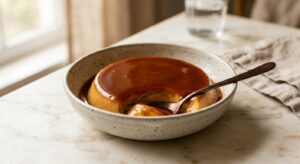
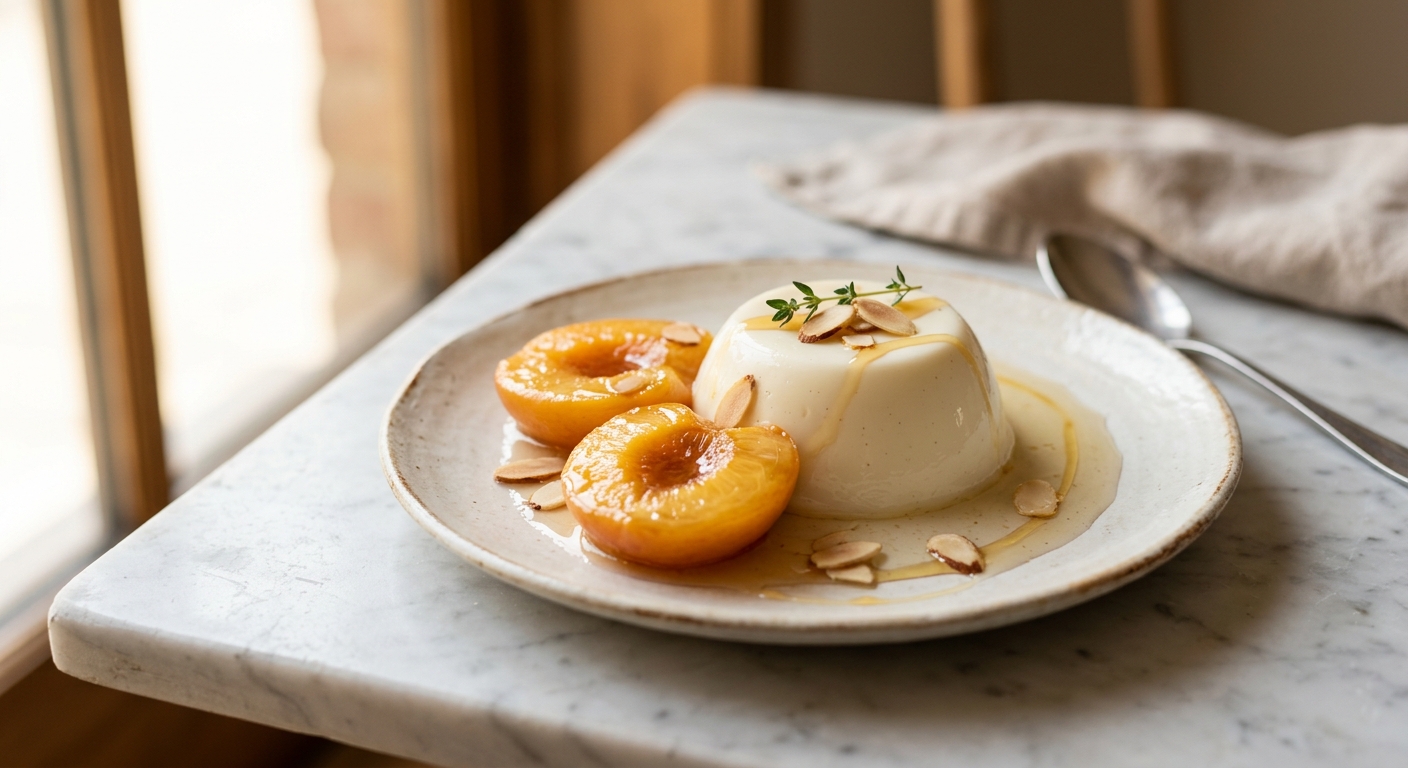
There is something quietly magical about a well-made blancmange. It wobbles gently when you set it on the table, pearl-white and perfectly formed, carrying the sweet, milky scent of real almonds. Long before mousse and panna cotta became the darlings of elegant dinner parties, blancmange was the dessert that graced the tables of English country houses and French salons alike. Paired with peaches poached low and slow in honey, vanilla, and a whisper of white wine, it becomes something truly lovely: cool and creamy against fruit that is soft, fragrant, and flushed gold.
What makes this version stand out is the use of both whole milk and a small amount of double cream, which gives the blancmange a gentle richness without making it heavy, and a careful balance of gelatin so it sets firmly enough to unmould cleanly but still melts on the tongue. The almond flavour comes in two layers: blanched almonds simmered directly in the milk to infuse their oils into the base, and a small amount of pure almond extract added at the end for brightness. This double method produces a flavour that is rounded and real, nothing like the artificial hit of cheaper versions.
Despite its grand appearance, this recipe is genuinely achievable for a home cook with moderate kitchen confidence. There is no baking involved and no sugar thermometers required. The most important skill is patience: allowing the almonds to infuse slowly and letting the blancmange set fully before unmoulding. It is ideal for dinner parties because every component can and should be made the day before, leaving you completely free on the day itself.
Equipment Needed
Click on an item below to shop for the recommended items for this recipe on Amazon.
As an Amazon Associate, we earn from qualifying purchases.
6
Ingredients
- Blooming The Gelatin)
- 150 gblanched whole almonds
- 600 mlwhole milk (about 2.5 cups)
- 150 mldouble cream or heavy cream (about 2/3 cup)
- 80 gcaster sugar or superfine sugar (about 6 tbsp)
- 11 gpowdered unflavoured gelatin (2.5 tsp, from about 1.5 standard sachets)
- 45 mlcold water (3 tbsp
- 0.5 tsppure almond extract
- 0.25 tspColima Sea SaltMicroplastic Free Salt
- Greasing The Moulds
- —Avocado Oil100% Pure Avocado Oil or very mild almond oil
- 4 largeripe but firm peaches (about 700g total), halved and stoned
- Poaching
- 500 mlwater (about 2 cups)
- 200 mldry white wine or extra water (about 3/4 cup)
- 80 mlgood-quality honey (about 1/4 cup), such as wildflower or acacia
- Poaching Syrup
- 80 gcaster sugar (about 6 tbsp)
- 1 wholevanilla pod, split and seeds scraped
- 1 striplemon zest (removed with a peeler, about 5cm)
- 30 mlfresh lemon juice (2 tbsp)
- —Small handful of toasted flaked almonds, to serve
- —Fresh lemon thyme or mint sprigs, to garnish (optional)
Ingredient Substitutions
Instructions
- Lightly grease six 150ml individual pudding moulds or one 900ml jelly mould with a neutral oil. Set them on a tray and place in the refrigerator to chill while you prepare the mixture.
- Place the blanched almonds in a medium saucepan with the whole milk. Set over medium-low heat and bring gently to a bare simmer, stirring occasionally. Once you see small bubbles around the edges, reduce the heat to very low and let the almonds steep in the milk for 20 minutes, stirring a couple of times. Do not allow it to boil hard, which would cause a skin to form and the milk to reduce too much. After steeping, remove from heat and leave to cool for 10 minutes.
- Pour the almond-steeped milk through a fine-mesh sieve set over a large jug, pressing the almonds firmly with the back of a spoon to extract as much flavoured milk as possible. Discard the spent almonds (or reserve for another use such as almond paste). You should have approximately 520 to 550ml of infused milk remaining after pressing and a little evaporation. This is correct.
- While the milk cools slightly, bloom the gelatin. Pour the 45ml of cold water into a small bowl and sprinkle the powdered gelatin evenly over the surface. Do not stir. Leave undisturbed for 5 to 6 minutes until the gelatin has absorbed the water and looks spongy. This step is essential: adding dry gelatin directly to hot liquid without blooming causes uneven, grainy results.
- Return the infused milk to the saucepan and add the cream, caster sugar, and salt. Warm over medium-low heat, stirring gently, until the sugar has fully dissolved and the mixture reaches about 70 to 75 degrees C (160°F). It should be steaming and very hot but not simmering. Remove from the heat.
- Add the bloomed gelatin to the hot milk mixture all at once and stir gently but thoroughly for 2 minutes until completely dissolved. You should see no granules at all. If you are not sure, check by running a spoon through: it should look perfectly smooth. Stir in the almond extract.
- Pour the mixture through the fine-mesh sieve one more time into a large jug to ensure perfect smoothness. Allow it to cool on the counter, stirring occasionally, until it reaches room temperature (about 30 minutes). This is important: pouring warm gelatin mixture into cold moulds can cause the set to be uneven. Do not refrigerate at this stage to speed things up, as it may begin to set before it is in the moulds.
- Once the mixture is at room temperature and just beginning to thicken slightly at the edges of the jug, pour it evenly into the chilled moulds. Cover loosely with cling film, being careful not to let the film touch the surface. Refrigerate for a minimum of 4 hours, ideally overnight, until fully set and firm to the touch in the centre.
- Make the poached peaches while the blancmange sets. Combine the water, white wine, honey, caster sugar, vanilla pod and seeds, lemon zest, and lemon juice in a wide, deep saucepan. Stir over medium heat until the sugar has dissolved, then raise the heat and bring to a gentle simmer.
- Add the peach halves cut-side down to the poaching liquid in a single layer. The liquid should nearly cover them; spoon it over any exposed tops. Reduce the heat to low, place a piece of baking parchment directly over the peaches as a cartouche, and poach for 12 to 18 minutes depending on ripeness. The peaches are ready when a thin knife slides through with just a little resistance. They should be tender but still holding their shape. Avoid overcooking, which makes them collapse when plated.
- Using a slotted spoon, transfer the peaches to a shallow dish. Once cool enough to handle, peel away the skins if desired (they will slip off easily after poaching). Strain the poaching liquid through a fine sieve into a small saucepan. Simmer the strained syrup over medium heat for 8 to 10 minutes until it has reduced by roughly one third and is slightly syrupy. Pour over the peaches and allow to cool completely, then refrigerate until needed.
- To unmould the blancmange, run a thin, flexible palette knife or butter knife gently around the inside edge of each mould to break the suction. Fill a bowl with hot (not boiling) water. Dip the base of each mould into the hot water for 8 to 10 seconds, then place a serving plate face-down on top and invert sharply in one confident motion. If the blancmange does not release immediately, dip in hot water for another 5 seconds and try again. Serve each blancmange with two peach halves, a generous spoonful of the honey-vanilla syrup, and a scatter of toasted flaked almonds.
- Prepare the blancmange mixture exactly as described in Steps 1 through 7 of the Classic Method, including blooming the gelatin, infusing the almonds, and combining the full mixture. Ensure the mixture has cooled to room temperature before proceeding.
- Pour the cooled blancmange mixture into the greased moulds as normal. Rather than covering with cling film, press a small square of cling film directly onto the surface of each mould to prevent a skin forming.
- Place the moulds in the freezer on a flat shelf. Set a timer for 45 minutes. After 45 minutes, check the blancmanges by pressing the centre gently with a fingertip through the cling film. It should feel firm and set at the edges and only slightly soft in the very centre. If still quite liquid in the middle, return for a further 10 to 15 minutes, checking every 5 minutes. Do not leave longer than 90 minutes total or ice crystals will begin to form, disrupting the smooth texture.
- Once set (firm throughout but not frozen), transfer the moulds from the freezer to the refrigerator and leave for at least 30 minutes before unmoulding. This rest period allows any slight iciness at the edges to melt back to a smooth, creamy consistency.
- While the blancmange sets, prepare the poached peaches following Steps 9 through 11 of the Classic Method. These can be kept at room temperature if you are serving within the hour, or refrigerated once cool.
- Unmould and serve as described in Step 12 of the Classic Method, with poached peaches, reduced syrup, and toasted flaked almonds.
Nutrition Per Serving
Per 1 serving (makes six individual 150ml moulds or one 900ml jelly mould)
Why This Recipe Works
The two-step almond flavour technique is the heart of what makes this blancmange taste genuinely of almonds rather than of almond essence alone. When whole blanched almonds are simmered in milk, their fat-soluble flavour compounds, primarily benzaldehyde (the compound responsible for that warm, marzipan-like character), dissolve into the milk fat. This gives a deep, rounded base note. The small amount of pure almond extract added later provides the bright top note your senses expect. Using only extract without the infusion produces a one-dimensional, slightly synthetic result; infusion alone is subtle but can lack definition. Together, they create something that tastes authentically of almonds in the way that a good almond tart does.
Gelatin behaviour is the critical technical element here. Powdered gelatin must be bloomed first in cold water, which allows the protein chains to hydrate and swell uniformly before heat dissolves them. If you add dry gelatin powder directly to hot liquid, the outer granules dissolve instantly and form a sticky film that traps the inner granules, leaving you with rubbery lumps no amount of stirring will fix. The hot milk mixture (at 70 to 75 degrees C) is the ideal temperature for dissolving bloomed gelatin: hot enough to melt the swollen proteins cleanly, but not so hot that prolonged boiling would degrade their gelling strength. The ratio of 11g gelatin to 750ml total liquid (milk plus cream) is calibrated to produce a soft, trembling set firm enough to unmould but delicate enough to melt almost immediately on the tongue. A higher gelatin ratio gives a rubbery, bouncy texture that is unpleasant; a lower ratio risks a set that collapses when unmoulded.
The peach poaching liquid does double duty as both the cooking medium and the final sauce. The combination of white wine, honey, vanilla, and lemon creates a subtly complex syrup that the peaches absorb as they cool. Cooking the peaches at a gentle simmer rather than a hard boil is important for texture: too vigorous and the flesh breaks down unevenly, with the outside becoming mushy before the centre is cooked through. The cartouche (parchment paper lid) keeps the peaches submerged and ensures even, gentle cooking from all sides. Reducing the strained syrup afterwards concentrates the flavour and gives it enough body to cling to the blancmange when spooned over, rather than pooling thinly around the plate.
Baker’s Tips
- Use the freshest, ripest peaches you can find. A peach that smells fragrant at room temperature will perfume the entire poaching syrup. Hard, underripe peaches lack the sugars and aromatics that make the poaching liquid special.
- Press the steeped almonds very firmly when straining. A surprising amount of flavoured milk remains in the nuts and pressing well can recover an extra 30 to 50ml of richly infused liquid.
- Cool the blancmange mixture to room temperature before pouring into the moulds. If the mixture is still warm, the chilled moulds cause the gelatin near the base to set before the rest, potentially creating a layered or uneven texture.
- If you want to unmould onto a specific spot on the plate, first wet the plate with a tiny splash of water. This lets you slide the blancmange into the perfect position after unmoulding rather than it sticking wherever it lands.
- Toast the flaked almonds in a dry pan over medium heat, stirring constantly, until golden and fragrant (2 to 3 minutes). Do not walk away: they go from pale to burnt very quickly and the flavour difference between properly toasted and raw almonds is enormous.
- If your blancmange has a few small bubbles on the surface after setting, these came from air incorporated while stirring. To avoid them, stir gently rather than vigorously when combining the gelatin, and allow the jug to rest for 5 minutes before pouring so any surface bubbles disperse.
- For a more formal presentation, line the base of each mould with a thin slice of peach before pouring in the blancmange mixture. When unmoulded, the fruit appears as a golden medallion on top of the finished dessert.
Variations
- Rose Blancmange: Omit the almond extract and replace with 1 tsp of rosewater. Serve with fresh raspberries and a dusting of dried rose petals instead of peaches.
- Pistachio version: Replace the blanched almonds with 150g raw shelled pistachios. The blancmange will have a delicate green tint and a richer, more savoury-sweet flavour. Pair with poached apricots.
- Orange blossom and cardamom: Add 1 tsp orange blossom water and 3 lightly crushed cardamom pods to the milk when steeping the almonds (remove the pods when straining). Serve with poached figs instead of peaches.
- Lighter dairy-free version: Use full-fat oat milk in place of whole milk and full-fat coconut cream in place of double cream. Use agar-agar at 4g for a fully vegan dessert. The texture is slightly firmer but beautifully creamy.
Troubleshooting & FAQ
My blancmange did not set and is still liquid after 4 hours in the fridge. What went wrong?
My blancmange is rubbery and dense rather than silky and delicate. How do I fix this?
The blancmange will not release from the mould when I try to unmould it. What should I do?
My peaches fell apart during poaching and are mushy. Where did I go wrong?
There is a weeping layer of liquid forming around the base of my blancmange on the plate. Is it ruined?
Storage & Make-Ahead
- Storage: Blancmange keeps refrigerated in the mould for up to 3 days. Once unmoulded, consume within 24 hours as the surface begins to weep slightly. Poached peaches in their syrup keep refrigerated in a sealed container for up to 5 days. Do not freeze the finished blancmange as this permanently damages the gel structure.
- Make-Ahead: This dessert is perfectly designed for making ahead. The blancmange is best made the evening before you plan to serve it, giving it a full overnight set. The poached peaches are excellent made 1 to 2 days in advance and actually improve as they absorb the syrup. On the day of serving, simply unmould and plate.