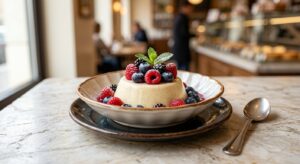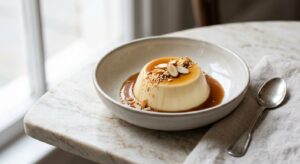
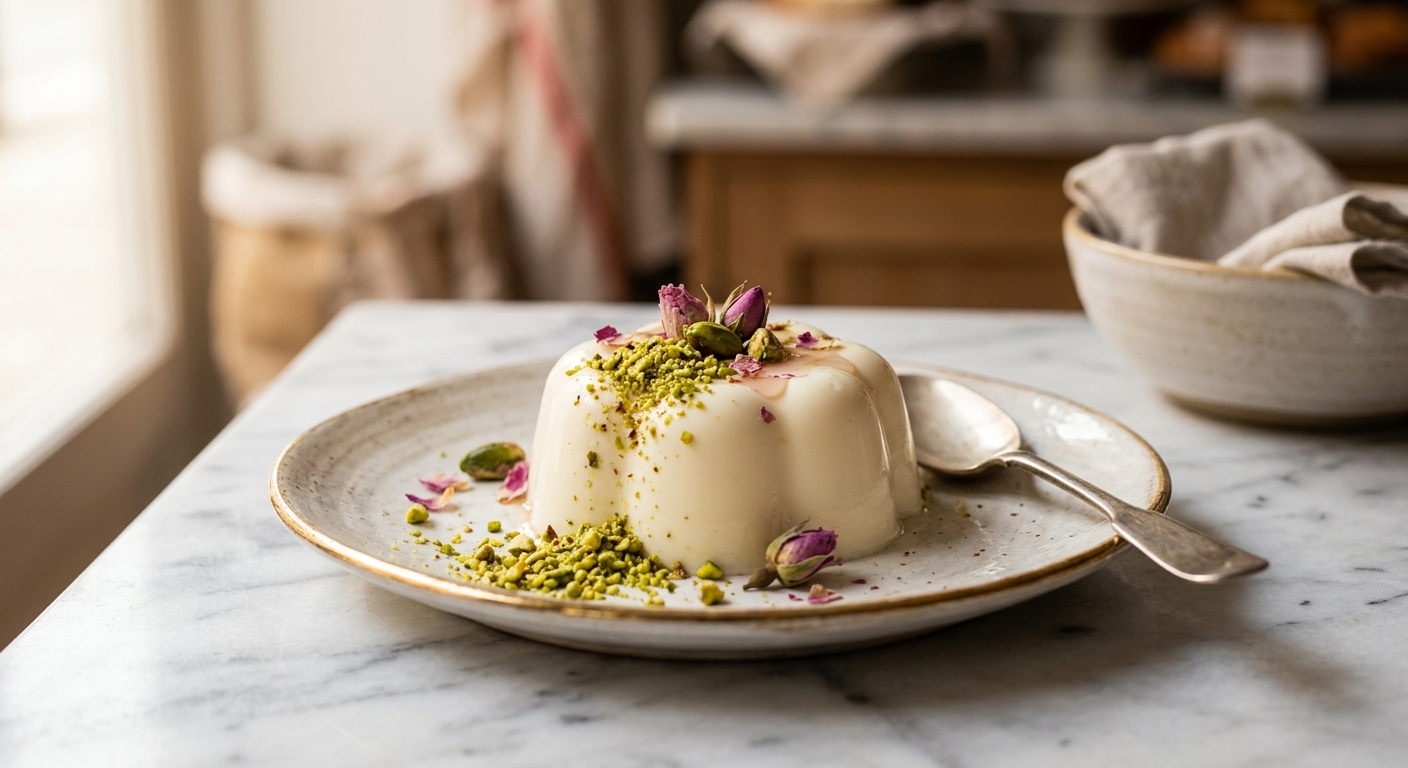
There is something almost otherworldly about a well-made blancmange. It arrives at the table cool and pale as moonlight, shivering softly when you set it down, carrying with it the faint, heady perfume of rose water. It is a dessert with genuine history, appearing in medieval European cookbooks and gracing Victorian supper tables alike, yet it never feels dusty or old-fashioned when done right. One spoonful of that smooth, barely-sweet, floral cream and you will understand entirely why people have been making versions of this pudding for centuries.
What sets this recipe apart from the stodgy, rubbery blancmanges of school-dinner memory is the ratio of cornstarch to milk. Many older recipes lean too heavily on thickener, producing a dessert that holds its shape like a candle rather than yielding gently under a spoon. Here, the balance is carefully calibrated so the set is just firm enough to unmould cleanly, but the texture remains creamy and almost mousse-like on the tongue. A generous measure of whole milk and a splash of double cream give the pudding its richness, while the rose water is added off the heat to preserve its delicate, aromatic top notes. The crushed pistachios on top are not merely decorative, their slight bitterness and crunch providing exactly the counterpoint this soft, sweet dessert needs.
This recipe sits comfortably at the easy end of the scale despite its elegant results. If you can whisk a sauce on the stovetop, you can make blancmange. It is ideal for home bakers who want a make-ahead dinner-party dessert with minimal fuss, and it is equally wonderful as a gentle weekend treat served in pretty glasses with fresh raspberries alongside. The one non-negotiable is patience: this pudding needs at least four hours to set properly, so plan ahead.
Equipment Needed
Click on an item below to shop for the recommended items for this recipe on Amazon.
As an Amazon Associate, we earn from qualifying purchases.
6
Ingredients
- 700 mlwhole milk (about 3 cups)
- 150 mldouble cream or heavy cream (about 2/3 cup)
- 90 gcaster sugar or superfine sugar (about 7 tbsp)
- 55 gcornstarch, also called cornflour (about 6 tbsp)
- 1.5 tbsprose water, good quality (adjust to taste, brands vary in intensity)
- 0.5 tsppure vanilla extract
- —Pinch of Colima Sea SaltMicroplastic Free Salt
- 40 gshelled unsalted pistachios, roughly crushed (about 1/3 cup), to serve
- —Dried rose petals or fresh raspberries, to serve (optional)
Ingredient Substitutions
Instructions
- Lightly grease six 150ml dariole moulds or ramekins with a neutral flavourless oil, then place them on a small tray. Alternatively, grease one 900ml jelly mould or pudding basin. Set aside.
- In a medium heavy-bottomed saucepan, whisk together the cornstarch and sugar. Gradually pour in about 150ml of the cold milk, whisking constantly to create a smooth, lump-free slurry. It is essential to start with cold milk here: cornstarch dissolves cleanly in cold liquid but clumps instantly if added to hot liquid.
- Add the remaining milk and the cream to the pan and whisk to combine. Place the pan over medium heat. Cook, stirring constantly with a heatproof silicone spatula or whisk, reaching all the way into the corners and along the base of the pan. After 8 to 12 minutes the mixture will begin to thicken. Keep stirring as it thickens because the base can scorch very quickly at this stage.
- Once the mixture reaches a thick, smooth, creamy pudding consistency that coats the back of a spoon heavily, remove the pan from the heat. Stir in the vanilla extract and the pinch of salt. Allow the mixture to cool for about 60 to 90 seconds, just long enough so it is no longer actively boiling, then stir in the rose water. Adding rose water off the heat protects its volatile aromatic compounds from evaporating away.
- Taste carefully and adjust rose water if needed. Different brands vary dramatically in strength, so trust your palate here. Pour the warm mixture through a fine-mesh sieve into a large measuring jug to catch any lumps, then divide evenly among the prepared moulds.
- Allow the puddings to cool at room temperature for 20 to 30 minutes, then cover each mould loosely with plastic wrap and refrigerate for a minimum of 4 hours, or overnight for the best, cleanest set.
- To unmould, run a thin butter knife gently around the edge of each pudding. Place a serving plate face-down on top of the mould, then invert quickly and confidently. Give the mould a sharp downward shake if needed. The pudding should release cleanly. Scatter with crushed pistachios and rose petals or raspberries, and serve immediately.
- Lightly grease your moulds or ramekins as described in the stovetop method and set aside.
- In a large microwave-safe bowl or jug (it should hold at least 1.2 litres to allow for bubbling), whisk together the cornstarch and sugar. Add about 150ml of the cold milk and whisk vigorously to a smooth, completely lump-free slurry. Add the remaining milk and cream and whisk to combine.
- Microwave on High (100% power) for 3 minutes. Remove and whisk very thoroughly, scraping the sides and base of the bowl where the mixture thickens first. Return to the microwave for another 2 minutes on High. Whisk again vigorously.
- Continue microwaving in 90-second intervals, whisking well between each interval, until the mixture is thick, smooth, and coats the spoon heavily. This typically takes 8 to 11 minutes total, depending on microwave wattage. If you see lumps forming, whisk more vigorously or switch to a handheld milk frother for 30 seconds.
- Remove from the microwave, stir in the vanilla and salt, rest for 60 to 90 seconds, then stir in the rose water. Strain through a fine-mesh sieve into a jug, divide among the greased moulds, cool slightly, then cover and refrigerate for at least 4 hours. Unmould and garnish as described above.
- For a softer, spoonable consistency that does not need to hold its shape, reduce the cornstarch to 40g (about 4.5 tbsp) rather than 55g. The pudding will be silky and mousse-like rather than firm enough to unmould.
- Prepare the blancmange mixture using either the stovetop or microwave method described above, using the reduced cornstarch quantity.
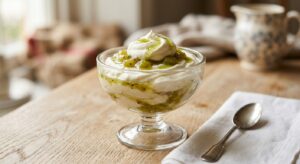
- Once the mixture is cooked, off the heat, stir in the vanilla, salt, and rose water as before. Strain through a fine-mesh sieve directly into six individual serving glasses, wine glasses, or coupes. Do not grease the glasses.
- For a layered presentation, allow the first pour to cool and set at room temperature for 20 minutes, then gently spoon a thin layer of rose-tinted cream (stir a drop of red food colouring and a tiny extra splash of rose water into a few tablespoons of lightly whipped cream) on top before chilling.
- Cover each glass with plastic wrap and refrigerate for at least 4 hours. Serve directly in the glasses topped with crushed pistachios, rose petals, and a few fresh raspberries.
Nutrition Per Serving
Per 1 serving (makes six individual 150ml (5 oz) moulds, or one 900ml (1-quart) mould)
Why This Recipe Works
The entire structure of blancmange depends on the gelatinisation of cornstarch. Cornstarch granules are insoluble in cold liquid, which is exactly why you must first whisk them with cold milk before applying heat. As the mixture warms past approximately 62°C (144°F), the starch granules begin to absorb water rapidly and swell, eventually bursting and releasing long-chain starch molecules that entangle with each other to form a smooth, continuous gel. This process, called gelatinisation, is what transforms a thin milky liquid into a thick, set pudding. Stirring constantly throughout is critical: without agitation, the starch nearest the heat source gelatinises much faster than the rest, creating lumps and, eventually, a scorched base.
The ratio of cornstarch to liquid in this recipe is specifically calibrated for a pudding that sets firmly enough to unmould cleanly from a greased mould, while still yielding a genuinely creamy, tender texture. Using too little starch produces a pudding that slumps or weeps on the plate, while too much creates the dense, rubbery texture that has unfairly given blancmange a bad reputation. The inclusion of cream alongside whole milk is not mere indulgence: the fat molecules in cream interfere slightly with starch granule swelling, resulting in a finer, silkier gel than milk alone would produce. This is the same principle behind why custard made with cream is smoother than one made with milk.
Rose water is always added off the heat, and this is non-negotiable for good flavour. Rose water’s aroma comes from volatile organic compounds, primarily geraniol and citronellol, which evaporate rapidly at high temperatures. Adding rose water to a boiling mixture would result in a pudding with very little detectable floral character. By removing the pan from the heat and waiting a minute before stirring it in, you preserve the majority of those delicate aromatic molecules. If your finished blancmange tastes flat or soapy rather than gently floral, the most likely culprit is either adding the rose water while the mixture was still too hot, or using a poor-quality rose water with artificial flavouring rather than genuine steam-distilled rose water.
Baker’s Tips
- Start with a cold milk slurry. Always mix the cornstarch with cold milk before adding to the rest of the liquid and applying heat. This one step prevents lumps completely.
- Use a silicone spatula rather than a wooden spoon for stirring. It reaches right into the corners of the pan where scorching starts first, and you will feel the moment the mixture begins to thicken through the spatula.
- Taste your rose water before you use it. Brands vary enormously in strength. A small bottle of very concentrated rose water might need only 1 tsp, while a larger bottle of diluted water might need 2 tbsp. Start with less and adjust.
- Grease your moulds generously with a neutral oil like sunflower or a very light brush of almond oil. Do not use butter: the milk solids in butter can cause the pudding to stick. A light, even film of neutral oil is all you need for a clean release.
- For the cleanest unmoulding, chill the moulds for a full overnight rather than the minimum four hours. A well-chilled pudding is more stable and releases more reliably.
- Warm the outside of the mould briefly if it sticks. Run the bottom half of the mould under warm (not hot) water for 5 seconds before inverting. The gentle warmth melts the outermost layer of pudding just enough to release the vacuum seal.
Variations
- Cardamom and Orange Blossom: Replace the rose water with orange blossom water and add 0.5 tsp ground cardamom to the cornstarch mixture at the start. Garnish with candied orange peel instead of rose petals.
- Coconut and Lime: Swap all the milk and cream for two 400ml cans of full-fat coconut milk (800ml total) and replace the rose water with 2 tsp finely grated lime zest stirred in off the heat. Garnish with toasted coconut flakes and lime zest.
- Chocolate Blancmange: Whisk 30g (3 tbsp) good-quality cocoa powder into the cornstarch and sugar before adding the milk, and increase sugar to 110g. Omit the rose water and replace with 1 tsp vanilla. Serve with a spoonful of lightly whipped cream.
- Almond Blancmange (Traditional): Replace 100ml of the milk with almond milk and add 0.5 tsp almond extract along with the vanilla. Garnish with toasted flaked almonds, which is the most historically accurate version of this classic dish.
Troubleshooting & FAQ
My blancmange has lumps in it. Where did I go wrong?
My pudding will not unmould cleanly. It is either stuck or it collapses when I invert it.
My blancmange tastes soapy or barely has any rose flavour. What happened?
My blancmange has a rubbery, gummy texture rather than a creamy one. How do I fix it?
There is a thin watery pool forming around the base of my unmoulded blancmange. Is it ruined?
Storage & Make-Ahead
- Storage: Store covered in the refrigerator for up to 3 days. Once unmoulded, blancmange is best served the same day as the surface can dry out slightly. If serving from glasses, keep covered until the moment of serving. Do not freeze: freezing destroys the smooth cornstarch-thickened texture, causing it to become watery and grainy on thawing.
- Make-Ahead: Blancmange is an ideal make-ahead dessert. Prepare the puddings up to 2 days in advance, keep them covered in their moulds in the refrigerator, and unmould just before serving. The crushed pistachio garnish should be added at the last moment to preserve its crunch.