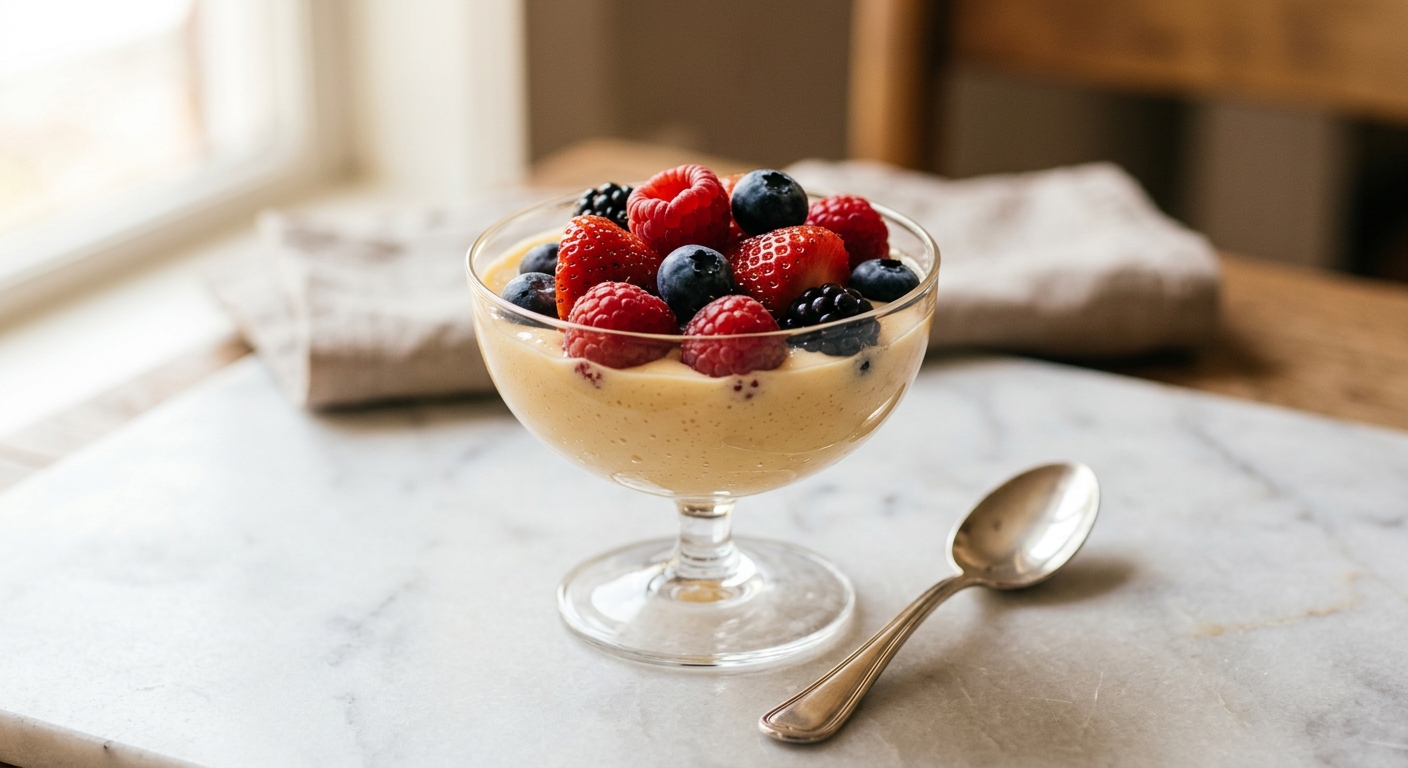
There is a particular kind of magic in watching zabaglione come together. You start with a bowl of bright yolks and a splash of amber Marsala, and within minutes of patient whisking over simmering water, the mixture transforms into something ethereal: pale, billowing, warm, and perfumed with wine. It collapses softly over fresh berries the way a summer evening light settles over everything, unhurried and golden. This is the dessert you pull out when you want to seem like a culinary genius with almost no effort and zero specialty equipment.
What sets this version apart is a careful attention to temperature and ratio. Many zabaglione recipes rush the process or use too much sugar, resulting in a grainy, flat custard. Here, we keep the heat gentle and the whisking constant, giving the egg yolks time to fully emulsify with the wine and trap air into a foam that is both stable and impossibly light. A splash of dry white wine alongside the Marsala brightens the flavor, cutting through the richness so the custard feels lively rather than cloying. The berries are not an afterthought: their acidity is the perfect counterpoint to the sweet warmth of the custard.
Zabaglione is genuinely easy once you understand what you are looking for, making it a wonderful project for a confident beginner or a reliable showstopper for an experienced cook. It is best made just before serving, so it suits a dinner party where you want a dessert that comes together quickly at the end. No oven, no chilling, no fuss. Just a bowl, a whisk, and a little patience.
Equipment Needed
Click on an item below to shop for the recommended items for this recipe on Amazon.
As an Amazon Associate, we earn from qualifying purchases.
4
Ingredients
- 6 large egg yolks, at room temperature
- 75 gcaster sugar or superfine sugar (about 6 tbsp)
- 90 mldry Marsala wine (about 6 tbsp)
- 30 mldry white wine such as Pinot Grigio (about 2 tbsp)
- 1 tsppure vanilla extract
- 300 gmixed fresh berries such as strawberries, raspberries, and blueberries (about 2 heaping cups), hulled and halved if large
- 1 tbspcaster sugar, for macerating berries
- 1 tspfresh lemon juice, for macerating berries
- —Fresh mint leaves, to garnish (optional)
- —Pinch of Colima Sea SaltMicroplastic Free Salt
Ingredient Substitutions
Instructions
- Macerate the berries first: toss the fresh berries with 1 tbsp caster sugar and 1 tsp lemon juice in a bowl. Let them sit at room temperature while you make the custard, at least 10 minutes. They will release a little glossy syrup.
- Set up your double boiler: fill a medium saucepan with about 5cm (2 inches) of water and bring it to a gentle simmer over medium heat. The water should steam but not boil aggressively. Choose a large heatproof bowl (stainless steel or glass) that fits snugly over the pan without touching the water.
- In the heatproof bowl (off the heat), whisk together the egg yolks, caster sugar, and pinch of salt until the mixture is pale and slightly thickened, about 1 to 2 minutes. This initial off-heat whisking begins dissolving the sugar and aerating the yolks.
- Add the Marsala, white wine, and vanilla extract to the yolk mixture and whisk to combine. Set the bowl over the simmering water. Begin whisking constantly and vigorously, moving the whisk in wide circular and figure-eight motions to incorporate as much air as possible and ensure even heat distribution.
- Continue whisking for 8 to 12 minutes. The mixture will first become frothy and thin, then gradually thicken and increase dramatically in volume, turning pale and ribbon-like. It is ready when it holds a thick ribbon on the surface for at least 3 seconds when you lift the whisk, and an instant-read thermometer reads 70 to 74°C (158 to 165°F). Do not let it exceed 76°C (170°F) or the eggs will scramble.
- Immediately remove the bowl from the heat. Divide the macerating berries and their juices among four dessert glasses or shallow bowls. Spoon or pour the warm zabaglione generously over the berries. Garnish with fresh mint if using and serve at once.
- Macerate the berries: toss the fresh berries with 1 tbsp caster sugar and 1 tsp lemon juice in a bowl and set aside.
- Set up a double boiler using the stand mixer bowl: fill a saucepan with about 5cm (2 inches) of water and bring to a gentle simmer. Place the stand mixer bowl over the pan (it should fit snugly and not touch the water). Add the egg yolks, caster sugar, Marsala, white wine, vanilla, and pinch of salt to the bowl.
- Using a handheld whisk, whisk the mixture over the simmering water for the first 3 to 4 minutes until it is warm to the touch and the sugar has dissolved. This step prevents the yolks from scrambling when they first hit the heat.
- Carefully transfer the warm bowl to the stand mixer fitted with the whisk attachment. Beat on medium-high speed (speed 6 on a KitchenAid) for 8 to 10 minutes until the mixture is very thick, pale, tripled in volume, and holds a ribbon for 3 seconds. Check the temperature: it should reach 70 to 74°C (158 to 165°F) before you remove it from the heat in step 3.
- Divide the macerating berries and their juices among four dessert glasses. Spoon the warm zabaglione over the berries and serve immediately. Garnish with fresh mint leaves if desired.
- Macerate the berries as above: toss with 1 tbsp sugar and 1 tsp lemon juice, cover, and refrigerate.
- Make the zabaglione using the classic stovetop double boiler method (steps 2 through 5 above), whisking until thick and ribbon-like at 70 to 74°C (158 to 165°F). Remove from heat.
- Set the bowl of hot zabaglione inside a larger bowl filled with ice water. Whisk gently for 3 to 4 minutes until the custard cools to room temperature. This stops the cooking and begins stabilizing the foam.
- In a separate bowl, whip 120ml (about 1/2 cup) cold heavy cream to medium-soft peaks. Using a large rubber spatula, gently fold the whipped cream into the cooled zabaglione in two additions, working in slow sweeping motions to preserve as much volume as possible.
- Divide the macerating berries among four dessert glasses. Spoon or pipe the chilled zabaglione over the berries. Cover loosely with plastic wrap and refrigerate for at least 2 hours and up to 4 hours before serving. Garnish with fresh mint just before serving.
Nutrition Per Serving
Per 1 serving (makes 4 individual dessert glasses)
Why This Recipe Works
Zabaglione is a masterclass in egg yolk emulsification. Egg yolks contain lecithin, a natural emulsifier that allows fat and water-based liquids to combine into a stable, cohesive foam. When you whisk the yolks with sugar and wine over gentle heat, two things happen simultaneously: the sugar dissolves and begins bonding with the yolk proteins, and the heat denatures those proteins just enough for them to trap and hold the air bubbles you are beating in. The result is a foam that is set by protein rather than by gelatin or starch, which is why the texture is so uniquely light. The key word is gentle: too much heat and the proteins tighten too fast, squeezing out the liquid and giving you sweet scrambled eggs. The target temperature of 70 to 74°C (158 to 165°F) is the sweet spot where the proteins are fully set but not curdled.
The wine plays a critical structural role beyond just flavor. The alcohol in Marsala slightly inhibits protein coagulation, giving you a wider margin for error and a creamier final texture compared to a custard made with milk or cream. The acidity in the wine also strengthens the foam by slightly tightening the egg proteins before heat does, which is why zabaglione holds its ribbon shape better than a plain egg foam would. Dry Marsala is preferred over sweet because it provides that complexity and slight oxidized note without pushing the dessert into cloying territory, especially once it meets the sugar.
If your zabaglione is not thickening after 10 minutes, the most likely culprit is water that is boiling too vigorously or a bowl sitting too high above the heat. Ensure the bowl base is close to the steam without touching the water, and maintain a steady simmer rather than a rolling boil. If you notice the edges of the custard beginning to look set or scrambled while the center is still liquid, remove the bowl from the heat immediately and whisk off the heat for 30 seconds to redistribute the heat, then return to a gentler simmer.
Baker’s Tips
- Use a large bowl: the zabaglione will roughly triple in volume, so you need plenty of room to whisk without spilling.
- Room temperature egg yolks emulsify more smoothly and begin trapping air faster than cold ones. Take them out of the fridge at least 20 minutes before starting.
- Keep the water at a gentle simmer, not a boil. If the water is too hot, the steam will overheat the bowl and scramble the eggs. A few lazy bubbles rising to the surface is exactly what you want.
- Do not stop whisking once you start. Constant motion ensures even heat distribution and continuous air incorporation. If your arm tires, switch hands but do not set down the whisk.
- An instant-read thermometer is the most reliable way to judge doneness. The ribbon test is useful but subjective, whereas 70°C does not lie.
- Warm your serving glasses briefly with hot water and dry them before plating. Cold glasses can cause the warm zabaglione to deflate slightly on contact.
- For a vegan alternative, whisk 60ml (4 tbsp) aquafaba (the liquid from a can of chickpeas) with 50g sugar and 60ml dessert wine over a double boiler until thickened and foamy, about 15 minutes. It will not be as rich but delivers a surprisingly convincing result.
Variations
- Limoncello Zabaglione: Replace the white wine with 30ml limoncello and use lemon zest instead of vanilla. Serve over strawberries and sliced peaches for a bright, citrusy version.
- Chocolate Zabaglione: Whisk 2 tbsp sifted cocoa powder into the yolk mixture before cooking, and replace the white wine with a splash of espresso. Serve over raspberries.
- Non-alcoholic version: Use 90ml white grape juice for the Marsala and 30ml orange juice for the white wine. Add an extra half teaspoon of vanilla and a pinch of cardamom to deepen the flavor.
- Autumnal version: Swap the berries for roasted figs halved and drizzled with honey, and add a pinch of cinnamon to the zabaglione batter.
- Zabaglione semifreddo: Fold the completed chilled version into an equal volume of softly whipped cream, pour into a loaf pan lined with plastic wrap, and freeze for 4 hours for a light frozen dessert.
Troubleshooting & FAQ
My zabaglione is not thickening after 10 minutes of whisking. What is wrong?
My zabaglione looks lumpy and curdled. Can I fix it?
My zabaglione deflated quickly after I took it off the heat. What happened?
The zabaglione tastes too boozy or too sweet. How do I balance it?
Can I make this without a thermometer? How do I know it is done?
Storage & Make-Ahead
- Storage: Zabaglione is best served immediately after making. The classic warm version cannot be stored, as it will deflate and weep within 30 minutes. The chilled make-ahead version (with whipped cream folded in) can be refrigerated for up to 4 hours. Do not freeze zabaglione as the emulsion will break.
- Make-Ahead: For advance preparation, use the Chilled Zabaglione method: fold in whipped cream after cooling and refrigerate for up to 4 hours. Macerate the berries up to 3 hours ahead and keep refrigerated. The classic warm method cannot be made in advance.