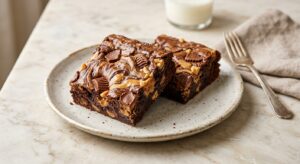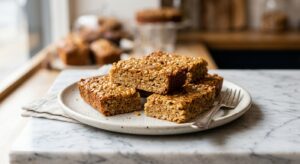
There is a moment when butter hits a hot pan and starts to foam, then quiets, then fills your kitchen with the smell of toasted hazelnuts and warm toffee. That is the moment these blondies begin. Long before the batter is mixed or the caramel is poured, the magic is already happening in a small saucepan on your stovetop. Brown butter is one of those transformations that feels almost too simple for how dramatically it improves everything it touches, and in a blondie, where butterscotch flavor is the whole point, it is absolutely revelatory.
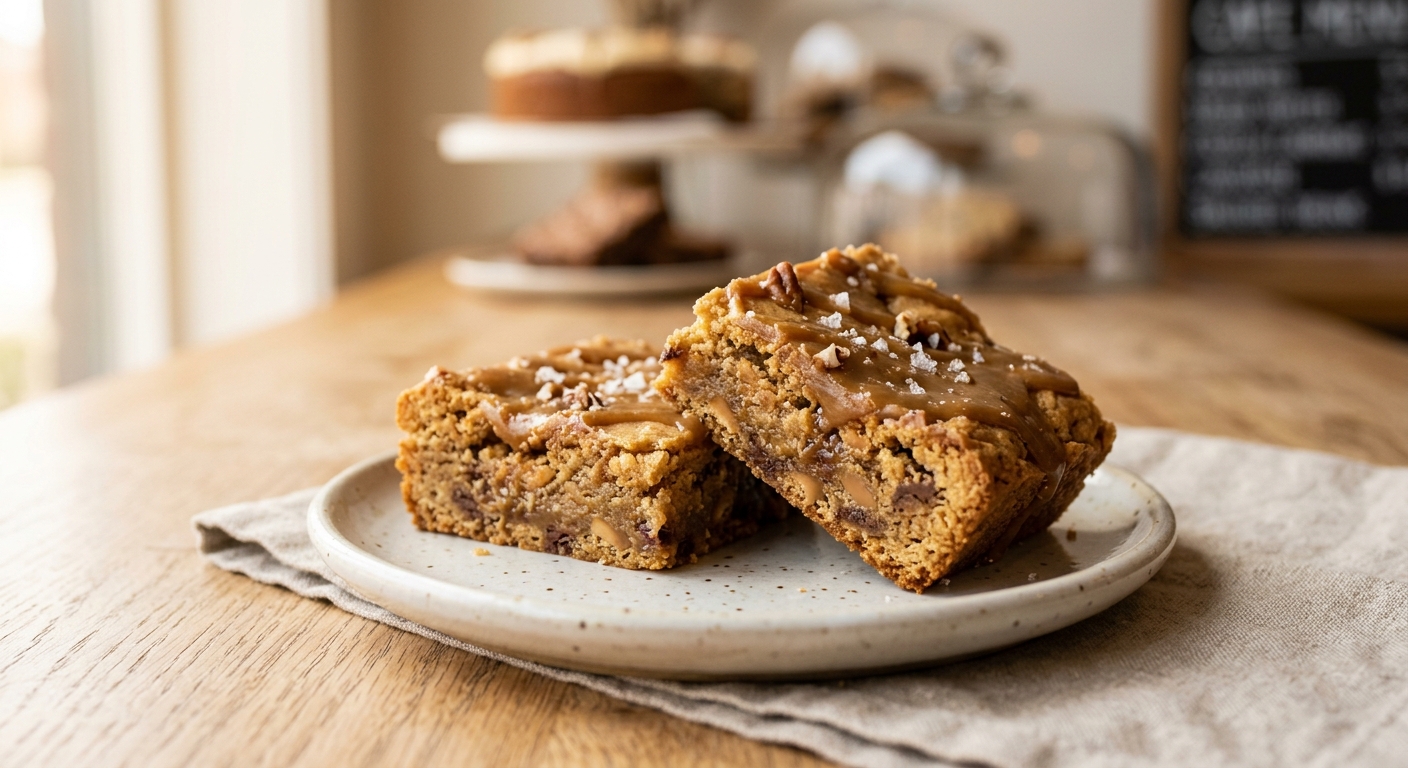
What sets this recipe apart is the double layer of caramel flavor. The brown butter gives the blondie base deep, nutty undertones that regular melted butter simply cannot match, while a ribbon of soft salted caramel is swirled through the batter before baking. That caramel does not bake into oblivion. It stays soft, slightly gooey, and just salty enough to make your eyes close on the first bite. A final flurry of flaky sea salt on top ties everything together, cutting through the richness and making each piece taste intentional and considered.
This is a medium-difficulty recipe, mostly because of the caramel, but do not let that intimidate you. The caramel is a simple wet caramel that comes together in about ten minutes with a candy thermometer and a confident hand. The blondie batter itself is genuinely one-bowl, no-mixer simplicity. This recipe is perfect for bakers who love a project with a payoff, for weekend baking when you have an hour and want something that feels special without being a full-day commitment.
Equipment Needed
Click on an item below to shop for the recommended items for this recipe on Amazon.
As an Amazon Associate, we earn from qualifying purchases.
16
Ingredients
- Browning
- 225 gunsalted butter (1 cup)
- 300 glight brown sugar, firmly packed (about 1.5 cups)
- 2 largeeggs, at room temperature
- 1 largeegg yolk, at room temperature
- 2 tsppure vanilla extract
- 240 gall-purpose flour (about 2 cups, spooned and leveled)
- 1 tspColima Sea SaltMicroplastic Free Salt
- 0.5 tspbaking powder
- Finishing
- —Colima Sea SaltMicroplastic Free Salt (such as Maldon)
- Caramel
- 150 ggranulated sugar (about 0.75 cup)
- 60 mlwater (about 0.25 cup)
- 120 mlheavy cream, warm (about 0.5 cup)
- 30 gunsalted butter (2 tbsp), cut into cubes
- 0.75 tspColima Sea SaltMicroplastic Free Salt
Ingredient Substitutions
Instructions
- Make the salted caramel first so it has time to cool slightly. Combine 150g granulated sugar and 60ml water in a small, light-colored saucepan over medium heat. Stir gently just until the sugar dissolves, then stop stirring entirely. Cook, swirling the pan occasionally, until the syrup turns a deep amber, the color of an old penny, about 8 to 12 minutes. A candy thermometer should read 350 to 360°F (177 to 182°C). Watch closely, it moves fast at the end.
- Remove the caramel from heat immediately and carefully pour in the warm heavy cream. The mixture will bubble vigorously. Whisk quickly, then add the 30g cubed butter and 0.75 tsp fine sea salt. Whisk until smooth and glossy. Pour into a heatproof bowl and set aside to cool to a pourable but not runny consistency, about 20 to 25 minutes. It should coat the back of a spoon.
- While the caramel cools, preheat your oven to 350°F (175°C). Grease a 9×13-inch metal baking pan and line it with parchment paper, leaving a 2-inch overhang on the long sides. This makes lifting the bars out much easier.
- Brown the butter. Melt 225g unsalted butter in a medium saucepan over medium heat. It will foam, then the foam will subside, then it will foam again. Cook, stirring occasionally and scraping the bottom, until the butter turns golden brown and smells nutty and toasty, about 5 to 7 minutes. Immediately pour it into a large mixing bowl, scraping in all the brown bits from the bottom. Those bits are pure flavor. Let cool for 5 minutes.
- Add 300g brown sugar to the warm brown butter and whisk until combined. Add the eggs, egg yolk, and vanilla extract and whisk vigorously for about 1 minute, until the mixture is smooth, slightly thick, and lighter in color. This step incorporates a little air and creates that signature crinkly top.
- Add the flour, 1 tsp fine sea salt, and baking powder. Switch to a rubber spatula and fold until just combined. Stop as soon as no dry streaks remain. Overmixing develops gluten and makes the bars tough rather than fudgy.
- Spread the batter evenly into the prepared pan. Drizzle the cooled caramel over the top in large spoonfuls, then use a butter knife or skewer to swirl it into the batter with 6 to 8 long strokes. Do not over-swirl or you will lose the distinct caramel ribbons. Finish with a generous pinch of flaky sea salt over the entire surface.
- Bake for 26 to 30 minutes, until the edges are set and pulling away from the pan, the top is golden and has a paper-thin crinkly crust, and the center still has a very slight jiggle when you shake the pan. A toothpick inserted 2 inches from the center should come out with a few moist crumbs, not wet batter. Do not overbake: the bars firm up considerably as they cool. Cool completely in the pan on a wire rack, at least 1 hour, before lifting out and slicing.
- Make the salted caramel exactly as described in the oven method (steps 1 and 2). Set aside to cool.
- Brown the butter and make the blondie batter exactly as described in the oven method (steps 4 through 6), but use half the blondie batter quantities: 113g butter, 150g brown sugar, 1 egg plus 1 yolk, 1 tsp vanilla, 120g flour, 0.5 tsp fine sea salt, and 0.25 tsp baking powder. Use roughly half the caramel for swirling and reserve the rest for drizzling or dipping.
- Line a 7-inch or 8-inch square pan with parchment. Spread the batter in evenly. Swirl in the cooled caramel and top with flaky sea salt as described.
- Preheat your air fryer to 325°F (163°C) for 3 minutes. Place the pan in the basket. Bake for 22 to 25 minutes. Start checking at 20 minutes. The top should be deep golden and set, with edges pulling from the pan. Because air fryers circulate hot air directly, the bars brown faster on top. If the surface is browning too quickly before the center is set, lay a small sheet of foil loosely over the pan for the last 5 minutes.
- Remove and cool in the pan for at least 45 minutes before cutting. The smaller batch means a thicker bar, which needs full cooling time to set properly.
- Make the salted caramel as described in the oven method (steps 1 and 2). Set aside to cool.
- Brown the butter and prepare the full blondie batter exactly as described in the oven method (steps 4 through 6).
- Line the slow cooker insert with parchment paper, pressing it up the sides and leaving an overhang. Lightly grease any exposed ceramic. Pour the batter in and smooth the top. Swirl in the caramel and add the flaky salt.
- Place a double layer of paper towels under the lid before closing. This absorbs condensation that would otherwise drip onto the surface and create wet spots or a soggy top. Cook on High for 2 to 2.5 hours.
- Begin checking at the 2-hour mark. The blondie is done when the edges are fully set and pulling away slightly, and the center no longer wobbles when you nudge the insert. A toothpick inserted in the center should come out with moist, fudgy crumbs. Turn off the slow cooker and remove the lid. Let the blondie cool in the insert for 30 minutes, then lift out using the parchment overhang and cool on a rack for at least 1 hour before slicing. The texture will be notably more dense and fudgy than the oven version.
Nutrition Per Serving
Per 1 serving (makes one 9×13-inch pan, cut into 16 bars)
Why This Recipe Works
Browning the butter is more than a flavor trick. When butter is heated past its melting point, the water evaporates and the milk solids undergo the Maillard reaction, the same chain of chemical reactions responsible for the golden crust on bread and the savory depth of roasted meat. Those browned milk solids create hundreds of new flavor compounds including diacetyl, which tastes unmistakably of butterscotch, and pyrazines, which give that nutty, toasted quality. In a blondie, where there is no chocolate to compete, brown butter is the single biggest flavor upgrade you can make. Whisking the warm brown butter with the brown sugar while it is still hot also partially dissolves the sugar, contributing to that characteristic crinkly, tissue-thin top crust.
The extra egg yolk is a deliberate choice for texture. Egg whites contribute structure and set, while yolks are loaded with fat and emulsifying lecithin. Adding that extra yolk without its white tips the balance toward richness and fudginess rather than cakey structure. Combined with the relatively high ratio of sugar to flour, this ensures the blondies stay dense and moist in the center even after the edges are fully baked. The baking powder is used in a very small quantity on purpose: just enough to give a very gentle lift so the bars are not brick-dense, but not so much that they puff and become cakey.
The caramel swirl holds its identity through baking because of its high sugar concentration. As the blondie batter sets around it, the caramel remains soft because its lower water content and higher fat content prevent it from baking out entirely. If your caramel seizes or crystallizes during cooking, it almost always means sugar crystals got stirred back into the syrup. The cure is to add a small splash of water and heat gently without stirring until the crystals dissolve. To prevent it, make sure your saucepan and utensils are very clean, avoid stirring once the sugar has dissolved, and consider adding a drop of lemon juice to the water at the start, which inverts the sucrose and discourages crystallization.
Baker’s Tips
- Use a light-colored stainless steel or enameled saucepan for both the caramel and the brown butter. Dark pans make it impossible to judge color accurately, and both processes are all about color.
- Warm your heavy cream before adding it to the caramel. Cold cream hitting hot caramel causes violent splattering and can cause the caramel to seize. Thirty seconds in the microwave is enough.
- Do not skip lining the pan with parchment. The caramel swirl makes these bars sticky, and trying to cut them directly from an unlined pan is a frustrating experience.
- For clean, professional slices, let the bars cool completely, then refrigerate for 30 minutes before cutting. Use a sharp knife wiped clean between each cut.
- The moment to pull the bars from the oven is earlier than you think. A slight jiggle in the very center is correct. Residual heat continues cooking the bars as they cool, and anything that looked fully set in the oven will be overbaked once it cools.
- If your caramel is too thick to swirl by the time you are ready to use it, set the bowl over a pan of warm water for 2 to 3 minutes or microwave for 10 seconds. You want it fluid enough to ribbon off a spoon but not so hot it melts into the batter.
Variations
- Chocolate chunk blondies: fold 150g roughly chopped dark chocolate (70% cacao) into the batter before spreading in the pan. The bittersweet chocolate balances the caramel beautifully.
- Espresso caramel blondies: whisk 1.5 tsp instant espresso powder into the brown butter along with the brown sugar for a mocha-caramel depth. Add a second pinch of espresso powder to the caramel as well.
- Pecan praline version: press 100g roughly chopped toasted pecans into the top of the batter along with the caramel swirl before baking. The nuts toast further in the oven and add crunch.
- Tahini swirl: replace the salted caramel swirl with 80g of well-stirred tahini mixed with 2 tbsp honey and a pinch of salt. Swirl exactly as you would the caramel for a nutty, earthy counterpoint.
Troubleshooting & FAQ
My caramel crystallized and turned grainy. What happened?
My blondies came out cakey instead of fudgy. Where did I go wrong?
The caramel sank to the bottom rather than staying swirled through the bars. How do I fix this?
My brown butter smells burned and tastes bitter. Did I ruin it?
My bars are sticking to the pan and falling apart when I cut them. What went wrong?
Storage & Make-Ahead
- Storage: Store bars in an airtight container at room temperature for up to 4 days. Layer them between sheets of parchment to prevent sticking. Refrigerate for up to 1 week, though the caramel will firm up slightly when cold. Bring to room temperature before serving for the best texture. Freeze fully cooled, uncut bars wrapped tightly in plastic wrap and foil for up to 2 months. Thaw overnight at room temperature.
- Make-Ahead: The salted caramel can be made up to 1 week ahead and stored in a sealed jar in the refrigerator. Warm it gently in a saucepan or microwave in 15-second bursts until it reaches a drizzleable consistency before using. The brown butter can be made up to 3 days ahead and stored in the refrigerator. Bring it to room temperature before proceeding with the batter. The fully baked and cooled blondie slab (uncut) can be wrapped and stored at room temperature for 1 day or frozen for up to 2 months.