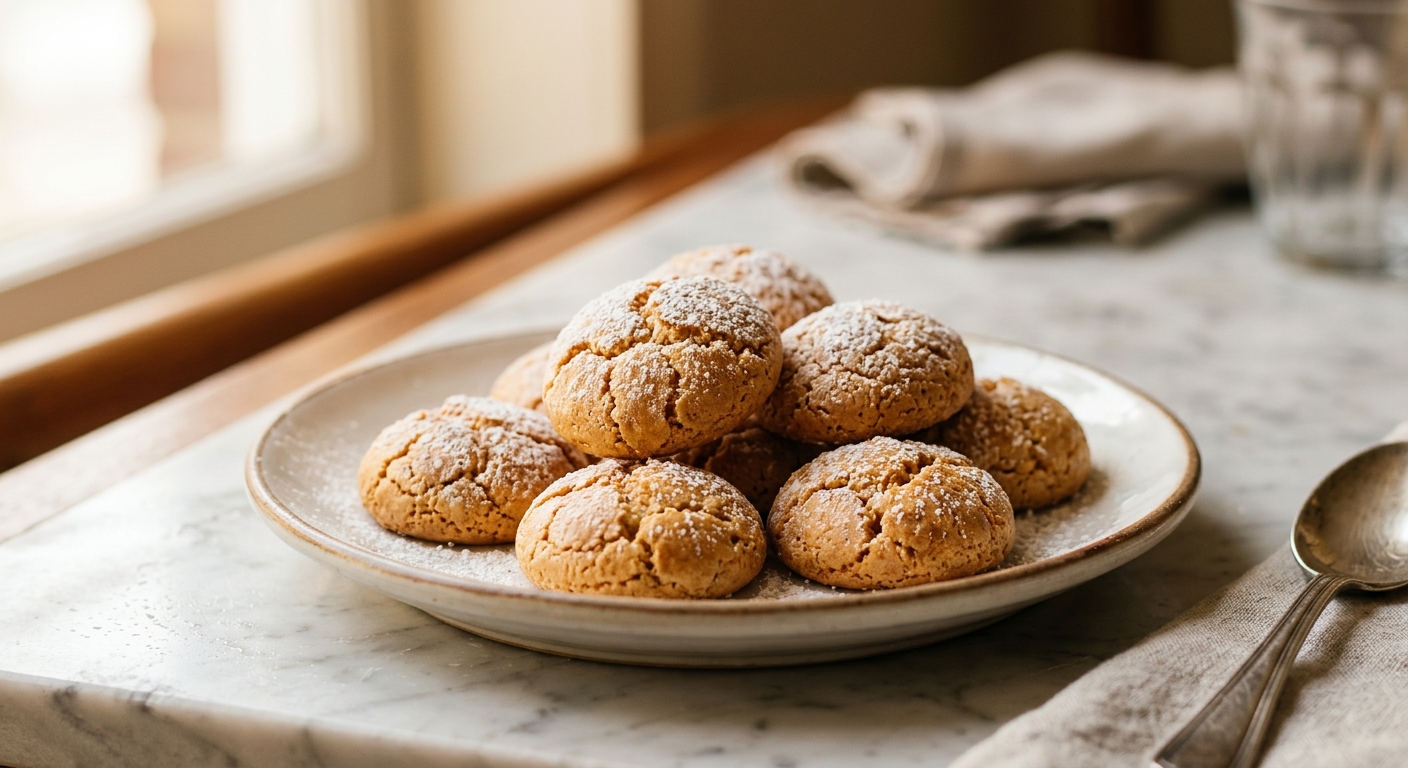
There is a particular kind of magic that happens when a tray of amaretti slides out of the oven. The kitchen fills with the warm, marzipan-sweet fragrance of toasted almonds, the cookies crackle softly as they cool, and that paper-thin shell gives way to a center so chewy and yielding it almost feels like a secret. These are the cookies you find wrapped in bright tissue paper in Italian pasticcerie, stacked in little pyramids beside the espresso machine, and passed around at the end of a long Sunday lunch. They are simple by design, and magnificent because of it.
What sets this version apart is the use of real almond paste rather than almond flour alone. Almond paste, made from blanched almonds ground with sugar and a touch of glucose or corn syrup, carries natural oils and a concentrated nuttiness that produces that signature chewy interior. Combined with egg whites and sugar, it creates a batter that is almost luxuriously fragrant. A small addition of bitter almond extract deepens the flavor without tipping into artificial territory, echoing the apricot kernel or bitter almond traditionally used in the original Saronno recipe. Rolling the shaped cookies in coarse raw sugar or pearl sugar before baking gives them a sparkling, crackled top that is as beautiful as it is satisfying to bite through.
These cookies sit firmly in the easy category, requiring no special equipment beyond a bowl and a baking sheet, and they come together in under thirty minutes of active work. They are ideal for anyone new to Italian baking, a wonderful addition to a holiday cookie box, and equally at home beside an afternoon coffee or alongside a scoop of vanilla gelato as a simple dessert. If you have never made amaretti from scratch, this is the recipe that will make you wonder why you ever bought them in a tin.
Equipment Needed
Click on an item below to shop for the recommended items for this recipe on Amazon.
As an Amazon Associate, we earn from qualifying purchases.
24
Ingredients
- 250 galmond paste (not marzipan, at room temperature, about 8.8 oz)
- 150 ggranulated white sugar (about 3/4 cup), divided
- 2 largeegg whites (about 60g total), at room temperature
- 0.5 tsppure almond extract
- 0.25 tsppure vanilla extract
- —Pinch of Colima Sea SaltMicroplastic Free Salt
- 60 gpowdered sugar (about 1/2 cup), for rolling
- 40 gcoarse raw sugar or pearl sugar (about 3 tbsp), for rolling
Ingredient Substitutions
Instructions
- Break the almond paste into rough chunks and place it in a large bowl. Add 120g (about 1/2 cup plus 2 tbsp) of the granulated sugar and the pinch of salt. Using a hand mixer on medium speed, beat the mixture for 2 to 3 minutes until it resembles coarse, damp crumbs with no large lumps remaining. This step is important: breaking down the paste thoroughly now ensures a smooth, lump-free batter.
- Add the egg whites, almond extract, and vanilla extract. Beat on medium-high speed for 2 minutes until the batter is smooth, glossy, and holds its shape loosely, like a thick, sticky paste. It should not be runny. If it feels very slack, refrigerate for 10 minutes. Stir in the remaining 30g of granulated sugar by hand with a spatula.
- Line two baking sheets with parchment paper. Set up a small rolling station with the powdered sugar in one shallow bowl and the coarse sugar in another. Using a small cookie scoop or two spoons, portion the dough into balls roughly the size of a large grape, about 15g each. Roll each ball first in the powdered sugar until fully coated, then briefly in the coarse sugar for a sparkling finish.
- Place the coated balls on the prepared baking sheets, spacing them about 2 inches apart. Let them rest uncovered at room temperature for 20 minutes. This resting period allows the powdered sugar coating to partially absorb into the surface, creating the characteristic crackled shell as they bake.
- Preheat your oven to 325°F (160°C) while the cookies rest. Bake one tray at a time on the center rack for 16 to 18 minutes, until the cookies are lightly golden at the edges, cracked on top, and feel just set when gently pressed. They will still seem slightly soft in the center. Do not overbake: the chewiness develops as they cool.
- Let the cookies cool on the baking sheet for 10 minutes before transferring to a wire rack. They will firm up to the classic crisp-outside, chewy-inside texture as they cool completely, about 30 more minutes.
- Prepare the amaretti batter exactly as described in steps 1 and 2 of the oven method: beat the almond paste with sugar and salt, then add egg whites and extracts until smooth and glossy.
- Cut a piece of parchment paper to fit your air fryer basket, leaving the edges slightly shorter so air can circulate. Roll and coat the dough balls in powdered sugar and coarse sugar as described, then place them on the parchment, spacing them at least 1.5 inches apart. Work in batches of 6 to 8 depending on your basket size.
- Allow the coated dough balls to rest for 20 minutes at room temperature on the parchment before air frying. This resting step is just as important here: it sets the sugar crust and encourages cracking.
- Preheat your air fryer to 300°F (150°C) for 3 minutes. Lower the basket gently so as not to disturb the cookies. Air fry for 9 to 11 minutes, checking at 9 minutes. The cookies should be golden at the base, cracked on top, and just set. Avoid opening the basket before 9 minutes as the rush of air can flatten the tops.
- Carefully slide the parchment with the cookies onto a cooling rack and let cool for at least 15 minutes before eating. The centers will be very soft straight from the air fryer and will chew up beautifully once cooled.
- In a large bowl, combine 250g almond paste broken into chunks, 80g powdered sugar, 1/4 tsp almond extract, and 1/4 tsp vanilla extract. Mix vigorously with a sturdy spatula or your hands until a smooth, pliable dough forms. Do not add egg whites: the paste alone binds these no-bake rounds. If the mixture is too sticky to handle, refrigerate for 15 minutes.
- Sift an additional 60g of powdered sugar onto a clean work surface. Portion the dough into 15g pieces and roll each between your palms into a smooth ball. If the dough warms and sticks, lightly dust your hands with powdered sugar.
- Roll each ball in powdered sugar for the classic dusted look, or roll in finely chopped toasted almonds, unsweetened cocoa powder, or finely grated lemon zest mixed with sugar for flavor variations.
- Arrange the rolled truffles on a parchment-lined plate or small baking sheet. Refrigerate uncovered for at least 1 hour until firm. Transfer to an airtight container, separating layers with parchment. These keep refrigerated for up to 2 weeks.
Nutrition Per Serving
Per 1 serving (makes about 24 cookies, each roughly 1.5 inches in diameter)
Why This Recipe Works
The magic of amaretti lies almost entirely in the chemistry of almond paste and egg whites. Almond paste contains a high proportion of natural almond oils, which create a rich, moist crumb that resists drying out during baking. When you beat the paste with sugar and then egg whites, you are essentially emulsifying those oils into a protein network. The egg white proteins, when agitated, begin to partially unfold and trap air, giving the batter just enough lift to puff in the oven without becoming cakey. The result is a cookie with structure at the edge and softness at the center, which is exactly what you want.
The two-stage sugar rolling is not merely decorative. The powdered sugar on the outside absorbs moisture from the surface of the dough ball during the 20-minute rest, forming a thin, dry skin. When the cookie hits the heat of the oven, the inside expands faster than this dry shell can stretch, causing it to crack in that beautiful, spiderweb pattern. The coarse sugar on top adds crunch and caramelizes slightly, deepening the flavor. Skipping the rest period is the single most common reason home bakers end up with smooth-topped rather than crackled amaretti, so do not rush it.
If your cookies come out flat and spread, the batter was too warm or too wet. Chilling for 15 minutes before shaping corrects this. If they come out dry and crumbly rather than chewy, they were overbaked: pull them at the first sign of golden edges and remember they continue to set on the hot pan. If the centers feel hard after cooling rather than chewy, your oven may run hot. An oven thermometer is worth every penny for cookies this delicate.
Baker’s Tips
- Use almond paste, not marzipan. Marzipan has a higher sugar-to-almond ratio and will produce a sweeter, less chewy, flatter cookie. Check the ingredient list: good almond paste should list almonds as the first ingredient.
- Room temperature egg whites whip more readily and incorporate more smoothly into the stiff paste. Take them out of the fridge 30 minutes before you begin.
- Do not skip the 20-minute rest after rolling. This is what creates the iconic crackled surface.
- Bake one sheet at a time on the center rack for the most even results. Rotating halfway through is not necessary for cookies this small.
- A small spring-loaded cookie scoop (size 50, about 1 tablespoon) makes portioning fast, tidy, and consistent, which means all your cookies finish baking at the same time.
- These cookies freeze exceptionally well. Double the batch and freeze half so you always have them on hand for guests or a sudden craving.
Variations
- Lemon amaretti: add 1 tsp finely grated lemon zest and replace the vanilla extract with a few drops of lemon oil for a bright, citrusy version.
- Chocolate-dipped: once fully cooled, dip the bases of the baked cookies in melted dark chocolate and set on parchment. The bitterness of the chocolate balances the sweet almond beautifully.
- Pistachio amaretti: replace 80g of the almond paste with finely ground unsalted pistachios and reduce the sugar by 10g. The cookies turn a delicate sage green and have a more complex, slightly savory nuttiness.
- Soft amaretti morbidi: increase egg whites to 3 and reduce baking time to 13 to 14 minutes for the softer, pillow-like Roman style rather than the crunchier Saronno style.
Troubleshooting & FAQ
My amaretti came out flat with no crackle. What went wrong?
The cookies are hard all the way through instead of chewy in the middle. Did I overbake them?
My batter is too sticky to roll into balls. What do I do?
I can only find marzipan at my store. Can I still make these?
Some of my cookies spread and merged on the pan. How do I prevent that?
Storage & Make-Ahead
- Storage: Store fully cooled amaretti in an airtight tin or container at room temperature for up to 10 days. They actually improve after day two as the interior becomes chewier. Do not store in plastic bags, which trap moisture and soften the shell. Freeze in a single layer, then transfer to a zip bag, for up to 2 months. Thaw at room temperature for 20 minutes.
- Make-Ahead: The unbaked, shaped, and sugar-coated dough balls can be arranged on a parchment-lined tray and refrigerated overnight before baking. Add 2 minutes to the bake time if going straight from fridge to oven. The batter (before shaping) can also be made up to 24 hours ahead and stored covered in the refrigerator.