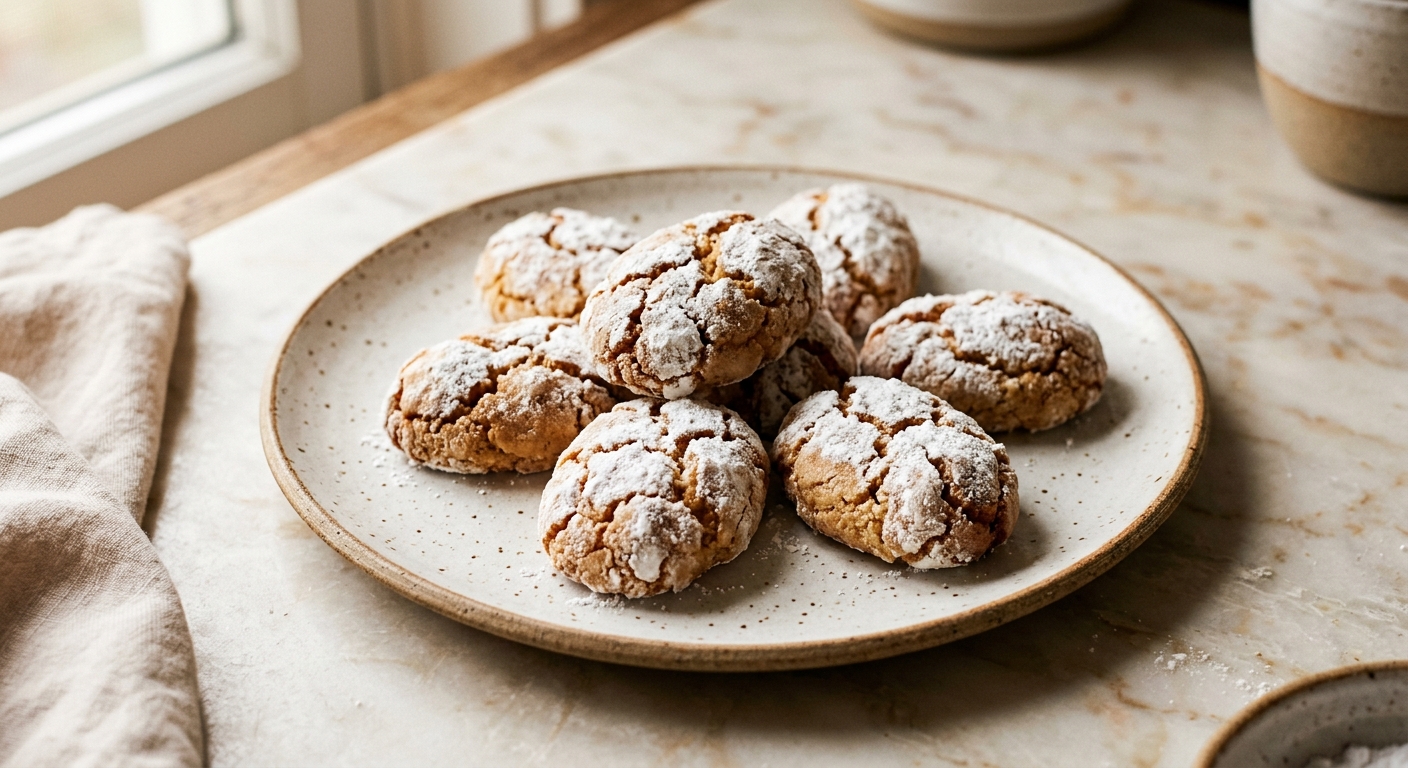
There is a particular kind of cookie that stops you mid-bite and makes you set down whatever you were doing. Ricciarelli are that cookie. Originating in Siena, Tuscany, these soft, diamond-shaped almond sweets have been baked since the Renaissance, and one taste tells you exactly why they’ve endured. The outside crackles gently under a dusting of powdered sugar, giving way to an interior that is dense, chewy, and heady with almond fragrance – somewhere between a macaron, a marzipan, and something entirely their own.
What sets this version apart is the use of both pure almond extract and a small amount of bitter almond extract (or amaretto liqueur), which gives ricciarelli their signature depth. Authentic recipes rely on aging the almond paste overnight, a simple but transformative step that deepens the flavor and firms the texture so the cookies hold their shape and develop those beautiful surface cracks. The dough is egg-white based, making these naturally gluten-free and dairy-free, and the lack of fat beyond what lives in the almonds themselves gives them a clean, pure flavor that lets the nut truly shine.
Ricciarelli fall firmly in the medium-difficulty category – they are straightforward in technique but require patience, particularly during the overnight rest. They are ideal for bakers who love exploring traditional European confections, anyone baking for the holidays (these are a classic Italian Christmas cookie), and anyone who simply wants something genuinely impressive that does not demand hours of decorating. If you love amaretti, you will adore ricciarelli.
Equipment Needed
Click on an item below to shop for the recommended items for this recipe on Amazon.
As an Amazon Associate, we earn from qualifying purchases.
24
Ingredients
- 250 gblanched almond flour, finely ground (about 2.5 cups) – not almond meal with skins
- 200 gpowdered sugar, sifted (about 1.75 cups), plus extra for coating
- 1 tsppure almond extract
- 0.5 tspbitter almond extract, or 1 tbsp amaretto liqueur
- 1 tspfinely grated orange zest (from about half a large orange)
- 0.25 tspbaking powder
- —Pinch of Colima Sea SaltMicroplastic Free Salt
- 2 largeegg whites (about 60 g / 2 oz), at room temperature
- 50 gpowdered sugar for coating the shaped cookies (about 0.5 cup)
Ingredient Substitutions
Instructions
- Make the almond paste: In a large bowl, whisk together the blanched almond flour, 200 g sifted powdered sugar, baking powder, and salt until evenly combined. Stir in the almond extract, bitter almond extract (or amaretto), and orange zest.
- Add the egg whites: Add the egg whites one at a time, stirring vigorously with a silicone spatula or wooden spoon after each addition. The dough will come together into a soft, slightly sticky paste that holds its shape when pressed. It should not be wet or runny – if it feels very loose, add 1 to 2 tablespoons of additional almond flour. Cover the bowl tightly with plastic wrap and refrigerate overnight (8 to 12 hours minimum). This rest is essential: it firms the dough and deepens the flavor.
- The next day, preheat your oven to 325°F (160°C). Line two baking sheets with parchment paper. Place the 50 g of additional powdered sugar in a shallow bowl.
- Shape the cookies: Scoop the dough into roughly 25 g (1 tablespoon) portions. Roll each portion into a short oval or log with your palms, then gently flatten into a classic diamond or oval shape about 1 inch wide and 2 inches long and roughly 0.5 inch thick. Roll each shaped cookie generously in the powdered sugar, pressing lightly so it adheres on all sides.
- Arrange the coated cookies on the prepared baking sheets, spacing them at least 1.5 inches apart. They spread very little, but the sugar coating needs airflow to crack properly.
- Bake for 14 to 16 minutes. The cookies are done when the sugar coating has crackled beautifully and the edges look just barely set with a hint of golden color at the base. The centers will feel soft – this is correct. They firm up as they cool.
- Remove from the oven and let the cookies cool completely on the baking sheet for at least 20 minutes before moving them. They are delicate when warm. Once cooled, dust lightly with a little extra powdered sugar before serving if desired.
- Prepare the dough exactly as described in the oven method, including the overnight refrigerator rest. Do not skip this step – the rested dough is essential for the right texture and the crackled crust.
- Preheat your air fryer to 300°F (150°C) for 3 minutes. Cut a piece of parchment paper to fit your air fryer basket, leaving a 0.5-inch border on all sides for airflow. Do not use foil – it prevents the cookies from developing cracks.
- Shape and coat the cookies in powdered sugar as described in the oven method. Place 6 to 8 cookies in a single layer in the air fryer basket, spaced at least 1 inch apart. Do not stack or crowd them.
- Air fry at 300°F (150°C) for 10 to 12 minutes. Check at the 10-minute mark: the cookies should show clear cracks across the sugar coating and the bases should be pale golden. Because air fryers vary, your first batch is a test batch – adjust timing by 1 to 2 minutes as needed.
- Use a thin spatula to carefully lift the cookies onto a wire rack. They will be very soft straight from the fryer. Cool for at least 15 minutes before handling. Repeat with remaining batches. Dust with extra powdered sugar before serving.
Nutrition Per Serving
Per 1 serving (makes about 24 cookies)
Why This Recipe Works
Ricciarelli are built on a principle borrowed from French macarons and Italian marzipan: fat-rich almond flour bound with egg whites and sugar behaves like a meringue-adjacent dough rather than a conventional cookie batter. The egg whites provide just enough moisture and protein structure to hold everything together without adding fat, which is why the final texture is chewy and dense rather than crumbly or cakey. Because there is no gluten network and no creamed butter, the cookies cannot become tough or dry from overmixing, making them forgiving despite their seemingly finicky nature.
The overnight rest is not optional – it is the secret to the crackled crust that makes ricciarelli visually iconic. During the rest, the sugar absorbs moisture from the egg whites, firming the exterior of the dough. When a thoroughly coated cookie hits the heat of the oven, the still-soft interior begins to expand while the set, sugar-crusted exterior resists, forcing it to crack. Cookies baked without resting will be flat, glossy, and crack-free. The rest also allows the almond oils to fully hydrate the dry ingredients, deepening flavor in the same way that letting a pie dough rest improves its texture.
Baking at the lower temperature of 325°F (160°C) rather than a standard 350°F (175°C) is deliberate. Ricciarelli need time to set through without browning, since their high sugar content means they would caramelize and harden at higher temperatures before the interior has a chance to cook. The cookies will look underdone when you pull them from the oven – the centers soft, the edges barely colored – but residual heat continues to set them on the pan. Resist the urge to bake longer: an overbaked ricciarello is dry and hard, losing its signature chew entirely.
Baker’s Tips
- Use finely ground blanched almond flour, not almond meal. Coarse or skin-on meal produces a grainy texture and darker color that diminishes the delicate look of these cookies.
- Room-temperature egg whites incorporate more easily and evenly into the almond mixture. Cold whites can make the dough feel stiff and uneven.
- Do not skip the overnight rest. Even 4 hours will work in a pinch, but 8 to 12 hours gives you the best cracks and the deepest flavor.
- Be generous with the powdered sugar coating. Roll each cookie twice if needed. The thick coating is what cracks dramatically in the oven – a thin coating will barely show.
- The cookies are done when they crack but the center still looks slightly underset. They will firm to a perfectly chewy texture as they cool. If in doubt, err on the side of pulling them out earlier.
- A kitchen scale makes this recipe much easier and more consistent. Almond flour is particularly prone to volume variation depending on how it settles.
- For the most beautiful cracks, place coated cookies on the baking sheet and let them sit at room temperature for 15 minutes before baking. This allows the powdered sugar to form a thin dry film on the surface.
Variations
- Chocolate ricciarelli: Replace 30 g of the almond flour with high-quality Dutch-process cocoa powder and add 0.5 tsp vanilla extract alongside the almond extract. Roll in cocoa-dusted powdered sugar (1 tsp cocoa per 50 g sugar) for a moody, elegant variation.
- Pistachio ricciarelli: Substitute 80 g of the almond flour with finely ground blanched pistachios. Omit the bitter almond extract and use 1 tsp vanilla instead. The cookies take on a subtle green hue and a richer, earthier flavor.
- Lemon and almond: Replace orange zest with 1.5 tsp lemon zest and add 0.5 tsp pure vanilla extract. Swap amaretto for 1 tsp limoncello for a bright, sunny variation.
Troubleshooting & FAQ
My cookies did not crack – they came out smooth and glossy. What went wrong?
My dough is too sticky to shape – it’s sticking to my hands and falling apart.
The cookies came out hard and dry, not chewy.
Can I make these without the overnight rest?
My cookies spread into flat discs rather than keeping their oval shape.
Storage & Make-Ahead
- Storage: Store ricciarelli in an airtight container at room temperature for up to 10 days – they actually improve after the first day as the texture softens and the flavors meld. Layer them between sheets of parchment paper. Do not refrigerate: the moisture will dissolve the sugar coating. Freeze in an airtight container for up to 2 months; thaw uncovered at room temperature for 30 minutes and re-dust with powdered sugar before serving.
- Make-Ahead: The dough must rest overnight and can stay refrigerated for up to 3 days before baking, making it ideal for spreading holiday baking over several days. Shaped and sugar-coated unbaked cookies can be frozen on a baking sheet until solid, then stored in a zip-lock bag for up to 1 month – bake from frozen, adding 2 to 3 extra minutes to the bake time. Baked cookies store so well that baking a full batch 3 to 4 days ahead is genuinely recommended.