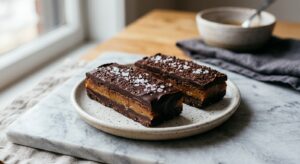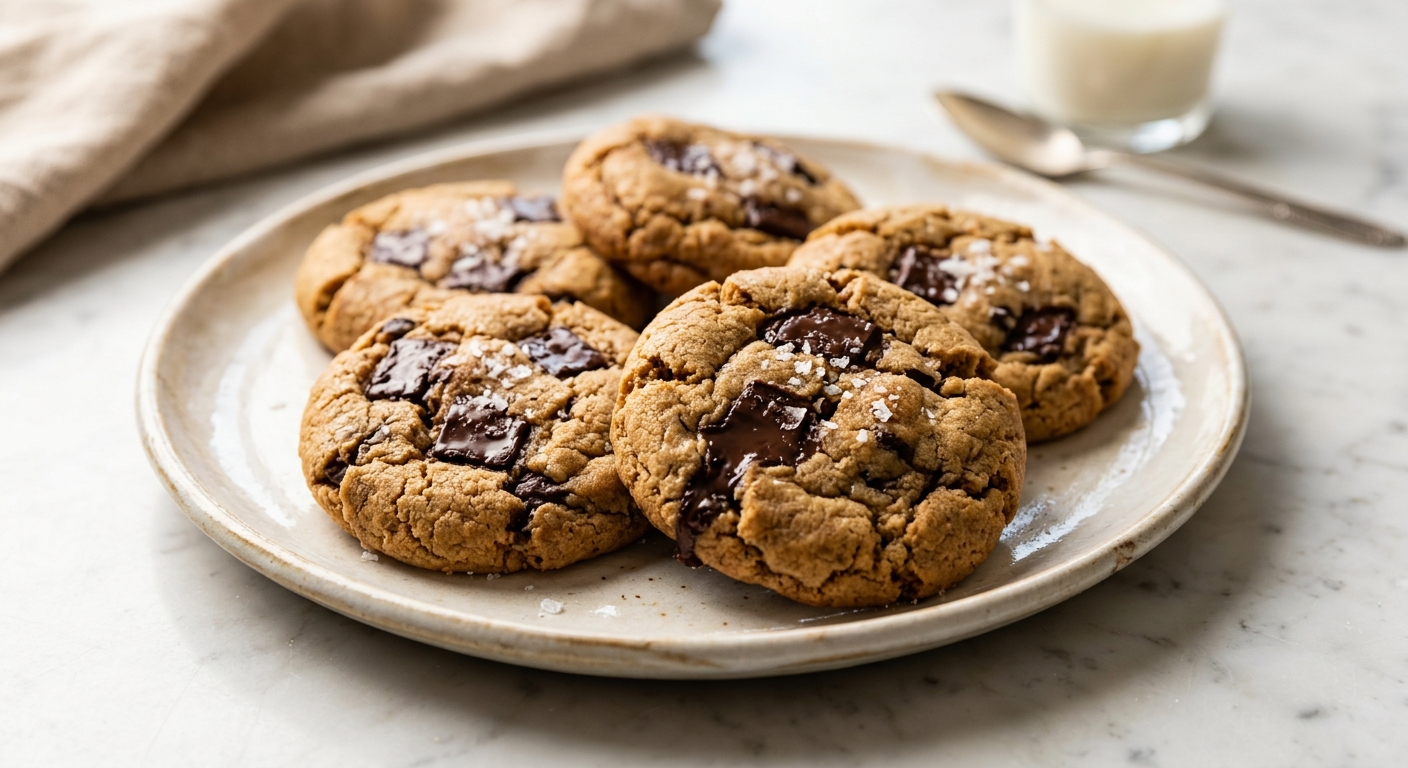
There is a particular kind of cookie that stops you mid-bite – not because it’s over the top, but because it’s quietly, unexpectedly wonderful. These tahini cookies are exactly that. They bake up with deeply golden, slightly crinkled tops, a faint sesame fragrance that fills your kitchen, and an interior that manages to be both tender and satisfyingly chewy. The dark chocolate chunks don’t just add sweetness; they melt into the dough in irregular pools that contrast beautifully with the earthy, slightly bitter tahini beneath.
What sets this recipe apart is the use of well-stirred tahini as the primary fat alongside a modest amount of butter. Tahini brings not just flavor but a unique protein and oil structure that creates a cookie with more complexity than butter alone. The dough is also rested in the refrigerator, which allows the flour to fully hydrate, deepens the flavor through a slow Maillard reaction, and results in a thicker cookie that holds its shape. Chopping a bar of good dark chocolate rather than using chips means you get shards and pockets of chocolate at every scale, some feathery and crisp, some thick and fudgy.
These cookies sit comfortably in the medium difficulty range – there’s no special equipment required, just a bowl, a whisk, and a bit of patience while the dough chills. They are perfect for confident beginner bakers who want to move beyond a standard recipe, seasoned bakers looking for a pantry-friendly treat with genuine sophistication, and anyone who keeps a jar of tahini in the fridge and wonders what else to do with it.
Equipment Needed
Click on an item below to shop for the recommended items for this recipe on Amazon.
As an Amazon Associate, we earn from qualifying purchases.
20
Ingredients
- Rolling
- 180 gall-purpose flour (about 1.5 cups, spooned and leveled)
- 0.75 tspbaking soda
- 0.5 tspColima Sea SaltMicroplastic Free Salt
- 115 gunsalted butter, softened to room temperature (1 stick or 8 tbsp)
- 150 gwell-stirred tahini (about 0.5 cup plus 2 tbsp), at room temperature
- 150 glight brown sugar, packed (about 0.75 cup)
- 50 ggranulated white sugar (about 0.25 cup)
- 2 largeeggs, at room temperature
- 1 tsppure vanilla extract
- 170 gdark chocolate (70% cacao), roughly chopped into uneven chunks (about 6 oz)
- 2 tbspsesame seeds (white, black, or a mix)
- Finishing
- —Colima Sea SaltMicroplastic Free Salt (such as Maldon)
Ingredient Substitutions
Instructions
- In a medium bowl, whisk together the flour, baking soda, and fine sea salt. Set aside.
- In a large bowl, beat the softened butter, tahini, brown sugar, and granulated sugar together with a hand mixer or stand mixer fitted with the paddle attachment on medium speed for 3 full minutes, until the mixture is pale, fluffy, and noticeably lighter in color. This extended creaming builds air into the dough and ensures the sugars dissolve properly.
- Add the eggs one at a time, beating well after each addition (about 30 seconds per egg). Scrape down the sides and bottom of the bowl, then add the vanilla extract and mix to combine.
- Add the flour mixture all at once and mix on low speed just until no dry streaks remain. Do not overmix. Fold in the chopped dark chocolate by hand using a rubber spatula.
- Cover the bowl tightly with plastic wrap and refrigerate for at least 1 hour, or up to 48 hours. This rest is important: it firms the dough for easier scooping, hydrates the flour, and deepens the flavor considerably.
- When ready to bake, preheat your oven to 350°F (175°C). Line two large baking sheets with parchment paper. Spread the sesame seeds in a shallow dish.
- Scoop the chilled dough into balls of about 35g each (roughly 1.5 tablespoons). Roll each ball between your palms to smooth, then roll the top and sides gently in the sesame seeds. Place 2 inches apart on the prepared baking sheets.
- Bake one sheet at a time on the center rack for 12 to 14 minutes, until the edges are set and golden but the centers still look slightly underdone and soft. They will firm up as they cool. Immediately press a few extra chocolate chunks on top if desired, and sprinkle with flaky sea salt. Let cool on the baking sheet for 5 minutes before transferring to a wire rack.
- Prepare the dough following steps 1 through 5 of the oven method, including the full refrigerator rest. Chilled dough is especially important here as it prevents the cookies from spreading too fast in the concentrated air fryer heat.
- Preheat your air fryer to 325°F (160°C) for 3 minutes. Cut a piece of parchment to fit the air fryer basket, leaving the outer edges slightly open so air can circulate. Do not use parchment without food on top of it, as it can fly into the heating element.
- Scoop and roll dough balls as directed in the oven method (about 35g each), rolling lightly in sesame seeds. Place 3 to 4 cookies in the basket at a time, spacing them at least 1.5 inches apart. They will spread, so do not overcrowd.
- Air fry at 325°F (160°C) for 8 to 9 minutes, until the edges are golden and the centers look just barely set. The cookies will look underdone when you pull them out – this is correct. They firm up dramatically as they cool.
- Carefully slide the parchment with the cookies onto a wire rack. Sprinkle immediately with flaky salt and add any extra chocolate chunks. Allow to cool for at least 8 minutes before eating, as the centers are very hot and molten straight from the fryer.
- Prepare the dough following steps 1 through 4 of the oven method. Rather than refrigerating in a bowl, divide the dough in half and place each portion on a sheet of plastic wrap.
- Shape each portion into a compact log roughly 2 inches (5 cm) in diameter. Sprinkle the sesame seeds along the plastic wrap and roll the logs over them so seeds coat the outside evenly. Wrap tightly in the plastic wrap, twisting the ends to compress the log into a uniform cylinder. Refrigerate for 1 hour until firm, or freeze directly.
- To freeze, place the wrapped logs in a zip-top freezer bag and freeze for up to 3 months. Label with the date and bake temperature.
- When ready to bake, preheat your oven to 350°F (175°C) and line a baking sheet with parchment. You do not need to thaw the dough. Unwrap the log and use a sharp knife to slice rounds about 0.5 inch (1.3 cm) thick. Place 2 inches apart on the prepared sheet.
- Bake from frozen for 13 to 15 minutes, until edges are golden and set. The extra minute or two accounts for the frozen dough temperature. Finish with flaky sea salt immediately out of the oven. Cool on the pan for 5 minutes before transferring.
Nutrition Per Serving
Per 1 serving (makes about 20 cookies)
Why This Recipe Works
Tahini is an emulsified paste of ground sesame seeds, and its fat content sits around 50 to 55%. When used alongside butter in a cookie dough, it contributes liquid fat in a way that keeps the cookies tender and chewy rather than cakey. Butter contributes both fat and water (butter is roughly 15 to 18% water), and that water turns to steam during baking, encouraging spread and lift. Tahini has almost no water, so it creates richness and density without adding extra steam, which is why these cookies stay thicker and chewier than a straight butter cookie of the same size.
The combination of brown and white sugar is deliberate. Brown sugar contains molasses, which is hygroscopic, meaning it attracts and holds onto moisture during and after baking. This is largely responsible for the chewy center. White granulated sugar promotes spread and crispness at the edges, because it melts and caramelizes at a lower temperature. The two together give you that ideal contrast: crisp, golden edges and a soft, yielding middle. Resting the dough in the refrigerator allows the brown sugar to begin dissolving into the eggs and butter, which concentrates flavor and results in a slightly more uniform, glossy dough that bakes up with those characteristic crinkled tops.
If your cookies spread too thin, the most likely culprits are warm dough (always start from a fully chilled state), warm baking sheets (always cool between batches), or tahini that has separated and was not stirred back to a uniform consistency before measuring. If your cookies turn out dry or crumbly, the tahini may have been too stiff or the flour over-measured; spooning flour into the measuring cup rather than scooping directly makes a meaningful difference. Always pull the cookies when the centers look underdone: carryover heat and the cooling process will finish the job.
Baker’s Tips
- Stir your tahini thoroughly before measuring. Sesame oil separates to the top in the jar, and using only the thick, dry paste from the bottom will result in a dry, crumbly dough.
- Chop your chocolate bar with a large chef’s knife at an angle to create varied sizes. The fine shards melt into the dough while the larger chunks stay intact and gooey.
- Do not skip the chill time. Beyond improving flavor, cold dough spreads more slowly in the oven, which means thicker, chewier cookies with better texture.
- Bake one sheet at a time on the center rack. Baking two sheets simultaneously creates uneven heat distribution that can cause over-browning on the bottom tray.
- Pull the cookies from the oven when the edges are set but the centers still look slightly raw. They will continue to cook on the hot pan for several minutes after you take them out.
- For perfectly round cookies straight from the oven, place a round cookie cutter or drinking glass slightly larger than the cookie over it and swirl it in a circular motion while the cookie is still hot and soft. This technique (called ‘scooching’) nudges uneven edges back into a circle.
Variations
- White chocolate and cardamom: Swap the dark chocolate for chopped white chocolate and add 0.5 tsp ground cardamom to the flour mixture. The floral spice and creamy chocolate complement the sesame beautifully.
- Tahini thumbprints: Roll the dough balls in sesame seeds, press a deep indent into each center before baking, and fill with a teaspoon of date jam, fig preserves, or halva cream after baking.
- Double sesame: Toast 30g (3 tbsp) of whole sesame seeds in a dry pan until golden, cool completely, and fold into the dough along with the chocolate for an even nuttier, more pronounced sesame flavor throughout.
- Tahini blondies: Press the un-chilled dough (it will be softer) into a parchment-lined 9×13-inch pan, sprinkle with sesame seeds and flaky salt, and bake at 350°F for 20 to 24 minutes for a bar-cookie version with a fudgy, brownie-like interior.
Troubleshooting & FAQ
My cookies spread out completely flat. What went wrong?
My cookies turned out dry and crumbly instead of chewy. Why?
The sesame seeds are falling off the cookies. How do I get them to stick?
My cookies taste bitter. Is that from the tahini?
Can I bake these without chilling the dough?
Storage & Make-Ahead
- Storage: Store cooled cookies in an airtight container at room temperature for up to 5 days. Place a sheet of parchment between layers to prevent sticking. Cookies actually improve in texture on day two as the flavors meld. Freeze baked cookies in a single layer until solid, then transfer to a freezer bag for up to 2 months. Thaw at room temperature for 20 minutes.
- Make-Ahead: The cookie dough can be refrigerated for up to 48 hours before baking, and the flavor genuinely improves with a longer rest. Shaped dough logs can be frozen for up to 3 months (see Freezer Slice-and-Bake method). Portioned dough balls can also be frozen on a tray and then bagged; bake straight from frozen, adding 2 minutes to the bake time.