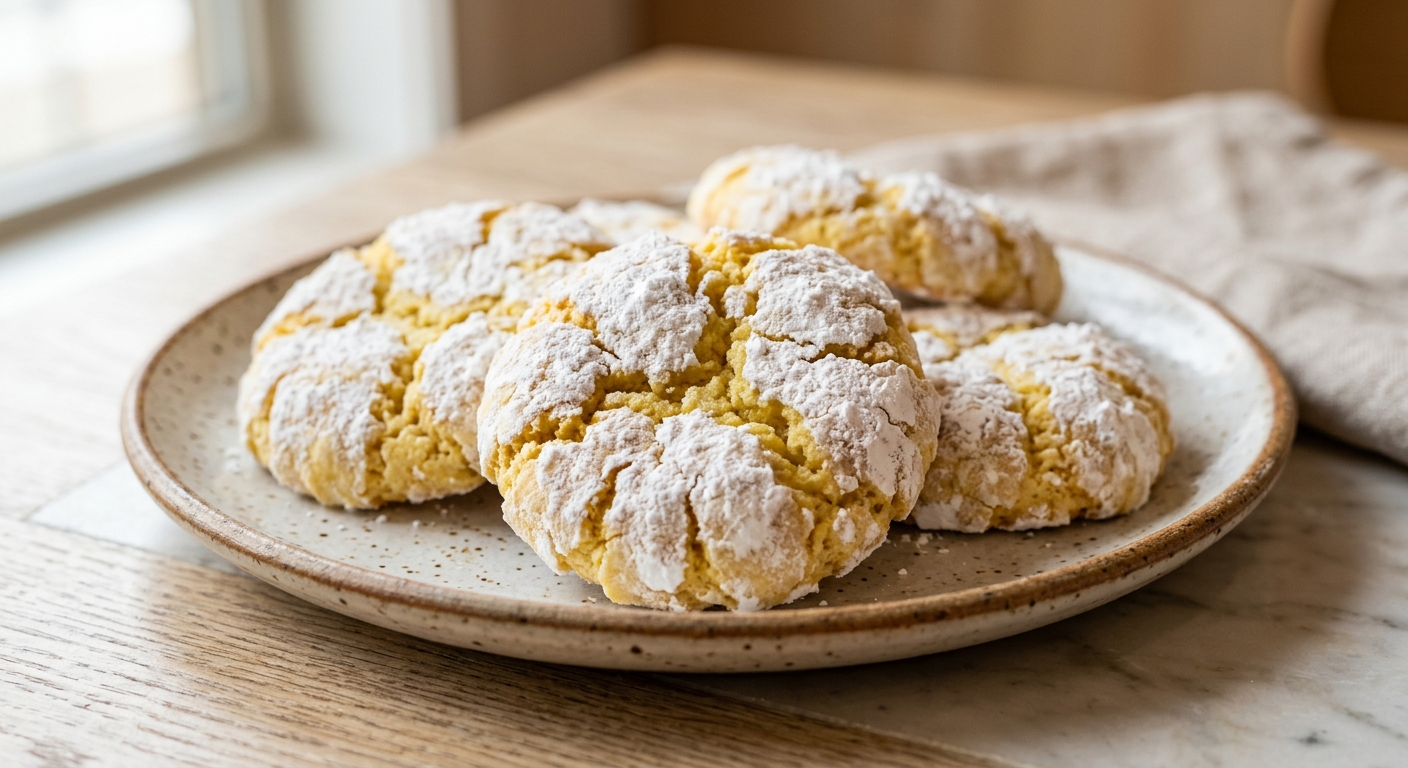
There is something deeply satisfying about pulling a tray of crinkle cookies from the oven and watching those dramatic white cracks settle into place as they cool. These lemon crinkle cookies are sunshine in cookie form: pale golden dough hidden beneath a generous snowdrift of powdered sugar, cracking open to reveal a soft, almost fudgy center with a crumb that practically melts on your tongue. The scent alone, warm lemon zest and sweet sugar toasting in the oven, is enough to bring everyone into the kitchen.
What sets this version apart is a double hit of lemon: both fresh zest and fresh juice go into the dough, and the zest is rubbed directly into the sugar before mixing to release the essential oils and build a deeper, more perfumed flavor than lemon extract can offer. A small amount of cream cheese in the dough is the quiet secret weapon here. It adds just enough fat and tang to keep the centers soft and slightly dense for days, rather than the dry, cakey texture that plagues so many crinkle cookie recipes. The result is a cookie with real lemon flavor and a texture worth talking about.
These cookies sit firmly in the easy category. You need one bowl, a hand mixer or a sturdy whisk, and about 25 minutes from start to finish. No chilling the dough, no special equipment, no fussing. They are ideal for beginner bakers who want an impressive result without the stress, and equally ideal for experienced bakers who simply want something delicious without the production. A batch makes 24 cookies, and in my experience they are rarely around past the first afternoon.
Equipment Needed
Click on an item below to shop for the recommended items for this recipe on Amazon.
As an Amazon Associate, we earn from qualifying purchases.
24
Ingredients
- 240 gall-purpose flour (about 1 3/4 cups, spooned and leveled)
- 1.5 tspbaking powder
- 0.25 tspbaking soda
- 0.5 tspColima Sea SaltMicroplastic Free Salt
- 200 ggranulated sugar (1 cup)
- 2 tbspfreshly grated lemon zest (from about 3 large lemons)
- 115 gfull-fat cream cheese, room temperature (4 oz, half a standard block)
- 113 gunsalted butter, room temperature (1/2 cup or 1 stick)
- 1 largeegg, room temperature
- 30 mlfresh lemon juice (2 tbsp, from about 1 lemon)
- 1 tsppure vanilla extract
- 1 tsplemon extract (optional but recommended for extra punch)
- 60 ggranulated sugar for rolling (1/4 cup)
- 120 gpowdered sugar for rolling (1 cup, sifted)
Ingredient Substitutions
Instructions
- Preheat your oven to 350°F (175°C). Line two large baking sheets with parchment paper and set aside. Set out two shallow bowls: one with the 60g (1/4 cup) of granulated sugar, and one with the 120g (1 cup) of sifted powdered sugar.
- In a medium bowl, whisk together the flour, baking powder, baking soda, and salt. Set aside. In a large bowl, combine the 200g granulated sugar with the lemon zest. Use your fingertips to rub the zest into the sugar for about 1 minute until the mixture is fragrant and slightly damp. This releases the lemon’s essential oils directly into the sugar for maximum flavor.
- Add the room-temperature cream cheese and butter to the lemon sugar. Beat with a hand mixer on medium speed for 2 to 3 minutes until light and fluffy, scraping down the sides once. Add the egg, lemon juice, vanilla extract, and lemon extract if using. Beat on medium for 1 minute until combined. The mixture may look slightly curdled at this point, which is normal.
- Add the dry ingredients to the wet ingredients and mix on low speed just until no dry streaks remain. Do not overmix. The dough will be soft and slightly sticky. This is correct.
- Scoop dough into 1.5-tablespoon portions (about 30g each) using a cookie scoop or two spoons. Roll each portion first in granulated sugar, then generously in powdered sugar, making sure each ball is completely coated with a thick layer of powdered sugar. This double-rolling technique is what creates the deep cracks. Place on the prepared baking sheets about 2 inches apart.
- Bake one sheet at a time on the center rack for 11 to 13 minutes, until the edges are just set and the tops are crackled and matte. The centers should still look slightly underdone and puffy. They will firm up as they cool. Do not overbake.
- Let the cookies cool on the baking sheet for 5 minutes before transferring to a wire rack. They will continue to set as they cool. Serve warm or at room temperature.
- Prepare the dough exactly as described in the oven method through the double-rolling step in granulated and then powdered sugar. Line your air fryer basket with a trimmed piece of parchment paper, leaving the edges open for air circulation. Do not use a full sheet as it will block airflow.
- Preheat the air fryer to 325°F (160°C) for 3 minutes. Place 4 to 6 dough balls in the basket, spacing them at least 1.5 inches apart. Depending on your basket size, you will need to bake in 4 to 6 batches.
- Air fry for 7 to 8 minutes until the tops are crackled and the edges look just set. The cookies will look underdone in the center, which is exactly right. Do not add extra time chasing a done appearance, as they firm up significantly while cooling.
- Use a thin spatula to carefully transfer cookies to a cooling rack. Let cool for at least 5 minutes before eating, as the centers are very soft straight from the basket. Repeat with remaining dough balls, refreshing the parchment if it becomes wet or greasy.
Nutrition Per Serving
Per 1 serving (makes 24 cookies, each about 2 inches wide)
Why This Recipe Works
The crinkle effect on these cookies comes down to a competition between two forces: the cookie spreading outward as it bakes, and the thick powdered sugar crust on the outside resisting that movement. As the dough heats up and expands, it pushes through the set sugar coating, creating those satisfying cracks. This is why the double-rolling step matters so much. Rolling first in granulated sugar creates a thin, slightly hydrophobic barrier that slows how quickly the powdered sugar absorbs moisture from the dough, keeping the outer shell drier and more crackle-prone. Rolling in powdered sugar alone often results in a coating that melts into the cookie before it has a chance to crack properly.
The cream cheese in this dough does double duty. Its fat content enriches the texture and keeps the cookies tender for days, while its mild acidity (from lactic acid) tenderizes the gluten strands in the flour, giving you that soft, slightly dense center rather than a puffy, cakey bite. The lemon juice contributes additional acidity that activates the baking soda, producing just enough lift without making the cookies too airy to crinkle well. Rubbing the zest into the sugar before creaming is a technique borrowed from classic citrus cakes: the sugar crystals abrade the zest and release the aromatic essential oils directly into the fat, resulting in a more pronounced and evenly distributed lemon flavor throughout the whole cookie rather than flecks of zest.
If your cookies are not cracking much, the most likely causes are that the powdered sugar coating was too thin, the oven temperature was too low, or the dough was too warm and spread before the crust could set. Use a generous, thorough coating of powdered sugar and make sure your oven is fully preheated. If your kitchen is very warm, a 15-minute rest in the fridge after rolling can help the exterior dry out just enough to encourage better cracking.
Baker’s Tips
- Use a microplane or fine zester for the lemon zest, and only grate the bright yellow outer layer. The white pith underneath is bitter and will muddy the flavor.
- Room-temperature cream cheese and butter are essential. Cold cream cheese will leave lumps in the dough that do not bake out. If you forgot to set them out, microwave each in 10-second bursts until just soft.
- Do not skimp on the powdered sugar coating. Roll each ball until it is completely white with no bare patches. A thin coating will not crinkle properly.
- Bake one sheet at a time on the center rack for the most even results. Doubling up sheets can cause uneven browning and less predictable spreading.
- Pull the cookies when the edges look set and the tops are crackled but the centers still look soft and slightly underdone. Residual heat finishes the baking. Cookies baked until they look done in the oven will be overdone by the time they cool.
- For picture-perfect cookies, immediately after pulling from the oven, use the back of a spoon to gently nudge any cookies that spread unevenly back into a round shape. You have about 30 seconds before they set.
Variations
- Lemon-Lavender: Add 1 teaspoon of dried culinary lavender, finely chopped, to the sugar and zest mixture when rubbing together. Subtle and fragrant.
- Lime Crinkle: Replace all lemon zest and juice with fresh lime zest and juice. The flavor is sharper and more tropical.
- Lemon-Poppy Seed: Fold 2 tablespoons of poppy seeds into the finished dough for a classic flavor pairing and a gentle crunch.
- Pink Lemonade: Replace 15ml of the lemon juice with 15ml of fresh strawberry juice or a high-quality strawberry puree for a blush-tinted dough with a berry-lemon flavor.
- Extra-Lemony Iced Version: Skip the powdered sugar rolling and instead drizzle cooled cookies with a simple glaze made from 120g powdered sugar whisked with 2 tablespoons fresh lemon juice.
Troubleshooting & FAQ
My cookies barely crinkled. What went wrong?
My cookies spread into flat puddles. How do I prevent that?
Why does my powdered sugar coating look translucent and wet after baking instead of staying white?
The cookies taste flat or not very lemony. How can I boost the flavor?
My dough is very sticky and hard to roll into balls. What should I do?
Storage & Make-Ahead
- Storage: Store cooled cookies in an airtight container at room temperature for up to 4 days. Place a sheet of parchment between layers to protect the powdered sugar coating. Refrigerate for up to 1 week, though the powdered sugar may absorb into the cookie surface over time. Freeze baked cookies in a single layer until solid, then transfer to a zip-top bag and freeze for up to 2 months. Thaw at room temperature for 30 minutes before serving.
- Make-Ahead: The dough can be made up to 48 hours ahead and stored covered in the refrigerator. Let it sit at room temperature for 15 minutes before scooping as cold dough is firmer and easier to roll. You can also freeze unrolled dough balls on a baking sheet until solid, then store in a zip-top bag for up to 2 months. Roll in sugars straight from frozen and add 2 to 3 extra minutes to the bake time.