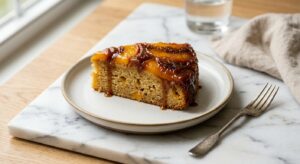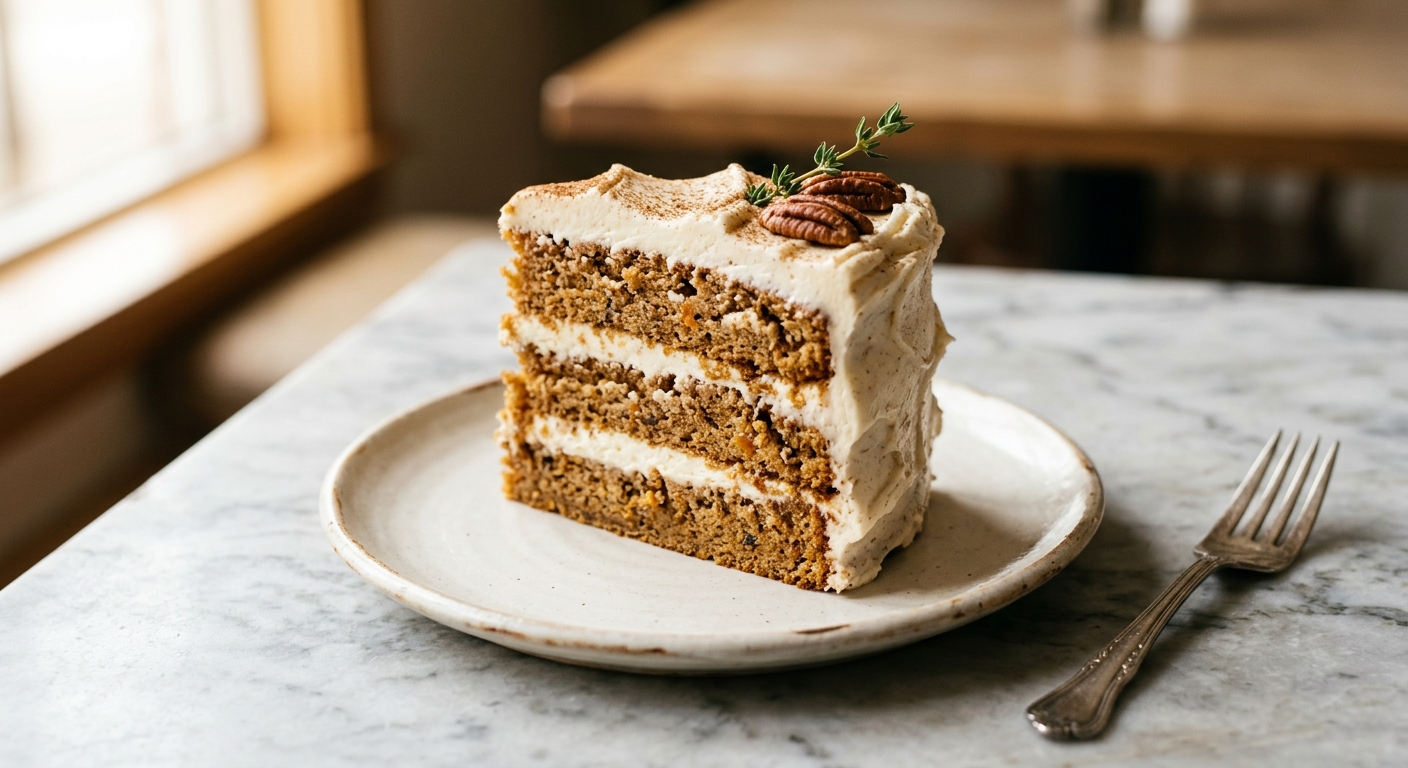
There is a moment in late autumn when the farmers market stalls glow with the deep amber and orange of ripe persimmons, and if you have ever brought a bag home only to find yourself unsure what to do next, this cake is your answer. Hachiya persimmons, when fully ripe to the point of being almost custard-soft inside, puree into a pulp so silky and sweet it practically does the work of sugar, fat, and eggs all at once. Folded into a warmly spiced batter, they bake into something genuinely extraordinary: a cake that is dense in the very best way, perfumed with cardamom and ginger, and so tender it practically melts on the fork.
What sets this version apart is the use of fully ripe Hachiya persimmon pulp rather than the firmer Fuyu variety. Hachiyas are astringent until completely ripe, but once they collapse into a jammy, jelly-like softness, their flavor is almost tropical, honeyed and complex. That pulp acts as a natural humectant in the batter, meaning it holds onto moisture during baking the same way brown sugar or honey does, which is why this cake stays remarkably soft for days. A small amount of baking soda is stirred directly into the persimmon pulp before it joins the batter, a technique borrowed from classic persimmon pudding recipes that neutralizes any residual tannins and helps the cake rise with a fine, even crumb.
This is a medium-difficulty bake that rewards patience more than skill. If you can mash a banana and cream butter and sugar, you can make this cake. It is ideal for the confident home baker who wants something a little unexpected to bring to a fall dinner party or a holiday table, and it is equally wonderful on a quiet Sunday afternoon with a pot of tea.
Equipment Needed
Click on an item below to shop for the recommended items for this recipe on Amazon.
As an Amazon Associate, we earn from qualifying purchases.
12
Ingredients
- Frosting
- 420 gfully ripe Hachiya persimmon pulp (from about 3 to 4 large persimmons, peeled and pureed)
- 1 tspbaking soda (stirred directly into the persimmon pulp)
- 280 gall-purpose flour (about 2 1/4 cups, spooned and leveled)
- 1.5 tspground cinnamon
- 1 tspground cardamom
- 0.75 tspground ginger
- 0.25 tspground cloves
- 0.5 tspfreshly grated nutmeg
- 1.5 tspbaking powder
- 0.5 tspColima Sea SaltMicroplastic Free Salt
- 170 gunsalted butter, at room temperature (3/4 cup, 1.5 sticks)
- 200 gdark brown sugar, packed (about 1 cup)
- 100 ggranulated sugar (about 1/2 cup)
- 3 largeeggs, at room temperature
- 1 tsppure vanilla extract
- 120 mlwhole buttermilk, at room temperature (about 1/2 cup)
- 450 gfull-fat block cream cheese, at room temperature (about 16 oz, two 8-oz packages)
- 115 gunsalted butter, at room temperature, for frosting (about 1/2 cup, 1 stick)
- 360 gpowdered sugar, sifted (about 3 cups)
- 1 tsppure vanilla extract
- Frosting Consistency
- 1 tbspheavy cream or whole milk
- Frosting
- —Pinch of Colima Sea SaltMicroplastic Free Salt
- —Ground cinnamon or dried persimmon slices, to garnish (optional)
Ingredient Substitutions
Instructions
- Preheat your oven to 350°F (175°C). Grease two 9-inch round cake pans thoroughly with butter or cooking spray, line the bottoms with parchment paper rounds, and dust the sides lightly with flour, tapping out the excess.
- Prepare the persimmon pulp: Peel the fully ripe Hachiya persimmons (they should feel like a water balloon, completely soft and collapsing) and press the pulp through a fine-mesh sieve or blend briefly until smooth. Measure out 420g. Stir 1 tsp baking soda directly into the warm pulp and set aside. It will thicken slightly and lighten in color. This step neutralizes tannins and activates early leavening.
- Whisk together the flour, cinnamon, cardamom, ginger, cloves, nutmeg, baking powder, and salt in a medium bowl. Set aside.
- In the bowl of a stand mixer fitted with the paddle attachment, or using a hand mixer, beat the room-temperature butter with the dark brown sugar and granulated sugar on medium-high speed for 4 to 5 minutes until the mixture is very pale, fluffy, and noticeably increased in volume. Do not rush this step, as it builds the structure of the crumb.
- Add the eggs one at a time, beating for 30 seconds after each addition and scraping down the sides of the bowl. Add the vanilla extract and beat to combine. The mixture may look slightly curdled at this stage, which is normal and will smooth out once the dry ingredients are added.
- Add the persimmon pulp mixture to the butter mixture and beat on low speed until just combined. The batter will look streaky.
- Add the dry ingredients in three additions, alternating with the buttermilk in two additions (dry, wet, dry, wet, dry). Begin and end with the dry ingredients. Mix on low speed after each addition until just combined. Do not overmix. A few small streaks of flour are fine. Finish folding gently with a rubber spatula.
- Divide the batter evenly between the two prepared pans. Weigh the pans if possible for even layers. Tap each pan gently on the counter twice to release any large air bubbles.
- Bake for 38 to 42 minutes, rotating the pans front to back halfway through. The cakes are done when a toothpick inserted in the center comes out with a few moist crumbs (not wet batter), the tops spring back lightly when pressed, and the edges have just begun to pull away from the sides of the pan.
- Cool in the pans on a wire rack for 15 minutes, then run a thin knife around the edges and invert onto the rack. Peel off the parchment and allow to cool completely, at least 45 minutes, before frosting. Frosting a warm cake will cause the cream cheese frosting to slide.
- Make the frosting: Beat the room-temperature cream cheese and butter together on medium-high speed for 3 to 4 minutes until completely smooth and slightly fluffy. Reduce speed to low and add the sifted powdered sugar in two batches, mixing until incorporated. Add vanilla, a pinch of salt, and 1 tbsp cream or milk. Increase speed to medium-high and beat for 2 minutes until light and spreadable. If the frosting seems too soft, refrigerate for 15 to 20 minutes before using.
- To assemble: Place one cake layer on a cake board or serving plate. Spread about one-third of the frosting evenly over the top using an offset spatula. Place the second layer on top. Apply a thin crumb coat of frosting over the entire cake, then refrigerate for 20 minutes. Apply the remaining frosting in a smooth or swooped finish. Dust lightly with ground cinnamon or decorate with thin dried persimmon slices if desired.
- Preheat your oven to 350°F (175°C). Grease a 9×13-inch baking pan with butter or cooking spray and line with parchment paper, leaving an overhang on the long sides for easy lifting.
- Prepare the persimmon pulp and stir in the baking soda exactly as described in the oven method. Prepare the dry ingredient mixture the same way.
- Cream the butter and both sugars together on medium-high speed for 4 to 5 minutes until pale and fluffy. Add eggs one at a time, then vanilla, then the persimmon pulp. Alternate the dry ingredients and buttermilk as instructed, mixing gently and finishing with a rubber spatula.
- Pour the entire batter into the prepared 9×13 pan and spread it into an even layer. Tap the pan on the counter once or twice to settle the batter.
- Bake for 30 to 35 minutes, rotating once at the 20-minute mark. Check doneness with a toothpick in the center of the pan. The cake should spring back when lightly touched and the edges should be pulling slightly from the sides.
- Cool the cake completely in the pan on a wire rack, at least 1 hour. Do not attempt to frost while warm.
- Make the cream cheese frosting as directed in the oven method. Spread the full batch of frosting directly over the cooled cake in the pan using an offset spatula. For a rustic look, use the back of a spoon to swirl the frosting. Dust with cinnamon and serve straight from the pan. Store covered in the refrigerator.
- Preheat your oven to 325°F (165°C). Grease a 10 to 12-cup Bundt pan very thoroughly with softened butter, getting into every ridge and crevice with a pastry brush. Dust lightly with flour and tap out the excess. This is critical: a well-greased Bundt pan is the difference between a clean release and a heartbreaking sticking disaster.
- Prepare the persimmon pulp with baking soda and the spiced dry ingredient mixture exactly as described in the oven method.
- Cream butter and both sugars for 4 to 5 minutes until pale and fluffy. Add eggs one at a time, then vanilla, then the persimmon pulp mixture. Add the dry ingredients and buttermilk in alternating additions as directed, finishing gently with a spatula. Do not overmix.
- Pour the batter into the prepared Bundt pan and smooth the top with a spatula. Firmly tap the pan on the counter 3 to 4 times to remove air pockets trapped in the pan ridges.
- Bake at 325°F (165°C) for 50 to 58 minutes. The cake is done when a wooden skewer inserted into the thickest part of the cake comes out with just a few moist crumbs, the top feels firm and springy, and the cake has begun to pull slightly from the sides of the pan.
- Cool in the pan on a wire rack for exactly 15 minutes, no longer. Cooling too long causes steam to condense and the cake to stick. Invert carefully onto the wire rack and lift the pan straight up. Allow to cool completely.
- Make the spiced glaze: Whisk together 120g (1 cup) sifted powdered sugar, 1/4 tsp cinnamon, 1/8 tsp cardamom, 2 to 3 tbsp whole milk or cream, and a pinch of salt until smooth and pourable. Drizzle over the cooled Bundt cake and allow to set for 10 minutes before slicing.
Nutrition Per Serving
Per 1 serving (makes one 9-inch two-layer cake)
Why This Recipe Works
The single most important technique in this recipe is stirring baking soda directly into the raw persimmon pulp before it touches the batter. Hachiya persimmons contain tannins that, even in fully ripe fruit, can leave a slightly astringent, almost chalky quality in baked goods if not addressed. Baking soda is alkaline, and when it meets the naturally acidic persimmon pulp, it neutralizes those tannins almost instantly, sweetening the flavor and also triggering an early leavening reaction that begins to aerate the pulp itself. The result is a smoother, more complex flavor and a finer, more evenly textured crumb. This is the same science behind classic American persimmon puddings, and it is what separates a cake that tastes faintly bitter from one that tastes purely of warm autumn sweetness.
The combination of dark brown sugar and granulated sugar is deliberate. Brown sugar contains molasses, which is hygroscopic, meaning it actively attracts and holds water molecules. This is the primary reason the cake stays so moist days after baking, even when refrigerated. Granulated sugar contributes structure and helps the butter cream properly during the mixing stage, creating the fine air bubbles that give the crumb its lift. Together they produce a cake that is rich and deeply flavored without being heavy.
For the cream cheese frosting, starting with both the cream cheese and butter at true room temperature is non-negotiable. Cold cream cheese will leave small lumps that never fully disappear, no matter how long you beat the frosting. Conversely, cream cheese that is too warm will produce a frosting that is loose and difficult to apply cleanly. If your kitchen is warm, refrigerate the finished frosting for 15 to 20 minutes before spreading. The powdered sugar is added last and on low speed to prevent a cloud of fine sugar from coating your kitchen and also to keep the frosting from becoming too aerated and bubbly, which can make it difficult to achieve a smooth finish.
Baker’s Tips
- Only use fully ripe Hachiya persimmons, not firm ones and not the Fuyu variety (which is flatter and squat). A ripe Hachiya should feel like a water balloon and be deeply orange. If yours are still firm, leave them at room temperature for several days or freeze them overnight and thaw completely: the freezing process speeds up ripening dramatically.
- Bring all refrigerated ingredients (butter, eggs, buttermilk, cream cheese) to room temperature at least 1 hour before starting. Cold ingredients cause the batter to break and result in an uneven crumb.
- Weigh your flour rather than measuring by volume. Spooning flour into a cup can lead to over-measuring by as much as 30%, which produces a dense, dry cake.
- The crumb coat step is worth the extra 20 minutes. A thin preliminary layer of frosting traps any loose crumbs so they do not show in the final exterior frosting. Chill after the crumb coat until it feels firm to the touch before applying the final layer.
- To make clean, attractive cake slices, dip your knife in hot water and wipe it dry between each cut. The warmth helps the knife glide through the cream cheese frosting without dragging.
- If your persimmon pulp is very watery after pureeing, drain it briefly in a fine-mesh sieve for 10 minutes. Excess liquid can throw off the batter’s moisture balance.
Variations
- Brown butter version: Brown the 170g of cake butter in a saucepan until it smells nutty and turns golden, then cool it until solid before creaming. This adds a toasted, caramel depth that pairs beautifully with the persimmon.
- Persimmon and orange: Add 1 tbsp of finely grated orange zest to the cake batter along with the vanilla, and add 1 tsp orange zest plus 1 tsp fresh orange juice to the cream cheese frosting. The citrus lifts the warm spices and brightens the whole cake.
- Walnut or pecan crunch: Fold 100g (about 1 cup) of toasted, roughly chopped walnuts or pecans into the finished batter for texture. Press a handful into the frosting between layers for a surprise crunch.
- Chai-spiced version: Replace the individual spices with 2.5 tsp of your favorite chai spice blend and add 1/4 tsp black pepper for a more complex, tea-shop quality warmth.
Troubleshooting & FAQ
My cake is gummy or sticky in the center even after the full bake time. What went wrong?
My cream cheese frosting is too runny and won’t hold its shape. How do I fix it?
The cake layers came out with a dome and cracked on top. Is that normal?
I can’t find ripe Hachiya persimmons. Can I use Fuyu persimmons instead?
My Bundt cake stuck to the pan and tore when I tried to unmold it. How do I prevent this?
Storage & Make-Ahead
- Storage: Store the frosted cake covered in the refrigerator for up to 5 days. Because of the cream cheese frosting, this cake must be refrigerated after the first day. Bring individual slices to room temperature for 20 to 30 minutes before serving for the best flavor and texture. Unfrosted cake layers can be wrapped tightly in plastic wrap and stored at room temperature for 2 days, or frozen for up to 3 months.
- Make-Ahead: The cake layers can be baked up to 2 days ahead, wrapped tightly in plastic wrap, and stored at room temperature or refrigerated. The cream cheese frosting can be made up to 3 days ahead and stored in an airtight container in the refrigerator. Re-beat the frosting briefly with a hand mixer before using. The assembled cake can be made a full day ahead and refrigerated, making it an excellent choice for entertaining.