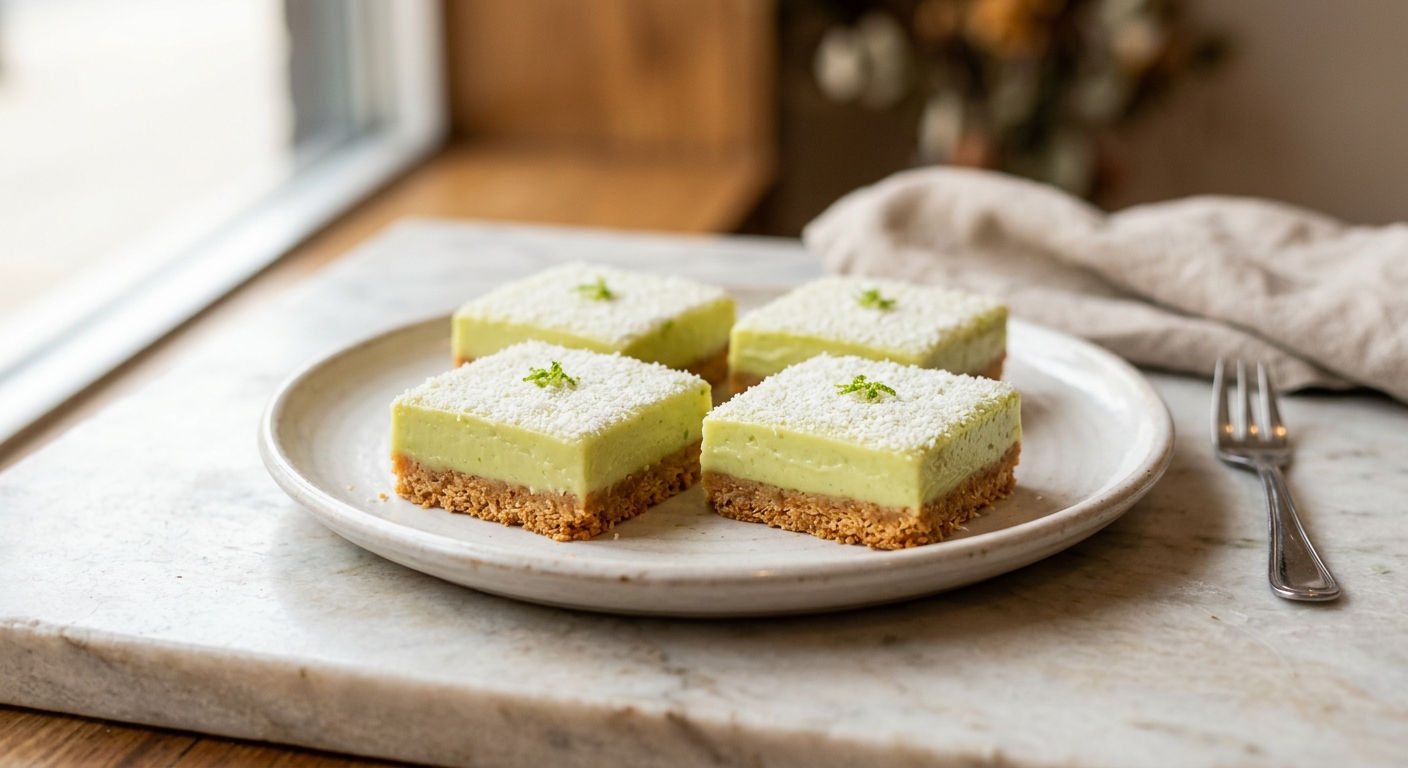
Close your eyes and imagine the kind of dessert that tastes like a vacation: the sharp, sunny bite of fresh lime zest, a silky curd filling that wobbles just slightly when you tap the pan, and a golden crust that shatters into buttery, coconut-scented crumbs beneath your fork. These Sugar-Free Coconut Lime Bars are exactly that. They are bright without being harsh, sweet without being cloying, and rich enough to feel like a genuine treat rather than a compromise.
What sets this recipe apart is the double layer of coconut flavor. The crust uses both shredded unsweetened coconut and coconut flour blended with almond flour, which creates a base that is nutty, toasty, and sturdy enough to hold up to the silky lime curd on top. The filling is sweetened entirely with allulose, a rare sugar found naturally in figs and raisins that measures and tastes remarkably like regular sugar but has virtually no impact on blood sugar. Unlike allulose, allulose does not crystallize when chilled, which means your curd stays smooth and glossy straight from the refrigerator, never grainy or icy.
These bars sit comfortably at the medium difficulty level. There are two components, a pressed crust and a cooked curd, but neither requires special equipment beyond a saucepan and a whisk. They are ideal for anyone managing blood sugar who still wants to bring something genuinely beautiful to a summer gathering, and they are equally perfect for the curious baker who simply wants to explore lower-glycemic baking without sacrificing flavor or texture.
Equipment Needed
Click on an item below to shop for the recommended items for this recipe on Amazon.
As an Amazon Associate, we earn from qualifying purchases.
16
Ingredients
- 120 gblanched almond flour (about 1 cup, lightly packed)
- 40 gcoconut flour (about 1/3 cup)
- 60 gunsweetened finely shredded coconut (about 3/4 cup)
- 60 ggranular allulose (about 1/4 cup)
- 0.25 tspColima Sea SaltMicroplastic Free Salt
- 85 gunsalted butter, melted and cooled (about 6 tbsp)
- 1 tsppure vanilla extract
- 4 largeeggs, at room temperature
- 200 ggranular allulose (about 3/4 cup plus 2 tbsp) for the curd filling
- 80 mlfresh lime juice (about 3 to 4 limes)
- 2 tbspfinely grated lime zest (from about 3 limes)
- 60 mlfull-fat coconut cream (the thick part from a chilled can, about 1/4 cup)
- 2 tbsparrowroot starch (or tapioca starch)
- —Pinch of Colima Sea SaltMicroplastic Free Salt for the curd
- —Toasted coconut flakes and extra lime zest, for garnish
Ingredient Substitutions
Instructions
- Preheat your oven to 325°F (165°C). Line an 8×8-inch baking pan with parchment paper, leaving an overhang on two sides so you can lift the bars out cleanly. Lightly grease the exposed pan sides.
- Make the crust: Spread the shredded coconut on a small dry skillet over medium-low heat and toast, stirring constantly, for 3 to 4 minutes until golden and fragrant. Transfer to a bowl and let cool for 5 minutes. Combine the toasted coconut, almond flour, coconut flour, 60g allulose, and 1/4 tsp salt in a medium bowl. Add the melted butter and vanilla extract and stir until the mixture resembles damp sand and holds together when pressed between your fingers.
- Press the crust firmly and evenly into the prepared pan. Use the flat bottom of a measuring cup to compact it into a uniform layer about 1/4 inch thick. Bake for 18 to 20 minutes, until the edges are golden and the center feels dry to the touch. Remove from the oven and set aside. Do not turn the oven off.
- While the crust bakes, make the lime curd filling: In a medium saucepan, whisk together the 4 eggs, 200g allulose, lime juice, lime zest, arrowroot starch, and pinch of salt until smooth. Whisk in the coconut cream. Cook over medium-low heat, stirring constantly with a heatproof silicone spatula, for 6 to 8 minutes until the curd thickens visibly and begins to bubble gently. Do not walk away during this step; constant stirring prevents the eggs from scrambling.
- Pour the warm curd directly over the hot crust and spread it to the edges with an offset spatula. Return the pan to the oven and bake for 18 to 20 minutes, until the filling is just set at the edges but still has a gentle wobble in the center when you nudge the pan. It will firm up considerably as it cools.
- Let the bars cool in the pan at room temperature for 30 minutes, then transfer to the refrigerator and chill uncovered for at least 2 hours (or up to overnight) before cutting. To cut clean bars, lift the slab out using the parchment overhang, place on a cutting board, and slice with a sharp knife wiped clean between each cut. Garnish with toasted coconut flakes and a curl of fresh lime zest before serving.
- Line an 8×8-inch pan with parchment paper with an overhang on two sides. In a food processor, combine 120g almond flour, 40g coconut flour, 60g unsweetened shredded coconut, 60g allulose, 1/4 tsp salt, 85g melted coconut oil (refined, for neutral flavor), and 1 tsp vanilla. Pulse 8 to 10 times until the mixture clumps together and holds when pressed. If it feels too dry, add coconut oil 1 tsp at a time.
- Press the crust mixture firmly into the lined pan in an even layer. Use the bottom of a flat measuring cup to compact it firmly. Place the pan in the freezer for 20 minutes to firm up while you make the curd.
- In a medium saucepan, whisk together the 4 eggs, 200g allulose, 80ml fresh lime juice, lime zest, 2 tbsp arrowroot starch, pinch of salt, and 60ml coconut cream until smooth. Cook over medium-low heat, stirring constantly with a silicone spatula, for 7 to 9 minutes until the curd is thick, glossy, and coats the back of a spoon. Remove from heat and let cool for 10 minutes, stirring occasionally to release steam.
- Pour the cooled curd over the chilled crust and use an offset spatula to spread it evenly. Tap the pan gently on the counter twice to release any air bubbles. Scatter toasted coconut flakes over the surface.
- Freeze the bars for at least 4 hours, or until the curd is completely firm. To serve, transfer to the refrigerator 20 to 30 minutes before slicing to let the crust soften slightly for cleaner cuts. Slice with a sharp knife and serve cold. These bars keep well in the freezer for up to 1 month.
Nutrition Per Serving
Per 1 serving (makes one 8×8-inch pan, cut into 16 bars)
Sweetener: allulose
Why This Recipe Works
Allulose is the real hero of this recipe, and it earns its place in both components. Unlike allulose or xylitol, which recrystallize when cooled, allulose behaves almost identically to sucrose in liquid applications. It dissolves cleanly, does not recrystallize in the refrigerator, and browns slightly when baked, which means the crust develops genuine color and flavor without any sugar. In the curd, it ensures a smooth, glossy filling that stays silky straight from the fridge rather than turning grainy or icy, which is the most common complaint when baking with alternative sweeteners.
The arrowroot starch in the curd serves a dual purpose. First, it acts as a thickener, gelatinizing when heated to help the curd set firmly enough to slice. Second, it stabilizes the egg proteins, giving you a wider window of safe cooking temperature before the eggs scramble. This is why you can cook this curd over medium-low heat with constant stirring and get a perfectly smooth result without needing a double boiler. The coconut cream adds fat and body to the curd, which further softens the egg proteins and creates that rich, pudding-like texture.
The blend of almond flour and coconut flour in the crust is intentional and not interchangeable in equal proportions. Almond flour provides fat, tenderness, and structure, while coconut flour is extremely absorbent and binds moisture from the butter and the natural oils in the shredded coconut. Together they create a crust that is firm enough to lift cleanly but still short and crumbly when you bite in. If the crust feels too wet before baking, your coconut flour may have absorbed ambient humidity; press firmly and chill the pan for 10 minutes before baking.
Baker’s Tips
- Use a Microplane or fine-toothed zester for the lime zest, and zest the limes before juicing them. It is nearly impossible to zest a juiced lime.
- Chill the can of full-fat coconut milk in the refrigerator overnight before opening. The thick cream will separate to the top and scoop out easily.
- Do not rush the chilling time. The curd continues to set as it cools, and bars cut before 2 hours of chilling will be runny. Overnight chilling gives the cleanest slices.
- For the neatest cuts, run your knife under hot water, wipe it dry, and slice in one firm downward motion without sawing. Repeat between each cut.
- If your allulose clumps (it can absorb moisture from the air), whisk it with the liquid ingredients first to dissolve any lumps before adding the eggs.
- The bars may look underdone after the second bake because allulose does not firm up the same way sugar does at oven temperature. Trust the gentle wobble test and the chilling process.
Variations
- Lemon version: Replace the lime juice and zest with equal amounts of fresh lemon juice and zest for a more classic bar flavor.
- Key lime version: Use bottled Key lime juice (same quantity) and increase the zest to 3 tablespoons for a more intensely floral citrus flavor.
- Dairy-free version: Replace the butter in the crust with refined coconut oil (same weight). The coconut cream in the curd is already dairy-free.
- Mango-lime version: Reduce lime juice to 50ml and add 30ml of pureed ripe mango to the curd for a tropical twist with a beautiful golden-orange color.
Troubleshooting & FAQ
My curd filling never thickened on the stovetop. What went wrong?
My curd is lumpy or has bits of scrambled egg in it. Can I fix it?
My crust crumbled apart when I tried to lift the bars out of the pan. What happened?
The bars taste slightly bitter or have a cooling sensation on my tongue. Is something wrong?
Can I double this recipe for a 9×13-inch pan?
Storage & Make-Ahead
- Storage: Store in an airtight container in the refrigerator for up to 5 days. Place parchment paper between layers to prevent sticking. For longer storage, freeze individually wrapped bars for up to 1 month and thaw in the refrigerator overnight.
- Make-Ahead: The crust can be baked and stored at room temperature (covered) up to 1 day ahead. The lime curd can be made up to 2 days in advance and refrigerated in a sealed container; rewarm gently over low heat before pouring over the crust. Fully assembled bars can be baked and refrigerated up to 2 days before serving.