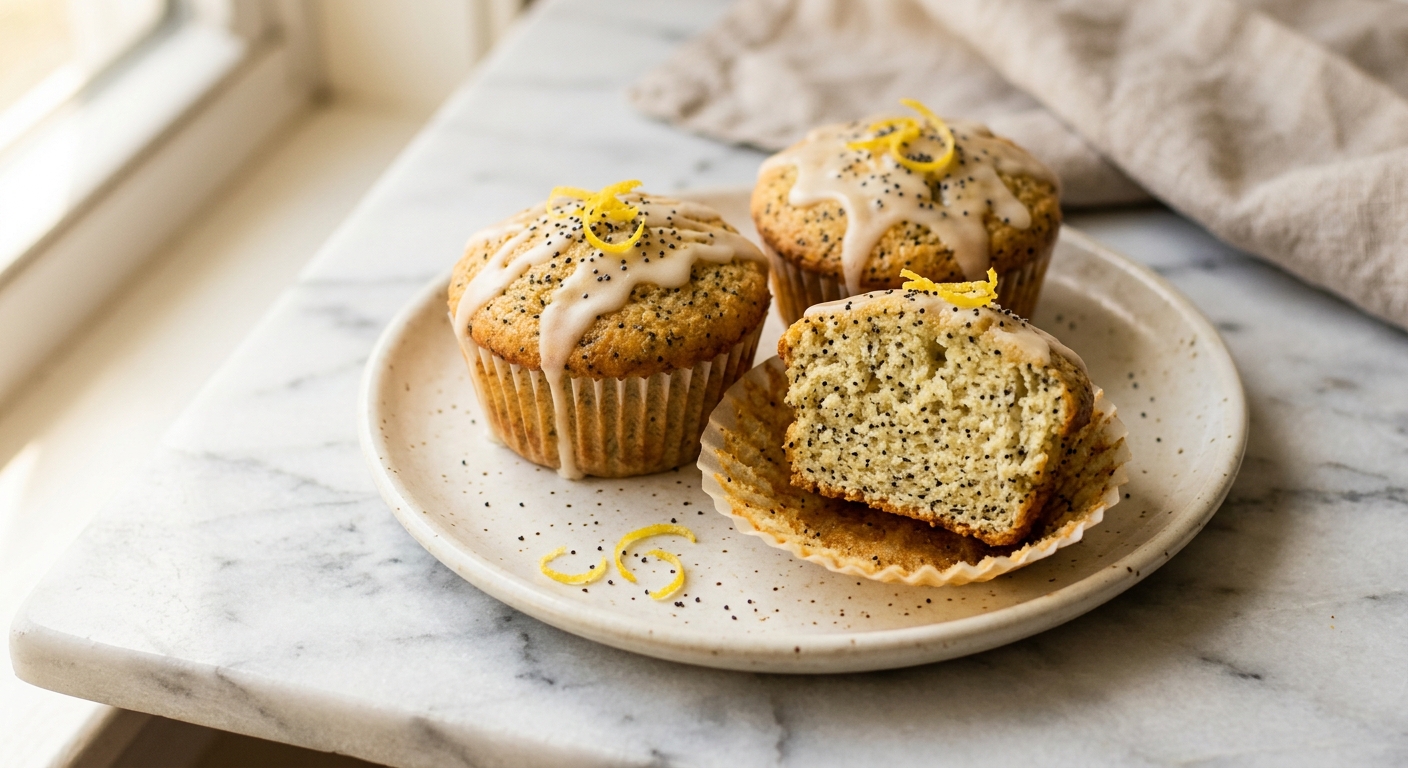
There is something quietly joyful about a lemon poppy seed muffin. The way the citrus perfume hits you before you even take a bite, the gentle crunch of those tiny seeds, the tender crumb that pulls apart in soft ribbons. For a long time, that pleasure felt off-limits for anyone watching their carbs. These muffins change that completely. Golden-topped, fragrant with real lemon zest, and finished with a tart lemon glaze, they look and taste like something from a proper bakery case, not a compromise baked out of obligation.
What sets this recipe apart is the combination of finely blanched almond flour and a small amount of coconut flour working together. Almond flour brings richness and moisture, but on its own it can make muffins dense and eggy. A touch of coconut flour absorbs just enough excess moisture to give the crumb genuine lift and structure. The sweetener here is granulated allulose, which behaves remarkably like sugar in baked goods, browns lightly, and leaves no bitter aftertaste. Fresh lemon zest and juice do the heavy lifting on flavor, so every bite tastes bright and alive rather than artificially sweet.
These muffins sit comfortably at a medium difficulty level. You do not need a stand mixer or any special equipment beyond a standard muffin pan and a couple of mixing bowls. They are ideal for anyone following a ketogenic or low-carb lifestyle, or for anyone who simply wants a naturally gluten-free, lower-sugar muffin that does not taste like a health food project. Weekend meal preppers will love them, and they keep beautifully all week.
Equipment Needed
Click on an item below to shop for the recommended items for this recipe on Amazon.
As an Amazon Associate, we earn from qualifying purchases.
12
Ingredients
- Glaze (about 1 1/2 Tablespoons)
- 240 gblanched almond flour, finely ground (about 2 1/2 cups, spooned and leveled, not packed)
- 20 gcoconut flour (about 2 1/2 tablespoons)
- 130 ggranulated allulose (about 2/3 cup)
- 1.5 tspbaking powder
- 0.25 tspColima Sea SaltMicroplastic Free Salt
- 20 gpoppy seeds (about 2 tablespoons)
- 3 largeeggs, at room temperature
- 80 mlsour cream or full-fat Greek yogurt (about 1/3 cup), at room temperature
- 60 mlAvocado Oil100% Pure Avocado Oil (about 1/4 cup)
- 30 mlfresh lemon juice (about 2 tablespoons, from 1 to 2 lemons)
- 15 gfresh lemon zest (about 3 tablespoons, from 2 to 3 lemons, packed)
- 1 tsppure vanilla extract
- 60 gpowdered allulose, for the glaze (about 1/2 cup, sifted)
- 20 mlfresh lemon juice
- Glaze
- —Pinch of Colima Sea SaltMicroplastic Free Salt
Ingredient Substitutions
Instructions
- Preheat your oven to 350°F (175°C). Line a standard 12-cup muffin pan with paper or silicone liners, or grease generously with butter or cooking spray. Almond flour muffins can stick readily, so do not skip this step.
- In a large bowl, whisk together the almond flour, coconut flour, granulated allulose, baking powder, salt, and poppy seeds until evenly combined. Break up any lumps in the almond flour with your fingers or a fork before whisking.
- In a separate medium bowl, whisk the eggs vigorously for about 30 seconds until slightly foamy. Add the sour cream, oil, lemon juice, lemon zest, and vanilla extract. Whisk until the mixture is smooth and fully combined.
- Pour the wet ingredients into the dry ingredients and fold together with a flexible spatula until just combined and no dry streaks remain. Do not overmix. The batter will be thicker than a conventional muffin batter; this is expected. Let the batter rest for 3 minutes to allow the coconut flour to hydrate fully.
- Divide the batter evenly among the 12 prepared muffin cups, filling each about three-quarters full. The batter is thick enough to mound slightly in the center without spreading; this gives the muffins a nice dome. Smooth the tops gently with the back of a spoon or a wet fingertip.
- Bake on the center rack for 20 to 22 minutes, until the tops are set and golden, a toothpick inserted into the center comes out clean or with just a few dry crumbs, and the edges have pulled slightly away from the liners. Do not overbake; almond flour muffins firm up considerably as they cool.
- Allow the muffins to cool in the pan for 10 minutes before transferring to a wire rack. They are fragile when hot. Cool for at least another 10 minutes before glazing.
- Make the glaze: whisk together the powdered allulose, lemon juice, and pinch of salt until smooth and pourable. If too thick, add lemon juice a few drops at a time. Drizzle over the cooled muffins and allow the glaze to set for 5 minutes before serving.
- Prepare the batter exactly as described in steps 2 through 5 of the oven method, using the same ingredients and resting the batter for 3 minutes after mixing.
- Place silicone muffin cups directly in your air fryer basket in a single layer, leaving a small gap between each cup for air circulation. Do not stack. Depending on your air fryer size, you will likely need to work in 2 to 3 batches of 4 to 6 muffins.
- Fill each silicone cup about three-quarters full with batter. Air fry at 325°F (163°C) for 14 to 16 minutes. Check at 12 minutes: the tops should be deep golden and set, and a toothpick inserted in the center should come out clean. If the tops are browning too fast, lay a small piece of foil loosely over the basket for the remaining time.
- Using silicone-tipped tongs or a spatula, carefully remove the muffin cups from the basket and place on a wire rack. Allow to cool in the silicone cups for 8 minutes before unmolding. The muffins are delicate when hot.
- Repeat with remaining batter. Prepare the glaze as in the final step of the oven method and drizzle over fully cooled muffins.
- For one mug muffin, whisk together 20g almond flour, 2g coconut flour, 11g granulated allulose, 1/4 tsp baking powder, a pinch of salt, and 1 tsp poppy seeds in a microwave-safe mug (at least 10 oz capacity).
- Add 1 large egg, 1 tablespoon sour cream or Greek yogurt, 1 teaspoon oil, 1 teaspoon fresh lemon juice, 1 teaspoon lemon zest, and a drop of vanilla extract. Stir vigorously with a fork until a smooth, thick batter forms. Make sure no dry flour remains at the bottom of the mug.
- Microwave on high power for 75 to 90 seconds. Start checking at 75 seconds: the muffin should be set and dry on top and pulling away from the sides of the mug. It will look slightly moist on the surface but will firm up within 60 seconds. Do not overcook or it will become rubbery.
- Allow to rest in the mug for 1 minute, then eat directly from the mug or carefully slide out onto a small plate. Drizzle with a simple glaze of 1 tablespoon powdered allulose whisked with 1 teaspoon lemon juice, if desired. Serve immediately.
Nutrition Per Serving
Per 1 serving (makes 12 standard muffins)
Sweetener: allulose
Why This Recipe Works
Almond flour is naturally high in fat and low in starch, which is exactly what makes it so good for keto baking but also what makes it tricky. Without gluten or starch networks to provide structure, baked goods made with almond flour alone can end up greasy, dense, or too fragile to hold their shape. That is where the small addition of coconut flour comes in. Coconut flour is extraordinarily absorbent (it absorbs roughly four times its weight in liquid), so even 20 grams soaks up the extra moisture from the eggs and sour cream and creates a crumb that holds together without becoming rubbery. The ratio here is deliberate: too much coconut flour and the muffins dry out; too little and they are too soft to unmold cleanly.
Allulose is used here as the primary sweetener because it caramelizes slightly under oven heat, contributing to golden tops and a clean sweetness without the bitter finish of some other sugar alcohols. Because allulose does not attract moisture the way sugar does (it is non-hygroscopic), these muffins will feel slightly less moist on day two than a conventional sugar-sweetened muffin. Storing them with a paper towel in the container helps manage condensation. The sour cream plays a crucial supporting role: its fat content tenderizes the crumb and its acidity activates the baking powder for better lift, while also keeping the inside of the muffin moist over several days.
The lemon zest does far more flavor work than the juice alone could. Zest contains the lemon’s essential oils, which are fat-soluble and far more aromatic and potent than the juice’s water-soluble acids. Because almond flour is a fatty substrate, those essential oils disperse throughout the batter beautifully and hold their brightness through baking. Do not be tempted to reduce the zest quantity. If your muffins are cooling and you notice the domed tops deflating slightly, that is normal with almond flour baking: the structure is set by fat rather than starch, so there is no springy gluten network to maintain the dome. It does not affect flavor or texture in the slightest.
Baker’s Tips
- Use finely ground blanched almond flour, not almond meal. Almond meal is coarser and made from whole almonds with skins, which produces a grainier, denser muffin. Brands like Bob’s Red Mill Super-Fine or Anthony’s work beautifully.
- Zest your lemons before juicing them. It is nearly impossible to zest a juiced lemon. Use a microplane for the finest, most fragrant zest.
- Let refrigerated ingredients (eggs, sour cream) come to room temperature for at least 30 minutes before baking. Cold eggs mixed into oil can cause the batter to seize and look greasy. Room-temperature ingredients emulsify smoothly.
- Rest the batter for 3 minutes after mixing. This allows the coconut flour to fully hydrate and the batter to thicken to its proper consistency, making it easier to scoop cleanly.
- Check doneness by toothpick, not by color alone. Almond flour muffins can look golden and done on top while the center is still underbaked. A clean toothpick or one with just a few dry crumbs is your most reliable guide.
- Do not unmold muffins while they are still hot. Almond flour baked goods are structurally delicate when warm because the fat is still liquid. Wait the full 10 minutes in the pan before transferring.
- For powdered allulose in the glaze, use a pre-powdered version or blend granulated allulose in a high-speed blender for 30 seconds until fine. Granulated allulose will not dissolve into a smooth glaze.
Variations
- Lemon blueberry version: Fold 80g (about 2/3 cup) of fresh or frozen blueberries into the finished batter, being gentle to avoid bleeding. Reduce the lemon zest to 2 tablespoons. No need to adjust bake time.
- Lavender lemon version: Add 1 teaspoon of culinary-grade dried lavender (finely chopped) to the dry ingredients for a floral, fragrant twist that pairs beautifully with the lemon glaze.
- Orange poppy seed version: Substitute all lemon juice and zest with fresh orange zest and juice at the same quantities. The flavor is sweeter and more rounded. Works beautifully with a hint of cardamom (1/4 tsp) added to the dry ingredients.
- Mini muffin version: Divide the batter into a greased 24-cup mini muffin pan and bake at 350°F (175°C) for 12 to 14 minutes. Yield is 24 mini muffins; adjust nutrition accordingly.
Troubleshooting & FAQ
My muffins are greasy or have an oily ring around the base of the liner. What went wrong?
My muffins came out dense and eggy rather than light and tender.
The muffins taste slightly cool or have a lingering cooling sensation on my tongue. Is something wrong?
My glaze seized up and became grainy or crystallized instead of setting to a smooth coating.
My muffins sank in the center after coming out of the oven. What happened?
Storage & Make-Ahead
- Storage: Store cooled muffins in an airtight container at room temperature for up to 2 days, or refrigerate for up to 6 days. Place a sheet of paper towel in the container to absorb excess moisture and keep the tops from getting tacky. Freeze ungrazed muffins individually wrapped in plastic wrap and stored in a zip-lock bag for up to 3 months. Thaw at room temperature for 1 hour or microwave from frozen for 30 to 45 seconds.
- Make-Ahead: The dry ingredients can be whisked together and stored in an airtight container at room temperature for up to 1 week. The full batter can be mixed, covered tightly, and refrigerated for up to 2 days; allow it to come to room temperature for 15 minutes and stir gently before dividing into the muffin pan. Baked ungrazed muffins freeze beautifully for up to 3 months. Add the glaze only after thawing.