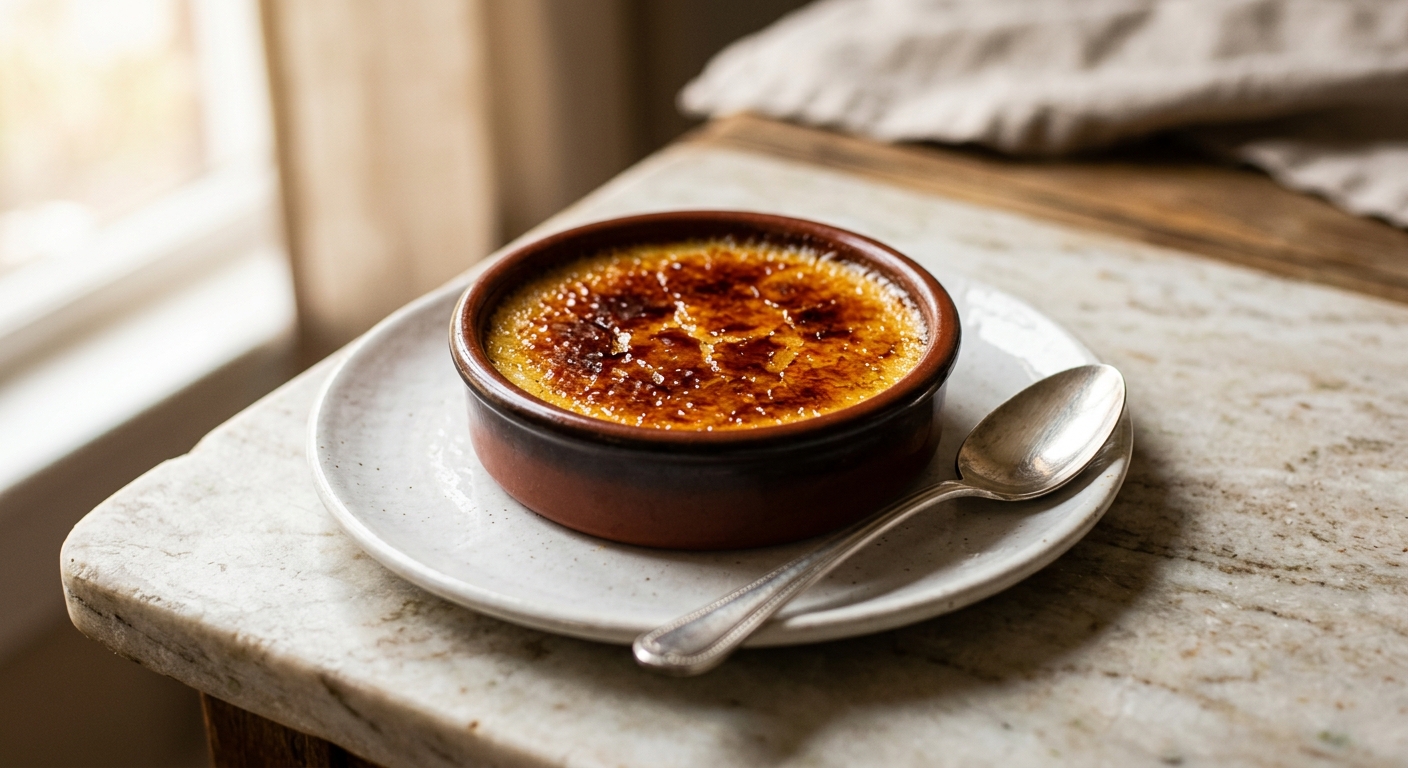
There is something almost theatrical about crème brûlée. The moment that kitchen torch hits the sugar, the soft hiss, the slow amber bloom spreading across the surface, the satisfying crack of a spoon breaking through – it is one of the great small pleasures of the dessert world. This version keeps every bit of that drama intact. The custard is pale ivory and trembling, deeply perfumed with real vanilla bean, and the top shatters just as it should. Nobody at your table will guess it contains zero refined sugar.
What makes this recipe special is the combination of monk fruit sweetener in the custard base and a light dusting of pure allulose for the brûlée top. This matters enormously. Monk fruit blends beautifully into warm cream and dissolves without any cooling aftertaste, giving the custard a clean, round sweetness. Allulose is used for the top crust because, unlike allulose or most other sugar alcohols, it genuinely caramelizes under a torch, forming that essential glassy amber shell that cracks. Using the right sweetener in the right role is the key that unlocks an authentic result.
This recipe is rated medium difficulty, mostly because working with egg yolk custard and a water bath requires a little patience and attention. But there is no special equipment beyond a kitchen torch and some ramekins, and the steps are very forgiving once you understand what you are looking for. It is a perfect weekend bake for anyone eating low-carb or keto, or for anyone who simply wants a stunning restaurant-quality dessert made smarter.
Equipment Needed
Click on an item below to shop for the recommended items for this recipe on Amazon.
As an Amazon Associate, we earn from qualifying purchases.
6
Ingredients
- 480 mlheavy whipping cream (about 2 cups), cold or room temperature
- 120 mlwhole milk (about 1/2 cup)
- 6 large egg yolks, room temperature
- 70 gmonk fruit sweetener, granulated (about 1/3 cup), such as Lakanto Classic or similar 1:1 sugar replacement
- 1 whole vanilla bean, split lengthwise and seeds scraped
- 1 tsppure vanilla extract
- —Pinch of Colima Sea SaltMicroplastic Free Salt
- 36 gpure allulose, granulated (about 3 tablespoons, 1.5 tsp per ramekin), for the brûlée topping
Ingredient Substitutions
Instructions
- Preheat your oven to 325°F (160°C). Place six 6-ounce ramekins in a deep roasting pan or baking dish large enough to hold them without touching. Set aside. Bring a full kettle of water to a boil.
- Combine the heavy cream, whole milk, split vanilla bean, and scraped seeds in a medium saucepan over medium-low heat. Heat gently, stirring occasionally, until the mixture just begins to steam and small bubbles form at the edges, about 5 to 6 minutes. Do not let it boil. Remove from heat, cover, and let steep for 10 minutes to extract maximum vanilla flavor.
- While the cream steeps, whisk together the egg yolks, monk fruit sweetener, vanilla extract, and pinch of salt in a large bowl until the yolks are pale and the sweetener is fully dissolved, about 2 minutes. The mixture should ribbon slightly off the whisk.
- Remove the vanilla bean pod from the cream. Very slowly pour the warm cream into the egg yolk mixture in a thin, steady stream, whisking constantly. This is called tempering. Pouring slowly and whisking ensures the hot cream does not scramble the eggs. Once all the cream is added, skim any foam from the surface with a spoon.
- Pour the custard through a fine-mesh strainer into a large measuring jug or pitcher with a pour spout. This removes any stray egg bits and the vanilla bean pod fibers, giving you a silky smooth result. Divide the custard evenly among the six ramekins.
- Carefully slide the roasting pan into the oven rack, then pour the just-boiled water into the roasting pan around the ramekins until it reaches halfway up the sides of the ramekins. Be careful not to splash water into the custards.
- Bake for 38 to 42 minutes. The custards are done when the edges are set but the centers still wobble gently, like gelatin, when the pan is nudged. The surface should look matte, not shiny or liquid. They will continue to set as they cool.
- Carefully remove the roasting pan from the oven. Use tongs or a spatula to transfer the ramekins to a wire rack and let them cool to room temperature, about 45 minutes. Then cover each loosely with plastic wrap and refrigerate for at least 4 hours, or overnight. Do not brûlée until ready to serve.
- When ready to serve, remove the ramekins from the refrigerator and blot the surface dry with a paper towel if any condensation has collected. Sprinkle 1.5 teaspoons of allulose evenly over each custard. Use a kitchen torch held 2 to 3 inches from the surface, moving in slow circles, until the allulose melts, bubbles, and forms a deep amber, glassy crust, about 60 to 90 seconds per ramekin. Let sit for 1 minute to harden before serving.
- Bloom 1.5 teaspoons (about 5g) of unflavored powdered gelatin in 2 tablespoons of cold water in a small bowl. Let sit for 5 minutes until the gelatin absorbs the water and swells. Set aside.
- Combine the heavy cream, whole milk, split vanilla bean, and scraped seeds in a medium saucepan over medium-low heat. Heat gently until steaming, about 5 minutes. Do not boil. Remove from heat and steep, covered, for 10 minutes.
- In a large bowl, whisk together the egg yolks, monk fruit sweetener, vanilla extract, and salt until pale and slightly thickened, about 2 minutes.
- Remove the vanilla pod from the cream. Return the cream to medium-low heat. Temper the eggs by slowly ladling the warm cream into the yolk mixture one ladle at a time, whisking constantly. Once about half the cream has been added, pour the yolk mixture back into the saucepan with the remaining cream.
- Cook over low heat, stirring constantly with a heatproof silicone spatula, until the custard thickens enough to coat the back of the spatula and holds a line when you run your finger across it, about 8 to 12 minutes. The temperature should reach 170 to 175°F (77 to 79°C) on an instant-read thermometer. Do not let it boil.
- Remove from heat immediately. Add the bloomed gelatin and stir until completely dissolved, about 1 minute. Strain through a fine-mesh sieve into a pitcher, then divide evenly among six ramekins.
- Let cool to room temperature, about 30 minutes, then refrigerate uncovered for 1 hour, then cover and chill for at least 3 more hours until fully set. Brûlée with allulose using a kitchen torch just before serving, as described in the oven method.
- Prepare the custard base exactly as described in steps 2 through 5 of the oven method: steep the cream with vanilla, whisk the yolks with monk fruit sweetener, temper the cream into the yolks, and strain into a pitcher. Divide among ramekins that fit your air fryer basket.
- Preheat your air fryer to 300°F (150°C) for 3 minutes. Place ramekins directly in the air fryer basket, leaving space between them for air to circulate. Do not stack.
- Air fry for 25 to 28 minutes. Check at 25 minutes: the edges should be set and the centers should wobble gently when nudged. The surface may look slightly rippled from the air circulation, which is normal. If the centers are still liquid, continue in 2-minute increments.
- Carefully remove the ramekins using tongs (they will be hot). Transfer to a wire rack and cool to room temperature, about 40 minutes. Cover and refrigerate for at least 4 hours.
- Brûlée with allulose using a kitchen torch just before serving, as described in the oven method. Because the air fryer produces a slightly drier surface, you may find the allulose caramelizes a touch faster, so keep the torch moving.
Nutrition Per Serving
Per 1 serving (makes six 6-ounce (180ml) ramekins)
Sweetener: monk fruit and allulose
Why This Recipe Works
Crème brûlée is fundamentally a stirred-and-set emulsion stabilized by egg yolk proteins. The yolks contain lecithin, a natural emulsifier that holds fat and water together in a smooth, cohesive gel. As the custard heats, the egg proteins gradually denature and cross-link, creating a soft, trembling network that traps the cream in a luscious solid. The key is keeping the temperature between 160°F and 180°F (71°C to 82°C): below this range the proteins do not fully set, above it they scramble into rubbery curds. The water bath in the oven method acts as a temperature buffer, absorbing heat and ensuring the custard never exceeds this safe window, even if your oven runs slightly hot.
Monk fruit sweetener contributes clean sweetness without the browning reaction that sucrose triggers, which is actually an advantage in the custard itself, keeping it pale and creamy. For the brûlée crust, however, caramelization is the entire point, which is why allulose is specifically called for. Allulose is a rare sugar with a glycemic index of zero and essentially zero net carbs, but chemically it behaves almost identically to fructose under heat, meaning it undergoes genuine Maillard browning and caramelization. Allulose, by contrast, has a much higher melting point and a crystalline structure that causes it to re-solidify as a white, powdery, chalky layer rather than a glassy amber crust. Choosing allulose for the top is not optional if you want the authentic crack.
If your custard comes out with a curdled or grainy texture, it was overheated. The fix is to blend the warm custard with an immersion blender before baking, which can rescue a mildly broken custard by re-emulsifying it. If it is severely scrambled, unfortunately it is best to start over. To prevent this, always temper slowly, always bake at 325°F or below, and always trust the wobble test over time alone. Ovens vary, and a custard pulled at 38 minutes that wobbles correctly will be perfect after chilling, even if it looks underdone in the oven.
Baker’s Tips
- Use room temperature egg yolks. Cold yolks mixed with hot cream can shock and begin to cook unevenly at the edges. Let them sit out for 20 minutes before you start.
- Do not skip straining the custard through a fine-mesh sieve. This single step is the difference between a silky restaurant-quality custard and one with stringy bits or uneven texture.
- Steep the vanilla bean in the warm cream for the full 10 minutes. This is where the deep, floral vanilla flavor comes from. Rushing this step produces a noticeably less complex result.
- Dry the surface of chilled custards with a paper towel before adding allulose. Any moisture on the surface prevents the allulose from caramelizing evenly and can cause it to bubble and pool rather than form a smooth crust.
- Keep your torch moving constantly. Holding a torch still in one spot will burn the allulose quickly. Use slow, overlapping circles from 2 to 3 inches away for an even, amber crust.
- If you do not have a kitchen torch, see the troubleshooting section for the broiler method, though a torch is strongly recommended for precision.
- Use shallow, wide ramekins rather than tall, narrow ones. A wider surface area means more crust per bite and more even heat penetration during baking.
Variations
- Espresso Crème Brûlée: Whisk 2 teaspoons of instant espresso powder into the warm cream before tempering. The bitterness of espresso pairs beautifully with the vanilla and complements the monk fruit sweetness.
- Citrus Brûlée: Add the zest of one orange or one Meyer lemon to the cream while steeping, then strain out with the vanilla pod. Bright and fragrant.
- Lavender Vanilla: Add 1 teaspoon of dried culinary lavender to the cream with the vanilla bean while steeping. Strain carefully. Floral and elegant.
- Dairy-Free Version: Replace the heavy cream with full-fat coconut cream and the whole milk with unsweetened almond milk. Use the stovetop method with gelatin for the most reliable set.
Troubleshooting & FAQ
My crème brûlée did not set. It is still liquid after chilling.
My brûlée topping is grainy and white instead of glassy and amber.
The surface of my custard has lots of small bubbles or a foamy layer.
Can I use the broiler instead of a kitchen torch?
My custard tastes slightly bitter or has an odd aftertaste.
Storage & Make-Ahead
- Storage: Store finished, un-brûléed custards covered loosely with plastic wrap in the refrigerator for up to 4 days. Once brûléed, the caramel crust will soften within a few hours due to moisture from the custard, so always brûlée immediately before serving. Do not freeze: the custard will weep and separate upon thawing.
- Make-Ahead: This recipe is ideal for making ahead. The custards can be baked and refrigerated up to 3 days in advance. Keep them covered and un-brûléed until the moment you are ready to serve. This makes it a perfect dinner party dessert.