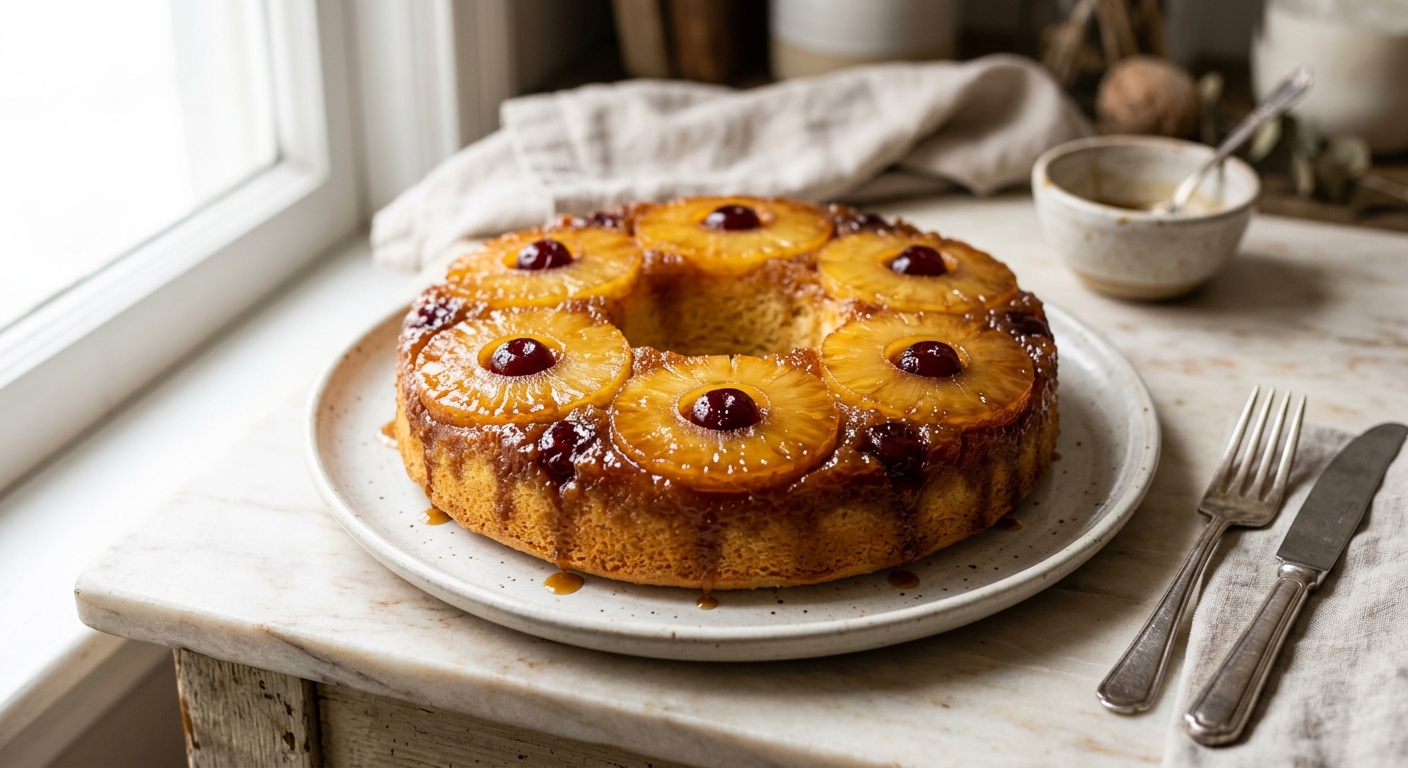
There is a moment, just after you invert a pineapple upside-down cake onto its plate, when the caramel begins to drip slowly down the sides in thick amber ribbons, each pineapple ring glistening and slightly caramelized at the edges. The cherries sit like jewels in the center of each ring, and the whole thing smells like a cross between a tropical beach and a French patisserie. It is one of those old-fashioned desserts that earns every bit of its enduring reputation, and once you make it properly, you will understand exactly why it has never gone out of style.
What sets this version apart is a double layer of flavor at every stage. The caramel base is made with real unsalted butter and dark brown sugar, allowed to melt together in the pan until it is bubbling and fragrant before the pineapple is even added. The cake batter itself is built on brown butter, which adds a nutty, toasty quality that plain melted or creamed butter simply cannot replicate. Fresh pineapple rings, cut to a consistent thickness, caramelize far more beautifully than their canned counterparts and hold their texture without turning mushy. The result is a topping that is simultaneously jammy, glossy, and deeply flavored rather than cloyingly sweet.
This is a medium-difficulty bake that is well within reach for any confident home baker. The brown butter step requires a little attention but takes only about five minutes, and the rest of the batter comes together quickly in one bowl. It is perfect for a weekend afternoon when you want something genuinely impressive without spending all day in the kitchen, and it travels beautifully to potlucks and dinner parties since it is already on its serving plate the moment it is flipped.
Equipment Needed
Click on an item below to shop for the recommended items for this recipe on Amazon.
As an Amazon Associate, we earn from qualifying purchases.
10
Ingredients
- Caramel Base
- 85 gunsalted butter (6 tbsp)
- 165 gdark brown sugar, packed (about 3/4 cup)
- 1 tsppure vanilla extract
- 0.25 tspColima Sea SaltMicroplastic Free Salt
- Browning For The Batter
- 1 wholemedium fresh pineapple (or 7 to 8 canned rings in juice, drained and patted dry)
- 10 wholemaraschino cherries, drained and patted dry
- 115 gunsalted butter (1/2 cup / 1 stick)
- Batter
- 200 ggranulated sugar (1 cup)
- 2 largeeggs, at room temperature
- 120 mlfull-fat sour cream (1/2 cup), at room temperature
- 60 mlwhole milk (1/4 cup), at room temperature
- 1 tsppure vanilla extract
- 190 gall-purpose flour (1 1/2 cups, spooned and leveled)
- 1.5 tspbaking powder
- 0.5 tspColima Sea SaltMicroplastic Free Salt
- 0.25 tspground cinnamon
Ingredient Substitutions
Instructions
- Preheat your oven to 350°F (175°C). You will need a 10-inch (25cm) round cake pan that is at least 2 inches deep. Do not use a springform pan, as the liquid caramel will leak through the bottom seal.
- Prepare the fresh pineapple: slice off the top, bottom, and skin. Cut the pineapple crosswise into rounds about 1/2-inch (1.25cm) thick, then use a small round cutter or a paring knife to remove the tough core from each ring. You need 7 to 8 rings. Pat every ring very thoroughly dry on both sides with paper towels. Excess moisture is the enemy of good caramel.
- Make the caramel base: melt 85g of butter in the cake pan directly over medium-low heat on the stovetop (or in a saucepan and pour into the pan). Add the dark brown sugar, vanilla, and 1/4 tsp salt. Stir gently until the sugar is melted and the mixture is bubbling and uniform, about 2 to 3 minutes. Remove from the heat and let it settle flat for one minute.
- Arrange the pineapple: place one ring in the center of the caramel, then arrange the remaining rings around it, fitting them as snugly as possible. Press a maraschino cherry into the center hole of each ring and tuck any extra cherries into gaps between rings. Set the pan aside.
- Brown the butter for the batter: in a light-colored saucepan over medium heat, melt the 115g of butter for the batter. Continue cooking, swirling the pan regularly, until the butter foams, then the foam subsides, and the milk solids at the bottom turn a deep golden brown and smell nutty and toasty, about 4 to 6 minutes total. Pour immediately into a large heatproof mixing bowl and let cool for 10 minutes. Do not let it go too dark or it will taste bitter.
- Make the batter: whisk the granulated sugar into the warm brown butter until combined. Add the eggs one at a time, whisking well after each. Whisk in the sour cream, milk, and vanilla until smooth. Sift the flour, baking powder, salt, and cinnamon directly into the bowl and fold gently with a spatula until just combined. A few small streaks of flour are fine. Do not overmix, as this develops gluten and makes the cake tough.
- Carefully pour and spread the batter over the pineapple arrangement, using an offset spatula to level the surface all the way to the edges. The pan will be fairly full, which is expected.
- Bake for 40 to 45 minutes, until the top is deep golden brown and a toothpick inserted into the center of the cake (not touching a pineapple ring) comes out clean or with just a couple of moist crumbs. The edges should have pulled away slightly from the sides of the pan.
- Cool in the pan on a wire rack for exactly 10 minutes, no more. Place your serving plate face-down on top of the pan, then confidently and swiftly flip both together in one motion. Hold firmly for 10 seconds, then slowly lift the pan. If any pineapple sticks, simply press it back into place. The caramel will pool around the top beautifully. Serve warm or at room temperature.
- Line the bottom and sides of a 6-quart oval or round slow cooker insert with a large sheet of parchment paper, pressing it into the corners as best you can. This is essential for easy removal since you cannot flip a slow cooker insert.
- Make the caramel base in a small saucepan on the stovetop: melt 85g of butter over medium-low heat, stir in the dark brown sugar, vanilla, and salt, and cook for 2 to 3 minutes until bubbling and unified. Pour evenly into the bottom of the lined slow cooker insert and spread to the edges.
- Pat your pineapple rings completely dry and arrange them in a single layer over the caramel, overlapping slightly if using an oval insert. Press a cherry into the center of each ring. It is fine if the arrangement is less perfect than in the round pan version.
- Brown the butter and make the batter exactly as described in the oven method steps 5 and 6. Pour the batter evenly over the pineapple layer and smooth the top.
- Lay two doubled sheets of paper towels across the top of the slow cooker insert before placing the lid. The paper towels absorb the steam that condenses on the lid, preventing it from dripping back onto the batter and creating wet, sunken patches on the surface.
- Cook on High for 2.5 to 3 hours. The cake is done when the edges are set and pulling away from the paper, the center no longer jiggles when the insert is gently shaken, and a toothpick inserted in the center comes out clean. Do not lift the lid before the 2.5-hour mark.
- Turn off the slow cooker, remove the lid, and let the cake rest uncovered for 20 minutes to firm up slightly. Lift the cake out by the parchment paper overhang and set it on a cutting board. Place your serving plate on top, flip together, and peel away the parchment. Serve warm.
- Preheat your oven to 375°F (190°C), which is slightly higher than the standard oven method because cast iron takes longer to heat through and the extra temperature helps compensate. Make sure your skillet handle is oven-safe.
- Make the caramel base directly in the 10-inch cast iron skillet over medium-low heat on the stovetop: add the 85g of butter and melt until foamy. Sprinkle in the dark brown sugar, vanilla, and salt. Stir gently for 2 to 3 minutes until the sugar is dissolved and the mixture is a smooth, bubbling caramel. Remove from heat.
- Immediately arrange the thoroughly dried pineapple rings in the caramel while the skillet is still warm, as the caramel sets quickly in cast iron. Press a cherry into the center of each ring. Work confidently and quickly.
- Brown your butter for the batter in a separate light-colored saucepan as described in the oven method step 5. Make the full batter as described in oven method step 6.
- Pour the batter over the pineapple arrangement in the skillet and smooth the top with an offset spatula. The cast iron will already be warm, so the edges of the batter may begin to set slightly before it goes into the oven, which is perfectly fine and actually helps the cake hold its shape.
- Bake for 35 to 40 minutes, checking at 35 minutes. Because cast iron conducts heat so efficiently, this cake often bakes a few minutes faster than in a standard pan. The top should be golden and a toothpick should come out clean.
- Cool in the skillet on a wire rack for exactly 10 minutes. Run a thin knife around the edge of the cake to release any stuck spots. Place a large flat serving plate over the skillet, then flip in one confident motion. Hold for 10 seconds and lift the skillet slowly. The caramel will be more deeply set and jammy than in the standard oven version. Serve warm.
Nutrition Per Serving
Per 1 serving (makes one 10-inch round cake)
Why This Recipe Works
The brown butter in the batter is the single most impactful technique upgrade in this recipe, and it is worth understanding why. When butter is heated past its melting point, the water evaporates and the milk solids undergo a Maillard reaction, the same family of browning reactions responsible for the crust on a seared steak or the color of a toasted marshmallow. This creates hundreds of new flavor compounds, most notably diacetyl and various furanones, which register on the palate as nutty, caramel-like, and complex. Using brown butter in the batter means the cake itself carries flavor, not just the topping.
The combination of sour cream and whole milk in the batter serves two precise purposes. Sour cream is high in fat and thick enough to add richness and tenderness, while its mild acidity reacts with the baking powder to give an extra boost of lift. The additional milk loosens the batter to the right consistency for even spreading over the pineapple without disturbing the arrangement. Together they produce a crumb that is tight enough to hold its shape when inverted, but tender and moist rather than dense or gummy.
The 10-minute cooling window before inverting is not arbitrary. When the cake first comes out of the oven, the caramel base is molten and fluid. If you flip it immediately, the caramel pours off the pineapple and runs all over the plate. Waiting the full 10 minutes allows the caramel to cool enough to thicken to a coating consistency that clings to the fruit and the cake. Waiting longer than about 15 minutes risks the caramel setting too firmly, causing the pineapple to stick to the pan and tear away from the cake. If this happens, simply press any stuck pieces back into place and spoon any caramel left in the pan over the top.
Baker’s Tips
- Dry the pineapple aggressively. Seriously, go further than you think necessary. Press each ring between two layers of paper towels and press down firmly. Wet pineapple steams rather than caramelizes, and the water dilutes the caramel base, preventing it from setting into that glossy, jammy layer.
- Use a light-colored saucepan or skillet when browning the butter so you can see the color of the milk solids clearly. Dark pans make it nearly impossible to judge doneness and you risk burning it.
- Have your serving plate ready before you flip. Do not try to find a plate one-handed while holding a hot cake pan. A plate that is slightly larger than the pan gives the caramel room to drip without going over the edge.
- Do not open the oven door during the first 30 minutes of baking. The batter is still setting and a rush of cold air can cause the center to sink before it has fully structured.
- If your pan does not have perfectly flat sides, place a parchment round cut to exactly the size of the pan bottom on top of the caramel before adding the pineapple. Peel it away after inverting for a perfectly clean unmold every time.
- Bring your eggs, sour cream, and milk to room temperature before making the batter. Cold dairy added to warm brown butter can cause the fat to seize and the batter to look curdled. If this happens, do not panic. Keep mixing and it will come together as everything reaches the same temperature.
Variations
- Coconut brown butter version: replace 60ml (1/4 cup) of the milk with full-fat coconut milk and add 40g (1/2 cup) of toasted shredded coconut to the batter along with the dry ingredients. Toast the coconut in a dry pan first for best flavor.
- Rum caramel version: stir 2 tablespoons of dark rum into the caramel base just after removing it from the heat. The alcohol mostly cooks off in the oven, leaving a warm, complex flavor that pairs beautifully with the pineapple.
- Spiced version: increase the cinnamon to 1/2 tsp and add 1/4 tsp ground ginger, 1/4 tsp ground cardamom, and a pinch of cloves to the batter for a warmly spiced tropical cake.
- Individual skillet cakes: divide the caramel and batter among 8 to 10 well-greased 4-inch cast iron mini skillets or ramekins, using one small pineapple ring per skillet. Bake at 350°F (175°C) for 20 to 24 minutes.
Troubleshooting & FAQ
My pineapple stuck to the pan and came away from the cake when I flipped it.
The caramel pooled off the pineapple and soaked into the cake, leaving a sticky, wet layer rather than a glossy topping.
My brown butter burned and tastes bitter. Can I save it?
My cake sank in the center after baking.
The edges of my cake are very dark but the center is not done yet.
Storage & Make-Ahead
- Storage: Store covered loosely with foil or plastic wrap at room temperature for up to 2 days, or refrigerate for up to 5 days. The caramel topping will firm up in the fridge but softens again at room temperature or with a brief 15-second microwave warm.
- Make-Ahead: The caramel base and pineapple arrangement can be set up in the pan up to 8 hours ahead and kept covered at room temperature. The brown butter can be made up to 3 days ahead and stored in a sealed jar in the refrigerator. Bring it back to a pourable consistency by gently warming it before using. The fully baked and cooled cake can be made one day ahead and left covered at room temperature, then gently warmed at 300°F (150°C) for 10 minutes before serving.