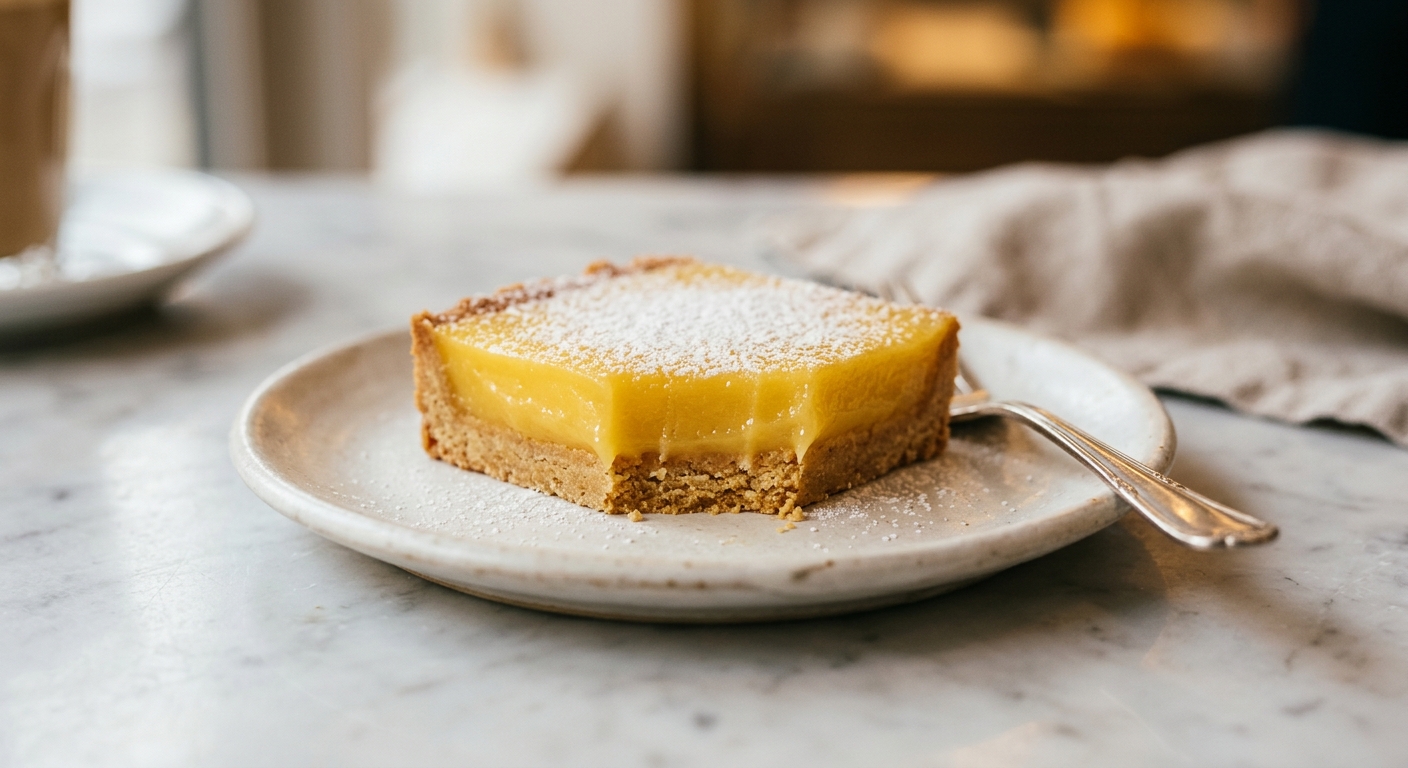
There is something undeniably cheerful about a lemon bar. That sharp, citrusy filling against a crumbly, golden crust is one of those combinations that just works, no matter the season. These sugar-free lemon bars capture everything you love about the classic, from the glossy, custardy curd to the melt-in-your-mouth shortbread base, and they do it without a single gram of refined sugar. A dusting of powdered allulose on top makes them look just as beautiful as anything you would find in a bakery case.
What sets this version apart is the combination of monk fruit sweetener in the curd and a blanched almond flour crust, which does double duty: it keeps the bars naturally lower in carbohydrates and adds a delicate, nutty richness that plain shortbread simply cannot match. The monk fruit sweetener is particularly well-suited to lemon curd because it has zero aftertaste at high acid levels, something that can trip up other sugar-free sweeteners. A small amount of arrowroot powder (instead of cornstarch) thickens the curd cleanly and keeps the texture silky and sliceable rather than stiff or gummy.
These bars sit at a medium difficulty level, mostly because the curd requires a little patience at the stove, but if you have ever made a stovetop pudding or hollandaise, you already have the skills you need. They are perfect for anyone managing blood sugar, following a low-carb lifestyle, or simply looking to cut back on sugar without cutting back on dessert. Make them for a weekend brunch, a picnic, or just because your kitchen deserves to smell like lemons on a Tuesday.
Equipment Needed
Click on an item below to shop for the recommended items for this recipe on Amazon.
As an Amazon Associate, we earn from qualifying purchases.
16
Ingredients
- Crust
- 200 gblanched almond flour (about 2 cups, lightly packed, not almond meal)
- 40 gpowdered allulose or powdered monk fruit blend (about 5 tbsp)
- 0.25 tspColima Sea SaltMicroplastic Free Salt
- 85 gunsalted butter, melted and slightly cooled (about 6 tbsp)
- 1 tsppure vanilla extract
- 4 largeeggs, at room temperature
- 2 largeegg yolks, at room temperature
- 180 mlfresh lemon juice (from about 4 to 5 large lemons, about 3/4 cup), strained
- 150 ggranulated monk fruit sweetener (about 3/4 cup) for the curd
- 1 tbspfinely grated lemon zest (from about 2 lemons)
- 15 garrowroot powder (about 1 tbsp plus 1 tsp)
- Curd
- 56 gunsalted butter, cut into 1/2-inch cubes, cold (about 4 tbsp)
- —Pinch of Colima Sea SaltMicroplastic Free Salt
- Dusting
- 20 gpowdered allulose or powdered monk fruit blend (about 3 tbsp)
Ingredient Substitutions
Instructions
- Preheat your oven to 325°F (165°C). Line an 8×8-inch baking pan with parchment paper, leaving a 2-inch overhang on two opposite sides to act as handles later. Lightly grease any exposed sides of the pan.
- Make the crust: In a medium bowl, whisk together the almond flour, 40g powdered monk fruit sweetener, and 1/4 tsp fine sea salt until no lumps remain. Add the melted butter and vanilla extract and stir with a fork until the mixture comes together into a damp, sandy dough. Press it evenly into the bottom of the prepared pan, using the bottom of a flat measuring cup to compact it firmly. The crust should be about 1/4 inch thick with slightly raised edges.
- Bake the crust for 20 to 22 minutes, until it is golden at the edges and just set in the center. It will feel soft when hot but will firm up as it cools. While the crust bakes, make the curd.
- Make the monk fruit lemon curd: In a medium heavy-bottomed saucepan, whisk together the 4 whole eggs, 2 egg yolks, 150g granulated monk fruit sweetener, arrowroot powder, and pinch of salt until smooth. Whisk in the fresh lemon juice and lemon zest. Place the pan over medium-low heat and cook, whisking constantly, for 8 to 11 minutes until the curd thickens noticeably and coats the back of a spoon. It should reach about 170°F (77°C). Do not let it boil or the eggs will scramble.
- Remove the curd from the heat and immediately add the cold butter cubes, whisking until each cube is fully melted and incorporated. The finished curd should be smooth, glossy, and pourable. If you notice any tiny egg bits, pour the curd through a fine-mesh strainer.
- When the crust comes out of the oven, immediately pour the warm curd over the hot crust and spread it into an even layer with an offset spatula. Return the pan to the oven and bake for 18 to 20 minutes, until the curd is just set at the edges but still has a slight jiggle in the very center (like a baked cheesecake). The filling will continue to firm up as it cools.
- Allow the bars to cool completely in the pan at room temperature for at least 45 minutes, then transfer to the refrigerator and chill for at least 1 hour (2 hours is ideal) before cutting. Lift the bars out using the parchment handles, slice into 16 squares with a sharp knife (wiping the blade between cuts), and dust generously with powdered allulose just before serving.
- Line an 8×8-inch pan with parchment paper with a 2-inch overhang on two sides. Make the no-bake crust: In a food processor, pulse the almond flour, 40g powdered monk fruit sweetener, and 1/4 tsp salt together. Add the melted butter and vanilla and pulse 5 to 6 times until the mixture resembles damp sand and holds together when pressed. Press firmly and evenly into the bottom of the pan, using a flat-bottomed measuring cup to compact it well.
- Place the crust in the freezer for 20 minutes to firm up while you prepare the curd. A frozen crust holds up better when the warm curd is poured over it.
- Make the stovetop curd: In a medium heavy-bottomed saucepan, whisk together the 4 whole eggs, 2 egg yolks, 150g granulated monk fruit sweetener, arrowroot powder, and pinch of salt. Whisk in the lemon juice and zest. Cook over medium-low heat, whisking constantly, for 10 to 13 minutes until the curd is thick enough to heavily coat the back of a spoon and leaves a clean line when you run your finger through it. It should reach 170°F (77°C).
- Remove from heat and immediately whisk in the cold butter cubes one at a time until completely melted and smooth. Strain through a fine-mesh sieve into a clean bowl or pitcher for the cleanest result. Let the curd cool for 10 minutes, stirring occasionally, until it is warm but not hot (around 120°F or 50°C). Pouring it slightly cooled prevents the no-bake crust from crumbling.
- Pour the curd evenly over the chilled crust. Gently tap the pan on the counter twice to release any air bubbles and smooth the surface. Cover loosely with plastic wrap (do not let it touch the curd surface) and refrigerate for at least 2 hours, or until fully set and firm. Slice and dust with powdered allulose just before serving. This version is best enjoyed straight from the refrigerator, as the no-bake crust softens at room temperature.
- Line a 6-inch or 7-inch square baking pan that fits in your air fryer basket with parchment paper. Halve all ingredient quantities to fit the smaller pan (this will yield about 9 bars). Preheat your air fryer to 300°F (150°C) for 3 minutes.
- Prepare the almond flour crust as directed in the oven method (using halved quantities), pressing it firmly and evenly into the prepared pan. Place the pan in the air fryer basket and bake at 300°F (150°C) for 14 to 16 minutes, checking at the 12-minute mark. The crust should be golden at the edges and just barely firm to the touch. Air fryers cook faster and more intensely than conventional ovens, so a lower temperature prevents the almond flour from burning.
- While the crust bakes, prepare the stovetop lemon curd using the halved quantities, following steps 4 and 5 from the oven method. Strain the curd for the smoothest finish.
- Pour the warm curd over the hot crust in the air fryer pan. Return the pan to the air fryer and bake at 280°F (138°C) for 10 to 12 minutes, until the curd is just set at the edges with a slight wobble in the center. Check at 8 minutes. The lower temperature here is important, as the egg-rich curd can curdle or puff unevenly at higher air fryer heat.
- Cool at room temperature for 30 minutes, then refrigerate for at least 1 hour until fully set. Slice into 9 bars and dust with powdered allulose before serving.
Nutrition Per Serving
Per 1 serving (makes one 8×8-inch pan, cut into 16 bars)
Sweetener: monk fruit
Why This Recipe Works
The magic of a great lemon curd comes down to controlled coagulation of egg proteins. Whole eggs and yolks both contain proteins that begin to set between 150°F and 185°F (65°C to 85°C). By keeping the heat at medium-low and whisking constantly, you raise the temperature of the curd gradually and evenly, preventing any one part of the mixture from overheating and scrambling. The arrowroot powder plays a critical supporting role here: it stabilizes the egg proteins, allowing the curd to thicken at a slightly lower temperature and giving you more forgiveness if the heat climbs a little. Unlike cornstarch, arrowroot produces a clearer, more jewel-like curd and does not leave a starchy aftertaste, which matters in a recipe where lemon is the star. The cold butter whisked in at the end is an emulsification step, the fat coats and separates the protein strands, giving the curd that signature silky, almost creamy texture rather than a rubbery or gel-like one.
Monk fruit sweetener behaves differently from sugar in a lemon curd in one important and positive way: it does not caramelize or add color, so the curd stays a bright, sunny yellow. It also does not interfere with the gel structure built by arrowroot and egg proteins, unlike some sugar alcohols that can disrupt hydration in cooked applications. In the almond flour crust, using powdered rather than granulated sweetener is essential. Powdered sweetener integrates fully into the fat and flour, producing a smooth, cohesive dough. Granulated sweetener can leave a slightly gritty or sandy texture in a press-in crust, because unlike in a regular sugar shortbread, there is no steam or water to help it dissolve during a short bake.
If your curd looks thin after baking, it is almost certainly underbaked. The arrowroot-thickened curd needs to reach temperature both on the stove and again in the oven to fully set. Give it those extra minutes and trust the jiggle test: set at the edges, slightly wobbly in the very center is exactly right. If your crust is browning too quickly in the oven, tent it loosely with foil for the last few minutes of the initial bake. Almond flour has a higher fat content than wheat flour and can go from golden to dark quickly, especially around the edges.
Baker’s Tips
- Use a kitchen scale for the almond flour. Almond flour is notoriously easy to over-pack into a measuring cup, and too much will make the crust dry and crumbly rather than tender.
- Zest your lemons before juicing them. It is nearly impossible to zest a juiced lemon effectively, and fresh zest is one of the most important flavor elements in this recipe.
- Strain the finished curd through a fine-mesh sieve even if it looks smooth. This removes any small bits of cooked egg or zest fibers and guarantees a perfectly silky texture.
- Use a sharp knife and wipe it clean between each cut for bakery-clean slices. A bench scraper also works well for the initial cuts.
- Do not dust with powdered allulose until just before serving. Allulose absorbs moisture from the curd over time and can turn translucent or disappear if applied too far in advance.
- Bring your eggs to room temperature before starting. Cold eggs can cause the curd to cook unevenly and may lower the pan temperature enough to extend your cooking time significantly.
Variations
- Lemon-Lavender: Add 1 tsp of dried culinary lavender to the lemon juice and steep for 10 minutes, then strain before using. The floral note pairs beautifully with the bright citrus.
- Lime or Meyer Lemon: Substitute equal amounts of fresh lime juice and zest for a more tropical bar, or use Meyer lemon juice for a sweeter, more floral curd with less tartness.
- Dairy-Free: Use refined coconut oil in place of butter in the crust (same weight) and vegan butter sticks in the curd. The curd will be slightly less rich but still very good.
- Coconut Crust: Replace 50g of the almond flour with unsweetened desiccated coconut for a crust with a toasty, tropical character that complements the lemon beautifully.
Troubleshooting & FAQ
My curd is still runny after chilling. What went wrong?
My curd turned grainy or scrambled. Can I fix it?
My almond flour crust is crumbling and will not hold together when I slice.
I can taste a cooling sensation in the bars. How do I reduce it?
The powdered allulose I dusted on top has disappeared or become wet-looking. What happened?
Storage & Make-Ahead
- Storage: Store bars in a single layer (or with parchment between layers) in an airtight container in the refrigerator for up to 5 days. Do not store at room temperature for more than 2 hours, as the egg-based curd requires refrigeration. Freeze fully set, undusted bars in a single layer for up to 2 months. Thaw overnight in the refrigerator and dust with powdered allulose just before serving.
- Make-Ahead: The lemon curd can be made up to 3 days ahead and stored in a sealed jar in the refrigerator. Warm it briefly in a saucepan over low heat, stirring, until pourable before adding to the baked crust. The baked crust can be made 1 day ahead, cooled completely, covered tightly, and left at room temperature. Assemble and bake the filled bars the next day.