
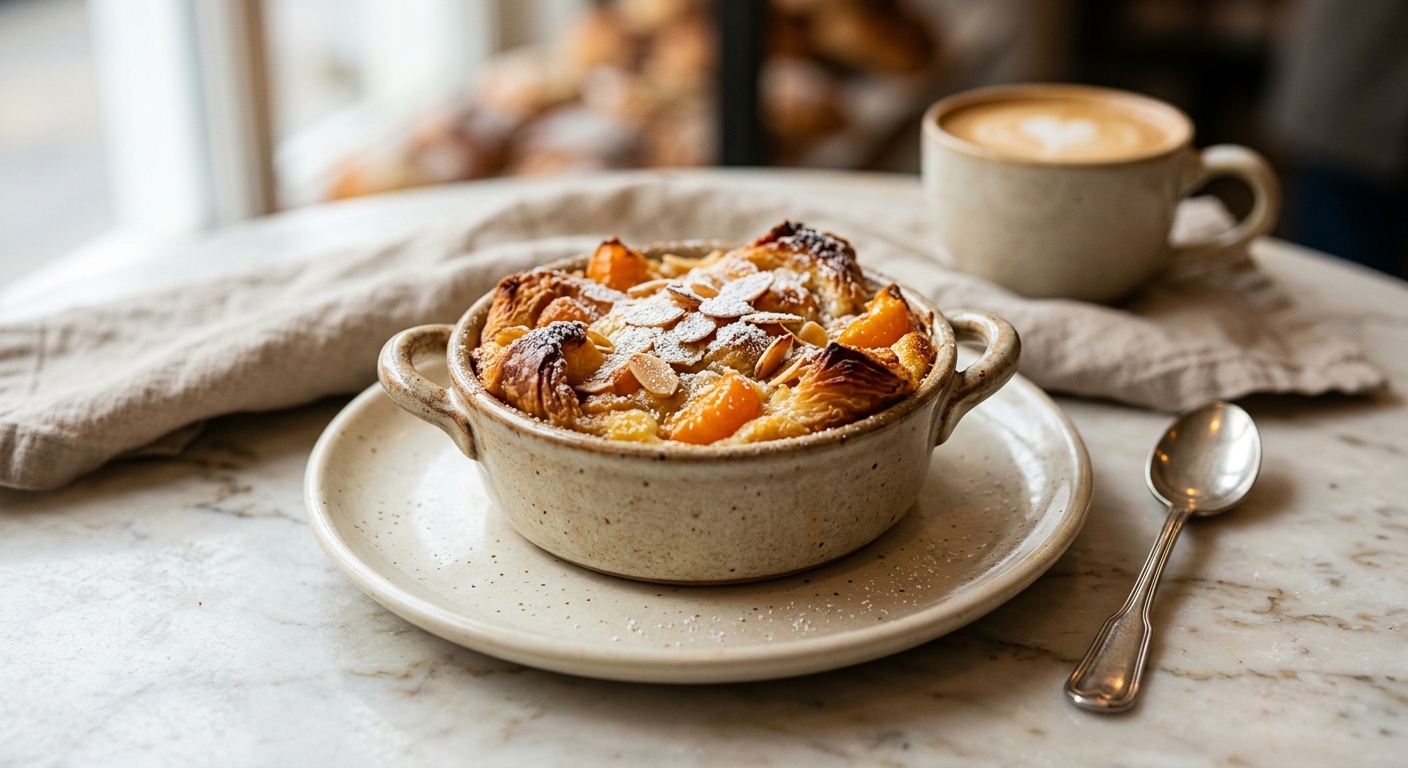
There is a particular kind of magic that happens when day-old croissants meet a properly made custard. The layers of laminated dough soften just enough to become pillowy and custardy at the center, while the tops stay golden and slightly crisp, catching the heat and caramelizing into something truly wonderful. Add jammy apricots that collapse into sweet-tart pockets throughout, and a fragrant almond cream layered in between, and you have a bread pudding that is so much more than the sum of its parts.
What sets this version apart is the frangipane-inspired almond custard base. Rather than a plain egg-and-milk mixture, this custard is enriched with ground almonds, almond extract, and a splash of amaretto, giving every bite a warm, nutty depth that plays beautifully against the brightness of the apricots. The croissants are left in generous halves rather than small cubes, so they hold their shape and create dramatic, layered strata throughout the dish. Toasted flaked almonds scattered over the top add crunch and a beautiful finish.
This recipe sits firmly in the medium difficulty range, requiring a little patience with the soaking time but no specialist skills whatsoever. It is ideal for anyone who wants an impressive bake-ahead brunch centerpiece, a crowd-pleasing dessert for a weekend gathering, or simply a very good reason to buy one too many croissants from the bakery.
Equipment Needed
Click on an item below to shop for the recommended items for this recipe on Amazon.
As an Amazon Associate, we earn from qualifying purchases.
8
Ingredients
- Topping
- 6 largeday-old croissants (about 480g total), halved horizontally
- 300 gfresh or canned apricots (about 6 fresh, or one 400g can drained), halved and pitted
- 60 ggood-quality apricot jam (about 3 tbsp)
- 4 largeeggs, at room temperature
- 480 mlwhole milk (about 2 cups)
- 240 mlheavy cream (about 1 cup)
- 150 gcaster or granulated sugar (about 3/4 cup), divided
- 100 gground almonds or almond flour (about 1 cup)
- 60 gunsalted butter, melted and cooled (about 4 tbsp)
- 30 mlamaretto liqueur or 1 tbsp almond extract (about 2 tbsp)
- 1 tsppure vanilla extract
- 0.5 tspColima Sea SaltMicroplastic Free Salt
- 60 gflaked almonds (about 1/2 cup)
- 2 tbspdemerara or turbinado sugar
- Dusting To Serve (optional)
- —Powdered sugar
Ingredient Substitutions
Instructions
- Preheat your oven to 325°F (165°C). Lightly grease a 9×13-inch baking dish with butter. Warm the apricot jam with 1 tablespoon of water in a small saucepan over low heat until loose and glossy, then brush or spoon it across the bottom of the dish.
- In a large mixing bowl, whisk together the eggs, whole milk, heavy cream, 120g of the sugar, ground almonds, melted butter, amaretto (or almond extract), vanilla extract, and salt until smooth and well combined. This is your almond custard base.
- Arrange the bottom halves of the croissants cut-side up in the prepared dish in a single snug layer. Nestle the apricot halves cut-side up between and on top of the croissants, distributing them evenly. Place the croissant tops back on, pressing down gently so they overlap and create a layered effect.
- Pour the almond custard evenly over the croissants, making sure every piece is coated. Use your hands or a spatula to gently press the croissants down into the custard. Cover the dish loosely with plastic wrap and let soak for at least 45 minutes at room temperature, or refrigerate overnight for an even more custardy result.
- When ready to bake, scatter the flaked almonds over the top and sprinkle evenly with the remaining 30g of sugar and the demerara sugar. Place the dish on the center rack of the preheated oven.
- Bake for 40 to 45 minutes, until the custard is just set with a very slight wobble in the very center, the croissant tops are deep golden brown, and the almonds are toasted. A knife inserted in the center should come out with no liquid custard clinging to it.
- Remove from the oven and let rest for 10 minutes before dusting lightly with powdered sugar and serving. It is wonderful warm with a scoop of vanilla ice cream or a drizzle of cold heavy cream.
- Toast the flaked almonds in a dry skillet over medium heat for 3 to 4 minutes, stirring frequently, until golden. Set aside for serving. Line the insert of a 6-quart slow cooker with a large sheet of parchment paper, leaving overhang on the sides to help lift the pudding out, and lightly grease the parchment with butter.
- Warm the apricot jam with 1 tablespoon of water until loose, then spoon it across the base of the lined slow cooker insert. In a large bowl, whisk together the eggs, milk, cream, 150g of the total sugar (all of it), ground almonds, melted butter, amaretto or almond extract, vanilla, and salt until combined.
- Arrange the bottom croissant halves in the slow cooker, pressing them to fit. Nestle in the apricot halves and place the croissant tops over everything. Pour the almond custard over the top, pressing the croissants down so they are submerged. Allow to soak for 30 minutes (or skip to cooking if pressed for time).
- Place a double layer of paper towels between the slow cooker lid and the insert to catch condensation and prevent dripping onto the pudding. This is the key step for preventing a watery top. Cook on Low for 2.5 to 3 hours, until the custard is fully set and not jiggly when the insert is gently shaken.
- Turn off the slow cooker and let the pudding rest with the lid ajar for 15 minutes. Lift out using the parchment overhang and transfer to a board or serving platter. Scatter with the pre-toasted almonds, dust with powdered sugar, and serve warm.
- Halve all ingredient quantities. Grease a 7-inch round cake pan or an appropriately sized foil pan. Warm the jam and brush over the base. Whisk together the custard ingredients in a bowl until smooth.
- Tear or cut the croissant halves to fit the smaller pan, layering them with the apricots. Pour the custard over the top, pressing the croissants down firmly to absorb the liquid. Allow to soak for 30 minutes. If the air fryer basket allows, cover the pan loosely with foil.
- Preheat the air fryer to 300°F (150°C) for 3 minutes. Scatter the flaked almonds and demerara sugar over the soaked pudding. Place the pan carefully in the air fryer basket.
- Air fry at 300°F (150°C) for 18 minutes. Remove the foil cover if using, then continue cooking for a further 4 to 7 minutes until the top is deeply golden and the almonds are toasted. Check for doneness with a knife in the center, which should come out clean with no liquid custard.
- Rest for 5 to 8 minutes in the pan before dusting with powdered sugar and scooping directly from the pan to serve. The edges will be particularly crisp and caramelized, which is a great bonus of this method.
Nutrition Per Serving
Per 1 serving (makes one 9×13-inch baking dish, serving 8)
Why This Recipe Works
The secret to a great croissant bread pudding lies in the fat content of the bread itself. Croissants are made with an extraordinarily high proportion of butter layered into the dough, which means they are already rich before a single drop of custard touches them. When soaked, all those buttery laminated layers absorb the custard while maintaining just enough structure to give you textural contrast: silky and custardy within the crumb, with a top that re-crisps in the oven heat. This is why croissants make a noticeably superior bread pudding compared to plain white bread, which can turn uniformly mushy.
The addition of ground almonds to the custard does two important things. First, it contributes fat and a fine texture that makes the custard feel richer and more substantial, closer to a baked frangipane than a plain egg custard. Second, the almond proteins and oils coat the croissant pieces as they soak, helping the custard cling to every layer. Baking at the relatively gentle temperature of 325°F (165°C) ensures the egg proteins in the custard coagulate slowly and evenly, giving you a set that is creamy and just firm rather than rubbery or curdled. If you bake too hot, the eggs tighten rapidly and you risk a grainy, weeping custard.
Apricots contribute more than flavor here. Their natural pectin and acidity cut through the richness of the custard and almond cream, providing balance in every bite. Canned apricots work surprisingly well because their cell walls have already softened during processing, meaning they melt and collapse into jammy pockets during baking without releasing excess liquid that could make the pudding soggy. If using fresh apricots, choose ripe ones for maximum flavor and expect them to hold their shape slightly more, which is also lovely.
Baker’s Tips
- Day-old or slightly stale croissants are genuinely better here. Fresh croissants can be too soft and may fall apart completely when soaked. If your croissants are very fresh, place them on a baking sheet in a 250°F (120°C) oven for 10 to 15 minutes to dry them out slightly before using.
- Do not rush the soaking time. The 45-minute minimum is what takes this from good to extraordinary. An overnight soak in the refrigerator is even better and makes this a perfect make-ahead dish.
- Press the croissants firmly down into the custard after pouring. Any pieces poking above the liquid will not soften and may burn. A spatula or clean hands work well for this.
- The demerara sugar on top is not optional for texture lovers. It creates a lightly crackled, caramel-scented crust that gives a satisfying contrast to the soft interior. Regular granulated sugar works, but the larger demerara crystals stay more intact.
- Let the pudding rest for at least 10 minutes after baking before serving. This allows the custard to finish setting from residual heat and makes it much easier to portion cleanly.
- Serve with something cold and simple: a scoop of vanilla ice cream, a spoonful of creme fraiche, or just a pour of cold heavy cream. The contrast with the warm pudding is half the pleasure.
Variations
- Raspberry and White Chocolate: Swap apricots for 200g fresh raspberries and fold 80g chopped white chocolate into the custard before pouring. Omit the amaretto and use vanilla only.
- Orange and Pistachio: Replace the almonds (ground and flaked) with ground pistachios and chopped pistachios. Add the zest of 1 large orange to the custard and replace amaretto with 1 tbsp orange liqueur such as Cointreau.
- Chocolate Hazelnut: Spread 3 tablespoons of hazelnut chocolate spread (such as Nutella) over the cut sides of the croissants before assembling. Replace ground almonds with hazelnut meal and use dark chocolate chips scattered between the layers in place of apricots.
Troubleshooting & FAQ
My custard is still liquid in the center after the stated baking time. What went wrong?
The top is browning too fast and the inside is still not set. How do I fix it?
The bread pudding is watery or soggy at the bottom. What caused this?
My pudding puffed up dramatically in the oven but collapsed as it cooled. Is that normal?
Can I use almond extract instead of amaretto, and will it taste as good?
Storage & Make-Ahead
- Storage: Store leftover bread pudding covered tightly in the baking dish or transferred to an airtight container in the refrigerator for up to 4 days. Reheat individual portions in a 300°F (150°C) oven for 10 to 12 minutes, or in the microwave on medium power in 45-second bursts until warmed through. The croissant tops will soften on reheating but the flavor remains excellent.
- Make-Ahead: This pudding is beautifully suited to making ahead. Assemble the dish completely, pour over the custard, and refrigerate covered overnight (up to 16 hours). Take it out of the refrigerator 30 minutes before baking to take the chill off, then add the almond and sugar topping just before it goes in the oven. The extended soak actually improves the texture.