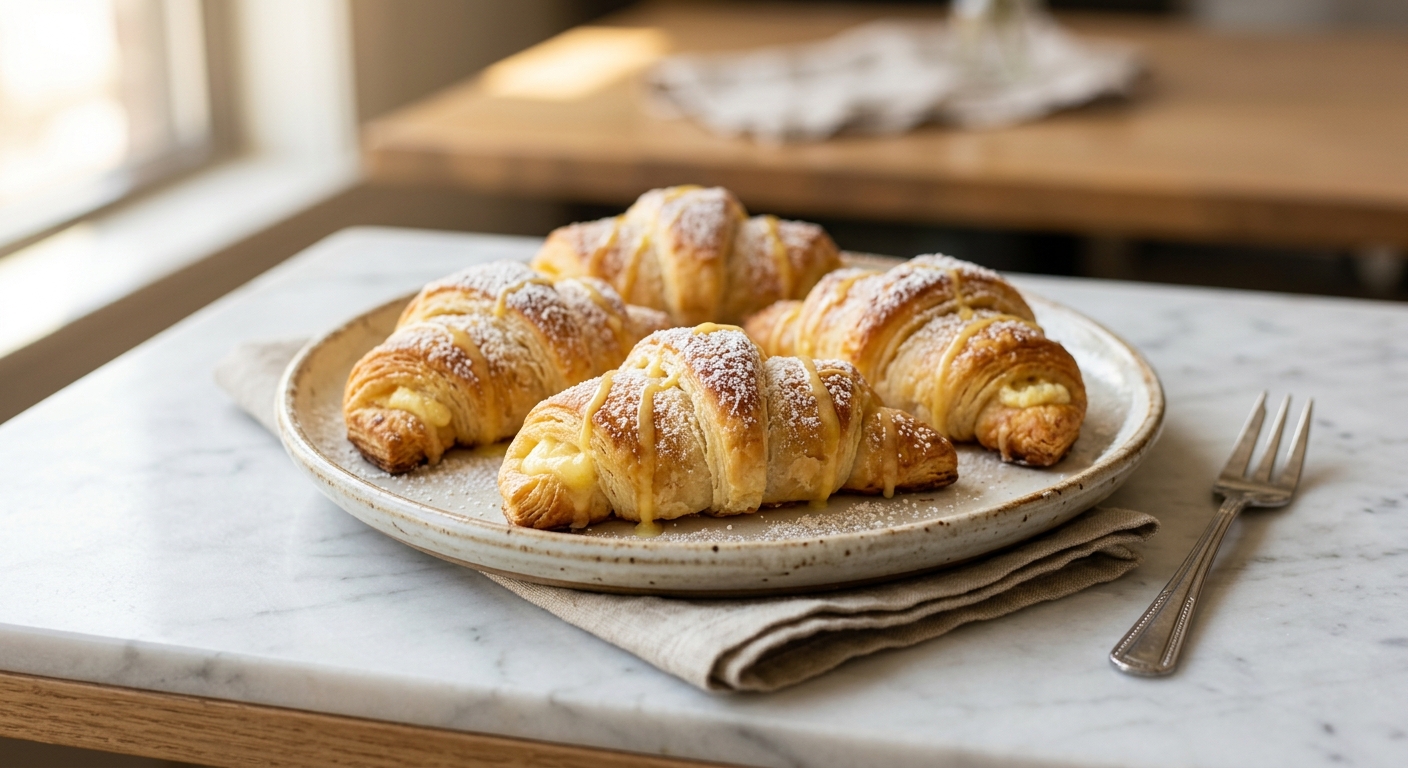
There is something quietly magical about pulling a tray of golden crescent rolls from the oven, their edges crisped and caramelized, the kitchen filled with the warm scent of butter and bright lemon. These Lemon Curd and Cream Cheese Crescent Rolls sit somewhere between a Danish pastry and a breakfast roll, pillowy and rich with a filling that is simultaneously tart, sweet, and luxuriously smooth. Each bite gives you flaky layers first, then that creamy, lemony center that never quite disappears into the dough the way lesser fillings do.
What sets this recipe apart is the balance of the filling. Many cream cheese pastry recipes lean so heavily on sweetness that the lemon becomes an afterthought. Here, real lemon curd, whether homemade or a good-quality store-bought jar, is folded directly into the cream cheese mixture so the citrus stays bold and present all the way through baking. A touch of lemon zest stirred into the cream cheese adds a second layer of fragrance that heat alone cannot replicate. The result is a filling that holds its shape, does not weep or pool, and tastes genuinely bright rather than just yellow.
This recipe is rated easy and is genuinely designed for everyday bakers. You are starting from store-bought crescent roll dough, which means no yeast, no proofing, no fussing with laminated pastry. The technique is simple enough for a weekend morning but the result is impressive enough to bring to a brunch table or a friend’s kitchen. If you can spread, roll, and slice, you can make these.
Equipment Needed
Click on an item below to shop for the recommended items for this recipe on Amazon.
As an Amazon Associate, we earn from qualifying purchases.
8
Ingredients
- Egg Wash
- 226 grefrigerated crescent roll dough (1 standard 8-count tube, such as Pillsbury)
- 115 gfull-fat cream cheese (about 4 oz), softened to room temperature
- 75 glemon curd (about 4 tbsp), store-bought or homemade
- 30 gpowdered sugar (about 4 tbsp), sifted
- 1 tspfresh lemon zest (from about 1 medium lemon)
- 0.5 tsppure vanilla extract
- 1 largeegg, beaten
- Glaze
- 60 gpowdered sugar (about 0.5 cup), sifted
- 15 mlfresh lemon juice (about 1 tbsp)
- 5 mlwhole milk (about 1 tsp), for glaze, plus more to adjust consistency
- —Pinch of Colima Sea SaltMicroplastic Free Salt
Ingredient Substitutions
Instructions
- Preheat your oven to 375°F (190°C). Line a large rimmed baking sheet with parchment paper and set aside.
- Make the filling: In a medium bowl, beat the softened cream cheese with a hand mixer or a sturdy spatula until completely smooth with no lumps, about 1 minute. Add the sifted powdered sugar, lemon zest, vanilla extract, and a pinch of fine sea salt. Mix until combined. Add the lemon curd and fold gently until the filling is uniform. Do not overmix or it may become too loose. Set aside.
- Unroll the crescent dough on a lightly floured surface or directly on the parchment. Separate the dough along the perforations into 8 individual triangles. If your dough comes as a sheet without perforations, use a knife or pizza cutter to cut it into 8 equal triangles.
- Spoon about 1 heaping teaspoon of filling onto the wide base of each triangle, spreading it gently but leaving a 0.5-inch (1.5 cm) border around all edges. Do not overfill or the filling will leak during baking.
- Starting from the wide base, roll each triangle up toward the pointed tip, curving the ends slightly to form a crescent shape. Place each roll on the prepared baking sheet, pointed tip tucked underneath so it does not unroll during baking, spaced about 2 inches apart.
- Brush each roll lightly with the beaten egg wash, taking care not to let it pool at the base where it can cause sticking.
- Bake for 12 to 14 minutes, until the rolls are deep golden brown on top and the undersides are set and colored. Do not underbake. A pale roll means the dough is still a little raw in the center.
- While the rolls bake, whisk together the sifted powdered sugar, lemon juice, and milk in a small bowl until a smooth, pourable glaze forms. It should drizzle off a spoon in a slow ribbon. Adjust with an extra drop of milk if too thick.
- Transfer the baked rolls to a cooling rack and let them cool for 5 minutes before drizzling generously with the lemon glaze. Serve warm or at room temperature.
- Prepare the filling and shape the crescent rolls exactly as described in Steps 2 through 5 of the oven method above. Brush with egg wash.
- Preheat your air fryer at 330°F (165°C) for 3 minutes. Lightly spray the air fryer basket with non-stick cooking spray or line it with a perforated parchment liner.
- Arrange the shaped rolls in the basket in a single layer with at least 1 inch of space between each one. Depending on your air fryer size, you will likely need to work in 2 batches of 4 rolls each.
- Air fry at 330°F (165°C) for 8 to 10 minutes, checking at the 8-minute mark. The rolls are done when they are deep golden brown on top and the dough feels firm, not soft or doughy, when gently pressed. If they are browning too fast on top before the dough is cooked through, tent loosely with a small piece of foil for the last 2 minutes.
- Transfer to a cooling rack and rest for 3 to 4 minutes before applying the lemon glaze. Because air fryer rolls cool quickly, glaze immediately before serving for the best presentation.
- Prepare the filling and shape all 8 crescent rolls as described in the oven method, Steps 2 through 5. Do not brush with egg wash yet.
- Arrange the shaped, unfilled rolls on a parchment-lined baking sheet so they are not touching. Place the sheet in the freezer and freeze until the rolls are solid, at least 1 hour and up to overnight.
- Once frozen solid, transfer the rolls to a zip-top freezer bag or airtight container, separating layers with parchment. Label and freeze for up to 6 weeks.
- When ready to bake, preheat your oven to 375°F (190°C). Place the frozen rolls directly on a parchment-lined baking sheet. Do not thaw. Brush immediately with egg wash.
- Bake from frozen for 16 to 18 minutes, until deep golden brown. They may look pale at the 12-minute mark but will color in the final minutes. Check the undersides as well as the tops before removing from the oven.
- Cool on a rack for 5 minutes, then make the lemon glaze fresh and drizzle over the warm rolls just before serving.
Nutrition Per Serving
Per 1 serving (makes 8 crescent rolls)
Why This Recipe Works
The key to a filling that does not turn runny and leak out during baking is the structure provided by the cream cheese. Full-fat cream cheese contains enough protein and fat to hold its shape under heat, effectively forming a barrier that keeps the lemon curd suspended within the mixture rather than melting into the dough. This is why softening the cream cheese fully before mixing is important: if it is even slightly cold or lumpy, the filling will be uneven and the curd will not incorporate smoothly, leaving you with pockets that can leak. Folding the curd in gently at the end, rather than beating it in aggressively, also preserves the curd’s texture and keeps the filling from becoming too airy or loose.
The egg wash does two important things. The proteins in the egg white set quickly in the oven heat and give the exterior of the roll a slight sheen and structure that helps it hold its spiral shape. The fat in the yolk browns via the Maillard reaction, producing that deep golden color that signals the dough underneath is properly cooked. Skipping the egg wash will still produce a baked roll, but it will be paler, less glossy, and slightly more prone to unrolling during baking. Brushing lightly, not heavily, matters too: too much egg wash pooling at the base can make the bottom sticky and prevent the underside from crisping properly.
Using store-bought crescent dough is a deliberate choice here, not a shortcut. The dough is leavened with chemical leaveners and contains layers of fat already pressed into the dough during manufacturing, which means it produces a tender, flakey result without any yeast activation or proofing time. Baking at 375°F (190°C) rather than a lower temperature ensures the fat in the dough melts and steams quickly, creating those layers, while the exterior sets before the filling has a chance to bubble out excessively. If your rolls are browning too fast and still look doughy in the center, your oven may be running hot: tent loosely with foil and give them another 2 minutes.
Baker’s Tips
- Soften the cream cheese fully before mixing. Cold cream cheese will leave lumps in the filling that are very difficult to smooth out once the curd is added. Set it out at least 30 minutes before you begin, or unwrap it and microwave on 50% power in 10-second bursts.
- Do not overfill. One heaping teaspoon per roll is the right amount. More filling than that will escape during baking no matter how carefully you roll.
- Tuck the tip firmly underneath the roll when you place it on the baking sheet. This single step prevents the roll from unspiraling in the oven.
- Use a good-quality lemon curd. Since the curd is one of only a few ingredients in the filling, its quality is directly noticeable. Look for a curd made with real butter and eggs rather than one thickened with cornstarch.
- Let the rolls cool for at least 5 minutes before glazing. If they are too hot, the glaze will run off entirely rather than setting into a pretty drizzle.
- If your rolls are browning very quickly before the 10-minute mark, your oven is likely running hot. Check with an oven thermometer and reduce the temperature by 10 to 15 degrees for the remainder of the bake.
Variations
- Raspberry Lemon: Spread a thin layer of seedless raspberry jam over the dough before adding the cream cheese filling for a berry-citrus combination.
- Blueberry Lemon: Press 3 to 4 fresh or frozen blueberries into the filling of each roll before rolling for bursts of fruit throughout.
- Honey Ricotta and Lemon: Replace the cream cheese with whole-milk ricotta mixed with 2 tbsp honey for a lighter, slightly grainy filling with a more delicate flavor.
- Orange Cardamom: Swap the lemon curd and zest for orange curd and orange zest, and add 0.25 tsp ground cardamom to the filling for a warmly spiced, Scandinavian-inspired version.
Troubleshooting & FAQ
My filling leaked out all over the baking sheet. What went wrong?
The rolls look golden on top but the dough in the middle still seems doughy. How do I fix this?
My cream cheese filling turned out lumpy. Can I still use it?
The rolls unrolled or opened up during baking. How do I prevent this?
My lemon glaze soaked straight into the rolls instead of sitting on top. What happened?
Storage & Make-Ahead
- Storage: Store leftover rolls in an airtight container at room temperature for up to 1 day, or refrigerate for up to 3 days. To re-warm, place in a 300°F (150°C) oven for 5 to 7 minutes or in the air fryer at 300°F (150°C) for 3 minutes. Glazed rolls are best not microwaved as the glaze becomes sticky and the texture suffers.
- Make-Ahead: The cream cheese and lemon curd filling can be made up to 3 days ahead and stored in an airtight container in the refrigerator. The shaped, unbaked rolls can be frozen for up to 6 weeks and baked directly from frozen (see the Freeze and Bake method above). The lemon glaze is best made fresh just before serving, as it takes only 2 minutes to whisk together.