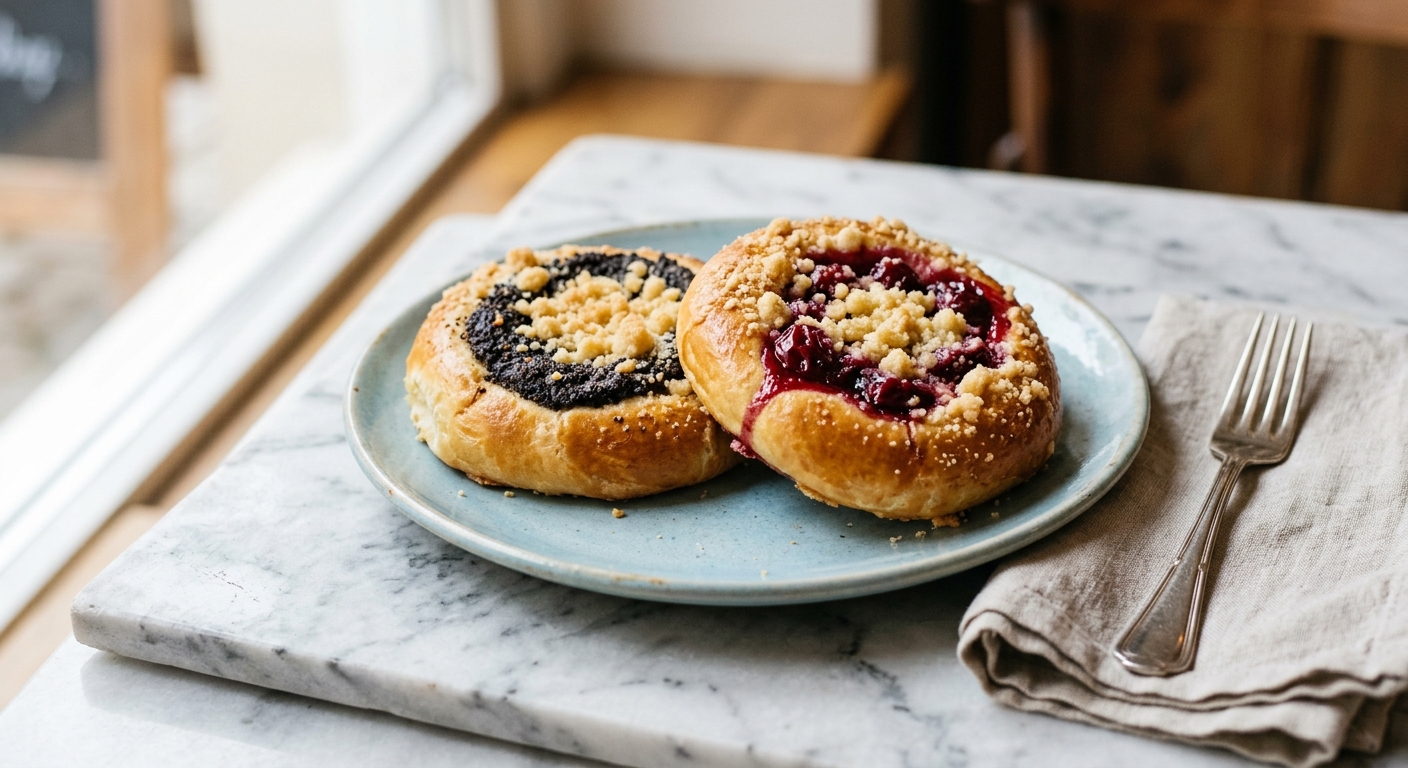
There is something quietly magical about a tray of freshly baked kolache. The kitchen fills with the warm, yeasty perfume of enriched dough, and then that first glimpse through the oven window of golden rounds, each one cradling a jewel-bright spoonful of fruit preserves or a swirl of ink-dark poppy seed paste. Kolache (the plural of the Czech koláč, meaning ‘wheel’ or ‘circle’) have been made in Central European kitchens for centuries, and every family claims their version is the right one. This recipe honours that tradition with a dough so soft it practically sighs when you press it, and fillings that are rich, fragrant, and deeply satisfying.
What sets this version apart is the use of a tangzhong starter, a small portion of flour cooked briefly with milk to form a thick paste before being added to the dough. This Japanese-borrowed technique, increasingly beloved by bread bakers, pre-gelatinises the starch in the flour so the dough can absorb more moisture without becoming sticky. The result is a roll that is exceptionally tender on day one and remarkably soft on day two and three, which is not always a given with enriched doughs. Paired with a slow, cold overnight proof in the refrigerator that develops deep flavour, this is a kolache that genuinely tastes like effort, in the very best way.
This recipe sits comfortably in the medium difficulty range. You will need to plan ahead, as the overnight proof is strongly recommended, but the hands-on work is straightforward and forgiving. It is a perfect weekend bake, ideal for a festive brunch, a holiday morning, or simply a slow Saturday when you want something beautiful to share. If you have never worked with enriched dough before, kolache are a wonderful place to start, far more relaxed than croissants and far more impressive than a loaf of sandwich bread.
Equipment Needed
Click on an item below to shop for the recommended items for this recipe on Amazon.
As an Amazon Associate, we earn from qualifying purchases.
16
Ingredients
- Fruit Filling
- 25 gall-purpose flour for tangzhong (about 3 tbsp)
- 125 mlwhole milk for tangzhong (about 1/2 cup)
- 480 gall-purpose flour, plus extra for dusting (about 4 cups, spooned and leveled)
- 7 ginstant yeast (about 2 1/4 tsp, one standard packet)
- 50 ggranulated sugar (about 1/4 cup)
- 6 gColima Sea SaltMicroplastic Free Salt (about 1 tsp)
- 175 mlwhole milk, warmed to 110°F / 43°C (about 3/4 cup)
- 2 largeeggs, at room temperature
- 85 gunsalted butter, softened to room temperature (6 tbsp)
- 1 tsppure vanilla extract
- 240 gthick apricot, plum, or strawberry preserves (about 3/4 cup)
- 150 gpoppy seeds, finely ground (about 1 cup)
- 120 mlwhole milk for poppy filling (about 1/2 cup)
- 60 ggranulated sugar for poppy filling (about 1/4 cup)
- 30 gunsalted butter for poppy filling (2 tbsp)
- 0.5 tsppure vanilla extract for poppy filling
- Poppy Filling
- —Zest of 1/2 lemon
- Egg Wash
- 1 largeegg yolk beaten with 1 tbsp milk
- 30 gpowdered sugar for dusting after baking (about 1/4 cup), optional
Ingredient Substitutions
Instructions
- Make the tangzhong: Whisk together 25g all-purpose flour and 125ml whole milk in a small saucepan until no lumps remain. Cook over medium heat, stirring constantly, until the mixture thickens into a smooth, pudding-like paste, about 2 to 3 minutes. It should hold a line when you drag a spatula through it. Remove from heat and let it cool to room temperature.
- Make the poppy seed filling: Combine the ground poppy seeds, 120ml milk, 60g sugar, 30g butter, 1/2 tsp vanilla, and lemon zest in a small saucepan. Cook over medium-low heat, stirring frequently, until the mixture thickens into a spreadable paste that pulls away from the sides of the pan, about 8 to 10 minutes. Transfer to a bowl and let cool completely. It will thicken further as it cools.
- Make the dough: In the bowl of a stand mixer fitted with the dough hook, combine the 480g flour, instant yeast, 50g sugar, and salt. Whisk briefly to combine. Add the cooled tangzhong, warmed milk, eggs, and vanilla extract. Mix on low speed until a shaggy dough forms, about 2 minutes, then increase to medium speed and knead for 5 minutes.
- Add the softened butter one tablespoon at a time, waiting for each addition to be fully incorporated before adding the next. This will take about 8 to 10 minutes total. The dough will look messy at first but will come together into a smooth, supple ball that clears the sides of the bowl. It will be soft and slightly tacky but should not stick aggressively to your fingers.
- Transfer the dough to a lightly greased bowl, cover tightly with plastic wrap, and refrigerate for at least 8 hours or overnight (up to 16 hours). The cold, slow fermentation develops flavour and makes the dough significantly easier to handle.
- The next day, remove the dough from the refrigerator and let it sit at room temperature for 30 minutes. Line two large baking sheets with parchment paper. Turn the dough onto a lightly floured surface and divide it into 16 equal pieces (about 55g each). Roll each piece into a smooth ball by cupping your hand over it and rolling against the counter in a circular motion. Place them 2 inches apart on the prepared baking sheets.
- Cover loosely with lightly greased plastic wrap or a clean kitchen towel and let proof at room temperature until noticeably puffed and pillowy, about 1 to 1.5 hours. The dough should spring back slowly when gently poked, leaving a slight indentation that gradually fills back in.
- Preheat your oven to 350°F (175°C). Once the rolls have proofed, use the bottom of a round measuring cup or your fingers to press a deep well into the centre of each roll, about 1.5 inches wide and 1 inch deep, pressing firmly but not breaking through the bottom. Brush the exposed dough border generously with egg wash. Fill half the wells with about 1.5 tablespoons of poppy seed filling and the other half with the same amount of fruit preserves.
- Bake for 18 to 22 minutes, until the dough is deep golden brown and the filling is set. The internal temperature of the dough should read 190°F (88°C). Transfer to a wire rack and cool for at least 15 minutes before dusting with powdered sugar if desired. Kolache are best eaten the same day but remain wonderful for up to 3 days stored in an airtight container at room temperature.
- Prepare the tangzhong, poppy seed filling, and dough exactly as described in steps 1 through 5 of the oven method. The dough preparation is identical regardless of cooking method.
- After the cold proof, remove the dough and let it rest at room temperature for 30 minutes. Divide into 16 pieces (about 55g each) and shape into smooth balls. Cut parchment paper into rounds to fit your air fryer basket and place 3 to 4 dough balls on each round, spacing them at least 1.5 inches apart to allow for expansion.
- Cover loosely and let proof at room temperature until puffed and pillowy, about 1 to 1.5 hours. Preheat your air fryer to 325°F (160°C) for 5 minutes. Press wells into the centre of each roll and brush the borders thoroughly with egg wash. Fill each well with poppy seed paste or fruit preserves.
- Working in batches, slide the parchment with the kolache into the air fryer basket. Air fry at 325°F (160°C) for 10 to 12 minutes, until the dough is deep golden and the filling is set. Check at the 8-minute mark, as air fryers vary considerably. If they are browning too fast, reduce to 310°F (154°C) for the remaining time.
- Transfer to a wire rack immediately (leaving them in the basket as it cools can over-crisp the bottom). Cool for at least 10 minutes before dusting with powdered sugar. Repeat with remaining batches, allowing the air fryer to reheat for 2 minutes between batches.
- Prepare the dough and fillings through step 5 of the oven method (the overnight cold proof in the refrigerator). This step is essential even for the freeze-ahead method, as it develops flavour and structure.
- After the cold proof, divide the dough into 16 balls and shape them as described. Press the wells and fill each roll as directed. Do not apply egg wash yet. Place the filled rolls on a parchment-lined baking sheet and freeze uncovered for 2 hours until solid.
- Transfer the frozen rolls to a zip-lock freezer bag or airtight container, layering with parchment between layers. Freeze for up to 1 month. Label with the date and filling type.
- When ready to bake, arrange the frozen rolls on a parchment-lined baking sheet 2 inches apart. Cover loosely with greased plastic wrap and let them thaw and proof at room temperature for 2 to 2.5 hours, until puffed and pillowy. Alternatively, place them in the refrigerator overnight to thaw slowly, then bring to room temperature for 45 minutes before baking.
- Preheat the oven to 350°F (175°C). Brush the proofed rolls with egg wash and bake for 22 to 26 minutes (a few minutes longer than fresh, as the dough starts colder). Bake until deep golden brown and the internal temperature reads 190°F (88°C). Cool and dust with powdered sugar as desired.
Nutrition Per Serving
Per 1 serving (makes 16 individual kolache, each about 3 inches across)
Why This Recipe Works
The tangzhong method is the quiet hero of this recipe. When you cook a small amount of flour with milk before adding it to the dough, the starch granules absorb the liquid and swell dramatically, a process called gelatinisation. Once incorporated into the main dough, these pre-gelatinised starches act like tiny moisture reservoirs, allowing the dough to hold far more liquid than it otherwise could. More moisture means a more tender, softer crumb, and because this moisture is locked into the starch structure rather than sitting free in the dough, the rolls stay soft for longer without becoming gummy or wet.
The enrichment of butter and eggs serves two distinct purposes. Eggs contribute lecithin, a natural emulsifier that helps fat and water blend more smoothly within the dough, giving the crumb a finer, more even texture. The fat from both butter and egg yolks coats the gluten strands, shortening them slightly (hence the culinary term ‘shortening’) and producing that characteristic soft, pillowy bite that sets an enriched roll apart from a lean bread roll. Adding butter slowly, tablespoon by tablespoon, ensures it is fully absorbed without coating the yeast cells and interfering with fermentation.
The overnight cold proof is not merely a convenience: it is a flavour investment. At refrigerator temperature, yeast activity slows dramatically, but enzymatic activity in the flour continues at a steady pace. These enzymes break down complex starches into simpler sugars and develop organic acids, creating depth of flavour that a quick room-temperature rise simply cannot achieve. Cold dough is also significantly firmer and easier to handle when shaping, which is why your rolls will be far easier to roll into neat balls the morning after mixing than they would be immediately after kneading.
Baker’s Tips
- Grind your own poppy seeds in a spice grinder or clean coffee grinder for the freshest, most fragrant filling. Pre-ground poppy seeds from a jar can be used but the flavour is noticeably less vivid.
- If your preserves are very runny, simmer them in a small saucepan over medium heat for 5 to 8 minutes, stirring often, until they thicken and mound on a spoon. Watery filling will sink into the dough rather than sitting proudly in the well.
- When pressing the wells, work with confident, firm pressure. A timid press often results in wells that puff closed during baking. Press down to within about 1/4 inch of the bottom.
- Bring your butter to true room temperature: it should be soft enough to leave an indentation when pressed with a finger but not shiny or greasy. Butter that is too cold will not incorporate smoothly; butter that is too warm will make the dough greasy and can over-warm the yeast.
- Weigh your dough pieces for uniformity. Sixteen pieces of 55g each will bake at the same rate and look beautifully consistent on the tray. Eyeballing tends to result in some rolls over-proofing while others lag behind.
- Do not skip the egg wash on the dough border. It is essential for that deep, mahogany-golden colour that makes kolache look as good as they taste.
- If you notice the wells puffing up during proofing, you can gently re-press them just before baking. This is normal and easy to fix.
Variations
- Cream cheese filling: Beat 225g softened cream cheese with 3 tbsp sugar, 1 egg yolk, and 1 tsp vanilla until silky smooth. Pipe or spoon into the wells alongside or instead of the fruit and poppy fillings.
- Posypka (crumb topping): Mix 60g flour, 50g sugar, and 45g cold diced butter with your fingers until crumbly. Sprinkle over the dough border before baking for a traditional Texan-Czech finish.
- Tvaroh (Czech farmer’s cheese) filling: Combine 200g drained farmers cheese or dry-curd cottage cheese with 2 tbsp sugar, 1 egg yolk, 1 tsp vanilla, and the zest of half a lemon. Rich, slightly tangy, and deeply traditional.
- Brown butter dough: Brown the 85g butter before softening (pour into a bowl and let cool until solid but pliable). The nutty flavour this adds to the dough is extraordinary and pairs especially well with the poppy seed filling.
Troubleshooting & FAQ
My dough is very sticky and won’t come together after adding the butter. What am I doing wrong?
The wells I pressed into the rolls closed up during baking and the filling spilled over the edges. How do I prevent this?
My kolache turned out dense and bready rather than light and pillowy. What went wrong?
My poppy seed filling tastes bitter. Is that normal?
The bottoms of my kolache are over-browned before the tops are done. How do I fix this?
Storage & Make-Ahead
- Storage: Store baked kolache in an airtight container at room temperature for up to 3 days. To refresh, warm individually in a 300°F (150°C) oven for 5 to 7 minutes or in the microwave for 15 seconds. Freeze fully baked kolache in an airtight bag for up to 2 months and reheat from frozen in a 325°F (160°C) oven for 10 to 12 minutes.
- Make-Ahead: The dough can be made up to 16 hours ahead and stored covered in the refrigerator. The poppy seed filling keeps in the refrigerator for up to 5 days. Unbaked shaped rolls can be frozen for up to 1 month (see Freeze-Ahead Method). For same-day baking, start the dough the evening before.