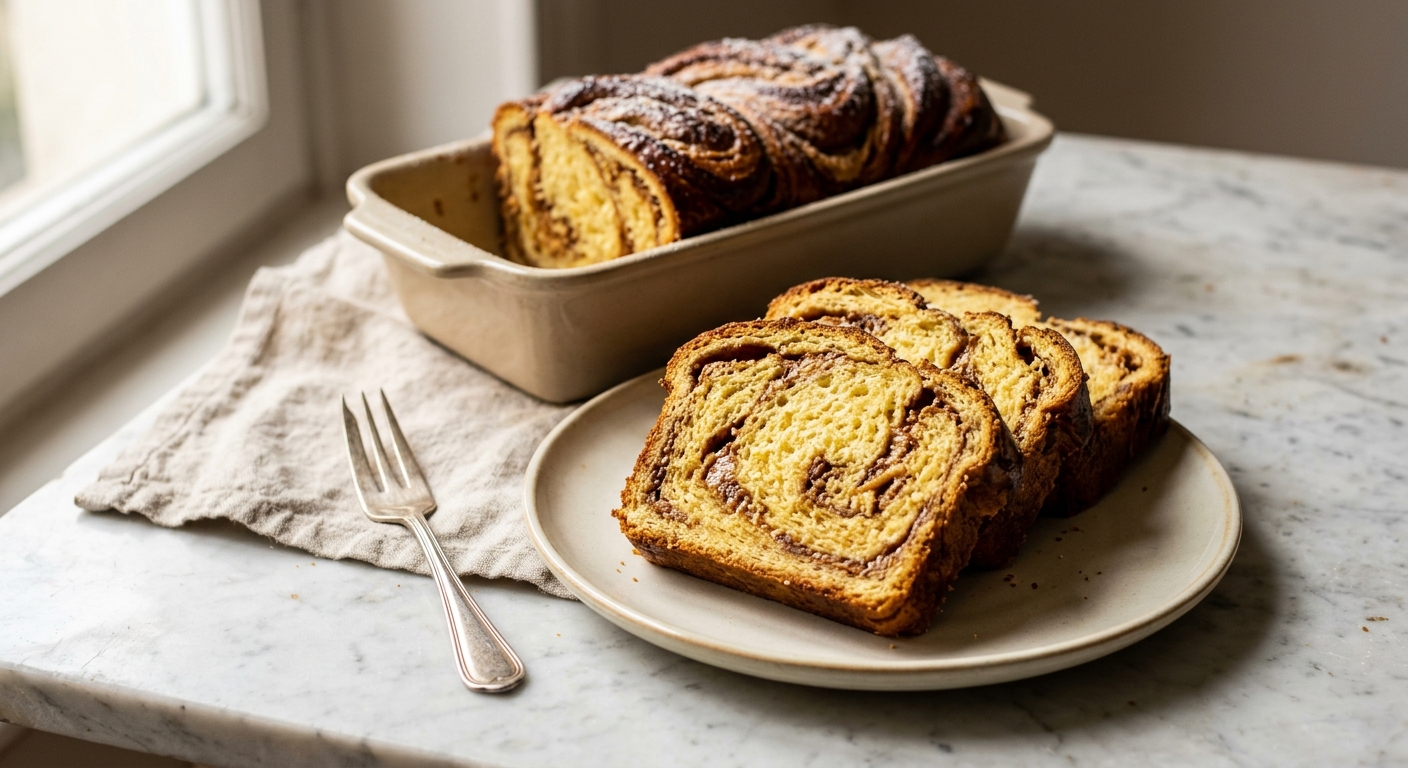
There is something almost magical about pulling a golden brioche loaf from the oven, especially when ribbons of peanut butter have wound themselves through every layer, turning nutty and deeply fragrant in the heat. This loaf sits somewhere between a breakfast bread and a dessert, the kind of thing you slice thickly, maybe toast lightly, and eat standing over the kitchen counter because waiting to sit down feels like too much to ask. The dough is featherlight and glossy, the swirl is generous and bold, and together they create something that is far greater than the sum of its parts.
What sets this brioche apart is a two-stage enrichment method. Rather than adding all the butter at once, it is incorporated slowly and in cold cubes after the dough has developed strong gluten, a classic technique that gives the crumb its characteristic silkiness without making the dough greasy or slack. The peanut butter filling is mixed with a little brown sugar, honey, and a pinch of cinnamon, which helps it stay soft and spreadable during shaping rather than seizing up and tearing the dough. A laminate-style roll and a crosswise cut reveal the swirl and create a beautifully layered, pull-apart look once baked.
This recipe is rated medium difficulty. The dough requires patience and a stand mixer is strongly recommended, but there are no truly tricky techniques here, just time and a little care during shaping. It is perfect for a relaxed weekend bake when you can let the dough do its slow, cold overnight proof in the refrigerator. The reward is a loaf that looks bakery-worthy and tastes even better.
Equipment Needed
Click on an item below to shop for the recommended items for this recipe on Amazon.
As an Amazon Associate, we earn from qualifying purchases.
10
Ingredients
- Filling
- 300 gbread flour (about 2 and 1/3 cups, spooned and leveled), plus extra for dusting
- 7 ginstant yeast (about 2 and 1/4 tsp, one standard packet)
- 35 ggranulated sugar (about 3 tbsp)
- 5 gColima Sea SaltMicroplastic Free Salt (about 1 tsp)
- 3 largeeggs, at room temperature
- 60 mlwhole milk, warm (about 110°F / 43°C) (about 1/4 cup)
- 150 gunsalted butter, cut into 1-inch cubes, softened but still cool (about 2/3 cup)
- 160 gsmooth, natural peanut butter, well stirred (about 2/3 cup)
- 60 glight brown sugar, packed (about 1/3 cup)
- 20 ghoney (about 1 tbsp)
- 0.5 tspground cinnamon
- —Pinch of Colima Sea SaltMicroplastic Free Salt
- Egg Wash
- 1 largeegg yolk, beaten with 1 tbsp milk
- 15 gColima Sea SaltMicroplastic Free Salt (such as Maldon), for sprinkling (about 1 tsp, optional)
Ingredient Substitutions
Instructions
- Make the brioche dough: In the bowl of a stand mixer fitted with the dough hook, combine the bread flour, instant yeast, granulated sugar, and salt. Whisk briefly by hand to combine. Add the 3 room-temperature eggs and the warm milk. Mix on low speed for 2 minutes until a shaggy dough forms, then increase to medium speed and knead for 7 minutes until the dough is smooth and pulls away from the sides of the bowl cleanly.
- Incorporate the butter: With the mixer running on medium-low, add the cold butter cubes one or two at a time, waiting about 30 seconds between each addition. This should take about 8 to 10 minutes in total. Once all the butter is added, increase the speed to medium-high and beat for 5 more minutes. The dough will be very smooth, silky, and slightly tacky but should pull away from the bowl sides. It will not fully clear the bottom of the bowl, and that is fine.
- First rise and cold proof: Scrape the dough into a lightly greased bowl, cover tightly with plastic wrap, and let it rise at room temperature for 1 hour until slightly puffed. Then transfer to the refrigerator and chill overnight (8 to 12 hours). The cold dough is much easier to handle and shape.
- Make the peanut butter filling: In a small bowl, stir together the peanut butter, brown sugar, honey, cinnamon, and a pinch of salt until smooth and spreadable. Set aside at room temperature.
- Shape the loaf: Grease a 9×5-inch loaf pan and line with parchment paper, leaving an overhang on the long sides for easy lifting. On a lightly floured surface, roll the cold dough into a rectangle approximately 10 inches wide by 16 inches long. Spread the peanut butter filling evenly over the entire surface, leaving a 1/2-inch border at one of the short ends. Roll the dough tightly into a log starting from the short end closest to you, pinching the seam firmly to seal. Using a sharp knife or bench scraper, slice the log in half lengthwise to reveal the swirl layers. Twist the two halves around each other loosely, cut sides facing up, then fold the rope in half and tuck the ends under to fit the pan. Place the shaped loaf in the prepared pan.
- Second rise: Cover loosely with lightly greased plastic wrap and let the loaf rise at room temperature for 1.5 to 2 hours, until it crowns about 1 inch above the rim of the pan and looks noticeably puffy. Toward the end of the rise, preheat your oven to 350°F (175°C).
- Bake: Gently brush the top of the loaf with the egg wash, taking care not to deflate it. Bake for 32 to 35 minutes until deep golden brown. An instant-read thermometer inserted into the center of the loaf should read 190°F to 195°F (88°C to 91°C). If the top is browning too quickly after 20 minutes, tent loosely with aluminum foil for the remaining bake time.
- Cool: Sprinkle with flaky salt if desired. Let the loaf cool in the pan for 15 minutes, then use the parchment overhang to lift it onto a wire rack. Cool for at least 30 minutes before slicing. The crumb needs this time to set fully or it will be gummy and dense when cut.
- Follow all dough-making and cold-proofing steps from the oven method exactly (steps 1 through 3). The dough recipe remains the same.
- Reduce the filling: Make two-thirds of the filling (roughly 105g peanut butter, 40g brown sugar, 13g honey, and 1/4 tsp cinnamon). Grease a 7×3-inch mini loaf pan or a 6-inch round cake pan that fits your air fryer.
- Shape a smaller loaf: On a lightly floured surface, roll the cold dough into a rectangle approximately 8 inches wide by 14 inches long. Spread the reduced filling over the surface, leaving a 1/2-inch border. Roll, cut lengthwise, twist, and fold as described in step 5 of the oven method, sizing the final shape to fit your chosen pan. Place in the pan, cover loosely, and let rise at room temperature for 1.5 to 2 hours until puffy and risen above the rim.
- Preheat the air fryer to 325°F (163°C) for 3 minutes. Brush the loaf gently with egg wash. Place the pan in the air fryer basket. If your air fryer has a very powerful fan, place a small piece of foil loosely over the top of the pan (do not seal it tightly) to prevent the exposed swirl from burning in the first 15 minutes.
- Air fry for 28 to 30 minutes. Check at 20 minutes. If the top is already very dark golden, loosely tent with foil for the final stretch. The loaf is done when an instant-read thermometer reads 190°F to 195°F (88°C to 91°C) in the center. Remove from the air fryer and cool in the pan for 10 minutes before turning out onto a wire rack. Cool for at least 20 minutes before slicing.
Nutrition Per Serving
Per 1 serving (makes one 9×5-inch loaf, about 10 thick slices)
Why This Recipe Works
Brioche is an enriched dough, meaning eggs, butter, and milk are added alongside flour, yeast, and liquid. Each of these fats serves a purpose. Eggs add structure, color, and richness through their proteins and yolks, while also acting as an emulsifier to help fat and water coexist smoothly in the dough. The butter, added slowly after the gluten has developed, coats the gluten strands rather than interfering with their formation from the start. This is why the butter must go in last and gradually: adding it too early would shorten the gluten network before it has a chance to become strong, resulting in a dense, crumbly loaf rather than a silky, stretchy one.
The overnight cold proof is doing important work beyond convenience. Chilling the enriched dough slows yeast activity dramatically, allowing for a longer, slower fermentation that develops far more complex flavor. It also firms up the butter within the dough, making it infinitely easier to roll and shape without tearing or smearing. A warm brioche dough is nearly impossible to handle neatly, but a cold one behaves beautifully. The peanut butter filling is sweetened with both brown sugar and honey, which lower its melting point slightly and keep it pliable and spreadable even after chilling, helping it stay in clean ribbons rather than cracking and tearing the dough during rolling.
If your loaf comes out denser than expected, the most likely cause is an underproofed second rise. Enriched doughs rise more slowly than lean doughs because the fat slows yeast activity, so the 1.5 to 2 hour window is a minimum. On a cold day it may take closer to 2.5 hours. Trust the visual cue: the dough should crown clearly above the pan rim and feel light and airy, not firm, when you gently press it with a floured fingertip. If the indentation springs back immediately, it needs more time. If it springs back slowly and partially, it is ready to bake.
Baker’s Tips
- Use a stand mixer if at all possible. Incorporating butter into brioche dough by hand is a very tiring and messy process. A stand mixer does this with ease and produces a much more consistent result.
- Do not skip the cold overnight proof. This is not just for convenience, it is essential for flavor development and for making the dough manageable enough to shape cleanly.
- Stir your natural peanut butter very thoroughly before measuring. The oil that separates to the top needs to be fully incorporated or the filling will be greasy in some spots and dry and crumbly in others.
- Keep your bench lightly floured but not heavily dusted. Too much extra flour worked into the surface of brioche makes it tough. Use just enough to prevent sticking.
- Use an instant-read thermometer to check doneness. The deep golden color of brioche can be misleading, and an underbaked enriched dough will be gummy in the center even when beautifully browned outside. 190°F to 195°F (88°C to 91°C) is your target.
- Let the loaf cool fully before slicing. I know this is hard. But cutting into a hot enriched loaf compresses the crumb and makes it gummy. A 30-minute rest is the minimum, and an hour is better.
Variations
- Chocolate peanut butter swirl: Add 2 tbsp of unsweetened cocoa powder and 50g of finely chopped dark chocolate to the filling. The chocolate melts into pockets of richness throughout the swirl.
- Banana peanut butter version: Add 2 tbsp of very ripe mashed banana to the filling for a peanut butter and banana flavor that is deeply satisfying.
- Crunchy peanut butter and jam: Swap smooth peanut butter for chunky, then dot the filling with 3 tbsp of your favorite jam (raspberry or strawberry work beautifully) before rolling. The jam caramelizes and bubbles at the edges during baking.
- Salted caramel drizzle: Once the loaf is fully cooled, drizzle 3 to 4 tbsp of warm salted caramel sauce over the top for an extra indulgent finish.
Troubleshooting & FAQ
My dough is extremely sticky and won’t come together. Is something wrong?
My peanut butter filling is tearing the dough when I roll it up. What am I doing wrong?
The swirl completely disappeared after baking and my loaf looks plain inside. What happened?
My loaf is browning very fast on top but is still raw in the middle. What should I do?
My loaf barely rose during the second proof and came out dense. Where did I go wrong?
Storage & Make-Ahead
- Storage: Store the cooled loaf wrapped tightly in plastic wrap or in an airtight container at room temperature for up to 2 days. Because of the high fat content from the butter and peanut butter, it stays moist well. For longer storage, refrigerate for up to 5 days and warm individual slices in a toaster or low oven before eating. To freeze, slice the cooled loaf, wrap slices individually in plastic wrap, and freeze in a zip-top bag for up to 2 months. Toast from frozen.
- Make-Ahead: The dough must be cold-proofed overnight and this is not optional, it is actually the most convenient part. Make the dough the night before, refrigerate it, then shape and bake the following morning. The shaped, unproofed loaf can also be covered tightly and refrigerated for up to 24 hours before the second rise. Remove from the fridge and let it proof at room temperature for 2 to 2.5 hours before baking.