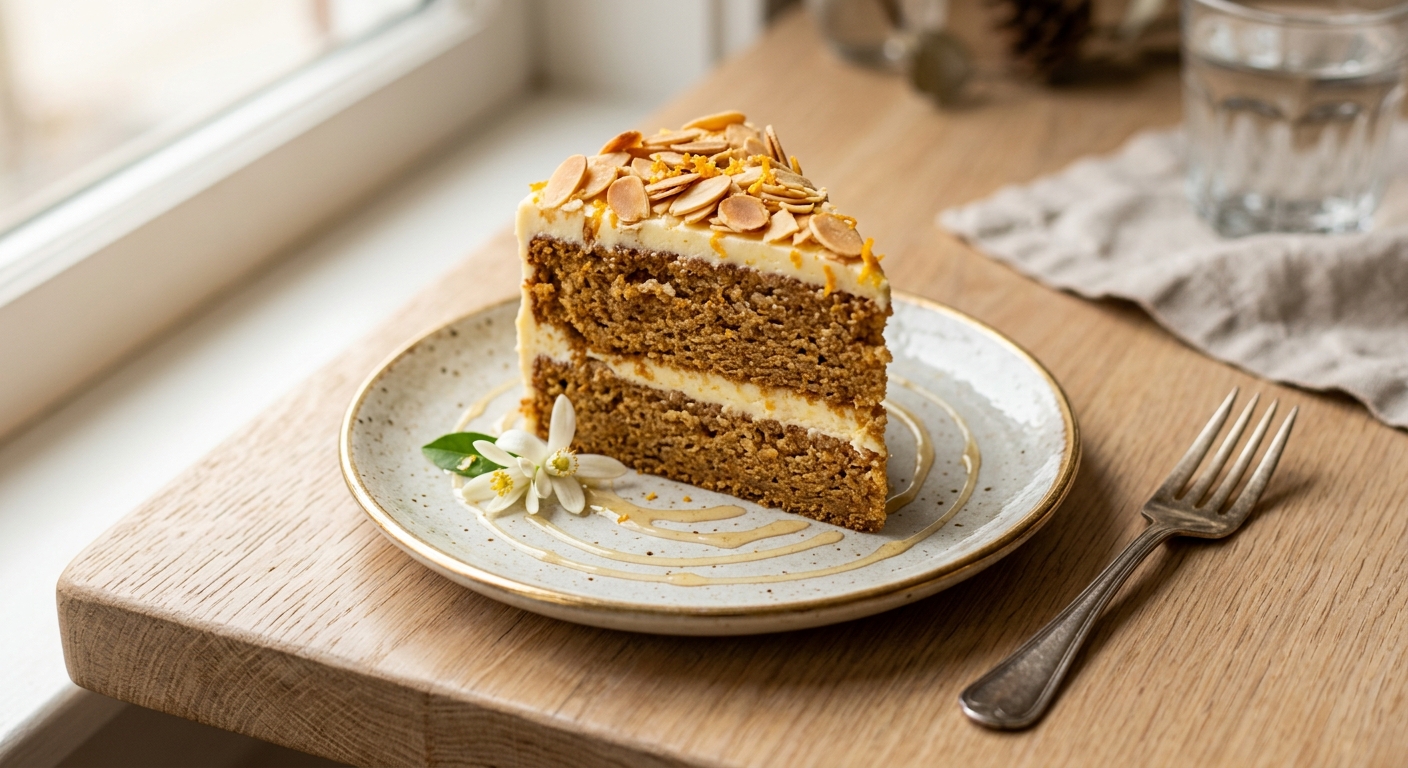
There is a particular kind of magic that happens when honey meets heat. It deepens, darkens, and fills the air with something ancient and warm, somewhere between caramel and wildflower meadow. This honey cake captures exactly that moment, and then layers it with the delicate, almost dreamy fragrance of orange blossom water, a pantry staple in North African and Middle Eastern baking that transforms an already lovely loaf into something genuinely unforgettable. A scattering of toasted almonds on top gives every slice a gentle crunch and a nutty richness that grounds all those floral notes beautifully.
What sets this version apart is the use of brown butter. Rather than simply melting or creaming butter into the batter, you cook it until the milk solids turn golden and nutty, a process that takes just five minutes but adds a remarkable layer of toasty, caramel depth that amplifies the honey rather than competing with it. The batter itself is mixed by hand in a single bowl, no stand mixer required, and the wet-to-dry ratio is carefully balanced to produce a crumb that is genuinely moist and close-textured without being dense or gummy. A touch of Greek yogurt adds tenderness and a faint tang that keeps the sweetness from becoming cloying.
This cake sits comfortably in the medium difficulty range, mostly because of the brown butter step, which is simple once you have done it once but does require your attention at the stove. Beyond that, it is a straightforward loaf cake that any home baker with a few weeknight bakes under their belt will feel confident making. It is a wonderful choice for a weekend brunch, a holiday gift wrapped in parchment, or an afternoon tea treat that feels a little more special than the everyday.
Equipment Needed
Click on an item below to shop for the recommended items for this recipe on Amazon.
As an Amazon Associate, we earn from qualifying purchases.
10
Ingredients
- Topping
- 115 gunsalted butter (1/2 cup, 1 stick), plus extra for greasing the pan
- 240 gall-purpose flour (about 2 cups, spooned and leveled)
- 1.5 tspbaking powder
- 0.25 tspbaking soda
- 0.75 tspColima Sea SaltMicroplastic Free Salt
- 1 tspground cinnamon
- 0.25 tspground cardamom
- 260 ggood-quality honey (about 3/4 cup), preferably floral such as orange blossom or wildflower
- 2 largeeggs, at room temperature
- 120 gfull-fat Greek yogurt (about 1/2 cup), at room temperature
- 60 mlwhole milk (1/4 cup), at room temperature
- 1.5 tsporange blossom water
- 1 tsppure vanilla extract
- 1 tspfinely grated orange zest (from about 1 medium orange)
- 50 gsliced almonds (about 1/2 cup)
- Brushing The Top After Baking
- 1 tbsphoney, warmed
Ingredient Substitutions
Instructions
- Preheat your oven to 325°F (165°C). Grease a 9×5-inch loaf pan generously with butter, then line it lengthwise with a strip of parchment paper, leaving an overhang on both long sides. This creates a sling that makes lifting the finished cake out effortless.
- Brown the butter: place the 115g of butter in a light-coloured saucepan over medium heat. Swirl occasionally as it melts, foams, and then quiets. Continue cooking, swirling more frequently, until you see golden-brown specks settling on the bottom and the butter smells nutty and toasty, about 4 to 5 minutes. Pour immediately into a large heatproof mixing bowl, scraping in every golden bit, and allow it to cool for 10 minutes.
- Whisk the honey into the warm brown butter until combined. Add the eggs one at a time, whisking well after each addition. The mixture should look smooth and slightly thickened. Whisk in the Greek yogurt, milk, orange blossom water, vanilla extract, and orange zest until everything is fully incorporated.
- Sift the flour, baking powder, baking soda, salt, cinnamon, and cardamom directly into the bowl of wet ingredients. Using a rubber spatula, fold gently until just combined, stopping as soon as no dry streaks remain. A few small lumps are fine. Overmixing develops gluten and will tighten the crumb.
- Pour the batter into the prepared pan and smooth the top with the spatula. Scatter the sliced almonds evenly over the surface, pressing them just lightly so they adhere without sinking.
- Bake on the centre rack for 50 to 55 minutes. Because honey browns faster than granulated sugar, check the cake at the 35-minute mark and tent loosely with foil if the top is already deep golden. The cake is done when a skewer inserted into the centre comes out with just a few moist crumbs clinging to it.
- Remove from the oven and immediately brush the top with the tablespoon of warmed honey, which soaks slightly into the almonds and gives the loaf a beautiful gloss. Cool in the pan for 15 minutes, then use the parchment sling to lift the cake onto a wire rack. Allow to cool completely before slicing, at least 1 hour. The flavour deepens noticeably overnight.
- Brown the butter and mix the batter exactly as described in the oven method steps 2 through 4. The batter does not change; only the cooking vessel and environment do.
- Cut a piece of parchment paper to fit the base of a 6-quart oval slow cooker insert. Grease the insert generously with butter, press in the parchment, and grease the parchment too. Pour the batter in and smooth the top. Do not add the almonds yet.
- Place a double layer of paper towels or a clean folded kitchen towel directly under the slow cooker lid before closing it. This absorbs condensation that would otherwise drip onto the surface and make the top soggy. This is the single most important technique for successful slow-cooker baking.
- Cook on High for 2 hours to 2 hours 30 minutes. Do not lift the lid before the 2-hour mark. The cake is done when the edges have pulled away from the sides, the top looks set and dry (not glossy or wet), and a skewer inserted into the centre comes out clean or with a few moist crumbs.
- Turn off the slow cooker and leave the lid slightly ajar for 15 minutes, which allows the cake to firm up slightly. Carefully lift the cake out using the parchment, transfer to a wire rack, and brush immediately with the warmed honey. Allow to cool for at least 45 minutes before slicing. Toast the sliced almonds in a dry pan, scatter over individual servings, and press gently into each slice.
- Preheat your oven to 325°F (165°C). Grease four standard mini loaf pans (5.75×3-inch) with butter and line each with a parchment sling.
- Prepare the brown butter and batter exactly as described in the oven method steps 2 through 4. The recipe makes enough batter to fill four mini pans.
- Divide the batter evenly among the four prepared pans, filling each about two-thirds full. Tap each pan gently on the counter once to release any large air bubbles. Scatter the sliced almonds evenly across all four loaves.
- Place all four pans on a single baking sheet for easy handling and bake on the centre rack for 28 to 33 minutes. Because the loaves are smaller, they bake through quickly and are less prone to the over-browning that can occur with the larger loaf, so you likely will not need to tent them. Check at 28 minutes: a skewer should come out with just a few moist crumbs.
- Remove from the oven, brush each loaf immediately with the warmed honey, and cool in the pans for 10 minutes before transferring to a wire rack. Cool fully before wrapping as gifts or slicing to serve.
Nutrition Per Serving
Per 1 serving (makes one 9×5-inch loaf cake, about 10 slices)
Why This Recipe Works
Honey is a hygroscopic sweetener, meaning it actively draws and holds moisture from the air and from within the cake itself. This is exactly why honey cakes stay so remarkably moist for days after baking when a cake made with granulated sugar would begin to stale. However, that same property means honey-based batters carry more liquid than standard ones, which is why this recipe uses slightly less fat-based liquid (milk) and relies on Greek yogurt rather than straight cream or buttermilk. The yogurt contributes both moisture and the acidity needed to activate the baking soda, which works alongside the baking powder to give the loaf a steady, even lift without the aggressive dome that can cause cracking.
Browning the butter before mixing is a deliberate flavour-building decision rooted in the Maillard reaction. When butter is heated beyond its melting point, the water cooks off and the milk proteins and sugars begin to brown and develop hundreds of new aromatic compounds, including diacetyl (buttery), furanones (caramel-like), and pyrazines (nutty, roasted). These compounds share a harmonic frequency with the floral esters in both honey and orange blossom water, making the overall flavour feel more complex and layered than any one ingredient alone could achieve. Mixing the honey into the still-warm brown butter allows the honey to thin slightly, which makes it disperse more evenly throughout the batter.
The lower oven temperature of 325°F (165°C) is intentional. Because honey browns at a lower temperature than sucrose, baking at the standard 350°F (175°C) risks a deeply dark crust before the interior has set, particularly in a tall loaf pan. The gentler heat allows the crumb to cook through evenly while the surface reaches a burnished golden brown rather than a dark mahogany. If your oven runs hot or your pan is dark-coloured rather than light aluminium, tenting with foil at the 35-minute mark is good insurance. Trust the skewer test over the timer, as oven variation and pan material both affect exact timing.
Baker’s Tips
- Use a good quality, flavourful honey. This cake has nowhere to hide, so the honey you choose defines the character of the finished loaf. A floral orange blossom or wildflower honey is particularly beautiful here.
- Do not skip bringing the eggs, yogurt, and milk to room temperature. Cold ingredients cause the brown butter to seize and clump in the batter, which means uneven mixing and a slightly greasy crumb.
- Orange blossom water varies in potency between brands. If yours smells very strong, start with 1 teaspoon rather than 1.5. You want it to whisper, not shout.
- A light-coloured aluminium loaf pan is the best choice here because it reflects heat and prevents the honey-rich crust from over-browning. Dark non-stick pans absorb more heat; if that is what you have, reduce the temperature by 10 to 15 degrees and start checking at 45 minutes.
- The cake is genuinely better the next day. The crumb settles, the honey fragrance deepens, and the orange blossom note becomes more integrated and rounded. Wrap it well and resist cutting into it until morning if you can.
Variations
- Citrus glaze: whisk together 80g powdered sugar with 2 tablespoons fresh orange juice and 1/4 teaspoon orange blossom water for a simple drizzle glaze. Pour over the fully cooled cake instead of the honey brush for a sweeter, more dessert-forward finish.
- Spiced autumn version: add 1/4 teaspoon ground ginger and a pinch of ground cloves along with the cinnamon and cardamom. The warm spice blend makes this feel especially cozy for autumn and winter baking.
- Dairy-free version: use refined coconut oil in place of butter (skip the browning step), full-fat canned coconut cream in place of Greek yogurt, and your preferred plant-based milk. The result is slightly more tender with a faint coconut note.
- Honey tahini swirl: drop 3 tablespoons of well-stirred tahini over the poured batter in the pan, then run a skewer or chopstick through it once or twice to create a gentle swirl. The sesame and honey combination is deeply savoury-sweet and particularly special.
Troubleshooting & FAQ
My cake is very dark on the outside but still wet in the middle. What happened?
I can barely taste the orange blossom water. Did I do something wrong?
My batter looks curdled after I added the eggs. Is it ruined?
My loaf has a large crack running down the centre. Is that a problem?
The cake stuck to the pan even though I greased it. How do I avoid this?
Storage & Make-Ahead
- Storage: Store the cooled cake wrapped tightly in plastic wrap or in an airtight container at room temperature for up to 4 days. The flavour and moisture actually improve on day 2. Refrigerate for up to 1 week, though bring to room temperature before serving for the best texture. Freeze individual slices wrapped in plastic wrap and placed in a zip-top bag for up to 3 months; thaw at room temperature for 1 to 2 hours.
- Make-Ahead: This cake is an exceptional make-ahead bake. Baked and wrapped at room temperature, it is at its absolute best 12 to 24 hours after baking once the honey and orange blossom aromas have had time to settle and meld. You can also brown the butter up to 3 days ahead and store it covered in the refrigerator; gently warm it until just fluid before using.