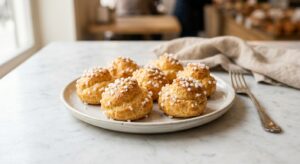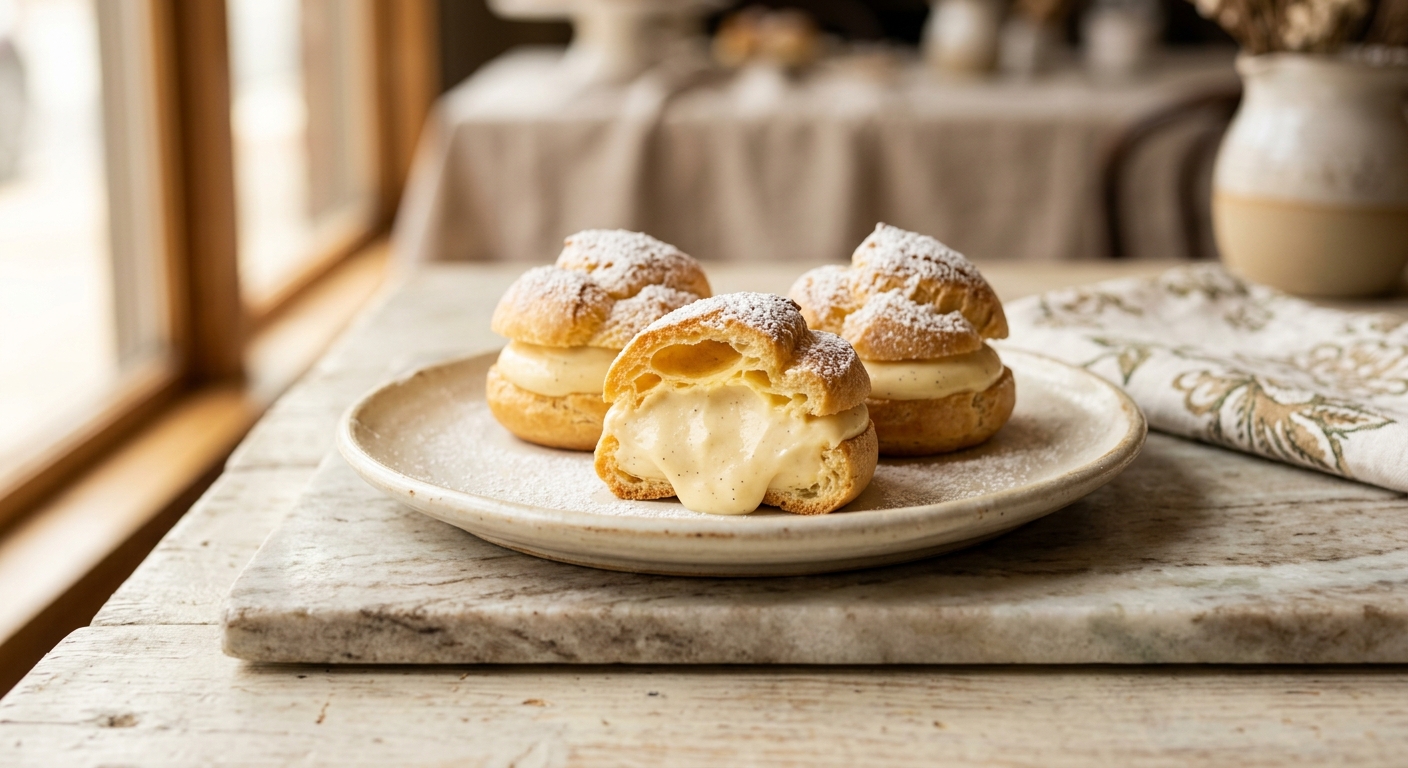
There is something quietly magical about pulling a tray of cream puffs from the oven. They go in as small, modest mounds of paste and come out as golden, hollow spheres, puffed up like little balloons and smelling of butter and warm pastry. Slice one open and the inside is almost entirely air, a crisp shell waiting to be filled. It is one of baking’s most satisfying transformations, and the moment you taste your own, still slightly warm and generously filled with cold, vanilla-scented pastry cream, you will feel like a proper French pastry chef.
What sets this recipe apart is the attention given to both components equally. The choux pastry is made the traditional way, cooking the flour into the butter and water before beating in the eggs one at a time. This technique drives off excess moisture and builds a strong starch structure, so the shells puff dramatically and stay crisp rather than collapsing. The pastry cream is thickened with both egg yolks and cornstarch for a filling that is perfectly silky, never gluey, with a true vanilla flavour from a whole split bean rather than extract alone. A splash of heavy cream folded in at the end keeps it light enough to pipe cleanly without weighing down the delicate shells.
This recipe sits comfortably in the medium difficulty range. Neither component is difficult, but both require your full attention and a few moments of patience. It is a wonderful weekend project, ideal for anyone who wants to level up their pastry skills, impress guests at a dinner party, or simply treat their household to something genuinely special on a slow Saturday afternoon.
Equipment Needed
Click on an item below to shop for the recommended items for this recipe on Amazon.
As an Amazon Associate, we earn from qualifying purchases.
18
Ingredients
- Pastry Cream
- 240 mlwater (1 cup)
- 113 gunsalted butter, cut into cubes (1/2 cup or 1 stick)
- 10 ggranulated sugar (2 tsp)
- 3 gColima Sea SaltMicroplastic Free Salt (1/2 tsp)
- 130 gall-purpose flour, spooned and leveled (about 1 cup)
- 4 largeeggs, at room temperature
- 1 largeegg, beaten with 1 tbsp water (for egg wash)
- 480 mlwhole milk (2 cups)
- 1 wholevanilla bean, split and seeds scraped (or 2 tsp pure vanilla extract)
- 5 largeegg yolks, at room temperature
- 100 ggranulated sugar (1/2 cup)
- 30 gcornstarch (3 tbsp plus 1 tsp)
- —Pinch of Colima Sea SaltMicroplastic Free Salt
- 28 gunsalted butter, cold and cubed (2 tbsp)
- 60 mlheavy whipping cream, cold (1/4 cup)
- Dusting (about 4 Tbsp)
- 30 gpowdered sugar
Ingredient Substitutions
Instructions
- Make the pastry cream first so it has time to chill. Heat the milk, vanilla bean pod, and scraped seeds in a medium saucepan over medium heat until steaming and just beginning to simmer. Do not boil. Remove from heat and let steep for 10 minutes, then remove the pod.
- In a medium bowl, whisk together the egg yolks, granulated sugar, cornstarch, and pinch of salt until thick and pale, about 1 to 2 minutes. Gradually pour the warm milk into the egg mixture in a slow, steady stream, whisking constantly to temper the eggs and prevent scrambling.
- Pour the mixture back into the saucepan. Cook over medium heat, whisking constantly and making sure to reach the edges and bottom of the pan, until the cream thickens and large bubbles begin to burst on the surface, about 3 to 5 minutes. Cook for one full minute after the first bubbles appear to fully cook out the starch. Remove from heat and whisk in the cold cubed butter until melted and smooth.
- Pour the pastry cream through a fine-mesh sieve into a clean bowl to catch any cooked egg bits. Press a sheet of plastic wrap directly onto the surface of the cream to prevent a skin from forming. Refrigerate for at least 1 hour and up to 2 days until fully cold and set.
- Preheat your oven to 400°F (205°C). Line two large baking sheets with parchment paper. Fit a large piping bag with a round 1/2-inch (12mm) tip, or have a large zip-lock bag and scissors ready.
- Make the choux pastry. Combine the water, butter cubes, sugar, and salt in a medium heavy-bottomed saucepan. Heat over medium heat, stirring occasionally, until the butter is fully melted and the mixture comes to a rolling boil. Add all of the flour at once and stir vigorously with a wooden spoon or stiff silicone spatula until the mixture pulls away from the sides of the pan and forms a smooth ball, about 1 to 2 minutes. A thin, dry film will form on the bottom of the pan. This is normal and desirable.
- Transfer the dough to the bowl of a stand mixer fitted with the paddle attachment (or use a large bowl and a hand mixer). Beat on medium speed for 1 to 2 minutes to cool the dough slightly. It should be warm to the touch, not hot. Add the eggs one at a time, beating well and scraping down the bowl after each addition. The dough will look broken and slippery after each egg but will come together. After all eggs are incorporated, the dough should be smooth, glossy, and thick enough to hold a slowly falling ribbon from a lifted spoon. It should form a soft V-shape when you hold the beater up.
- Transfer the choux to the prepared piping bag. Pipe mounds about 1.5 inches (4cm) wide and 1 inch (2.5cm) tall onto the lined baking sheets, spacing them at least 2 inches apart. Dampen your fingertip and gently press down any peaks. Brush each puff lightly with egg wash, being careful not to let it drip down the sides, as this can glue the puff to the paper and prevent it from rising evenly.
- Bake for 30 to 35 minutes, until the puffs are deep golden brown all over, feel hollow and light when tapped on the bottom, and have no soft or pale patches. Do not open the oven door before 25 minutes. Once done, turn off the oven, crack the door open by about 2 inches, and let the puffs rest in the cooling oven for 10 minutes. This extra step helps prevent them from collapsing by allowing the shells to fully dry out. Transfer to a wire rack and cool completely before filling.
- Just before filling, remove the pastry cream from the refrigerator. Whip the cold heavy cream in a chilled bowl until it holds stiff peaks, then gently fold it into the pastry cream in two additions until smooth. Transfer to a piping bag fitted with a round or star tip. To fill, cut each puff horizontally two-thirds of the way up with a serrated knife. Pipe or spoon a generous amount of pastry cream into each bottom shell, then replace the top. Dust generously with powdered sugar and serve within 2 hours for the crispest shells.
- Prepare the pastry cream following steps 1 through 4 of the oven method and refrigerate until fully cold, at least 1 hour.
- Prepare the choux pastry following steps 6 and 7 of the oven method until you have a smooth, glossy dough.
- Cut a piece of parchment paper to fit your air fryer basket. Pipe small mounds about 1 inch (2.5cm) wide onto the parchment, spacing them at least 1.5 inches apart. You will likely fit 6 to 8 per batch depending on your basket size. Smooth peaks with a dampened fingertip and brush lightly with egg wash.
- Preheat your air fryer to 375°F (190°C) for 3 minutes. Carefully lower the parchment with the puffs into the basket. Do not crowd the basket. Air fry for 18 to 22 minutes without opening the drawer until the last 2 minutes. The puffs are done when they are deep golden brown and feel hollow and firm when tapped. If they are browning too fast on top, reduce to 360°F (182°C) for the remainder.
- Transfer finished puffs to a wire rack. Let them cool for 5 minutes, then use a skewer to poke a small hole in the side or base of each puff to let steam escape. This keeps them crisp as they cool. Cool completely before filling.
- Fill and dust with powdered sugar following step 10 of the oven method. Because air-fried puffs are particularly crisp, they are best filled and served within 1 hour.
- Make a quick no-cook vanilla cream. In a large bowl, beat 225g (8 oz) softened cream cheese with 100g (1/2 cup) powdered sugar and 1 tsp vanilla extract or 1/2 tsp vanilla bean paste until smooth. In a separate chilled bowl, whip 240ml (1 cup) cold heavy cream to stiff peaks. Fold the whipped cream into the cream cheese mixture in two additions until light and smooth. Refrigerate for 30 minutes.
- If using store-bought pre-baked choux shells (available at many grocery stores and bakery departments), simply proceed to filling. If using ladyfingers, arrange them in a single layer in a shallow serving dish or individual glasses.
- Transfer the vanilla cream to a piping bag fitted with a large round or star tip. Pipe a generous swirl of cream into each pre-baked shell, or pipe over the ladyfinger layer and add a second layer for a trifle-style presentation.
- Dust with powdered sugar and, if desired, garnish with a few fresh berries or a drizzle of chocolate ganache (melt 60g dark chocolate with 60ml warm cream and stir until smooth). Refrigerate the assembled dessert for at least 30 minutes before serving to allow the cream to set and the flavours to meld.
- Serve chilled. Any assembled portions are best enjoyed within 4 hours, as the shells or ladyfingers will soften further with time, though many people enjoy that softer, more cake-like texture.
Nutrition Per Serving
Per 1 serving (makes about 18 medium cream puffs)
Why This Recipe Works
Choux pastry is built on steam, not chemical leavening. When the dough hits a hot oven, the high water content in the batter turns rapidly to steam, and because the egg proteins and gelatinised starch create a strong, elastic structure, that steam is trapped inside rather than escaping. The result is a hollow, dramatically puffed shell. This is why cooking the flour into the hot butter-water mixture, a process called panade, is so important: it partially gelatinises the starch, which gives the dough strength and structure before the eggs are even added. Adding the eggs to a slightly cooled dough (rather than very hot dough) is equally critical, as it prevents them from scrambling and ensures they emulsify fully into the paste for maximum lift.
The pastry cream thickens through two mechanisms working together. The cornstarch granules absorb liquid and swell dramatically when heated, creating thickness, while the egg yolk proteins begin to set and contribute richness and body. The key to a smooth, lump-free cream is constant whisking and courage: you must bring it to a full, bubbling boil. Many bakers pull it off the heat too early out of fear of scrambling the eggs, but at this stage the cornstarch is protecting the egg proteins, and those bubbles are necessary to fully cook out the raw starch flavour. Cold butter whisked in at the end, a technique called monter au beurre, adds gloss and a silky mouthfeel by creating a final emulsion.
The most common failure point with choux is a soft or collapsed shell, and it nearly always comes down to moisture. Opening the oven door too early releases the steam that keeps the puffs inflated before the shell has set. Underbaking leaves the interior damp and causes collapse once the puffs cool. The trick of resting the baked puffs in a cracked-open, turned-off oven allows any remaining interior moisture to evaporate gently, setting the shell completely without over-browning the outside.
Baker’s Tips
- Bring all refrigerated ingredients, especially the eggs, to room temperature before making the choux. Cold eggs added to warm dough can cause it to seize and make incorporation difficult.
- When making the choux, the dough is ready to receive eggs when it is warm but not hot, around 140°F (60°C). If you do not have a thermometer, it should feel warm, not burning, when you press the back of your hand against the bowl.
- The consistency test for finished choux dough is important: lift the beater and the dough should fall off slowly in a thick, smooth ribbon and form a soft V-shape. If it falls in chunks, beat in a little more egg. If it is too loose to hold a mounded shape, it is over-thinned and unfortunately cannot be fixed by adding more flour.
- Use a damp fingertip to smooth down any peaks on the piped mounds before baking. Pointed peaks will over-brown and can crack, leading to uneven puffs.
- Never rush cooling. Filling even slightly warm shells causes the pastry cream to weep liquid into the shell, creating a soggy bottom almost immediately.
- For the cleanest filling job, poke a small hole in the base of each cooled puff with a skewer and pipe the cream directly in through the hole using a small round piping tip. This keeps the tops intact and looks beautiful on a dessert tray.
- If your pastry cream has lumps after cooking, strain it immediately through a fine-mesh sieve while it is still hot and fluid. Once cold, lumps cannot be smoothed out.
Variations
- Chocolate pastry cream: Replace 15g (2 tbsp) of the cornstarch with 25g (3 tbsp) unsweetened cocoa powder, and stir in 85g (3 oz) finely chopped dark chocolate off the heat along with the butter for a rich chocolate filling.
- Coffee cream puffs: Dissolve 2 tsp instant espresso powder into the warm milk before tempering the eggs for a subtle, elegant coffee-flavoured pastry cream.
- Salted caramel filling: Replace the pastry cream entirely with a thick salted caramel pastry cream. Swap half the granulated sugar in the pastry cream for deep amber dry caramel, and increase salt to 1/4 tsp.
- Eclairs: Use the same choux dough piped into 4-inch logs rather than rounds. Dip the tops in chocolate glaze (melt 115g dark chocolate with 60ml warm heavy cream) instead of dusting with powdered sugar.
- Profiteroles: Pipe smaller 1-inch rounds, fill with lightly sweetened whipped cream or vanilla ice cream, and serve stacked in a bowl with warm chocolate sauce poured over the top.
Troubleshooting & FAQ
My cream puffs collapsed after coming out of the oven. What went wrong?
My choux dough is very stiff and the eggs are not incorporating smoothly. What should I do?
My pastry cream has lumps or a cooked-egg smell. Can I fix it?
The cream puffs are soggy and soft by the time I serve them. How do I keep them crisp?
My choux puffs are very pale and have soft, doughy spots even after baking the full time. What happened?
Storage & Make-Ahead
- Storage: Unfilled baked choux shells can be stored in an airtight container at room temperature for up to 2 days, or frozen in a single layer for up to 1 month. Re-crisp in a 350°F (175°C) oven for 5 minutes before filling. Pastry cream keeps refrigerated for up to 3 days. Once filled, cream puffs are best served within 2 hours for maximum crispness, but will keep refrigerated for up to 24 hours (the shells will soften).
- Make-Ahead: This dessert was made for make-ahead prep. Bake the shells up to 2 days ahead and store airtight at room temperature, or freeze for up to 1 month. Make the pastry cream up to 2 days ahead and refrigerate, covered. On the day of serving, re-crisp the shells in the oven, fold in the whipped cream, fill, and dust. You will have homemade cream puffs on the table in under 20 minutes.