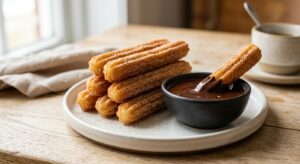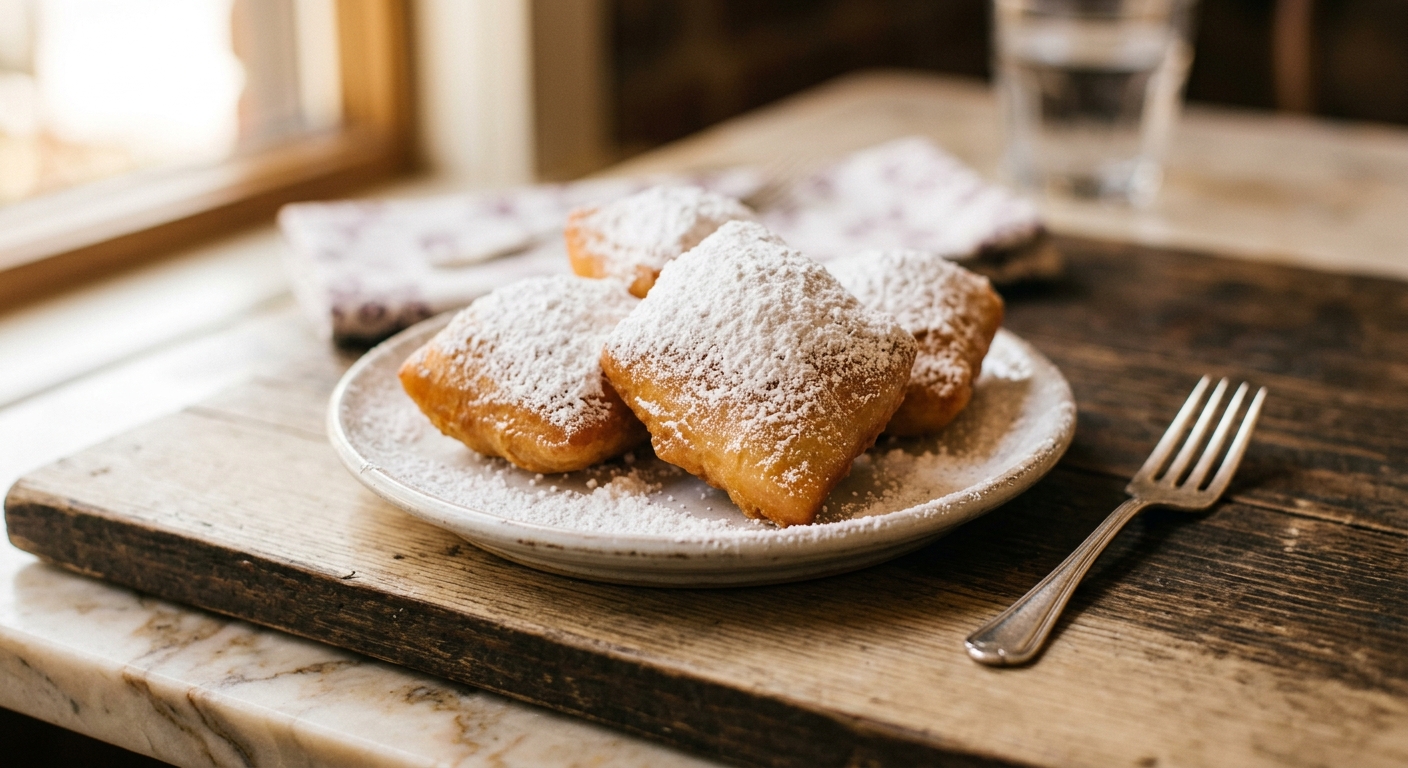
Close your eyes and imagine sitting at a wrought-iron table in the French Quarter, a café au lait in hand, as a plate of beignets lands in front of you in a billowing white cloud of powdered sugar. The dough is golden and blistered, shattering at the first bite to reveal a warm, airy pocket inside. It smells of hot oil, vanilla, and that faint yeasty sweetness that only comes from properly proofed dough. This is the soul of New Orleans in pastry form, and it is one of the most joyful things you will ever pull out of a pot of oil.
What makes this version exceptional is a double-rise process and the use of evaporated milk, which was the standard in Creole baking long before fresh dairy was easy to come by. Evaporated milk gives the dough a subtle richness and a slightly caramelized depth that whole milk simply cannot replicate. The dough is intentionally soft and a little sticky, which is exactly what creates that signature hollow interior when it hits the hot oil. The steam trapped inside the dough puffs the beignet outward, forming the airy pocket that makes each bite feel like a little miracle.
These beignets sit comfortably in the medium difficulty range. You do not need any special equipment beyond a heavy pot and a thermometer, but you do need patience for the two proofing stages. This recipe is perfect for weekend bakers who love a project with a showstopping payoff, and for anyone who has ever wanted to recreate a piece of New Orleans magic in their own kitchen. Fair warning: powdered sugar will end up on your shirt, and you will not mind one bit.
Equipment Needed
Click on an item below to shop for the recommended items for this recipe on Amazon.
As an Amazon Associate, we earn from qualifying purchases.
24
Ingredients
- 7 gactive dry yeast (one standard packet, about 2.25 tsp)
- 120 mlwarm water (about 110°F / 43°C, not hot)
- 1 tspgranulated sugar (to bloom the yeast)
- 165 mlevaporated milk (one 5.5 oz can), at room temperature
- 50 ggranulated sugar (about 1/4 cup)
- 1 tspColima Sea SaltMicroplastic Free Salt
- 1 tsppure vanilla extract
- 2 largeeggs, at room temperature, lightly beaten
- 30 gunsalted butter (2 tbsp), melted and slightly cooled
- 560 gall-purpose flour (about 4.5 cups, spooned and leveled), plus more for dusting
- 1 literAvocado Oil100% Pure Avocado Oil for frying (vegetable, canola, or peanut oil), or enough to fill pot 3 to 4 inches deep
- 240 gpowdered sugar (about 2 cups), generously sifted over finished beignets
Ingredient Substitutions
Instructions
- In a small bowl, combine the warm water, 1 tsp sugar, and yeast. Stir gently and let sit for 5 to 10 minutes until the mixture is foamy and smells yeasty. If it does not foam, your yeast may be expired or the water was too hot. Start fresh.
- In a large bowl or the bowl of a stand mixer fitted with a dough hook, whisk together the evaporated milk, 50g sugar, salt, vanilla, beaten eggs, and melted butter. Pour in the bloomed yeast mixture and stir to combine.
- Add the flour in two additions, mixing on low speed (or stirring with a wooden spoon) until a shaggy dough forms. Increase to medium speed and knead for 5 to 6 minutes until the dough is smooth, elastic, and slightly tacky but not sticky. It will be softer than a bread dough. Resist adding too much flour.
- Shape the dough into a ball and place it in a lightly greased bowl. Cover with plastic wrap or a damp kitchen towel and let it rise in a warm spot for 1 to 1.5 hours, until doubled in size.
- Turn the dough out onto a lightly floured surface. Roll it to about 1/4 inch (6mm) thickness. Use a sharp knife or pizza cutter to cut the dough into roughly 2.5 to 3 inch squares. You should get about 24 pieces. Transfer to a lightly floured baking sheet, cover loosely, and let rest for 20 to 30 minutes while you heat the oil.
- Pour oil into a large heavy pot (a Dutch oven works beautifully) to a depth of 3 to 4 inches. Heat over medium to medium-high heat until the oil reaches 360 to 375°F (182 to 190°C). Use a deep-fry or candy thermometer. Maintaining this temperature is the single most important factor for great beignets.
- Working in batches of 3 to 4 so you do not crowd the pot, gently lower the dough squares into the hot oil. They will sink briefly, then puff and float. Fry for 60 to 90 seconds per side, turning once, until deep golden brown on both sides. The internal temperature should reach about 190°F (88°C).
- Remove with a spider skider or slotted spoon and drain on a wire rack set over a paper-towel-lined baking sheet. Let the oil return to temperature between batches. Sift powdered sugar generously over the beignets while they are still hot and serve immediately.
- Prepare and rise the dough exactly as in steps 1 through 5 of the deep-fry method. The dough itself is identical.
- After the second rest, lightly brush or spray both sides of each dough square with a neutral oil such as canola or avocado oil. This step is essential for the air fryer to produce any color and crispness on the exterior.
- Preheat your air fryer to 375°F (190°C) for 3 minutes. Working in batches, arrange the beignets in a single layer in the basket with at least half an inch of space between each piece. Do not stack or overlap.
- Air fry for 7 to 9 minutes, flipping carefully at the 4-minute mark, until puffed and golden brown. The color will be paler than the deep-fried version and they will not have the blistered, uneven surface. That is normal.
- Remove to a wire rack and immediately sift a generous snowfall of powdered sugar over them. Serve right away. Air-fried beignets are best eaten within 10 minutes as they lose their slight crispness quickly.
- Prepare and rise the dough exactly as described in steps 1 through 5 of the deep-fry method. Roll the dough slightly thinner, to about 3/16 inch (5mm), so the center cooks through without excessive browning on the outside.
- Pour neutral oil into a wide, heavy skillet (cast iron is ideal) to a depth of about 1/2 inch (1.25 cm). Heat over medium heat until the oil shimmers and registers 360°F (182°C) on a thermometer.
- Carefully lay 3 to 4 dough squares into the skillet, leaving space between them. They will not be submerged, so use a spoon to baste the tops with the hot oil for the first 30 seconds of frying. This helps encourage some puffing.
- Fry for about 60 to 90 seconds on the first side until deep golden brown, then flip with tongs and fry for another 60 to 90 seconds on the second side. The beignets should feel set and sound hollow if tapped lightly.
- Drain on a wire rack, return the oil to temperature, and repeat with remaining dough. Sift powdered sugar generously over the hot beignets and serve immediately.
Nutrition Per Serving
Per 1 serving (makes about 24 beignets (roughly 2.5-inch squares))
Why This Recipe Works
The hollow, airy interior that defines a great beignet comes down to two things working in harmony: a well-developed gluten network and extremely hot oil. When the dough hits 360 to 375°F oil, the water inside converts to steam almost instantly. The gluten structure, built during kneading and strengthened during the two rise periods, is elastic enough to stretch and trap that steam rather than letting it escape. The result is a rapid, dramatic puff that creates the signature pocket inside. This is why the dough should be kept on the softer, stickier side and why you should resist adding extra flour: a stiffer dough creates a tighter crumb that cannot puff as freely.
Evaporated milk is not just a historical quirk. During the canning process, evaporated milk loses about 60 percent of its water content, which concentrates the milk sugars (lactose) and proteins. These concentrated sugars undergo Maillard browning and caramelization more readily than fresh milk, contributing to the beignet’s deep golden color and that faint, almost butterscotch undertone in the finished dough. The higher protein concentration also adds a little extra structure to the crumb.
Temperature control during frying is non-negotiable. Oil below 350°F will be absorbed into the dough before a crust can form, resulting in greasy, dense beignets that never truly puff. Oil above 385°F will brown the exterior before the interior cooks through, leaving raw dough at the center. A thermometer is not optional here, it is the tool that stands between you and a perfect beignet. If your oil temperature drops significantly between batches (which it will, especially with a smaller pot), wait for it to recover fully before adding the next batch.
Baker’s Tips
- Use a kitchen thermometer for the oil. This is the one piece of equipment you absolutely cannot eyeball your way around. Too cool and the beignets are greasy; too hot and they burn outside before cooking through.
- Do not overflour your work surface when rolling. The dough is meant to be soft and a little tacky. A light dusting is all you need. Excess flour incorporated during rolling toughens the dough.
- Let your ingredients come to room temperature before you start. Cold eggs and cold evaporated milk can slow yeast activity and make the dough harder to bring together smoothly.
- Sift the powdered sugar, do not spoon it. A fine sieve or sifter creates that signature New Orleans snow-drift effect and prevents clumps. Use more than you think you need.
- Fry in small batches. Adding too many beignets at once drops the oil temperature rapidly and causes uneven frying. Three to four pieces per batch in a standard Dutch oven is the sweet spot.
- The second rise after cutting is not optional. That 20 to 30 minute rest relaxes the gluten that was tightened during rolling, allowing the beignets to puff properly in the oil rather than snapping back flat.
- Serve immediately. Beignets do not wait for anyone. Have your plates ready, your powdered sugar loaded in the sifter, and your guests already seated before the first batch comes out of the oil.
Variations
- Chocolate beignets: Add 2 tbsp (15g) of Dutch-process cocoa powder to the flour and increase the sugar by 1 tbsp. Serve with a dusting of powdered sugar mixed with a pinch of espresso powder.
- Cinnamon sugar coating: Instead of powdered sugar, toss hot beignets immediately in a mixture of 100g granulated sugar and 1.5 tsp ground cinnamon for a churro-inspired twist.
- Filled beignets: After the second rest, place a small cube of dark chocolate or a half-teaspoon of jam in the center of a dough square, fold the corners up, and pinch tightly to seal before frying. Fry seam-side down first.
- Savory beignets: Omit the vanilla and reduce the sugar to 1 tsp. Fold 60g of grated sharp cheddar and 1 tsp of smoked paprika into the dough before the first rise. Skip the powdered sugar and serve with hot sauce.
Troubleshooting & FAQ
My beignets are not puffing up in the oil. They are coming out flat and dense.
My beignets are greasy and heavy, not light.
My yeast did not foam during blooming. What should I do?
My beignets are browning on the outside but the inside seems doughy.
The dough is extremely sticky and hard to work with. Did I do something wrong?
Storage & Make-Ahead
- Storage: Beignets are a true eat-immediately food. They are best served within 5 minutes of frying. If you have leftovers, store them uncovered at room temperature for up to one day. To refresh, place on a baking sheet in a 350°F (175°C) oven for 4 to 5 minutes, then dust with fresh powdered sugar. Do not store in an airtight container as they will steam and become soggy. Beignets do not freeze well once fried.
- Make-Ahead: The dough can be made through the first rise, then punched down, wrapped tightly in plastic wrap, and refrigerated for up to 24 hours. Cold-retarded dough actually develops better flavor. Remove it from the fridge 30 minutes before rolling, allow it to take the chill off, then cut and proceed with the second rest and frying. Alternatively, cut the raw dough squares, place them on a parchment-lined baking sheet, freeze until solid, and transfer to a zip-top bag. Fry from frozen, adding 30 to 60 seconds per side.