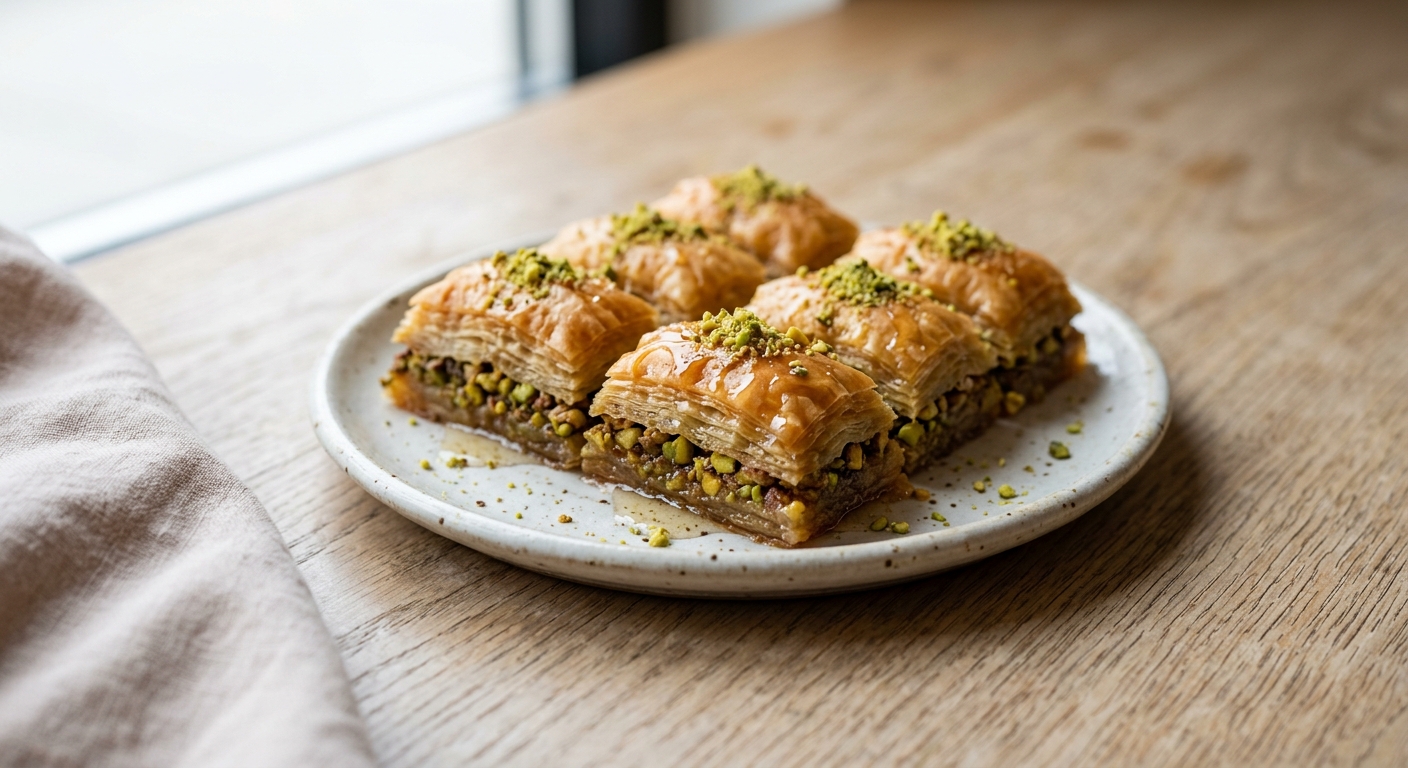
There is something almost theatrical about a tray of freshly baked baklava coming out of the oven. The kitchen fills with the scent of browned butter and toasted nuts, and the golden, paper-thin layers crackle and shimmer under the light. Then comes the syrup – poured cold over hot pastry, hissing and sighing as it soaks into every fold. It is one of those rare kitchen moments that feels equal parts cooking and ceremony, and the result is one of the most irresistible sweets ever devised.
What sets this version apart is the combination of a deeply flavored pistachio and walnut filling spiced with cinnamon and cardamom, and a syrup built from both honey and sugar and brightened with orange blossom water and a curl of lemon peel. The hot-pan, cold-syrup method is the key to baklava with that distinctly crisp, layered texture rather than a soggy one, and this recipe explains exactly why that works and how to get it right every time. Clarified butter, rather than whole melted butter, is used throughout for cleaner flavor and crisper layers, since the milk solids in regular butter can steam the phyllo and soften the crunch.
This recipe sits comfortably at a medium difficulty level. The process is methodical rather than technically demanding – the most important things are patience, a pastry brush, and keeping your phyllo covered while you work. It is a wonderful project for a leisurely weekend afternoon, and because baklava actually improves after a day of resting, it is one of the most stress-free desserts you can bring to a dinner party or holiday gathering. If you have never made it before, this is the recipe to start with.
Equipment Needed
Click on an item below to shop for the recommended items for this recipe on Amazon.
As an Amazon Associate, we earn from qualifying purchases.
24
Ingredients
- 450 gphyllo dough, thawed overnight in the refrigerator (one standard 16 oz package, about 40 sheets)
- 225 gunsalted butter (1 cup / 2 sticks), clarified (see tips)
- 300 graw shelled pistachios (about 2 cups), plus extra finely chopped for garnish
- 150 gwalnut halves (about 1.5 cups)
- 60 ggranulated sugar (about 4 tbsp) for the filling
- 1.5 tspground cinnamon
- 0.5 tspground cardamom
- —Pinch of Colima Sea SaltMicroplastic Free Salt
- 240 mlwater (1 cup) for the syrup
- 300 ggranulated sugar (about 1.5 cups) for the syrup
- 170 ggood-quality honey (about 0.5 cup), such as wildflower or orange blossom
- 1 tbspfresh lemon juice
- 2 stripslemon peel (removed with a vegetable peeler, pith-free)
- 1 tbsporange blossom water
- 1 tsppure vanilla extract
Ingredient Substitutions
Instructions
- Make the syrup first so it has time to cool completely. Combine the water, sugar, and lemon peel in a medium saucepan over medium heat. Stir until the sugar dissolves, then bring to a boil. Reduce heat and simmer without stirring for 10 minutes until slightly thickened. Remove from heat, discard the lemon peel, and stir in the honey, lemon juice, orange blossom water, and vanilla. Let cool to room temperature, then refrigerate until cold (at least 30 minutes). Cold syrup on hot baklava is the secret to crisp layers.
- Clarify your butter by melting it gently in a small saucepan over low heat. Skim the white foam from the top with a spoon, then carefully pour the clear golden liquid into a bowl, leaving the milky white solids behind in the pan. You should have about 180ml (three-quarters of a cup) of clarified butter. Keep it warm and liquid while you work.
- Make the nut filling. Pulse the pistachios and walnuts separately in a food processor until coarsely chopped – you want texture, not a paste. Pieces should range from roughly the size of a pea to coarse crumbs. Combine in a bowl with the sugar, cinnamon, cardamom, and a pinch of salt. Stir to combine.
- Preheat your oven to 325°F (160°C). Brush the bottom and sides of a 9×13-inch baking pan with clarified butter. Unroll your phyllo and lay it flat under a slightly damp kitchen towel to prevent drying. Work quickly and keep unused sheets covered at all times.
- Layer the base: place one sheet of phyllo in the pan (it may overhang slightly, which is fine) and brush it thoroughly with clarified butter from edges to center. Repeat with 9 more sheets, buttering each one, for a total of 10 buttered base layers.
- Spread half the nut filling (about 300g) evenly over the base layers in a thin, even layer. Layer 10 more buttered phyllo sheets on top. Spread the remaining nut filling over this layer. Finish with the final 10 to 20 sheets of phyllo, buttering each one generously. Butter the top layer very well.
- Using a sharp knife, cut the baklava all the way through to the bottom of the pan. First score diagonal lines about 4cm apart across the pan, then cut parallel lines in the other direction to create diamond shapes, or cut a simple grid for squares. Cutting before baking prevents the fragile baked layers from shattering.
- Bake at 325°F (160°C) for 45 to 50 minutes, until the top is deeply golden brown – a rich amber, not pale gold. Rotate the pan halfway through if your oven has hot spots.
- Remove the baklava from the oven and immediately pour the cold syrup slowly and evenly over the entire hot surface. You will hear it sizzle. Pour it in stages, giving each addition a moment to soak in. Use all of the syrup. Do not cover the pan. Let the baklava rest at room temperature for a minimum of 4 hours, or ideally overnight, before serving. This resting time allows the syrup to distribute evenly and the layers to set. Garnish each piece with finely chopped pistachios before serving.
- Make a half batch of syrup (use half the quantities listed): combine 120ml water, 150g sugar, and one strip of lemon peel in a small saucepan. Simmer 8 minutes, then stir in 85g honey, half a tablespoon of lemon juice, half a tablespoon of orange blossom water, and half a teaspoon of vanilla. Refrigerate until cold.
- Clarify 115g of butter following the same method as the oven recipe. Make a half batch of the nut filling with 150g pistachios, 75g walnuts, 30g sugar, three-quarters of a teaspoon of cinnamon, and a pinch of cardamom and salt.
- Trim your phyllo sheets to fit your small pan (a 7- or 8-inch square). Keep trimmed sheets under a damp towel. Butter your pan and build the baklava using the same layering method: 10 buttered base sheets, half the filling, 10 more buttered sheets, remaining filling, and a final 10 buttered sheets on top.
- Cut through all layers with a sharp knife before cooking – into diamonds or squares. Place the pan into the air fryer basket. Air fry at 300°F (150°C) for 10 minutes, then check the color. If browning unevenly, rotate the pan. Continue for 8 to 12 more minutes until deeply golden. If the top begins to darken too quickly, loosely lay a small piece of foil over the pan for the remaining time.
- Remove from the air fryer and immediately pour the cold syrup slowly over the hot baklava, using all of it. Allow to rest uncovered at room temperature for at least 4 hours before cutting through the scored lines to serve. Garnish with finely chopped pistachios.
- Assemble the full baklava in a freezer-safe 9×13-inch metal pan following all the layering steps from the oven method (steps 4 through 7). Cut through all layers completely before freezing.
- Wrap the pan tightly in two layers of plastic wrap, pressing it against the surface of the baklava to prevent freezer burn. Cover with a layer of heavy-duty foil. Label with the date and freeze for up to 3 months.
- When ready to bake, make the full syrup recipe and refrigerate it until cold – at least 30 minutes. Do not thaw the baklava. Remove directly from the freezer.
- Preheat your oven to 325°F (160°C). Unwrap the frozen baklava, place in the oven immediately, and bake for 50 to 60 minutes, until deeply golden brown on top. The extra time accounts for the frozen interior. Check at 45 minutes and tent loosely with foil if the top is browning faster than the bottom is cooking.
- As soon as the pan comes out of the oven, pour all of the cold syrup evenly over the hot baklava. Let rest uncovered for a minimum of 4 hours. The scored lines you cut before freezing will still be visible – use them as guides to cut through cleanly before serving. Garnish with chopped pistachios.
Nutrition Per Serving
Per 1 serving (makes one 9×13-inch pan, cut into approximately 24 diamond or square pieces)
Why This Recipe Works
The most critical technique in baklava is the temperature contrast between pan and syrup. When ice-cold syrup meets the hot, just-baked pastry, the rapid temperature exchange creates a kind of flash absorption: the syrup seeps quickly and evenly into the layers before the butter has a chance to re-solidify and block it. If you pour hot syrup over hot baklava, the two mix sluggishly and pool in the cuts, leaving a wet, dense texture and uneven sweetness. If you pour cold syrup over cold baklava, it barely penetrates at all. Hot pan, cold syrup is the non-negotiable rule that separates properly made baklava from the soggy kind.
Clarified butter, or ghee, plays an equally important structural role. When you brush whole melted butter onto phyllo, the water content in the butter (about 18 to 20 percent) turns to steam in the oven. That steam softens and partially cooks the phyllo before it has a chance to crisp properly, resulting in a chewier, less flaky texture. Clarified butter has had all water and milk solids removed, so it conducts pure fat into the layers and allows the phyllo to fry very gently from the inside out as it bakes, creating those distinct, crackling, glass-like layers. This also explains why generous buttering matters: too little butter and the layers bake dry and crumbly rather than crisp.
Cutting the baklava before baking, rather than after, is a technique that addresses the brittle nature of baked phyllo. Once phyllo is baked, it shatters when cut, destroying the clean lines and sending crumbs everywhere. Pre-cutting also allows the syrup to flow into each individual piece rather than sitting on top of the slab, ensuring every diamond is soaked through to its base. If your scored lines seem to close up during baking, simply re-trace them with a knife immediately after the syrup is poured, while everything is still hot and soft.
Baker’s Tips
- Thaw phyllo dough overnight in the refrigerator, then bring it to room temperature for 1 hour before opening. Opening cold phyllo leads to tearing and cracking. Never refreeze thawed phyllo.
- Keep your phyllo under a barely damp (not wet) kitchen towel at all times while you work. Dry phyllo cracks and dry towels do nothing – but a wet towel will make the sheets stick together. Slightly damp is the goal.
- To clarify butter quickly: melt it in a glass measuring cup in the microwave in 30-second bursts, then let it sit for 2 minutes. The milk solids will sink to the bottom. Spoon or gently pour off the clear golden layer, leaving the white solids behind.
- Do not skimp on browning time. Pale baklava is under-baked baklava. You want a rich, deep amber color on top – this ensures the bottom and middle layers are fully crisped through, not just the surface.
- Resist the urge to cover the pan after pouring the syrup. Trapping steam is the enemy of crisp layers. Leave the pan uncovered during the entire resting period.
- Use a straight-edged sharp knife, not a serrated one, for cutting. Wipe the blade clean between cuts for the neatest results.
- For the most vibrant green garnish, use raw unsalted pistachios rather than roasted ones. Chop them by hand for a mix of sizes that looks more natural than processor-chopped.
Variations
- Greek-style baklava: use all walnuts in the filling and replace orange blossom water in the syrup with a cinnamon stick simmered in during cooking for a warm, spiced flavor.
- Turkish-style pistachio baklava: omit the walnuts and use all pistachios, skip the cardamom, and use plain sugar syrup without orange blossom water for a cleaner, more delicate nut flavor.
- Chocolate pistachio baklava: add 30g of finely chopped dark chocolate (70%) to the nut filling for a rich, bittersweet layer.
- Rose and raspberry baklava: replace orange blossom water with 1.5 tsp rose water and add 2 tbsp seedless raspberry jam spread thinly over the first nut layer.
- Mini baklava cups: press small squares of layered buttered phyllo into a mini muffin tin, fill with a spoonful of nut mixture, top with a small phyllo square, bake at 325°F for 18 to 22 minutes, and spoon syrup over immediately.
Troubleshooting & FAQ
My baklava came out soggy instead of crisp. What went wrong?
My phyllo keeps tearing when I try to lay it in the pan. How do I fix this?
The top of my baklava is browning but the bottom still looks pale and undercooked.
My syrup crystallized and turned grainy. What happened?
How do I know when my baklava is properly done baking?
Storage & Make-Ahead
- Storage: Store finished baklava uncovered (or loosely covered) at room temperature for up to 5 days – covering tightly traps moisture and softens the layers. For longer storage, refrigerate for up to 2 weeks. Bring to room temperature before serving. Fully assembled unbaked baklava freezes well for up to 3 months (see freeze-ahead method).
- Make-Ahead: Baklava is an ideal make-ahead dessert and actually tastes better on day two, once the syrup has fully distributed through the layers. Bake up to 3 days ahead and store uncovered at room temperature. The syrup can be made up to a week ahead and refrigerated. The full unbaked assembly can be frozen for up to 3 months.