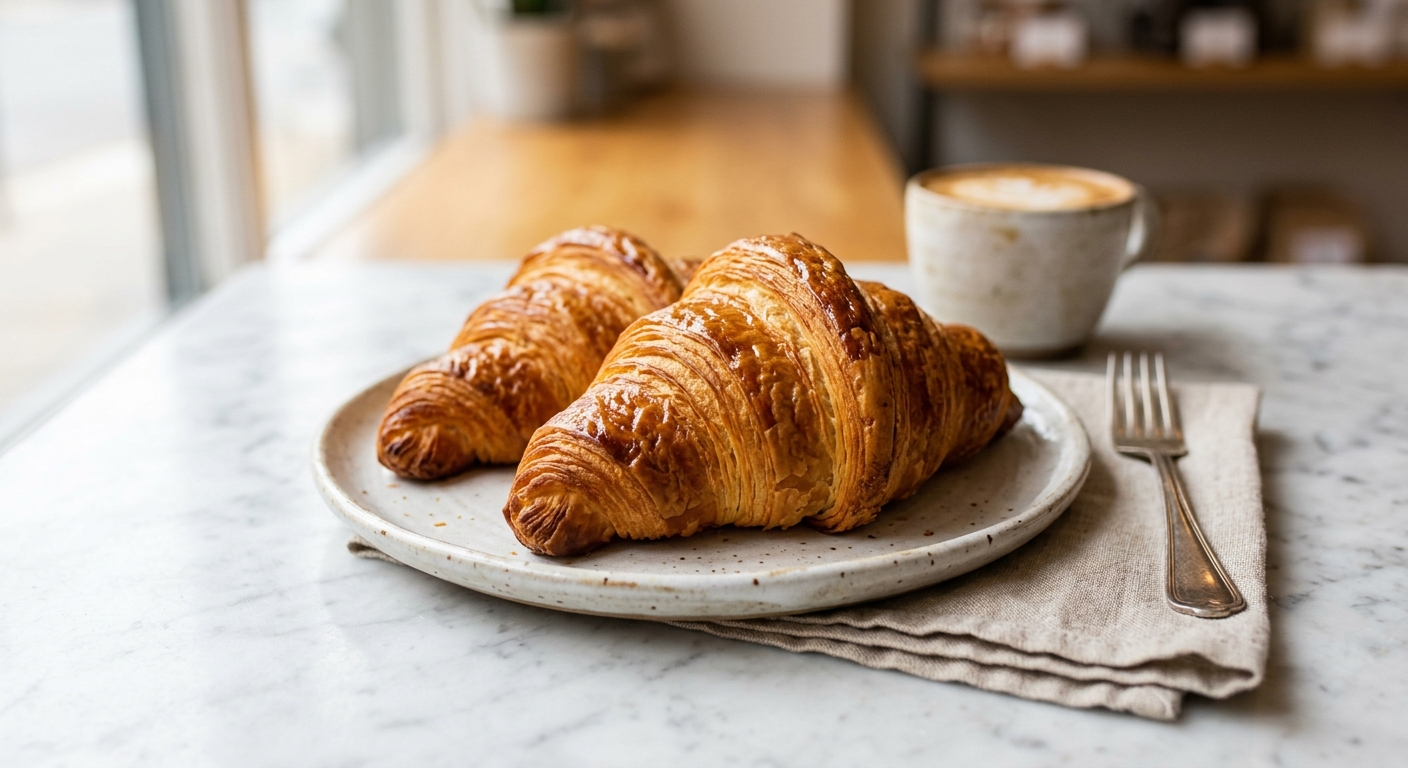
There is a particular kind of morning magic that happens when you pull a tray of homemade croissants from the oven. The deep amber shells crackle as they cool, releasing that unmistakable scent of warm butter and caramelized dough into every corner of your kitchen. You made those. From flour and butter and just a little bit of patience, you coaxed something extraordinary into existence, and now you get to eat it still warm, pulling apart the layers to watch them separate into gossamer ribbons of pastry. It is one of the great joys of baking.
What sets this recipe apart is the attention to temperature and timing at every single stage. Laminated dough is all about keeping the butter cold and firm so it stays in distinct, separate layers rather than melting into the dough. This version uses a European-style butter with a higher fat content (at least 82 percent) for maximum flavor and flexibility, and the dough itself is enriched with just enough milk and a touch of honey to give the crust that gorgeous deep-mahogany color without compromising the delicate, open crumb. The folding sequence is a classic double fold followed by two single folds, building 72 distinct butter layers that puff and shatter in the oven.
Be honest with yourself: this is an ambitious bake. It is not difficult in the sense of requiring advanced technique, but it demands respect for time and temperature. It is ideal for the dedicated home baker who wants to spend a relaxed weekend on a truly rewarding project, for anyone who has always been curious about viennoiserie, or for the person who wants to give the most impressive gift a baker can offer. Follow the steps, keep everything cold, and you will succeed.
Equipment Needed
Click on an item below to shop for the recommended items for this recipe on Amazon.
As an Amazon Associate, we earn from qualifying purchases.
12
Ingredients
- Dough
- 500 gbread flour (about 4 cups, spooned and leveled), plus extra for dusting
- 10 ginstant yeast (about 3 tsp)
- 55 ggranulated sugar (about 1/4 cup)
- 10 gColima Sea SaltMicroplastic Free Salt (about 1 3/4 tsp)
- 300 mlwhole milk, cold (about 1 1/4 cups)
- 15 ghoney (about 2 tsp)
- 30 gunsalted butter, softened (about 2 tbsp)
- Butter Block
- 280 ghigh-fat European-style unsalted butter (82% fat or higher), cold (about 1 1/4 cups)
- Egg Wash
- 2 largeegg yolks
- 30 mlwhole milk (about 2 tbsp)
- —Pinch of Colima Sea SaltMicroplastic Free Salt
Ingredient Substitutions
Instructions
- DAY 1, STEP 1 – MAKE THE DOUGH (DÉTREMPE): In a large bowl or the bowl of a stand mixer fitted with a dough hook, combine the bread flour, instant yeast, sugar, and salt. Add the cold milk and honey. Mix on low speed for 2 minutes until a shaggy dough forms, then increase to medium and mix for 3 minutes. Add the 30g softened butter and continue mixing for another 3 to 4 minutes until the dough is smooth and slightly tacky but not sticky. It should clear the sides of the bowl. Do not over-knead. The dough should be developed but not fully elastic, as over-kneading makes rolling difficult.
- DAY 1, STEP 2 – FIRST REST: Shape the dough into a smooth rectangle (roughly 20x15cm), wrap tightly in plastic wrap or place in a sealed container, and refrigerate for at least 1 hour or up to overnight. The cold rest relaxes the gluten and makes the dough easier to roll without springing back.
- DAY 1, STEP 3 – MAKE THE BUTTER BLOCK (BEURRAGE): Place the 280g cold European butter between two sheets of parchment paper. Using a rolling pin, beat and then roll it into an even 19x19cm (7.5-inch) square, approximately 1cm thick. Every corner should be as square as possible. The butter should be pliable and bend slightly without snapping or crumbling. If it snaps, it is too cold; let it sit at room temperature for 5 minutes and try again. If it is greasy or looks oily, refrigerate it for 10 minutes. The ideal butter temperature is 15 to 17°C (59 to 63°F). Refrigerate the butter block until needed.
- DAY 1, STEP 4 – LAMINATION, FIRST ENCLOSURE: On a lightly floured surface, roll the chilled dough into a rectangle approximately 40x22cm (16×9 inches). Place the butter block in the center of the dough so it sits like a diamond rotated 45 degrees, with each corner of the butter pointing to the center of each long and short edge. Fold the four flaps of dough up and over the butter, pinching all seams firmly to completely encase the butter. You now have a package. Gently press the rolling pin across the package a few times to begin flattening, then roll it out to a 60x20cm (24×8 inch) rectangle, working from the center outward. Work quickly and confidently. If the butter breaks through the dough, dust the spot with flour and keep going.
- DAY 1, STEP 5 – FIRST FOLD (DOUBLE FOLD): With one short edge facing you, fold the bottom third of the dough up, then fold the top third down over it, like a business letter. This is a single (letter) fold, giving you 3 layers. Rotate 90 degrees so the seam is on your right like the spine of a book. Roll out again to 60x20cm. Now perform a double (book) fold: fold the bottom quarter of the dough up to the center line, fold the top quarter down to meet it, then fold the whole thing in half along that center line, like closing a book. You now have 4 layers. Wrap the dough tightly in plastic wrap and refrigerate for 30 minutes. Cold resting between folds is non-negotiable. It keeps the butter cold and allows the gluten to relax so the dough rolls smoothly.
- DAY 1, STEP 6 – SECOND FOLD (SINGLE FOLD): Remove the dough from the refrigerator and unwrap it with the seam on your right. Roll out again to 60x20cm and perform one final single (letter) fold, folding it into thirds. Wrap and refrigerate for at least 1 hour, or preferably overnight. At this point you have approximately 72 butter layers. Overnight cold retard in the refrigerator develops flavor significantly.
- DAY 2, STEP 7 – SHAPE THE CROISSANTS: On a very lightly floured surface, roll the laminated dough out to a large rectangle approximately 60x40cm (24×16 inches) and about 4mm thick. Work gently and evenly, taking care not to press so hard that the layers merge. Using a sharp knife or pizza cutter, trim the edges cleanly (this removes sealed edges and allows the layers to puff). Cut the dough into 12 tall isosceles triangles, each with a base of about 10cm (4 inches) and a height of about 20cm (8 inches). At the base of each triangle, make a small 1cm notch in the center of the base edge. This helps the croissant curl into its crescent shape without distorting.
- DAY 2, STEP 8 – ROLL AND PROOF: Gently stretch each triangle to elongate it slightly. Starting from the notched base, roll each triangle up toward the tip, applying gentle but consistent pressure and rolling away from you. The tip should end up tucked underneath the croissant. Curve the ends inward slightly to form the classic crescent. Place on two parchment-lined baking sheets, spaced well apart. Make the egg wash by whisking the 2 egg yolks with 2 tbsp milk and a pinch of salt until smooth. Brush each croissant gently with egg wash, taking care not to let it drip down the cut sides (this glues the layers together and prevents full puffing). Refrigerate the remaining egg wash. Let the croissants proof, uncovered, at warm room temperature (24 to 26°C / 75 to 78°F) for 2 to 3 hours, until they look visibly puffed and jiggly. When you gently shake the tray, they should wobble. If you can see the layers from the side, they are ready.
- DAY 2, STEP 9 – BAKE: Preheat the oven to 400°F (200°C), conventional (not fan/convection, which can cause uneven browning). When the croissants are fully proofed, brush them very gently with a second coat of egg wash. Bake for 20 to 22 minutes, rotating the pans halfway through, until they are a deep, even mahogany brown. Do not underbake. A pale croissant will be doughy inside. Transfer to a wire rack and allow to cool for at least 15 minutes before eating. The interior structure sets as they cool.
- Follow all lamination and shaping steps from the oven method (Steps 1 through 8) up to the point where the shaped croissants are placed on the baking sheets. Do not proof them at room temperature.
- Brush each shaped croissant once with egg wash, then place the entire tray in the freezer. Freeze for 2 to 3 hours until the croissants are completely solid, then transfer them to a zip-seal freezer bag or airtight container. They will keep in the freezer for up to 1 month.
- THE NIGHT BEFORE YOU WANT TO BAKE: Remove the desired number of croissants from the freezer and place them on a parchment-lined baking sheet. Brush lightly with egg wash. Cover loosely with lightly greased plastic wrap so the wrap does not stick as they expand. Refrigerate overnight (8 to 10 hours). The croissants will slowly thaw and proof in the cold.
- IN THE MORNING: Remove the tray from the refrigerator and let the croissants sit at room temperature for 45 to 60 minutes. They should look noticeably puffed and a little jiggly. Preheat your oven to 400°F (200°C). Brush the croissants with a second coat of fresh egg wash and bake for 22 to 25 minutes until deeply golden brown. Frozen croissants may need 2 to 3 extra minutes compared to freshly proofed ones, so watch for that deep mahogany color as your doneness cue.
- Alternatively, you can do a full room-temperature overnight proof by placing the shaped (never-frozen) croissants directly in the refrigerator overnight, then finishing the same way. Both methods deliver exceptional results with minimal morning effort.
Nutrition Per Serving
Per 1 serving (makes 12 full-size croissants)
Why This Recipe Works
The entire magic of a croissant comes down to lamination, which is the process of folding cold butter into dough to create hundreds of alternating, distinct layers. When the croissants go into the hot oven, two things happen simultaneously: the water in the butter (about 16 to 18 percent of its weight) turns to steam and forces the layers apart, while the fat coats each layer of dough and prevents the gluten strands from bonding back together. The result is a dramatic vertical lift and those characteristic honeycomb layers. This is why bread flour is specified over all-purpose flour. Its higher protein content (12 to 13 percent versus 10 to 11 percent) builds a stronger gluten network that can withstand the rolling and folding without tearing, while still being extensible enough to roll thin.
Temperature is the single most important variable in lamination. Butter at 15 to 17°C (59 to 63°F) is pliable enough to bend without snapping but firm enough to remain in sheets rather than smearing into the dough. If the butter is too cold it shatters and creates uneven patches rather than continuous layers. If it is too warm it melts into the dough, effectively shortening it rather than laminating it, and you lose all layer definition. This is also why every fold is followed by a cold rest in the refrigerator. The gluten fibers relax during resting, which prevents the dough from springing back during rolling, and the butter firms back up to maintain its separation from the dough.
The choice of European-style butter with 82 percent or higher fat is not snobbery. Higher-fat butter has less water and milk solids, which means more pure fat to create those clean, shatteringly crisp layers, and significantly more flavor. Standard American butter at 80 percent fat works but produces slightly softer, less distinct layers. If your croissants are spreading wide and flat rather than puffing tall, the butter was likely too warm during lamination or the croissants were over-proofed. If the layers are dense and there is no open crumb, the butter was too cold and shattered, or the dough was under-proofed. Look for that characteristic jiggle before you bake, and trust your oven thermometer.
Baker’s Tips
- Invest in an oven thermometer. Ovens routinely run 15 to 25 degrees off from what the dial says, and temperature accuracy is critical for both butter temperature management and baking.
- Work in a cool kitchen. If your kitchen is above 22°C (72°F), chill your rolling pin and work surface briefly before starting lamination. Warm hands melt butter quickly, so use the rolling pin to do most of the work and touch the dough as little as possible.
- Do not rush the proof. Under-proofed croissants will be dense with little open crumb. Over-proofed ones will spread and collapse. The jiggle test is your best guide: when you gently shake the tray, the croissants should wobble like set gelatin.
- A sharp knife or pizza cutter for cutting the triangles is important. Dragging a dull blade seals the cut edges together and prevents the layers from separating fully during baking.
- The first egg wash coat before proofing is a light, barely-there coat. The second coat right before baking is what gives the deep glossy mahogany finish. Two coats, not one heavy one.
- If the dough resists rolling and keeps springing back, stop, wrap it, and rest it in the refrigerator for 10 minutes. Forcing resistant dough will tear the butter layers. Patience here saves the whole batch.
- Use a ruler when rolling and cutting. Even triangles proof and bake evenly. Uneven pieces result in some over-baked and some under-baked on the same tray.
Variations
- Pain au Chocolat: Cut the laminated dough into 10x12cm rectangles instead of triangles. Place one or two batons of dark chocolate (about 10g each) at the base of each rectangle and roll up tightly. Proof and bake exactly as for croissants.
- Almond Croissants: This is the classic French solution for day-old croissants. Slice each croissant in half horizontally, fill generously with almond cream (frangipane), close, spread more almond cream on top, and scatter sliced almonds over. Bake at 375°F (190°C) for 14 to 16 minutes until golden. Dust with powdered sugar.
- Ham and Gruyere Croissants: Before rolling each triangle, place a thin slice of good ham and a small amount of grated Gruyere at the wide base. Roll and bake as usual for a savory version. Reduce the sugar in the dough by half.
- Whole Wheat Croissants: Replace up to 100g of the bread flour with whole wheat flour. The dough will be slightly stiffer and the flavor more nutty. Add 15ml more milk to compensate for the extra absorption.
Troubleshooting & FAQ
My butter broke into chunks and tore through the dough during rolling. What went wrong?
My croissants came out dense and doughy with no visible layers or open crumb. What happened?
My croissants spread out flat and wide instead of puffing up tall. Why?
The layers are visible from the outside but the inside is raw or gummy after the full bake time.
Why do my croissants unroll or unwind during baking?
Storage & Make-Ahead
- Storage: Croissants are best eaten the day they are baked, ideally within 4 hours of coming out of the oven. Store cooled leftovers in a paper bag (never airtight, which softens the crust) at room temperature for up to 1 day. To refresh, place on a baking sheet in a 350°F (175°C) oven for 5 to 6 minutes until the crust re-crisps. Do not microwave.
- Make-Ahead: The laminated dough can be completed through all folds and refrigerated for up to 24 hours before shaping. Shaped, unbaked croissants can be frozen for up to 1 month (see Freeze-and-Bake method). Fully baked croissants can be frozen in a single layer, then transferred to a bag, for up to 3 weeks. Reheat from frozen at 325°F (160°C) for 12 to 15 minutes.