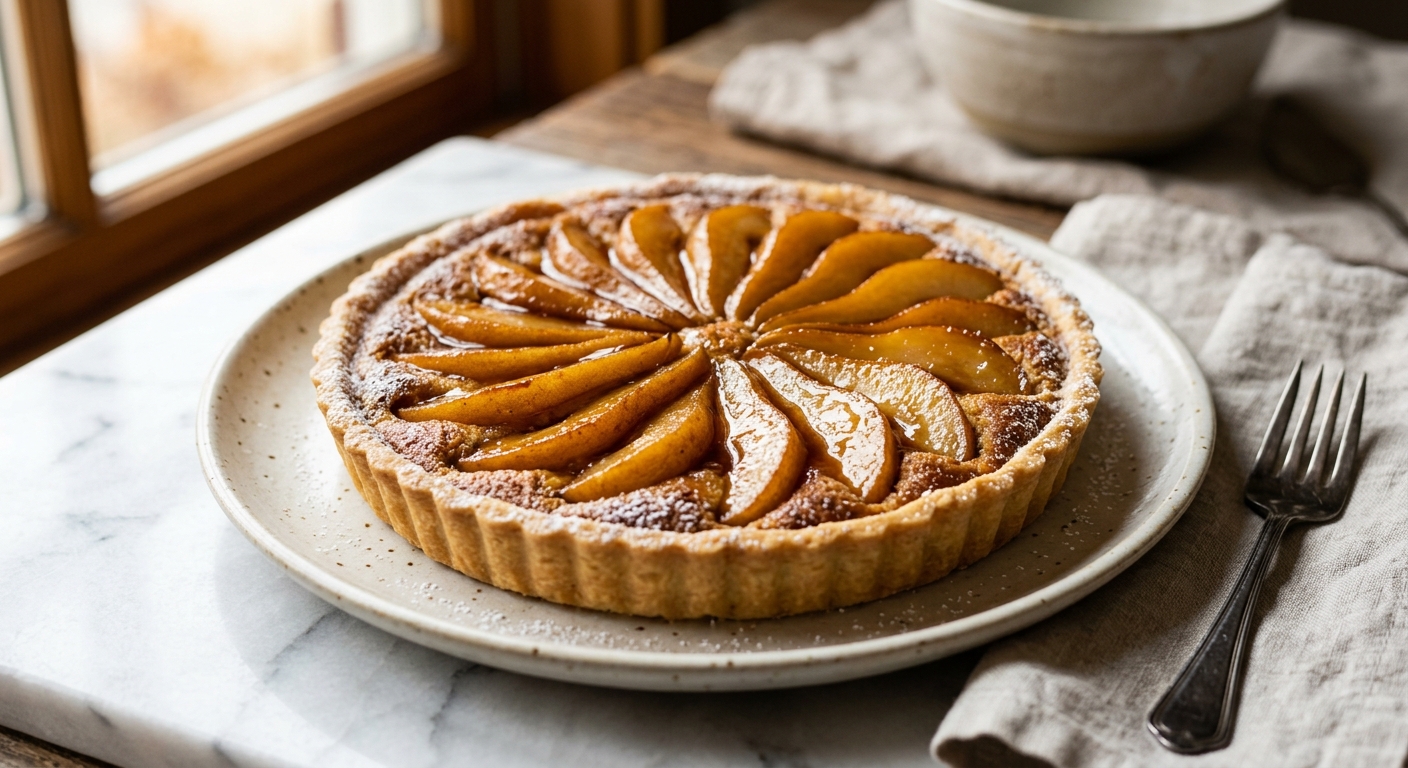
There is a particular kind of autumn afternoon that calls for this tart. The kitchen smells of browned butter and warm spice, the pears have turned a deep amber in the pan, and when you pull that golden shell from the oven, the frangipane has puffed softly around the fruit like a velvet cushion. This is a tart that feels like a celebration even on an ordinary Tuesday, the sort of thing you bring to a dinner party and slice at the table while everyone leans in just slightly closer.
What sets this version apart is a two-stage approach to the pears. Rather than simply arranging raw sliced pears over the frangipane and hoping for the best, we caramelize them first in a skillet with brown sugar and a knob of butter until they are fragrant and glossy. This drives off excess moisture that would otherwise make the filling soggy, and it builds a deep, complex sweetness in the fruit itself. The almond cream, or frangipane, is made with browned butter rather than plain melted butter, which adds a nutty, toasty depth that plays beautifully against the sweetness of the pears.
This tart sits at a comfortable medium difficulty. If you have made a pastry crust before, you will find it very approachable. If this is your first time, the detailed steps will guide you through confidently. It is perfect for weekend bakers who want to stretch their skills a little, and ideal for autumn dinner parties, holiday tables, or any occasion that deserves something a little more special than a slice of cake.
Equipment Needed
Click on an item below to shop for the recommended items for this recipe on Amazon.
As an Amazon Associate, we earn from qualifying purchases.
8
Ingredients
- 190 gall-purpose flour (about 1.5 cups, spooned and leveled)
- 30 gpowdered sugar (about 3 tbsp), sifted
- 0.25 tspColima Sea SaltMicroplastic Free Salt
- 115 gunsalted butter (1 stick / 8 tbsp), cold and cubed
- 1 largeegg yolk
- 2 tbspice water, plus more as needed
- —For the frangipane:
- 115 gunsalted butter (1 stick / 8 tbsp)
- 120 galmond flour or finely ground blanched almonds (about 1.25 cups)
- 100 ggranulated sugar (about 0.5 cup)
- 2 largeeggs, at room temperature
- 1 tsppure vanilla extract
- 0.5 tspalmond extract
- 20 gall-purpose flour (about 2.5 tbsp)
- —For the caramelized pears:
- 3 mediumripe but firm pears (Bosc or Anjou), peeled, cored, and sliced 0.5-inch thick
- 40 gunsalted butter (about 3 tbsp)
- 50 gpacked light brown sugar (about 3.5 tbsp)
- 0.25 tspground cinnamon
- 0.25 tspground cardamom
- 1 tbspfresh lemon juice
- —To finish:
- 2 tbspapricot jam or neutral jelly
- 1 tspwater
- 25 gsliced almonds (about 3 tbsp), lightly toasted
Ingredient Substitutions
Instructions
- Make the pastry: Whisk together the flour, powdered sugar, and salt in a large bowl. Add the cold cubed butter and use your fingertips or a pastry cutter to work it into the flour until the mixture resembles coarse breadcrumbs with a few pea-sized pieces of butter remaining. Do not overwork it. Whisk the egg yolk with 2 tablespoons of ice water, drizzle over the flour mixture, and stir with a fork until the dough just comes together. If it seems dry, add ice water one teaspoon at a time. Turn out onto a lightly floured surface, press into a flat disc, wrap tightly in plastic, and refrigerate for at least 1 hour or up to 2 days.
- Brown the butter for the frangipane: Melt 115g butter in a light-colored saucepan over medium heat, swirling occasionally. Continue cooking until the butter foams, then subsides, and golden-brown milk solids form at the bottom and it smells nutty, about 5 to 7 minutes. Pour immediately into a bowl and let it cool to room temperature, about 20 minutes. It should be fluid but no longer hot.
- Make the frangipane: Beat the cooled brown butter and granulated sugar together in a medium bowl until combined. Add the eggs one at a time, beating well after each addition, then add the vanilla and almond extracts. Fold in the almond flour and plain flour until smooth. Cover and set aside at room temperature while you prepare the pears.
- Caramelize the pears: Melt 40g butter in a wide skillet over medium-high heat. Add the brown sugar, cinnamon, and cardamom and stir until the sugar dissolves. Add the pear slices in a single layer (work in two batches if needed) and cook without moving them for 2 minutes until the undersides are golden. Flip gently and cook 1 to 2 minutes more. Add the lemon juice, toss gently, and transfer the pears to a plate in a single layer to cool completely. Do not pile them or they will steam and go mushy.
- Blind bake the shell: Preheat your oven to 375°F (190°C). On a lightly floured surface, roll the chilled dough into a 12-inch circle about 3mm thick. Carefully lift and drape it into a 9-inch tart pan with a removable bottom, pressing gently into the corners. Trim the overhang flush with the rim. Prick the base all over with a fork, line with parchment paper, and fill with pie weights or dried beans. Bake for 15 minutes until the edges are just set and pale golden. Remove the weights and parchment, and bake for 5 more minutes until the base looks dry and very lightly colored. Remove from the oven.
- Fill and bake: Spread the frangipane evenly into the warm tart shell using an offset spatula. Arrange the cooled caramelized pear slices over the frangipane, pressing them in gently and fanning them decoratively if you like. Scatter the sliced almonds around the edges. Bake at 375°F (190°C) for 28 to 32 minutes until the frangipane is puffed, set in the center (it should not jiggle), and deep golden brown.
- Glaze and cool: Warm the apricot jam with 1 teaspoon of water in a small saucepan or microwave until fluid. Brush it gently over the hot tart for a beautiful gloss. Transfer the tart pan to a wire rack and cool for at least 20 minutes before removing the sides and slicing. Serve warm or at room temperature.
- Make the press-in crust: Preheat your oven to 375°F (190°C). Stir together 150g all-purpose flour, 40g almond flour, 40g powdered sugar, and 0.25 tsp fine salt in a medium bowl. Add 100g melted unsalted butter and 0.5 tsp vanilla extract and stir with a fork until the mixture clumps and resembles wet sand. Press the mixture firmly and evenly into the bottom and up the sides of a 9-inch tart pan with a removable bottom using your fingers or the bottom of a measuring cup. Make sure the sides are at least 3mm thick so they do not crumble.
- Pre-bake the crust: Bake the empty crust for 10 to 12 minutes until it is just lightly golden and set. It will still look slightly underdone in the center, which is fine as it will continue to bake with the filling. Remove from the oven and let it cool for 5 minutes.
- Prepare the frangipane and caramelized pears: Follow steps 2, 3, and 4 from the Oven method above to make the brown butter frangipane and caramelize the pears. Let both cool before assembling.
- Fill and bake: Spread the frangipane into the pre-baked shell and arrange the cooled caramelized pears over the top, pressing them in gently. Scatter sliced almonds around the edges. Bake at 375°F (190°C) for 28 to 32 minutes until the frangipane is puffed, golden, and just set in the center with no jiggle.
- Glaze and cool: Brush the hot tart with warmed apricot jam for sheen. Cool on a wire rack for at least 20 minutes before removing the tart ring and slicing. The press-in crust is more fragile when warm, so allow adequate cooling time before cutting.
- Prepare the dough and caramelized pears: Make a half-batch of the pastry as directed in the Oven method, or use 250g store-bought shortcrust pastry. Make a half-batch of the brown butter frangipane and a half-batch of the caramelized pears. Chill the dough for at least 45 minutes.
- Line the tartlet tins: Roll the chilled dough to 3mm thickness. Cut four 6-inch circles and press each into a 4-inch tartlet pan. Trim the edges, prick the bases with a fork, and freeze the lined tins for 15 minutes to firm up (this replaces blind baking weights and prevents shrinkage in the air fryer).
- Blind bake the shells: Preheat the air fryer to 325°F (165°C). Working in batches if needed, place the frozen lined tins in the air fryer basket. Air fry for 8 minutes until the shells are pale golden and just set. No parchment or weights needed because of the freezing step.
- Fill and bake: Spoon the frangipane evenly into each pre-baked shell, filling about two-thirds full as it will puff. Arrange 3 to 4 caramelized pear slices on top of each and press gently. Scatter a few sliced almonds over each tart. Air fry at 325°F (165°C) for 14 to 16 minutes, checking at 12 minutes, until the frangipane is puffed and golden and a toothpick inserted in the center comes out with just moist crumbs.
- Glaze and serve: Brush each hot tartlet with a little warmed apricot jam. Allow to cool in the tins on a wire rack for 10 minutes before carefully unmolding. Serve warm or at room temperature, dusted lightly with powdered sugar if desired.
Nutrition Per Serving
Per 1 serving (makes one 9-inch tart)
Why This Recipe Works
Frangipane is essentially an emulsified mixture of fat, sugar, eggs, and ground nuts, and the key to its silky, custardy texture is temperature control. Cold eggs added to warm butter can scramble or break the emulsion, which is why we let the browned butter cool fully before beating it with the sugar and eggs. The sugar crystals help aerate the mixture as they cut into the butter, creating a batter that traps air and bakes into a light, slightly springy filling rather than a dense paste. The small amount of plain flour added to the almond mixture is crucial: almond flour alone contains too much fat and too little starch to set properly, and without that stabilizing starch the frangipane can turn greasy and collapse as it cools. The flour gives it just enough structure to hold its shape while remaining tender.
The pre-caramelizing step for the pears is not just about flavor, though the flavor it builds is extraordinary. Raw pear slices contain a lot of free moisture. When placed directly on unbaked frangipane and put in the oven, that moisture steams out into the filling, making it wet, dense, and undercooked in places. By cooking the pears first in butter and brown sugar, we drive off much of that water, concentrate the sugars, and create a firm surface on the fruit that will not continue to weep in the oven. The Maillard reaction between the sugars and the butter also creates hundreds of new flavor compounds that you simply cannot get from raw fruit.
Blind baking the tart shell before adding the filling solves the single most common tart problem: a soggy bottom. Pastry needs direct heat to set and crisp, and wet fillings like frangipane insulate the base from that heat. By partially baking the shell first, we give the pastry a head start so it has a chance to set into a crisp, golden structure before the frangipane goes in. If your shell still comes out slightly pale on the bottom after the full bake, simply remove the tart ring for the last 5 minutes so the sides and base get a final blast of direct heat.
Baker’s Tips
- Keep everything cold when making the pastry. If your kitchen is warm and the butter starts to soften before you have finished, pop the whole bowl in the freezer for 5 minutes. Visible butter flakes in the dough are a good sign, not a problem.
- Do not skip cooling the caramelized pears before placing them on the frangipane. Warm pears will begin to cook the filling unevenly before the tart even goes in the oven.
- Use Bosc pears if you can find them. They are denser and hold their shape better under heat than Bartlett pears, which tend to turn mushy.
- When rolling the pastry, lift and rotate it a quarter turn every few rolls to ensure it is not sticking and to keep it an even round shape. If it cracks at the edges, just press it back together.
- The frangipane is done when it no longer jiggles in the center and a toothpick inserted in the thickest part between the pears comes out with moist, sticky crumbs but not wet batter. It will firm further as it cools.
- Apply the apricot glaze while the tart is still hot so it soaks in slightly and sets to a beautiful sheen. If you wait until the tart is cold, the glaze sits on top and can look thick and sticky.
- Toast the sliced almonds before scattering them if you want maximum flavor. Spread them on a dry skillet over medium heat and toss for 2 to 3 minutes until golden and fragrant.
Variations
- Chocolate frangipane: Replace 20g of the almond flour with 20g of cocoa powder for a dark, bittersweet base that makes the pears taste even more vibrant.
- Pear and Gorgonzola: Dot 50g of crumbled Gorgonzola dolce over the frangipane before adding the pears for a sophisticated sweet-savory tart that is remarkable alongside a glass of dessert wine.
- Spiced walnut version: Replace the almond flour with finely ground toasted walnuts and add 0.5 tsp of ground ginger to the frangipane for a warmer, more robust autumn flavor.
- Berry and almond summer version: Replace the pears with 200g of fresh raspberries or blueberries scattered over the frangipane. Skip the caramelizing step entirely and add a squeeze of lemon zest to the filling.
Troubleshooting & FAQ
My tart shell shrank down the sides during blind baking. What went wrong?
My frangipane is greasy and dense rather than light and custardy. What happened?
The pears sank through the frangipane during baking and the filling around them is wet and undercooked.
The pastry base is pale and soft even though the tart baked for the full time. How do I fix it?
My caramel glaze from the pears pooled at the bottom of the tart and the filling looks wet. How do I prevent this?
Storage & Make-Ahead
- Storage: Store the tart loosely covered at room temperature for up to 1 day, or refrigerate for up to 3 days. Bring to room temperature or warm gently in a 300°F (150°C) oven for 8 minutes before serving. The baked tart can be frozen whole or in slices for up to 1 month; thaw overnight in the refrigerator.
- Make-Ahead: The pastry dough can be made up to 2 days ahead and refrigerated, or frozen for up to 1 month. The frangipane can be made and refrigerated for up to 3 days; bring to room temperature and stir before using. The pears can be caramelized up to 1 day ahead and stored covered in the refrigerator. The fully baked and glazed tart is best the day it is made but remains excellent the next day.