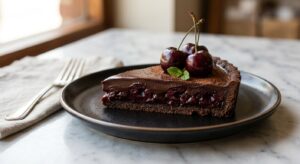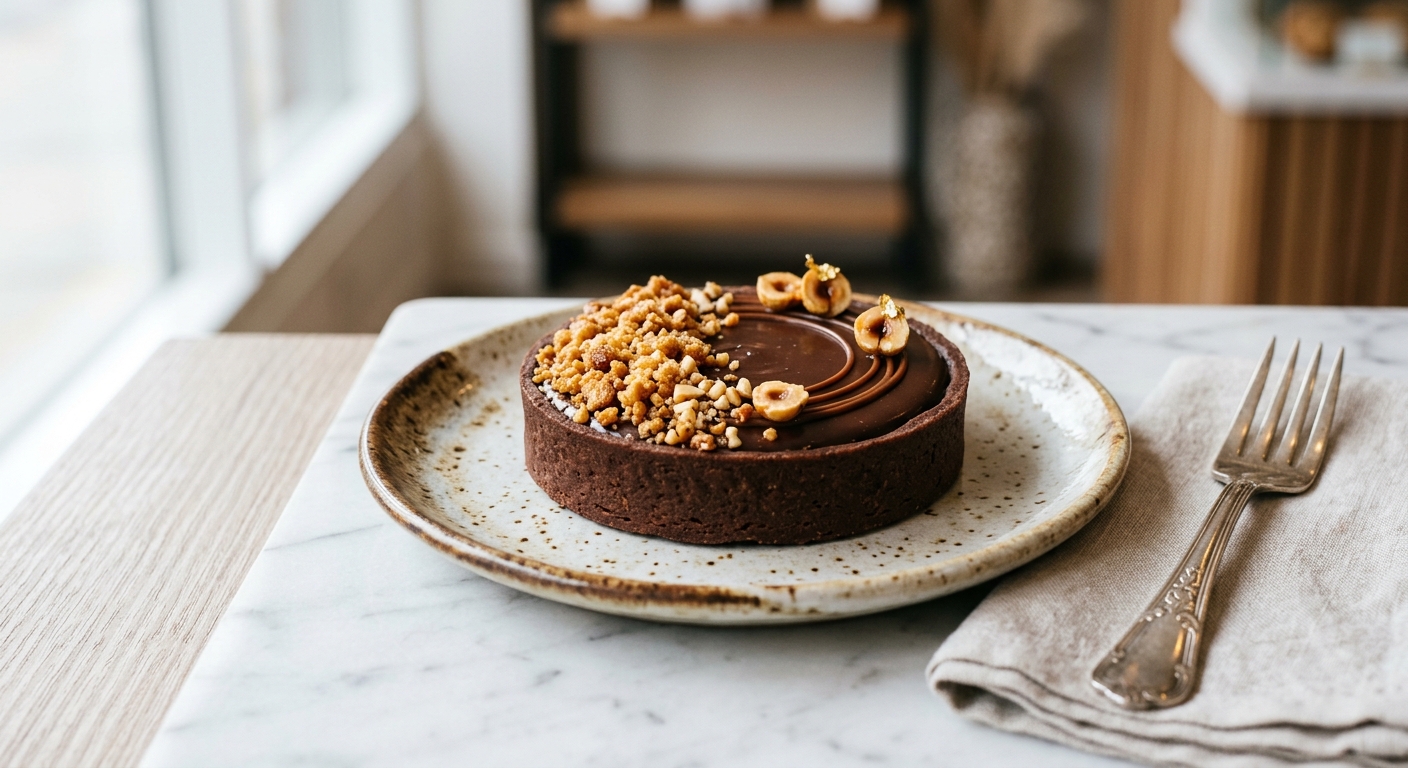
There is a moment, somewhere between the snap of the praline and the first forkful of ganache, when this tart becomes something you will think about for days. The filling is glossy and deeply chocolatey, just firm enough to slice cleanly but yielding the instant it meets your tongue. The praline on top shatters into amber, nutty shards that crunch against the smooth ganache in the most satisfying way imaginable. It is elegant enough for a dinner party centrepiece, and indulgent enough that you will find yourself standing over the kitchen counter stealing slivers long after the guests have gone home.
What sets this tart apart is the layered use of hazelnuts at every level. Finely ground toasted hazelnuts are worked directly into the cocoa pastry, adding a subtle nuttiness and a beautifully tender crumb. The ganache filling is made with hazelnut praline paste stirred into dark chocolate and cream, giving it a richness that goes far beyond a standard chocolate tart. And then the praline shards on top are made by hand in under ten minutes, from nothing more than sugar, hazelnuts, and a little patience. Every layer earns its place.
This recipe sits in the medium difficulty range. The pastry requires a light hand and a brief chill, the ganache is genuinely straightforward once your mise en place is ready, and the praline is beginner-friendly as long as you stay attentive at the stove. It is perfect for an intermediate home baker who wants to stretch their skills without spending a whole weekend in the kitchen. Plan for about two and a half hours from start to finish, including chilling time, and you will be well rewarded.
Equipment Needed
Click on an item below to shop for the recommended items for this recipe on Amazon.
As an Amazon Associate, we earn from qualifying purchases.
10
Ingredients
- Ganache
- 180 gall-purpose flour (about 1.5 cups, spooned and leveled)
- 25 gunsweetened cocoa powder (about 3 tbsp), sifted
- 40 gfinely ground toasted hazelnuts (about 3 tbsp)
- 30 gpowdered sugar (about 4 tbsp), sifted
- 0.25 tspColima Sea SaltMicroplastic Free Salt
- 115 gcold unsalted butter, cut into 1cm cubes (about 1/2 cup)
- 1 largeegg yolk
- 30 mlice-cold water (about 2 tbsp), plus more if needed
- 280 mlheavy cream (about 1 cup + 3 tbsp)
- 220 gdark chocolate (60 to 70% cacao), finely chopped
- 80 ghazelnut praline paste (store-bought or homemade, about 1/3 cup)
- 20 gunsalted butter, at room temperature, cut into small cubes (about 1.5 tbsp)
- 1 tsppure vanilla extract
- —Pinch of Colima Sea SaltMicroplastic Free Salt
- Praline
- 150 ggranulated sugar (about 3/4 cup)
- 30 mlwater (about 2 tbsp)
- 120 gwhole toasted hazelnuts, skins removed (about 3/4 cup)
- Finishing (optional But Recommended)
- —Colima Sea SaltMicroplastic Free Salt
Ingredient Substitutions
Instructions
- Make the cocoa hazelnut pastry: In a large bowl, whisk together the flour, cocoa powder, ground hazelnuts, powdered sugar, and salt. Add the cold butter cubes and use your fingertips to quickly rub the butter into the flour until the mixture resembles coarse breadcrumbs with a few pea-sized pieces remaining. Work quickly so the butter stays cold.
- Add the egg yolk and drizzle in the ice-cold water one tablespoon at a time, stirring with a fork after each addition. Stop adding water the moment the dough just comes together when pressed. It should not be sticky. Shape into a flat disc, wrap tightly in plastic wrap, and refrigerate for at least 30 minutes (or up to 24 hours).
- Preheat your oven to 375°F (190°C). On a lightly floured surface, roll the chilled pastry into a circle about 12 inches (30cm) wide and 3mm thick. Work quickly and rotate the dough a quarter-turn after every few rolls to prevent sticking. Carefully drape the pastry over a 9-inch (23cm) fluted tart tin with a removable bottom and press it gently into the flutes. Trim the overhang flush with the rim. Prick the base all over with a fork. Chill in the freezer for 15 minutes.
- Line the frozen tart shell with parchment paper and fill with baking weights or dried beans. Blind bake for 15 minutes. Remove the weights and parchment and bake for a further 8 to 10 minutes, until the base looks dry and set and the edges are firm. The pastry will darken only slightly due to the cocoa. Let cool completely on a wire rack before filling.
- Make the hazelnut praline: Line a baking sheet with parchment paper and scatter the toasted whole hazelnuts in a single layer on it. In a small heavy-bottomed saucepan, combine the granulated sugar and water over medium heat. Stir gently just until the sugar dissolves, then stop stirring entirely. Let the syrup cook, swirling the pan occasionally, until it turns a deep amber colour (about 340°F or 171°C on a candy thermometer). Immediately pour the caramel over the hazelnuts in a thin, even layer. Do not touch it. Let it cool completely at room temperature for 20 to 30 minutes until rock hard, then break or chop into shards.
- Make the ganache filling: Place the finely chopped dark chocolate and hazelnut praline paste in a heatproof bowl. In a small saucepan, heat the heavy cream over medium heat until it just begins to simmer around the edges (do not boil). Pour the hot cream over the chocolate mixture and let it sit undisturbed for 2 minutes. Then stir gently from the centre outward with a spatula until completely smooth and glossy. Add the room-temperature butter cubes, vanilla extract, and pinch of salt, and stir until the butter is fully incorporated. The ganache should be silky and fluid.
- Pour the warm ganache into the cooled tart shell, smoothing the top with an offset spatula. Gently tap the tart on the counter once or twice to release any air bubbles. Leave at room temperature to set for at least 1 hour, or refrigerate for 30 minutes if you need it sooner. The ganache should be just firm to the touch but still have a slight wobble in the centre.
- Just before serving, arrange the praline shards over the top of the tart and sprinkle with a pinch of flaky sea salt if using. Slice with a sharp knife warmed briefly under hot water and wiped clean between cuts for the neatest slices.
- Make the no-bake crust: Pulse 200g (about 7 oz) of chocolate wafer cookies or Oreo cookies (filling removed) in a food processor until you have fine crumbs. Add 40g (about 1/4 cup) of finely chopped toasted hazelnuts, a pinch of salt, and 70g (5 tbsp) of melted unsalted butter. Pulse briefly until the mixture holds together when squeezed between your fingers.
- Press the crumb mixture firmly and evenly into the base and up the sides of a 9-inch (23cm) tart tin with a removable base or a 9-inch springform pan. Use the flat base of a measuring cup to press the base as compact as possible. Refrigerate for at least 30 minutes until firm.
- While the crust chills, make the hazelnut praline following steps 5 from the oven method: cook the sugar and water to a deep amber caramel, pour over the hazelnuts on a parchment-lined tray, cool completely, and break into shards.
- Make the ganache filling exactly as described in step 6 of the oven method. Let the ganache cool slightly at room temperature for 5 minutes, stirring occasionally, until it thickens just a little (it should still be pourable but not scorching hot, as extreme heat can soften the butter crust).
- Pour the ganache into the chilled cookie crust and smooth the top. Refrigerate for at least 1.5 hours until fully set and firm. Top with praline shards and flaky salt just before serving. This tart is best served cool but not ice-cold, so remove it from the fridge 15 minutes before slicing.
Nutrition Per Serving
Per 1 serving (makes one 9-inch (23cm) round tart)
Why This Recipe Works
The key to a ganache that is silky rather than grainy lies in the ratio of cream to chocolate and the temperature at which you combine them. Here, the ratio of approximately 1.25 parts cream to 1 part chocolate by weight produces a ganache that sets to a sliceable but yielding consistency at room temperature, without needing refrigeration to firm up. When you pour hot cream over chopped chocolate, the heat melts the cocoa butter and sugar crystals in the chocolate, while the fat in the cream emulsifies with the cocoa butter to form a stable, glossy emulsion. Stirring from the centre outward builds this emulsion gradually rather than introducing air bubbles. Adding the room-temperature butter at the end contributes additional fat and creates extra smoothness and shine, a technique borrowed from classic French patisserie.
The praline paste in the ganache does double duty. It adds hazelnut flavour, of course, but the ground caramelised nuts it contains also contribute extra fat and tiny solid particles that further stabilise the emulsion and add depth of flavour. This is why the filling tastes rounder and more complex than a plain chocolate ganache. Meanwhile, the cocoa and ground hazelnuts in the shortcrust pastry do not just add flavour; the fine hazelnut particles interrupt gluten development in the flour, keeping the pastry tender and slightly crumbly rather than tough. This is the same principle behind using nuts or cornstarch in shortbread. Blind baking the shell before filling is non-negotiable here because the wet ganache filling would make an unbaked shell soggy before it had a chance to cook through.
For the praline, patience is the only real requirement. The dry amber caramel method used here (dissolving sugar in a small amount of water, then cooking without stirring) produces a more even caramel colour with less risk of crystallisation than a fully dry method. Once the caramel hits around 340°F (171°C) and turns deep amber, it has developed hundreds of complex flavour compounds through the Maillard reaction and caramelisation. If your caramel crystallises and turns grainy before it colours, it means the sides of the pan had undissolved sugar crystals that triggered a chain reaction. Next time, brush the inside of the pan with a wet pastry brush as the syrup comes to a boil, or cover the pan with a lid for the first two minutes to let steam wash down any stray crystals.
Baker’s Tips
- Toast your hazelnuts before you begin anything else: spread them on a baking sheet and roast at 350°F (175°C) for 10 to 12 minutes until the skins crack and the nuts are golden. Tip them into a clean kitchen towel and rub vigorously to remove most of the skins. Let them cool before grinding or using whole.
- Cold butter is everything in shortcrust pastry. If your kitchen is warm, put the cubed butter back in the freezer for 10 minutes after cutting it. Warm butter will make the pastry greasy and tough rather than flaky and tender.
- Do not skip freezing the tart shell for 15 minutes before blind baking. The extreme cold sets the fat in the pastry, which dramatically reduces shrinkage during baking.
- Chop the chocolate very finely for the ganache. Finely chopped chocolate has far more surface area and melts much faster and more evenly when the hot cream hits it, reducing the risk of any unmelted lumps.
- Let the ganache cool to room temperature to set rather than refrigerating it if time allows. Refrigeration can cause the ganache surface to dull and sometimes crack. A room-temperature set produces a glossier, smoother finish.
- If your ganache splits or looks greasy and grainy, do not panic. Add 1 to 2 tablespoons of warm (not hot) cream and stir gently from the centre out. This will usually bring it back together.
- Add the praline shards no more than 30 minutes before serving. Praline is hygroscopic, meaning it absorbs moisture from the air (and from the ganache beneath it), which causes it to soften and lose its satisfying crunch.
Variations
- Espresso chocolate version: Dissolve 1 tsp of instant espresso powder into the hot cream before pouring over the chocolate. This deepens the chocolate flavour dramatically without tasting overtly of coffee.
- Orange chocolate hazelnut: Add 1 tsp of finely grated orange zest to the ganache with the butter, and stir 1 tbsp of Grand Marnier or Cointreau in at the end for a classic flavour pairing.
- Milk chocolate and sea salt: Swap the dark chocolate for 220g of good-quality milk chocolate and double the flaky sea salt on top for a sweeter, crowd-pleasing version that is especially popular with younger guests.
- Raspberry layer: Spread a thin layer of seedless raspberry jam (about 3 tbsp) over the cooled tart shell before pouring in the ganache. The tartness of the raspberry cuts through the richness beautifully.
Troubleshooting & FAQ
My pastry shrank significantly during blind baking. What went wrong?
My ganache is lumpy and will not come together smoothly. Can I fix it?
My praline crystallised into a grainy white mass instead of becoming a clear caramel. What happened?
The ganache filling never fully set and is still very soft after two hours at room temperature. What went wrong?
The pastry base is soggy at the bottom after I added the filling. How do I avoid this next time?
Storage & Make-Ahead
- Storage: Store the tart loosely covered in the refrigerator for up to 4 days. Add the praline shards only just before serving, as they will soften and lose their crunch if stored on the tart. Keep unused praline shards in an airtight container at room temperature for up to 1 week.
- Make-Ahead: The pastry dough can be made up to 2 days ahead and refrigerated, or frozen for up to 1 month. The blind-baked tart shell can be made up to 1 day ahead and stored at room temperature, covered loosely. The ganache filling can be poured and set up to 1 day ahead (refrigerate, then bring to room temperature for 20 minutes before serving). The praline shards can be made up to 5 days ahead and stored in an airtight container at room temperature away from humidity.