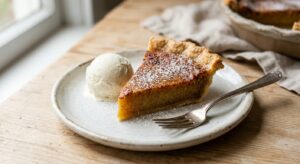
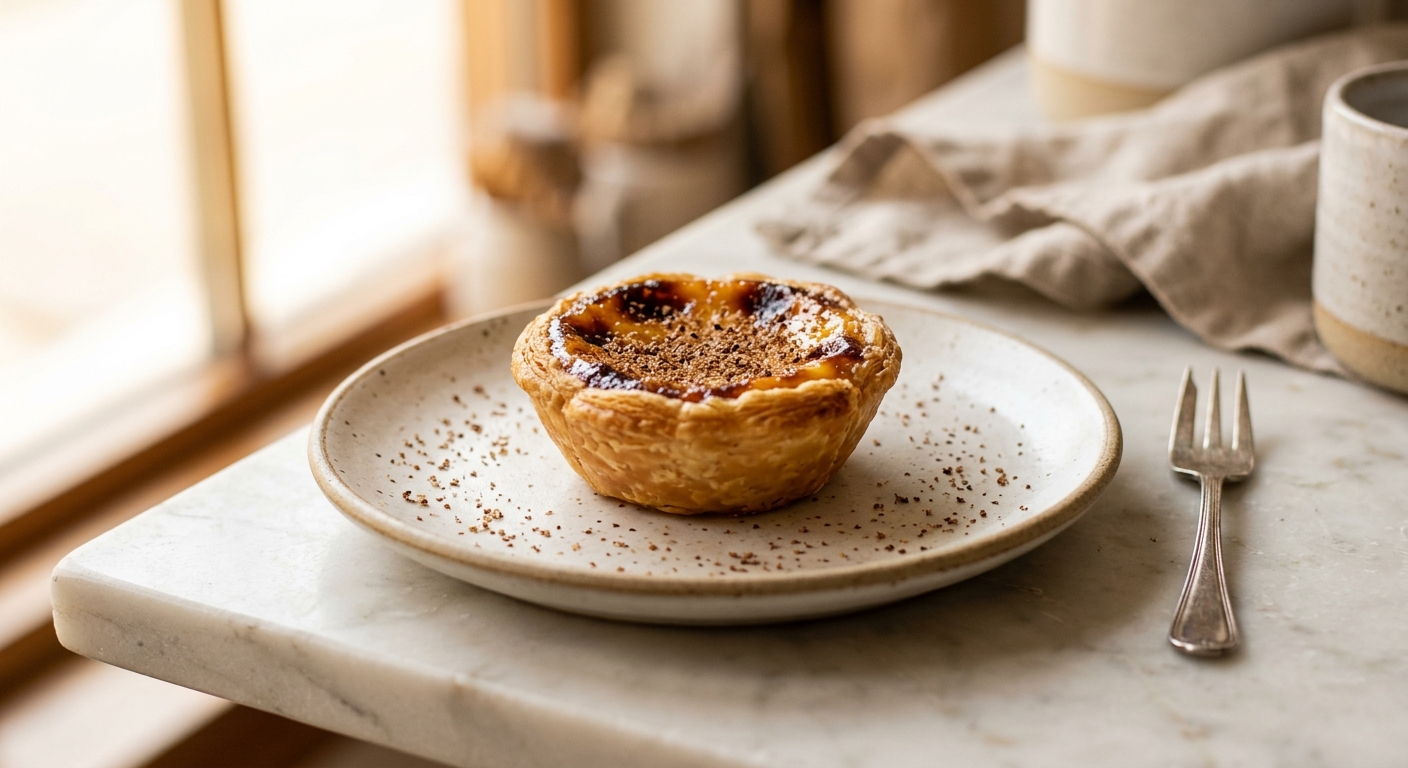
There is something deeply comforting about a well-made custard tart. The filling trembles just slightly when you move the plate, the pastry shatters cleanly at the edge of a fork, and that warm, fragrant cloud of nutmeg reaches you before the first bite even arrives. This is old-fashioned baking at its finest, the kind of recipe that feels like it has been sitting on a kitchen windowsill for generations, waiting patiently for you to come home.
What sets this version apart is the method for the custard itself. Rather than simply whisking eggs into warm cream and hoping for the best, we temper the egg yolks with a warm cream mixture, which gives you unmatched control over the final texture. We also blind-bake the pastry shell until it is genuinely golden and crisp before a single drop of filling goes in. That extra step is the difference between a tart with a soggy, underdone base and one with a proper, structured shell that holds its shape beautifully when sliced. Freshly grated whole nutmeg (not the pre-ground kind) provides a floral, aromatic depth that is simply irreplaceable here.
This recipe sits comfortably at a medium difficulty level. The pastry requires a little confidence and some chilling time, and the custard needs a watchful eye in the oven, but neither step is beyond a home baker who has made pastry or a baked egg dish before. It is ideal for a weekend bake, a dinner party dessert, or any afternoon when you want to make something genuinely beautiful from scratch.
Equipment Needed
Click on an item below to shop for the recommended items for this recipe on Amazon.
As an Amazon Associate, we earn from qualifying purchases.
8
Ingredients
- Topping (about 1/4 To 1/2 A Whole Nutmeg)
- 200 gall-purpose flour (about 1 cup + 5 tsp, spooned and leveled)
- 30 gpowdered sugar (about 3 tbsp), sifted
- 0.25 tspColima Sea SaltMicroplastic Free Salt
- 115 gunsalted butter (1/2 cup / 1 stick), cold and cut into 1 cm cubes
- 1 largeegg yolk, cold
- 2 tbspice-cold water, plus more if needed
- 480 mlheavy cream (2 cups / double cream)
- 120 mlwhole milk (1/2 cup)
- 5 largeegg yolks, at room temperature
- 80 gcaster sugar (about 1/3 cup + 1 tbsp)
- 1 tsppure vanilla extract
- —Freshly grated whole nutmeg
- Egg Wash
- —1 egg beaten with 1 tbsp milk
Ingredient Substitutions
Instructions
- Make the pastry: Combine the flour, powdered sugar, and salt in a large bowl or food processor. Add the cold butter cubes and rub in with your fingertips (or pulse in the processor) until the mixture resembles coarse, damp sand with a few pea-sized pieces of butter remaining. Add the egg yolk and ice-cold water, then mix or pulse just until the dough comes together. It should hold when pressed but not feel sticky. If it crumbles, add water one teaspoon at a time. Shape into a flat disc, wrap tightly in plastic wrap, and refrigerate for at least 45 minutes, or up to 2 days.
- Roll and line the tin: Lightly flour your work surface and roll the chilled pastry into a circle about 12 inches (30 cm) in diameter and 3 to 4 mm thick. Carefully drape it over a 9-inch (23 cm) fluted tart tin with a removable base. Press it gently into all the flutes, then roll your rolling pin across the top to trim the excess. Prick the base all over with a fork. Refrigerate the lined tin for 30 minutes – this prevents shrinkage during baking.
- Blind bake the shell: Preheat your oven to 375°F (190°C). Line the chilled pastry shell with parchment paper and fill generously with baking weights or dried beans. Bake for 15 minutes, then carefully lift out the parchment and weights. Brush the base and sides with egg wash and return to the oven for 8 to 10 more minutes, until the pastry is uniformly golden and there are no pale, doughy patches. Remove and let cool slightly. Reduce the oven temperature to 300°F (150°C).
- Make the custard: Combine the heavy cream and whole milk in a medium saucepan over medium heat. Warm until steaming and just beginning to show a few small bubbles at the edges – do not boil. Meanwhile, whisk together the egg yolks, caster sugar, and vanilla extract in a large bowl until slightly pale and well combined, about 90 seconds. Very slowly pour the warm cream mixture into the egg mixture in a thin, steady stream, whisking constantly as you go. This is tempering – it raises the eggs’ temperature gradually so they do not scramble. Skim off any surface foam with a spoon.
- Fill and bake: Place the tart tin on a baking sheet. Pour the warm custard mixture through a fine-mesh sieve directly into the cooled pastry shell, filling it to about 5 mm below the rim. Open the oven, slide the baking sheet in, then carefully pour in any remaining custard (doing this in the oven avoids spills). Grate a generous layer of fresh nutmeg evenly over the surface. Bake at 300°F (150°C) for 30 to 35 minutes, until the edges are set but the centre 3 inches still have a gentle, jelly-like wobble when you nudge the tray. The custard will continue to set as it cools.
- Cool and serve: Remove the tart from the oven and leave it on the baking sheet to cool at room temperature for at least 1 hour before attempting to remove it from the tin. The custard needs this time to fully set. Once cooled, carefully push up the removable base. Slice with a sharp knife and serve at room temperature or lightly chilled.
- Make the biscuit shell: Preheat your oven to 350°F (175°C). Crush 200g (7 oz / about 14 full sheets) of digestive biscuits or graham crackers into fine crumbs in a food processor or zip-lock bag. Mix the crumbs with 80g (1/3 cup) melted unsalted butter and 20g (1.5 tbsp) caster sugar until the mixture resembles wet sand. Press firmly and evenly into the base and up the sides of a 9-inch (23 cm) tart tin or springform pan using the back of a spoon or a flat-bottomed glass. Bake for 12 minutes until lightly golden and fragrant. Allow to cool completely.
- Prepare a cornstarch-stabilised custard: Whisk together the 5 egg yolks, 80g caster sugar, 1 tsp vanilla extract, and 2 tbsp (16g) cornstarch in a medium bowl until smooth and pale. In a saucepan, warm the 480ml heavy cream and 120ml whole milk over medium heat until steaming.
- Cook the custard: Temper the eggs by pouring the warm cream mixture into the egg mixture in a thin, steady stream, whisking continuously. Pour everything back into the saucepan through a fine-mesh sieve. Cook over medium-low heat, stirring constantly with a heatproof spatula and scraping the base of the pan, for 8 to 10 minutes until the custard thickens noticeably and coats the back of a spoon. Do not let it boil. Remove from the heat immediately.
- Fill and set: Pour the warm custard through a sieve into the cooled biscuit shell, smoothing the top with a spatula. Grate a generous layer of fresh nutmeg evenly over the surface. Allow to cool at room temperature for 20 minutes, then cover loosely with plastic wrap (lay it directly on the surface to prevent a skin forming) and refrigerate for a minimum of 3 hours, or overnight, until fully set.
- Serve: Remove from the refrigerator 15 to 20 minutes before serving to take the chill off. Slice carefully with a warm, dry knife. This version is best served cold or at a cool room temperature.
Nutrition Per Serving
Per 1 serving (makes one 9-inch single-layer tart)
Why This Recipe Works
The key to a silky, smooth custard without any eggy graininess is gentle, controlled heat, and this recipe uses two techniques to achieve it. First, tempering: by pouring the warm cream mixture slowly into the egg yolks while whisking, you gradually raise the temperature of the eggs without cooking them. This prevents the proteins from seizing up and curdling before the custard is even in the oven. Second, the low bake temperature of 300°F (150°C) keeps the oven environment calm enough that the egg proteins set slowly and evenly throughout the filling rather than tightening abruptly. Egg proteins begin to coagulate around 160 to 180°F (70 to 82°C), and an oven that is too hot can push the edges past that point while the centre is still liquid, resulting in a curdled, weepy texture. Low and slow is your greatest ally here.
The ratio of cream to milk matters too. Using mostly cream gives you a rich, glossy, barely-set custard with real body, while the addition of some whole milk loosens the richness just enough to keep the filling from being cloying. A custard made entirely with cream would be almost too dense, while one made entirely with milk would be thinner and less stable. The caster sugar not only sweetens but also slightly raises the temperature at which the proteins set, giving you a small buffer of forgiveness. Straining the custard through a fine-mesh sieve before pouring removes any chalazae or scrambled egg fragments, guaranteeing a flawlessly smooth surface and texture.
For the pastry, using powdered sugar rather than granulated produces a finer, more tender crumb, often called pate sucree. The fat in the butter coats the flour proteins before they can link up and develop too much gluten, which is why cold butter and minimal mixing are so important. Overworked pastry becomes tough and shrinks dramatically in the oven. Chilling the dough twice, once after mixing and again after lining the tin, relaxes whatever gluten did develop and firms the butter back up, so the shell holds its shape and does not slump down the sides during blind baking.
Baker’s Tips
- Use a whole nutmeg and a fine Microplane grater for topping. The difference in flavour between freshly grated and pre-ground nutmeg is dramatic: freshly grated is warm, floral, and complex, while pre-ground is dusty and flat.
- Do not skip the second chill after lining the tin. It is the single most effective way to prevent pastry shrinkage.
- The wobble test is your most reliable doneness cue. The custard should look set at the edges with a distinct jelly-like jiggle in the centre 3 inches. If the whole surface ripples like water, it needs more time. If there is no wobble at all, it may be slightly overbaked.
- Place the tart tin on a preheated baking sheet before adding the custard. The residual heat from below helps the base of the custard set evenly and reduces the risk of a soggy bottom.
- If small cracks appear on the custard surface, the oven was likely slightly too hot or the tart baked a touch too long. The flavour will still be excellent. Next time, reduce the temperature by 10°F (5°C).
- For the cleanest slices, run your knife under hot water, wipe it dry, and then cut. Repeat between slices.
Variations
- Portuguese-style: Use the same custard recipe but bake in individual pre-made puff pastry shells at a higher temperature, 425°F (220°C), for 15 to 18 minutes until the custard is deeply spotted and caramelised on top.
- Lemon curd layered: Spread 2 to 3 tbsp of good-quality lemon curd on the base of the blind-baked shell before pouring in the custard. The lemon and nutmeg combination is quietly spectacular.
- Bay leaf infusion: Add 2 fresh bay leaves to the cream and milk while warming. Remove before tempering. The bay adds a subtle floral, slightly herbal depth that is very traditional in some regional British and Portuguese recipes.
Troubleshooting & FAQ
My custard is grainy or curdled inside, not smooth. What went wrong?
There is liquid pooling on top of or beneath my custard. What caused that?
My pastry shrank down the sides of the tin and is much thinner than it should be. How do I prevent this?
The base of my tart is soggy even though I blind baked it. Why?
The custard puffed up in the oven and then sank and cracked as it cooled. Is it ruined?
Storage & Make-Ahead
- Storage: Store the tart loosely covered in the refrigerator for up to 3 days. Bring to room temperature for 20 minutes before serving for the best flavour and texture. The baked tart does not freeze well, as the custard becomes watery when thawed.
- Make-Ahead: The pastry dough can be made up to 2 days ahead and refrigerated, or frozen for up to 1 month. The blind-baked pastry shell can be prepared up to 1 day ahead and stored at room temperature, covered loosely. The fully assembled tart is best made the day before serving, as the custard firms up beautifully overnight in the refrigerator.