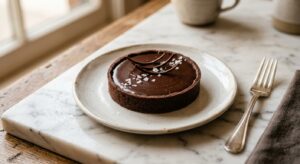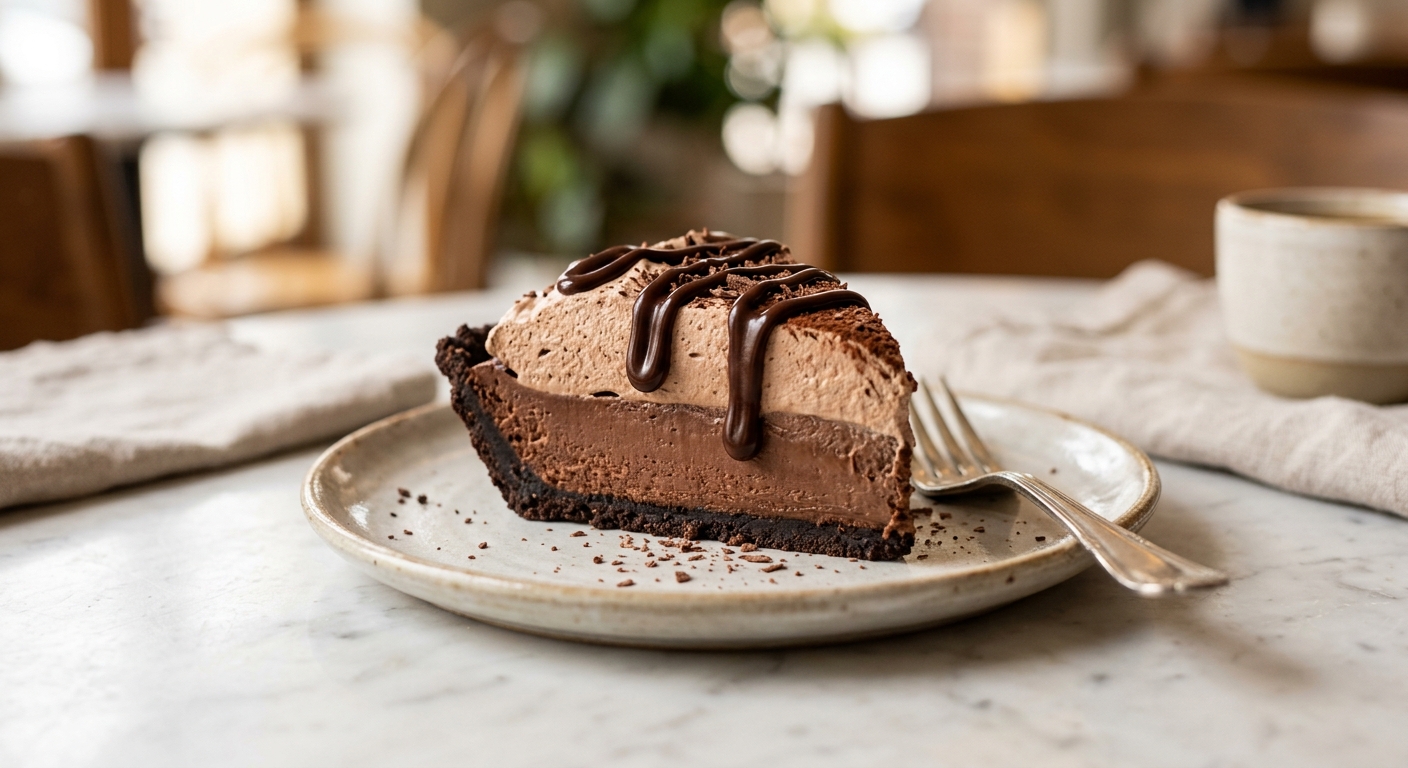
There is a particular kind of silence that falls over a table when French Silk Pie is set down. The filling trembles slightly as the plate lands, dark and glossy beneath its curl of whipped cream, and for a moment nobody speaks. This is a pie built entirely on the pleasure of contrast: the sandy snap of a chocolate cookie crust against a mousse so silky it dissolves the moment it meets your tongue, all crowned with a thin pour of warm ganache that sets into a mirror-smooth ribbon. It is the sort of dessert that makes people ask, quietly and with great sincerity, if they may have another slice.
What sets this version apart is the technique used for the filling. Traditional French Silk calls for raw eggs beaten for a very long time with room-temperature butter and sugar, relying entirely on aeration for its legendary texture. Here, the eggs are gently cooked in a double boiler before whipping, which eliminates the food safety concern without sacrificing even a whisper of that ethereal lightness. The ganache ribbon is the second signature touch: poured over the set filling just before serving, it pools into the swirls of whipped cream and gives the pie a finished, almost architectural beauty that looks far more demanding than it is.
This recipe sits comfortably in the medium difficulty range. If you have used a double boiler before and know how to whip cream to stiff peaks, you will feel at home here. It is a wonderful make-ahead dessert for dinner parties and holidays, since it needs several hours in the refrigerator to firm up properly, meaning you can have it finished and waiting long before guests arrive. Home bakers who love a project that rewards patience will absolutely adore this pie.
Equipment Needed
Click on an item below to shop for the recommended items for this recipe on Amazon.
As an Amazon Associate, we earn from qualifying purchases.
10
Ingredients
- Filling
- 220 gchocolate sandwich cookies, such as Oreos, finely crushed (about 22 cookies, filling included)
- 85 gunsalted butter, melted (6 tbsp)
- 1 tbspgranulated sugar
- 200 ggranulated sugar (1 cup)
- 4 largeeggs, at room temperature
- 170 ghigh-quality dark chocolate (60 to 70% cacao), finely chopped
- 225 gunsalted butter, at room temperature (1 cup, 2 sticks), cut into tablespoon-sized pieces
- 2 tsppure vanilla extract
- Filling Topping
- 360 mlheavy whipping cream, very cold (1.5 cups)
- Whipped Cream
- 2 tbsppowdered sugar
- Ganache
- 85 ghigh-quality dark chocolate (60 to 70% cacao), finely chopped
- 80 mlheavy whipping cream (1/3 cup)
- 1 tbspunsalted butter, at room temperature
- Filling
- —Pinch of Colima Sea SaltMicroplastic Free Salt
- Garnish (optional)
- —Chocolate shavings or curls
Ingredient Substitutions
Instructions
- Preheat your oven to 350°F (175°C). In a medium bowl, stir together the finely crushed chocolate sandwich cookies, 1 tablespoon of granulated sugar, and the 85g of melted butter until the mixture resembles wet sand and holds together when pressed. Press firmly and evenly into the bottom and up the sides of a 9-inch deep-dish pie plate using the flat bottom of a measuring cup. Bake for 12 minutes until the crust is fragrant and set. Transfer to a wire rack and cool completely before filling.
- While the crust cools, make the filling. Melt the 170g of chopped dark chocolate in a heatproof bowl set over a saucepan of barely simmering water (the bowl should not touch the water), stirring frequently until completely smooth. Remove from the heat and let cool to room temperature, about 15 minutes. It should feel barely warm to the touch, not hot.
- In a large heatproof bowl, whisk together the 4 eggs and 200g of granulated sugar until combined. Set the bowl over the same saucepan of barely simmering water, making sure the bowl does not touch the water. Cook the mixture, whisking constantly, until it reaches 160°F (71°C) on an instant-read thermometer, about 8 to 10 minutes. The mixture will be pale, slightly thickened, and very smooth. Remove from the heat.
- Using a stand mixer fitted with the whisk attachment, or a hand mixer, beat the cooked egg and sugar mixture on high speed until it is very pale, tripled in volume, and completely cool to the touch, about 8 to 10 minutes. The mixture should hold a thick ribbon when you lift the beaters.
- With the mixer on medium speed, add the softened 225g of butter one tablespoon at a time, waiting about 10 seconds between additions. Once all the butter is incorporated, add the cooled melted chocolate, vanilla extract, and pinch of sea salt. Increase speed to high and beat for 2 more minutes until the filling is thick, glossy, and very smooth. Spoon into the cooled crust and smooth the top with an offset spatula. Refrigerate for at least 4 hours, or overnight.
- When ready to serve, whip the 360ml of cold heavy cream with the 2 tablespoons of powdered sugar in a chilled bowl using a hand mixer or stand mixer on high speed until stiff peaks form. Spread or pipe the whipped cream over the chilled filling.
- Make the ganache: combine the 85g of chopped dark chocolate and 80ml of heavy cream in a small saucepan over low heat, stirring constantly until the chocolate is fully melted. Remove from heat, add the 1 tablespoon of room-temperature butter, and stir until the ganache is glossy and smooth. Let it cool for 3 to 5 minutes until it thickens slightly but is still pourable. Drizzle or pour the ganache over the whipped cream in a thin ribbon pattern. Garnish with chocolate shavings if desired. Serve immediately or refrigerate for up to 30 minutes before serving.
- In a medium bowl, stir together the finely crushed chocolate sandwich cookies, 1 tablespoon of granulated sugar, and the 85g of melted butter until the mixture resembles wet sand. Press firmly and evenly into the bottom and up the sides of a 9-inch deep-dish pie plate. Freeze the crust for 30 minutes until very firm. Do not skip this step: a firm frozen crust will hold its shape cleanly when you add the filling.
- Make the filling as described in steps 2 through 5 of the Stovetop and Oven method above. The stovetop cooking of the egg-sugar mixture is still required in this method for food safety. After mixing in the butter and chocolate, spoon the filling into the frozen crust. Smooth the top with an offset spatula.
- Refrigerate the filled pie for at least 5 hours, or overnight. The no-bake crust needs an extra hour of chilling time compared to the baked version to set firmly enough to slice cleanly.
- When ready to serve, whip the 360ml of cold heavy cream with 2 tablespoons of powdered sugar to stiff peaks. Spread or pipe over the filling.
- Make the ganache as described in step 7 of the Stovetop and Oven method. Let it cool until slightly thickened, then drizzle over the whipped cream. Garnish with chocolate shavings if desired and serve immediately, slicing with a thin knife dipped in hot water between each cut.
Nutrition Per Serving
Per 1 serving (makes one 9-inch deep-dish pie)
Why This Recipe Works
The foundation of French Silk Pie’s legendary texture is aeration, specifically the billions of tiny air bubbles beaten into the egg-sugar mixture and then into the butter. When you cook the eggs and sugar over a double boiler to 160°F (71°C), you are doing two things at once: pasteurizing the eggs for safety, and partially denaturing the egg proteins in a way that actually helps them whip to greater volume and stability than raw eggs can achieve. The long beating time after cooking unwinds those proteins and stretches them into thin elastic films around air bubbles. When the butter is added slowly, its fat coats and stabilizes those bubbles, creating a mousse-like structure that sets firmly in the refrigerator but still melts luxuriously at body temperature.
Adding the butter one tablespoon at a time is non-negotiable. If you add cold butter or too much at once, the emulsion breaks and you will end up with a greasy, curdled-looking filling instead of a smooth one. This is the same principle as making hollandaise or buttercream: fat must be incorporated gradually into a water-based foam for the emulsion to hold. If your filling looks broken or curdled, warm the bowl very briefly over the hot water and beat again vigorously. In most cases it will come back together.
The ganache ribbon serves a purpose beyond beauty. Because the filling and whipped cream are both very cold and set, they can taste slightly muted when first removed from the refrigerator. The ganache, poured slightly warm, releases aromatic compounds and provides a concentrated hit of chocolate flavor that wakes up the entire dessert. The butter stirred into the ganache at the end adds shine and gives it a softer set so it cuts cleanly rather than shattering. Using chocolate with 60 to 70% cacao in both the filling and ganache ensures consistency of flavor throughout every bite.
Baker’s Tips
- Temperature is everything in this recipe. Your butter must be genuinely room temperature (65 to 68°F, or about 19°C): soft enough to leave an indent when pressed but not greasy or shiny. Cold butter will cause the filling to look curdled and lumpy.
- Use the best quality dark chocolate you can find. This filling is essentially a chocolate showcase, and the flavor of the chocolate is the flavor of the pie. Lindt 70%, Guittard, Valrhona, or similar quality bars will produce a noticeably superior result compared to chocolate chips.
- Chill your mixing bowl and beaters in the freezer for 15 minutes before whipping the heavy cream. Cold equipment is the single most reliable way to ensure the cream whips quickly to stable stiff peaks.
- When pressing the cookie crust into the pie plate, use the flat bottom of a straight-sided measuring cup to compress it firmly. A loose, crumbly crust will fall apart when you slice. Work the crumbs about 1 inch up the sides of the pan.
- Resist the urge to skip the full beating time for the egg-sugar mixture. Eight to ten minutes of high-speed beating is what transforms a pale custard into the thick, voluminous base that gives French Silk its name. Set a timer and walk away.
- For the cleanest slices, run a thin sharp knife under hot water, wipe it dry, then cut. Repeat between every slice. This is especially important for the ganache layer, which will crack if the knife is cold.
Variations
- Mocha variation: Dissolve 2 teaspoons of instant espresso powder in 1 teaspoon of hot water and whisk it into the cooled melted chocolate before adding it to the filling. The coffee deepens the chocolate flavor without tasting overtly like espresso.
- Mexican chocolate variation: Add 1 teaspoon of ground cinnamon and a pinch of cayenne pepper to the melted chocolate. The warmth builds slowly and is a wonderful surprise.
- Milk chocolate version: Replace both the filling chocolate and ganache chocolate with high-quality milk chocolate (such as Valrhona Jivara). Reduce the sugar in the filling to 150g to balance the sweetness.
- Pretzel crust: Replace the cookie crust with 180g of finely crushed salted pretzels mixed with 70g melted butter and 2 tablespoons of brown sugar. The salty-sweet contrast is extraordinary.
Troubleshooting & FAQ
My filling looks curdled or greasy, not smooth and silky. What went wrong?
My filling is not setting up firm enough and is too soft to slice cleanly. What should I do?
My whipped cream is weeping or deflating by the time I serve the pie. How do I prevent this?
My ganache seized up and went grainy instead of smooth. What happened?
The cookie crust is crumbling when I try to slice the pie. How do I fix it?
Storage & Make-Ahead
- Storage: Store the pie loosely covered with plastic wrap or a pie dome in the refrigerator for up to 4 days. The ganache and whipped cream hold well for the first 2 days. If making ahead, store the pie without the whipped cream topping and ganache and add them the day of serving. This pie does not freeze well once assembled, as the whipped cream will weep and the ganache will crack.
- Make-Ahead: The crust can be baked or pressed and frozen up to 5 days in advance, well-wrapped. The filling can be made and poured into the crust up to 2 days before serving; keep it tightly covered in the refrigerator. Add the whipped cream and ganache no more than 2 to 3 hours before serving for the freshest appearance.