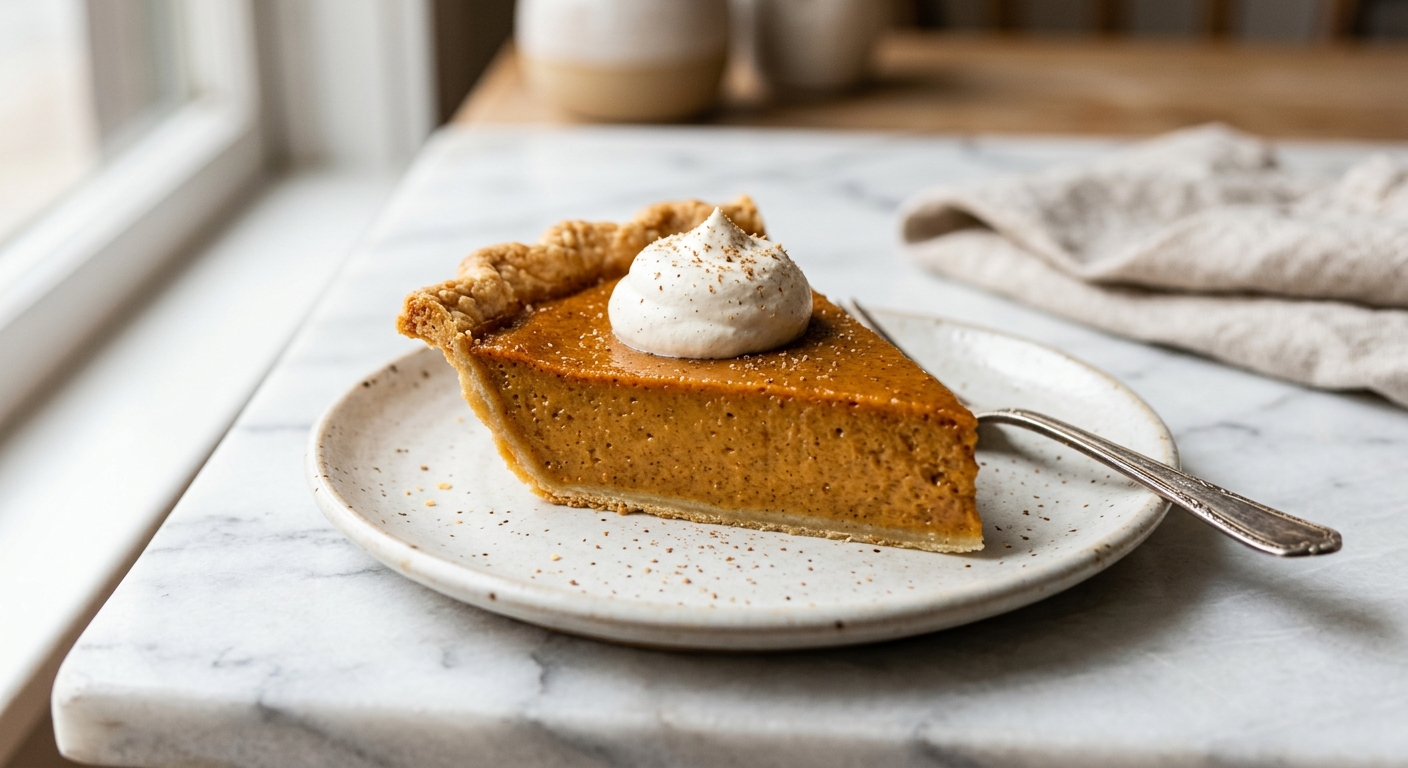
There is a moment, somewhere between October and the first real cold snap, when the craving for pumpkin pie stops being nostalgic and becomes urgent. You want something that smells like nutmeg and cloves and browning butter, something that wobbles just slightly when you pull it from the oven and sets into a silky, spoonable custard by the time dessert comes around. This pie is that moment made edible. The filling is copper-colored, deeply fragrant, and just sweet enough to feel like a treat without tipping into cloying territory.
What sets this version apart is the swap from granulated white sugar to packed dark brown sugar throughout the entire filling. Brown sugar contains molasses, and molasses does something remarkable in a custard: it adds a faint bitterness that keeps the sweetness honest, a subtle caramel depth that white sugar simply cannot replicate, and a hint of warmth that makes the spices sing louder. Combined with a generous hand with cinnamon, ginger, nutmeg, and a whisper of cloves and black pepper, this filling has genuine complexity. The other technique worth noting is tempering the eggs gently into warm pumpkin puree rather than simply whisking everything cold, which helps the custard set smoothly and evenly without any curdled edges.
This pie sits comfortably in the medium difficulty range. The crust requires a light touch and a little patience with chilling, but the filling itself comes together in one bowl in under ten minutes. It is perfect for confident beginner bakers ready to tackle their first homemade crust, and equally satisfying for experienced bakers who want a version of pumpkin pie they can genuinely be proud of. Make it for Thanksgiving, for a Sunday dinner in autumn, or simply because it is that time of year.
Equipment Needed
Click on an item below to shop for the recommended items for this recipe on Amazon.
As an Amazon Associate, we earn from qualifying purchases.
8
Ingredients
- Crust
- 190 gall-purpose flour (about 1.5 cups, spooned and leveled)
- 1 tspgranulated sugar
- 0.5 tspColima Sea SaltMicroplastic Free Salt
- 115 gunsalted butter, very cold and cut into 1cm cubes (1 stick / 8 tbsp)
- 60 mlice water, plus more as needed (about 4 tbsp)
- 425 gpure pumpkin puree (one 15 oz can), not pumpkin pie mix
- 200 gpacked dark brown sugar (about 1 cup firmly packed)
- 2 tspground cinnamon
- 1 tspground ginger
- 0.5 tspfreshly grated nutmeg (or 0.5 tsp ground nutmeg)
- 0.25 tspground cloves
- 0.25 tspfreshly ground black pepper
- Filling
- 0.5 tspColima Sea SaltMicroplastic Free Salt
- 3 largeeggs, at room temperature
- 240 mlheavy cream (1 cup)
- 60 mlwhole milk (4 tbsp)
- 1 tsppure vanilla extract
- —Lightly sweetened whipped cream, to serve
Ingredient Substitutions
Instructions
- Make the crust: Whisk together the flour, granulated sugar, and salt in a large bowl. Add the cold butter cubes. Using your fingertips or a pastry cutter, work the butter into the flour until the mixture resembles coarse crumbs with some pea-sized pieces of butter still visible. Those butter pieces are what create flaky layers, so do not overwork it.
- Drizzle in 3 tablespoons of the ice water. Toss gently with a fork until the dough just begins to come together. Add the remaining tablespoon of water only if needed. The dough should hold when you press a small handful together but should not feel wet or sticky. Flatten into a disc, wrap tightly in plastic wrap, and refrigerate for at least 1 hour or up to 2 days.
- On a lightly floured surface, roll the chilled dough into a 12-inch circle about 3mm thick. Carefully transfer it to a 9-inch deep-dish pie pan. Gently press it into the bottom and up the sides without stretching. Trim any overhang to about 1 inch, fold the excess under itself, and crimp the edge as desired. Refrigerate the unbaked crust for 20 minutes while you preheat the oven.
- Preheat your oven to 425°F (220°C). Line the chilled crust with parchment paper and fill it with pie weights or dried beans. Blind bake for 15 minutes, then remove the weights and parchment and bake for another 5 minutes until the bottom looks dry and just beginning to turn pale gold. Remove from the oven and reduce the temperature to 350°F (175°C). If any cracks appear, press them closed gently with your fingers.
- Make the filling: Warm the pumpkin puree in a medium saucepan over medium-low heat, stirring frequently, for 3 to 4 minutes until it steams slightly and darkens a shade. This cooks off excess moisture and concentrates the flavor. Remove from heat and stir in the brown sugar, cinnamon, ginger, nutmeg, cloves, black pepper, and salt until fully combined.
- Whisk the eggs lightly in a separate bowl, then slowly stir them into the warm pumpkin mixture. Whisking eggs into a warm base rather than a cold one tempers them gently, giving you a smoother custard. Stir in the heavy cream, whole milk, and vanilla extract until the filling is completely smooth.
- Pour the filling into the par-baked crust. If any bubbles appear on the surface, drag a toothpick across them to pop them. Bake at 350°F (175°C) for 40 to 45 minutes. The pie is done when the edges are fully set and the center has a slight jiggle, about a 2-inch wobbly circle in the middle. It will continue to set as it cools.
- Transfer to a wire rack and let the pie cool completely at room temperature for at least 2 hours before slicing. Cutting into a warm pumpkin pie will give you a soupy filling. Refrigerate if not serving within 2 hours. Serve with generously whipped cream.
- Prepare or purchase a fully baked 9-inch pie crust or a graham cracker crust. If making your own, fully blind bake the pastry crust at 375°F (190°C) for 20 to 25 minutes until deep golden, then let it cool completely before filling.
- In a medium heavy-bottomed saucepan, whisk together the pumpkin puree, brown sugar, cinnamon, ginger, nutmeg, cloves, black pepper, salt, and 30g (3 tbsp) cornstarch until smooth. Whisk in 4 egg yolks (rather than 3 whole eggs) and the whole milk. Stir in the heavy cream.
- Cook the mixture over medium heat, whisking constantly and making sure to reach the corners of the pan, for 8 to 10 minutes until the custard visibly thickens, begins to bubble gently, and coats the back of a spoon. Once you see the first bubbles, cook for exactly 2 more minutes to cook out the cornstarch. Remove from heat immediately.
- Stir in the vanilla extract. For an exceptionally smooth filling, strain the custard through a fine-mesh sieve into a clean bowl or directly into the cooled crust. Press a sheet of plastic wrap directly onto the surface of the filling to prevent a skin from forming.
- Refrigerate for a minimum of 4 hours, or ideally overnight, until fully set and cold. Slice with a clean knife wiped between cuts. Serve topped with lightly sweetened whipped cream and a dusting of cinnamon.
- Prepare the pie dough and crust as described in the oven method steps 1 through 3, but press it into a 7-inch or 8-inch pie pan that fits your air fryer. Crimp the edges and refrigerate for 20 minutes. Skip blind baking as described below.
- Prepare the filling exactly as in oven method steps 5 and 6. Set aside.
- Preheat your air fryer to 375°F (190°C). Line the chilled crust with a small piece of parchment and a handful of pie weights or dried beans. Air fry for 8 minutes. Remove weights and parchment and air fry for 3 more minutes until the bottom looks dry. Reduce air fryer temperature to 310°F (155°C).
- Pour the filling into the par-baked crust, filling it no more than three-quarters full to prevent overflow from the fan. Tent a small piece of foil loosely over the pie (do not seal it tightly) to protect the crust edges from over-browning in the concentrated heat.
- Air fry at 310°F (155°C) for 35 to 40 minutes, checking at the 30-minute mark. The filling is done when the edges are set and the center still has a slight wobble. Remove foil for the last 5 minutes if you want a slightly drier surface. Cool on a wire rack for at least 1 hour 30 minutes before slicing.
Nutrition Per Serving
Per 1 serving (makes one 9-inch deep-dish pie)
Why This Recipe Works
Pumpkin pie is, at its heart, a baked custard, which means the entire filling is held together by the proteins in eggs coagulating gently in the oven’s heat. Getting this right means not overbaking: the proteins tighten too much if the oven runs too hot or the pie bakes too long, resulting in a cracked, curdled, or weeping filling. This is why the oven temperature drops from 425°F to 350°F partway through, and why the center should still jiggle when you pull it out. Carryover cooking inside the hot filling will finish the job on the cooling rack.
Dark brown sugar contains roughly 6 to 10 percent molasses by weight, and molasses is chemically rich: it contains organic acids, minerals, and long-chain sugars that give it that characteristic bittersweet, almost toffee-like depth. In a custard filling, these compounds interact with the eggs and cream during baking, producing subtle Maillard browning products that deepen both the color and the flavor far beyond what white sugar can achieve. This is also why warming the pumpkin puree before adding it to the other filling ingredients matters: it drives off excess moisture from the canned puree and concentrates the pumpkin flavor, giving you a more intense, less watery filling.
The brief blind bake of the crust before adding the filling is non-negotiable for a crisp bottom. Wet pumpkin custard poured directly onto raw pastry will steam the dough from the inside and leave you with the dreaded soggy bottom. Blind baking sets the fat and starch structure of the crust before liquid ever touches it. If you find the crust edges browning too quickly during the final bake, shield them loosely with strips of foil or a purpose-made pie shield, which redirects heat away from the thinner, more exposed edge.
Baker’s Tips
- Keep your butter genuinely cold. If it starts to soften while you are making the dough, pop the whole bowl in the freezer for 5 minutes before continuing.
- Do not skip chilling the shaped crust before blind baking. Cold fat in the crust holds its shape and shrinks less during baking.
- Warming the pumpkin puree before building the filling is a small step with a big payoff. It concentrates the flavor and takes only 4 minutes.
- Use a deep-dish 9-inch pie pan. A standard shallow pan will leave you with leftover filling, and overfilling a shallow pan can cause the custard to crack or spill.
- Strain the finished filling through a fine-mesh sieve for the silkiest possible texture. This is optional but worth the extra 2 minutes.
- Let the pie cool completely before slicing. Two full hours at room temperature is the minimum. Overnight in the refrigerator is better, and it genuinely tastes better the next day once the spices have had time to bloom and meld.
- For clean slices, run your knife under hot water and wipe it dry between cuts.
Variations
- Maple and bourbon version: Replace 50g of the brown sugar with 60ml (4 tbsp) pure maple syrup and add 2 tablespoons of good-quality bourbon to the filling. Reduce heavy cream by 2 tablespoons to compensate for the added liquid.
- Chai-spiced version: Replace the individual spices with 2 tablespoons of strong-brewed chai tea concentrate added to the filling, plus 1.5 teaspoons cinnamon, 0.5 teaspoon cardamom, and a pinch of white pepper.
- Chocolate swirl version: Melt 60g dark chocolate with 1 tablespoon of cream. Pour the pumpkin filling into the shell, then drop spoonfuls of the chocolate on top and drag a skewer or toothpick through to create a swirl. Bake as directed.
- Gingersnap crust variation: Replace the pastry crust with a pressed gingersnap crust: blitz 200g gingersnap cookies into crumbs, mix with 75g melted butter and 1 tablespoon brown sugar, press firmly into the pie pan, and bake at 350°F (175°C) for 10 minutes before filling.
Troubleshooting & FAQ
My pie filling cracked on top. What went wrong?
The filling is jiggly and did not set even after cooling for 2 hours. Is it ruined?
My pie crust shrank and slid down the pan during blind baking. How do I prevent that?
There is liquid pooling on the surface of the cooled pie. What is that?
The bottom of my crust is soggy even after blind baking. What can I do?
Storage & Make-Ahead
- Storage: Cover loosely with plastic wrap or foil and refrigerate for up to 4 days. Pumpkin pie contains eggs and dairy and should not be left at room temperature for more than 2 hours. The crust will soften slightly after day one, which is normal.
- Make-Ahead: The pie dough can be made up to 2 days ahead and refrigerated, or frozen for up to 1 month. Thaw overnight in the refrigerator before rolling. The fully baked and cooled pie can be refrigerated overnight before serving, making it ideal for Thanksgiving prep. For best results, bake the day before and let it chill overnight. The filling can be made and refrigerated separately (without eggs added) for up to 1 day; whisk in the eggs just before baking.