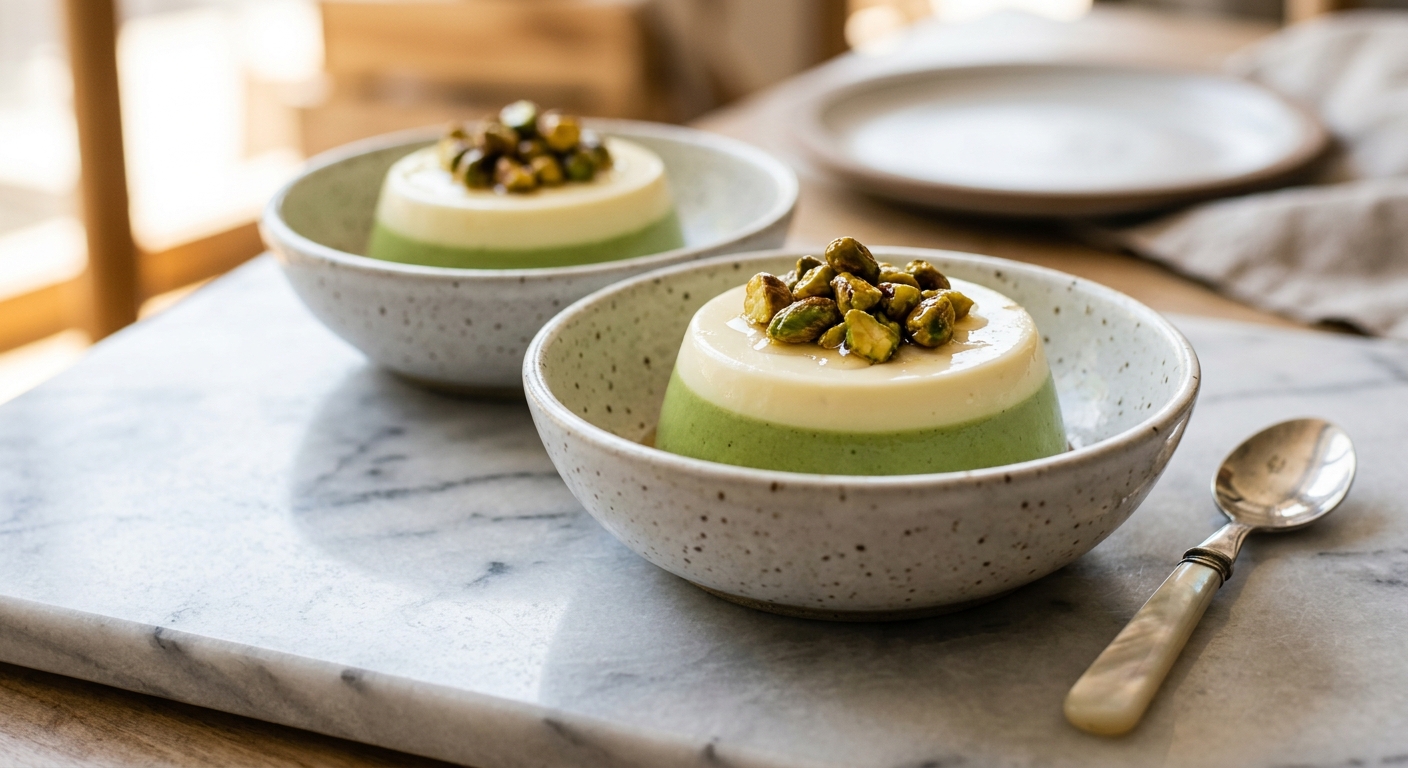
There is something quietly magical about panna cotta. You pour what looks like warm cream into a mold, tuck it into the refrigerator, and hours later it emerges trembling and glossy, holding its shape just enough to wobble when you nudge the plate. This version layers two flavors – a deeply vegetal, bittersweet matcha base and a lush, vanilla-scented white chocolate cream – creating a dessert that is as striking to look at as it is to eat. The contrast between the soft jade green and the ivory white is subtle and sophisticated, and the flavors are a genuinely beautiful match: the grassy bitterness of good matcha cuts right through the sweetness of white chocolate, keeping every bite balanced and interesting.
What sets this recipe apart is a two-stage layering technique that requires a little patience but zero special skill. Each layer is set just enough in the refrigerator before the next is poured on top, preventing the colors from bleeding together and giving you those clean, distinct horizontal bands when you unmold or spoon into the glass. The matcha layer is made with a small amount of heavy cream whisked into the matcha powder first, which prevents the clumping that ruins so many matcha recipes. The white chocolate layer uses real chopped white chocolate, not chips, melted directly into warm cream for a flavor that is noticeably rounder and richer than anything made with extract or flavoring.
This recipe sits firmly in the easy category, despite its impressive appearance. If you can heat cream without scorching it and bloom gelatin without rushing, you can make this. It is ideal for anyone who wants a make-ahead dinner party dessert that requires no baking, no water baths, and no last-minute stress. It is equally lovely served in individual glasses for a relaxed presentation, or unmolded onto plates for something more dramatic. Either way, a handful of honeyed pistachios and a dusting of matcha powder on top takes it from beautiful to genuinely unforgettable.
Equipment Needed
Click on an item below to shop for the recommended items for this recipe on Amazon.
As an Amazon Associate, we earn from qualifying purchases.
6
Ingredients
- Matcha Layer
- 480 mlheavy cream, divided (about 2 cups)
- 240 mlwhole milk, divided (about 1 cup)
- 50 ggranulated sugar (about 3.5 tbsp)
- 10 gculinary-grade matcha powder (about 3.5 tsp), sifted
- 7 gpowdered unflavored gelatin (about 2.25 tsp or one standard packet)
- 30 mlcold water (about 2 tbsp), to bloom gelatin for the matcha layer
- White Chocolate Layer
- 480 mlheavy cream (about 2 cups)
- 120 mlwhole milk (about 0.5 cup)
- 120 ggood-quality white chocolate, finely chopped (about 4 oz), not chips
- 25 ggranulated sugar (about 2 tbsp)
- 7 gpowdered unflavored gelatin (about 2.25 tsp or one standard packet)
- 30 mlcold water (about 2 tbsp), to bloom gelatin for the white chocolate layer
- 1 tsppure vanilla extract
- 40 gshelled pistachios, roughly chopped (about 3 tbsp)
- 20 mlrunny honey (about 1.5 tbsp)
- Dusting To Serve
- —Extra sifted matcha powder
Ingredient Substitutions
Instructions
- Set out 6 glasses or ramekins (about 150ml / 5 oz each) on a small tray so you can move them to the refrigerator easily. If you want to unmold your panna cottas onto plates, lightly grease the ramekins with a neutral oil using a pastry brush.
- Make the matcha layer first. Pour the cold water (30ml) for the matcha gelatin into a small bowl and sprinkle the gelatin powder over the surface. Let it bloom for 5 full minutes without stirring. It will swell and become spongy. While the gelatin blooms, sift the matcha powder into a small bowl. Add about 60ml of the measured heavy cream and whisk vigorously until you have a completely smooth, lump-free green paste. Set aside.
- Combine the remaining heavy cream, whole milk, and sugar for the matcha layer in a medium saucepan. Place over medium heat and warm, stirring occasionally, until the mixture just begins to steam and tiny bubbles appear around the edges, about 4 to 5 minutes. Do not let it boil. Remove from the heat and whisk in the matcha paste until fully combined and the liquid is an even, vivid green.
- Add the bloomed gelatin to the warm matcha cream and whisk gently until the gelatin dissolves completely, about 1 minute. You can return the pan to very low heat for 30 seconds if needed to help it dissolve, but do not let the mixture simmer. Pour the matcha cream evenly among the 6 glasses, filling each about halfway. Transfer the tray to the refrigerator and chill until the matcha layer is just set but still slightly tacky on top, about 2 to 2.5 hours.
- When the matcha layer is nearly set, make the white chocolate layer. Bloom the second packet of gelatin in 30ml of cold water for 5 minutes. Combine the heavy cream, whole milk, and sugar for the white chocolate layer in a clean saucepan over medium heat. Warm until steaming, then remove from the heat. Add the finely chopped white chocolate and let it sit for 2 minutes, then whisk until completely melted and smooth. Add the vanilla extract.
- Add the bloomed gelatin to the white chocolate mixture and whisk until fully dissolved. Let this mixture cool at room temperature until it is just slightly warm to the touch, about 15 to 20 minutes. This step is important: pouring a hot liquid onto a set layer can melt it and cause the layers to bleed together. If you are impatient, set the pan over a bowl of ice water and stir gently to speed the cooling.
- Remove the tray of matcha panna cottas from the refrigerator. Gently pour the cooled white chocolate cream over the back of a spoon held just above the surface of each matcha layer, distributing it evenly. This slow pour minimizes impact and keeps the layers clean. Return the tray to the refrigerator and chill for at least 2 more hours, until the white chocolate layer is fully set.
- To serve, warm the pistachios and honey together in a small pan over low heat for 1 to 2 minutes, just until the honey loosens and the nuts are fragrant. Spoon a small mound onto each panna cotta, dust lightly with sifted matcha, and serve directly in the glasses. To unmold: run a thin knife around the edge of each ramekin, cover with the serving plate, and invert with a confident flick. Give the ramekin a gentle shake if it does not release immediately.
- Set out 6 glasses or small bowls on a tray. Bloom both packets of gelatin together in 60ml of cold water in one small bowl for 5 minutes.
- Combine all of the heavy cream (960ml), all of the whole milk (360ml), and all of the sugar (75g) in a large saucepan over medium heat. Warm until steaming, then remove from the heat. Add the chopped white chocolate and let it sit for 2 minutes before whisking until smooth. Add the vanilla extract.
- Add all of the bloomed gelatin to the warm cream mixture and whisk until fully dissolved. Divide the mixture evenly into two bowls or measuring jugs. Sift the matcha powder into one portion and whisk vigorously until smooth and evenly colored.
- Pour alternating spoonfuls of the white chocolate cream and the matcha cream into each glass, allowing them to naturally marble together. For a more deliberate swirl, use a thin skewer or chopstick to draw a figure-eight through the mixture once or twice. Do not over-swirl or the colors will muddy.
- Transfer to the refrigerator and chill for at least 2.5 hours until fully set. Top with honeyed pistachios and a dusting of matcha to serve.
Nutrition Per Serving
Per 1 serving (makes 6 individual panna cottas in 150ml (5 oz) glasses or ramekins)
Why This Recipe Works
Panna cotta, which means ‘cooked cream’ in Italian, relies on gelatin to transform liquid cream into a barely-solid, trembling gel. Gelatin is a protein derived from collagen, and when dissolved in hot liquid and then cooled, its long protein chains form a loose, flexible network that traps the liquid inside. This is why the ratio of gelatin to cream is so important: too little and the panna cotta will not unmold cleanly or will collapse on the plate; too much and it becomes rubbery and dense, more like a block of cream cheese than a delicate dessert. The amount used here, approximately 7g of gelatin per 720ml of liquid, gives you the classic panna cotta set: firm enough to hold its shape when unmolded, soft enough to quiver and melt almost instantly on the tongue.
The layering technique works because of gelatin’s controlled setting behavior. At refrigerator temperature (around 4 degrees Celsius), a gelatin gel sets but remains thermally reversible, meaning a sufficiently hot liquid poured on top can re-melt the surface and cause the layers to merge. Cooling the white chocolate cream to just above room temperature before pouring it over the set matcha layer ensures it is fluid enough to pour evenly but cool enough not to disturb the layer beneath. The ‘pour over the back of a spoon’ technique is a classic kitchen trick that disperses the liquid over a wider surface area and reduces the force of impact, further protecting the set layer.
Whisking the matcha into a paste with a small amount of cream before adding it to the bulk of the liquid is a critical step that many recipes skip. Matcha powder is hydrophobic in its dry form, meaning it resists absorbing liquid. Adding it directly to a large volume of warm cream almost always results in stubborn green clumps. Forming a smooth paste first saturates the matcha particles with fat and cream, breaking down their resistance and ensuring the layer sets with a perfectly even, lump-free color and flavor. If your matcha layer still shows traces of speckling, pass it through a fine-mesh sieve before pouring into your glasses.
Baker’s Tips
- Use the best quality white chocolate you can find. Look for a bar that lists cocoa butter in the first few ingredients. Brands like Valrhona Ivoire or Callebaut produce a noticeably richer, more complex flavor than most supermarket white chocolate.
- Sift your matcha powder before doing anything else. Even a small number of clumps will persist through whisking and ruin the smooth, glossy finish of the layer.
- Do not let your cream boil. A rolling boil causes the cream to reduce, altering your ratios, and can also start to denature the proteins in the gelatin before it even has a chance to set properly. Low and slow is the goal: steaming and barely bubbling at the edges is perfect.
- Bloom your gelatin properly. Sprinkling the powder over cold water (not the other way around) ensures every granule is evenly hydrated. Five minutes is the minimum; up to 10 minutes is fine. Rushed or improperly bloomed gelatin will leave undissolved specks in your cream.
- Test your gelatin before committing to the recipe if you are using an older packet. Bloom a small amount in water, gently warm it, then chill a spoonful on a cold plate for 5 minutes. If it sets to a wobbly gel, your gelatin is active. If it stays liquid, buy a fresh packet.
- For the cleanest unmolding, refrigerate your ramekins for the full 4 to 5 hours and then dip the base of each ramekin in warm (not hot) water for exactly 10 seconds before inverting. Overheating will melt the outer layer and cause the panna cotta to collapse.
Variations
- Mango and coconut version: Replace the matcha layer with a mango puree layer. Warm 200ml mango puree with 200ml coconut cream and 2 tbsp sugar, then add bloomed gelatin. The result is a tropical, vibrant orange and white dessert.
- Dark chocolate base: Swap the matcha layer for a dark chocolate layer by adding 80g melted 70% dark chocolate to the cream base in place of matcha. The bitterness of dark chocolate mirrors the role matcha plays, keeping the white chocolate layer from becoming too sweet.
- Espresso and white chocolate: Replace the matcha with 2 tsp of finely ground instant espresso dissolved in the warm cream. A shot of Kahlua added to the espresso layer makes this an elegant adults-only dessert.
- Berry jelly top layer: For a third visual layer, make a simple raspberry or blackcurrant jelly (fruit puree, a little sugar, and one third of a gelatin packet) and pour it over the fully set white chocolate layer. Let it set for 1 final hour in the refrigerator.
Troubleshooting & FAQ
My panna cotta did not set and is still liquid after 4 hours in the refrigerator. What went wrong?
My two layers have blended together and the colors are muddy. How do I prevent this?
There are green lumps or specks in my matcha layer. How do I fix it?
My panna cotta stuck to the ramekin and broke when I tried to unmold it. What should I do?
My white chocolate layer tastes grainy or slightly waxy. What happened?
Storage & Make-Ahead
- Storage: Cover each glass or ramekin with plastic wrap and refrigerate for up to 4 days. The texture is best on days 1 and 2. Do not freeze panna cotta, as gelatin-set desserts break down and become grainy when frozen and thawed. Add the honeyed pistachio topping just before serving.
- Make-Ahead: This dessert is purpose-built for making ahead. Complete both layers up to 2 days before your event, cover, and refrigerate. The flavors actually deepen and mellow overnight. Prepare the honeyed pistachios the morning of serving and store at room temperature. Dust with matcha at the last moment.