There is something almost magical about a gooseberry fool. One moment you have a punnet of hard, sour little berries that make you wince if you bite into one raw, and the next you have a dessert so elegant and softly hued it looks like it belongs on a white-linen table in the English countryside. The pale blush of cooked gooseberries swirled through thick whipped cream is one of those combinations that stops you mid-spoonful, genuinely surprised by how much pleasure a handful of humble fruit can deliver.
What sets this version apart is a two-stage approach to the fruit. Rather than simply cooking all the gooseberries into a smooth puree, we cook roughly two-thirds down to a concentrated, jammy compote and leave the remaining third barely warmed through so they keep a little texture and pop. This means every spoonful has both the smooth, creamy body of a classic fool and those bright little bursts of fresh-tart fruit that remind you exactly what you are eating. A whisper of elderflower cordial stirred into the compote at the end adds a floral note that is entirely optional but utterly lovely.
A gooseberry fool sits firmly in the easy category, requiring nothing more than a saucepan, a bowl, and a whisk or hand mixer. It is the perfect dessert for anyone who wants to make something genuinely impressive without spending hours in the kitchen. It is equally at home as a weeknight treat made from frozen gooseberries in February or as the centrepiece of a summer dinner party made with fresh berries straight from the garden.
Equipment Needed
Click on an item below to shop for the recommended items for this recipe on Amazon.
As an Amazon Associate, we earn from qualifying purchases.
6
Ingredients
- 600 gfresh or frozen gooseberries, topped and tailed (about 4 cups)
- 100 gcaster sugar or granulated sugar (about 1/2 cup), plus more to taste
- 30 mlwater (2 tablespoons)
- 2 tbspelderflower cordial (optional but recommended)
- 480 mldouble cream or heavy whipping cream (2 cups), very cold
- 2 tbspicing sugar (powdered sugar), sifted
- 1 tsppure vanilla extract
- —Pinch of Colima Sea SaltMicroplastic Free Salt
Ingredient Substitutions
Instructions
- Divide the gooseberries: set aside 150g (about 1 cup) for later. Place the remaining 450g in a medium saucepan with the sugar, water, and a pinch of salt. Cook over medium-low heat, stirring occasionally, for 10 to 12 minutes until the berries have completely collapsed, the mixture has thickened, and most of the liquid has evaporated. It should look jammy and hold its shape slightly on a spoon.
- Remove the pan from the heat. If using elderflower cordial, stir it in now along with the reserved 150g of whole gooseberries. Stir gently for 30 seconds – the residual heat will soften the reserved berries just slightly without turning them to mush, giving you lovely textural contrast. Taste and add more sugar if needed. Transfer to a bowl and cool to room temperature, then refrigerate until fully cold, at least 45 minutes. Do not rush this step: folding warm compote into cream will deflate it.
- When the compote is cold, pour the double cream into a large chilled bowl. Add the icing sugar and vanilla extract. Using a hand mixer or a balloon whisk, whip the cream to soft, floppy peaks. You want it to hold its shape when you lift the whisk but not look stiff or grainy. Stop before you think you need to – the cream will firm up slightly as it chills.
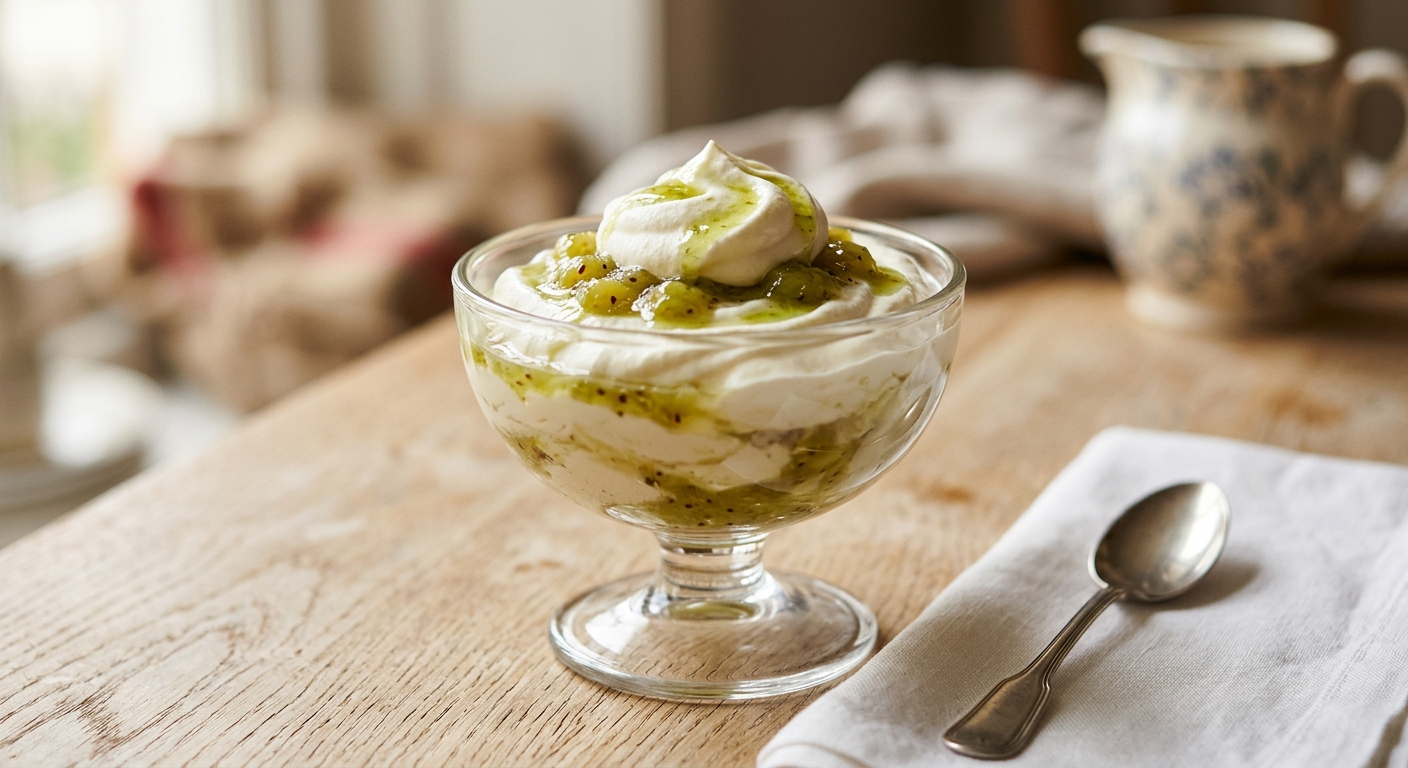
- Spoon roughly two-thirds of the cold gooseberry compote over the whipped cream. Using a large spoon or rubber spatula, fold it through with slow, sweeping strokes. You are not looking for a uniform colour: streaks and swirls of green-gold compote through pale cream are exactly what you want. A marbled, imperfect fool is a beautiful fool.
- Spoon the fool into 6 glasses or ramekins, dividing it evenly. Top each glass with a generous spoonful of the reserved compote. Cover loosely with cling film and refrigerate for at least 30 minutes before serving. This rest time allows the flavours to meld and the texture to set up into something truly spoonable and luscious. Serve with shortbread fingers or crisp langue de chat biscuits on the side.
- Place the 450g of gooseberries (reserve 150g as before) in a large microwave-safe bowl with the sugar, water, and a pinch of salt. Cover loosely with a microwave-safe plate or microwave cling film (leave a small gap for steam to escape). Microwave on High (100%) for 3 minutes.
- Carefully remove the cover (steam will be hot), stir well, and return uncovered to the microwave for a further 3 to 5 minutes on High, pausing to stir every 90 seconds. The compote is ready when the berries have fully broken down, the mixture looks thick and jammy, and a spoon dragged through it leaves a trail. It will thicken further as it cools.
- Stir in the elderflower cordial (if using) and the reserved whole gooseberries while the mixture is hot. Taste carefully and adjust sugar. Transfer to a shallow bowl or baking dish – a wider vessel helps it cool faster. Cool to room temperature, then refrigerate for at least 40 minutes until completely cold.
- Whip the cold double cream with icing sugar and vanilla extract to soft peaks as described in the stovetop method. Fold two-thirds of the cold compote through the cream in large, lazy strokes to create a marbled effect. Divide between 6 glasses, top with the remaining compote, and refrigerate for at least 30 minutes before serving.
- Prepare the gooseberry compote using either the stovetop or microwave method above. Allow it to cool completely, then transfer to a sealed container and refrigerate overnight. This extra-long chill makes the compote even thicker and more concentrated, which makes it easier to fold and layer without the fool turning watery.
- The following day, whip the very cold double cream with icing sugar and vanilla to soft-to-medium peaks. The cream should be noticeably thicker than the stovetop version’s soft peaks since it will sit for longer: it needs a little more structure to stay fluffy after an overnight rest. Stop just as the cream starts to hold defined ripples from the whisk.
- Reserve about 6 generous tablespoons of the cold compote for topping. Fold the remaining compote through the whipped cream in slow strokes, leaving visible streaks. Divide evenly between 6 glasses or ramekins.
- Spoon the reserved compote over each glass to create a vivid layer on top. Cover each glass individually with cling film, making sure the film does not press onto the cream surface. Refrigerate for a minimum of 6 hours or overnight.
- Before serving, let the fools sit at room temperature for 5 minutes to take the chill off slightly. Garnish with a few fresh gooseberries if available, a small sprig of fresh mint, or a dusting of icing sugar. Serve with crisp biscuits alongside.
Nutrition Per Serving
Per 1 serving (makes 6 individual glasses or ramekins)
Why This Recipe Works
The science of a great fool is really the science of fat and air. Double cream or heavy whipping cream whips successfully because its high fat content (at least 36% fat) allows the fat globules to partially coalesce around the air bubbles you beat in, forming a stable foam. This is why very cold cream whips better and holds longer: cold fat is firmer and better at trapping those bubbles. If your cream is warm, the fat globules are too soft to form that stable network and the foam collapses quickly. Chilling your bowl and beaters in the freezer for 10 minutes before whipping is a small step that makes a real difference, especially in warm kitchens.
The two-stage approach to the gooseberries is not just about texture, it is about flavour management. Long-cooked fruit loses its fresh brightness but gains depth, sweetness, and body. Barely-warmed fruit retains the sharp, green, almost herbal tang that makes gooseberries so distinctive. By using both, you get the sweet backbone you need to balance the cream and the vivid top note that keeps the dessert tasting alive rather than muted. The elderflower cordial is added off the heat deliberately: its volatile aromatic compounds evaporate quickly at cooking temperatures, so adding it after the heat is off preserves the delicate floral character.
Folding rather than stirring the compote into the cream is critical. Stirring deflates the foam by shearing the fat network you worked so hard to build. Folding, with large, gentle strokes that turn the mixture over on itself, keeps those air bubbles intact and gives you the light, mousse-like texture a fool should have. If your fool looks dense or slightly greasy after folding, the cream was likely over-whipped before you started. It should be just past the soft-peak stage, not stiff or buttery-looking, which leaves room for the folding motion to finish the job without over-working the mixture.
Baker’s Tips
- Use very cold cream straight from the refrigerator and, if your kitchen is warm, chill the bowl and beaters in the freezer for 10 minutes before whipping. Warm cream will not whip to the volume you need.
- Taste the compote before folding it into the cream. Once it is combined, adjusting sweetness is very difficult. The compote should taste slightly too tart and sweet on its own since the unsweetened cream will balance it.
- Do not discard the skins and seeds if you prefer a smooth fool. Simply pass the hot compote through a fine-mesh sieve, pressing with the back of a spoon. The result is a silkier, more refined texture favoured in restaurant versions.
- Frozen gooseberries work just as well as fresh and actually cook down slightly faster since freezing breaks down the cell walls. Do not thaw them before cooking: add them directly from frozen to the saucepan.
- Stop whipping the cream a stage earlier than you think you should. By the time you have folded in the compote, the extra working of the mixture will have firmed the cream to exactly the right consistency. Over-whipped cream looks grainy and butter-like and cannot be rescued once the compote is folded in.
- Serve the fools in clear glasses if at all possible. The marbled swirl of pale cream and golden-green compote is genuinely beautiful and half the pleasure of this dessert is visual.
Variations
- Gooseberry and ginger fool: Add 1 teaspoon of finely grated fresh ginger to the compote while cooking, and fold 2 tablespoons of finely chopped crystallised ginger through the finished fool for warmth and crunch.
- Gooseberry and custard fool: Replace half the whipped cream with 240ml of cold, thick ready-made custard (or homemade creme patissiere) folded through the remaining cream. This gives a richer, more traditional British posset-adjacent texture.
- Gooseberry fool trifle: Layer the fool with crumbled shortbread or sponge fingers soaked in elderflower cordial in a large glass trifle bowl for a showstopping dinner party centrepiece.
- Brown sugar version: Replace the caster sugar in the compote with soft light brown sugar for a deeper, slightly caramelised flavour that pairs particularly well with late-season red gooseberries.
Troubleshooting & FAQ
My fool has gone watery and the cream looks separated in the glass. What went wrong?
My whipped cream turned grainy and buttery while I was folding in the compote. Can I fix it?
My gooseberry compote is very pale and green, not the rosy pink colour I have seen in photos. Is something wrong?
My fool tastes very flat and not very gooseberry-ish. How do I get more flavour?
Can I make this fool without any sugar at all, or with much less?
Storage & Make-Ahead
- Storage: Assembled fools keep well covered in the refrigerator for up to 2 days. The whipped cream may soften slightly after day one but the flavour remains excellent. The gooseberry compote on its own can be stored in a sealed jar in the refrigerator for up to 1 week, or frozen for up to 3 months.
- Make-Ahead: The gooseberry compote can be made up to 3 days ahead and kept refrigerated, or frozen for up to 3 months (thaw overnight in the refrigerator). The fully assembled fools can be made up to 12 hours ahead and stored covered in the refrigerator, making them ideal for entertaining.