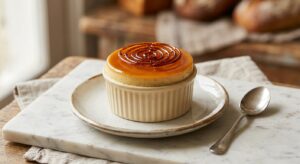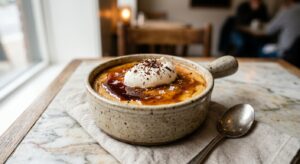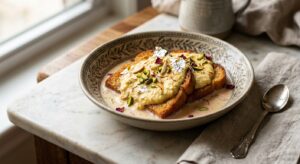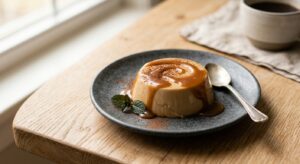
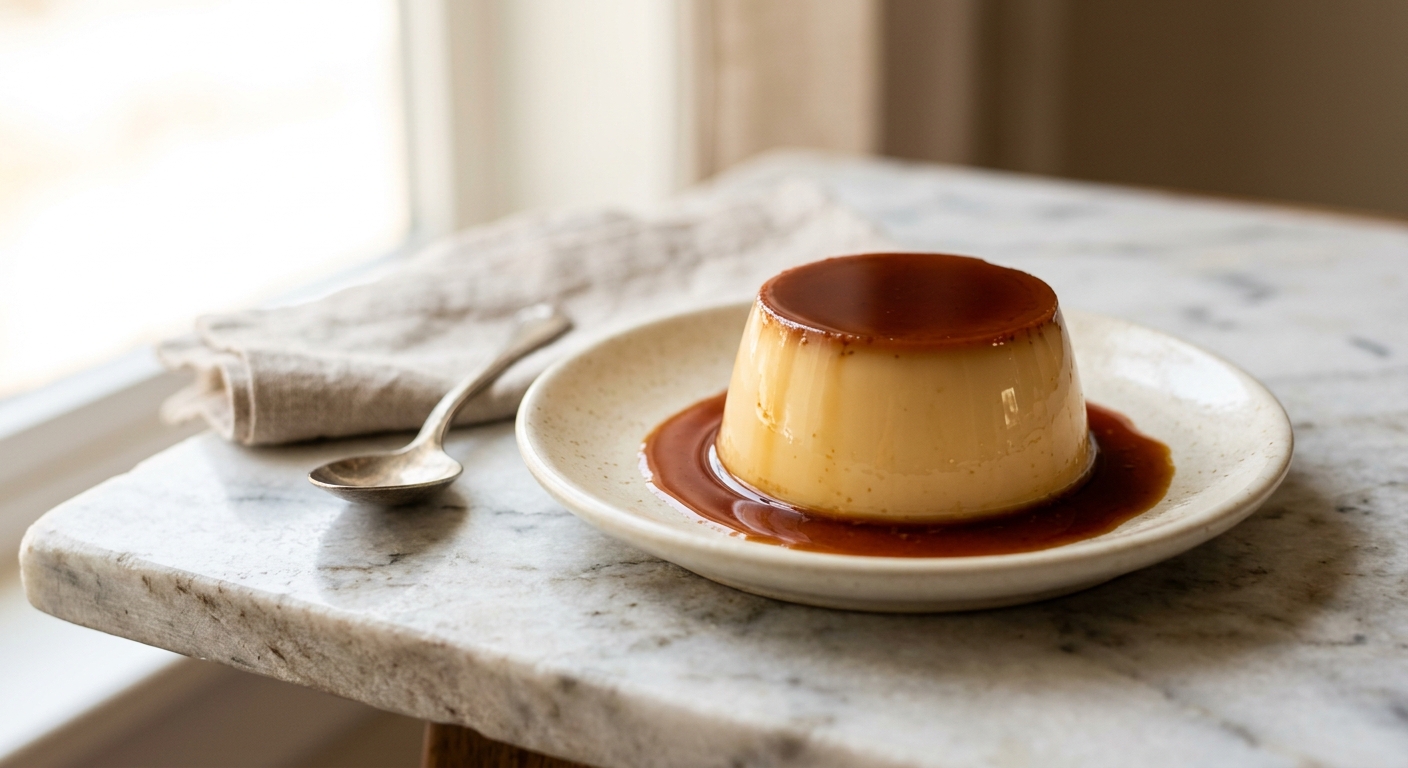
There is something almost meditative about a perfectly unmolded purin. It wobbles on the plate with an almost architectural composure, glossy and pale ivory, then the dark amber caramel spills slowly down its sides like a slow-motion sunset. Japanese milk pudding is a beloved staple of kissaten, the old-school Japanese coffee shops, where it arrives on a small plate with a little pool of bitter caramel underneath, served simply with a spoon and no further ceremony. One bite and you understand immediately why this dessert has endured for decades without needing a single reinvention.
What sets this version apart from a standard crème caramel is the careful balance of dairy and eggs. We use a combination of whole milk and a touch of heavy cream for richness, but the ratio is deliberately restrained so the pudding stays light and jiggly rather than dense. The caramel is taken to a genuinely dark amber, almost to the edge of burnt, because that bitterness is not an accident but the whole point. It counterbalances the gentle sweetness of the custard and gives the dessert its soul. A tiny pinch of fine sea salt in the caramel sharpens everything further.
This recipe sits firmly in the easy-to-medium range. The caramel requires your full attention for about three minutes, and the bain-marie (water bath) needs a steady oven temperature, but neither step is beyond a confident beginner. If you have made any kind of baked custard before, you will feel right at home. This recipe is perfect for dinner parties where you want an elegant, make-ahead dessert, or for a quiet weekend when you simply want to treat yourself to something quietly extraordinary.
Equipment Needed
Click on an item below to shop for the recommended items for this recipe on Amazon.
As an Amazon Associate, we earn from qualifying purchases.
6
Ingredients
- Caramel
- 120 ggranulated sugar (about 1/2 cup plus 1 tsp)
- 45 mlwater (3 tbsp)
- 15 mlhot water (1 tbsp), to loosen the caramel
- 1 pinchColima Sea SaltMicroplastic Free Salt
- 480 mlwhole milk (2 cups)
- 120 mlheavy cream (1/2 cup)
- 3 largeeggs, at room temperature
- 2 largeegg yolks, at room temperature
- Custard
- 80 ggranulated sugar (about 1/3 cup plus 1 tbsp)
- 1 tsppure vanilla extract
- —Pinch of Colima Sea SaltMicroplastic Free Salt
Ingredient Substitutions
Instructions
- Make the caramel: Combine 120g granulated sugar and 45ml water in a small, light-colored saucepan over medium heat. Stir gently just until the sugar dissolves, then stop stirring. Bring to a boil and cook, swirling the pan occasionally, until the caramel turns a deep amber, the color of dark honey, about 8 to 10 minutes. Watch it carefully in the final minute as it can go from perfect to burnt very quickly. Remove from heat immediately and carefully add the 15ml of hot water (it will sputter). Swirl to combine, then add the pinch of sea salt. Working quickly, divide the caramel evenly among 6 ramekins (about 1.5 to 2 tbsp each), tilting each ramekin to coat the bottom. Set aside to harden while you make the custard.
- Preheat your oven to 325°F (160°C). Place the 6 filled ramekins into a deep baking dish or roasting pan. Bring a kettle of water to a boil.
- Make the custard: Combine the whole milk and heavy cream in a medium saucepan. Heat over medium-low heat until steaming and just beginning to simmer around the edges, about 4 to 5 minutes. Do not boil. Remove from heat and let cool for 5 minutes. Meanwhile, in a large bowl, whisk together the 3 eggs, 2 egg yolks, 80g sugar, vanilla extract, and pinch of salt until smooth and pale, about 1 minute. Do not whisk vigorously as you want to avoid creating foam, which would make the surface of your pudding bubbly.
- Slowly pour the warm milk mixture into the egg mixture in a thin, steady stream, whisking gently and constantly. This gradual tempering prevents the eggs from scrambling. Strain the custard through a fine-mesh sieve into a large liquid measuring cup or a bowl with a spout. This removes any cooked egg bits and any foam, giving you the smoothest possible pudding.
- Skim any remaining surface bubbles from the strained custard using a spoon, or press a paper towel lightly over the surface. Divide the custard evenly among the prepared ramekins, pouring gently over the set caramel. Fill them to about 1cm (about 1/2 inch) from the top.
- Pour the boiling water into the baking dish around the ramekins until it reaches halfway up the sides of the ramekins. Cover the entire baking dish tightly with aluminum foil. Bake for 38 to 42 minutes, until the puddings are set around the edges but still have a gentle wobble in the center, like just-set gelatin. They will firm up as they chill.
- Carefully remove the ramekins from the water bath using tongs or a folded kitchen towel. Let cool at room temperature for 30 minutes, then cover each ramekin with plastic wrap and refrigerate for at least 4 hours, or overnight. The flavor improves noticeably overnight.
- To unmold: Run a thin offset spatula or butter knife around the edge of each pudding. Place a rimmed serving plate (rimmed so the caramel does not run off) face-down on top of the ramekin, then quickly and confidently invert. Hold for 5 seconds, then lift the ramekin. If the pudding does not release, gently press one side of the custard away from the ramekin wall with the tip of your finger to break the seal, then try again. Serve immediately.
- Prepare the caramel and ramekins exactly as described in Step 1 of the Oven method. Set the filled ramekins aside.
- Make the custard following Steps 3 and 4 of the Oven method (heat milk and cream, temper into eggs, strain through a fine sieve). Skim any surface bubbles. Divide evenly among the caramel-lined ramekins.
- Cover each ramekin tightly with a small square of aluminum foil, pressing it against the rim. This is critical for steaming: it prevents condensation droplets from dripping onto the surface of the custard, which would cause pitting and an uneven texture.
- Set up your steamer: Place a steamer rack or a folded kitchen towel in the bottom of a large, wide pot with a lid. Add enough water to come 2 to 3 cm (about 1 inch) below the rack. Bring the water to a boil over high heat, then reduce to medium-low so the water is producing gentle, steady steam but is not at a rolling boil. Aggressive steam will cause bubbles in your pudding.
- Arrange the covered ramekins on the steamer rack, spacing them so steam can circulate. Cover the pot with its lid, but leave it very slightly ajar (tuck a wooden chopstick or spoon handle under the lid edge) to prevent steam pressure from building up. Steam on medium-low for 20 to 25 minutes, until the edges are set and the center has a slight wobble.
- Remove the ramekins carefully using tongs. Remove the foil covers, let cool at room temperature for 30 minutes, then cover with fresh plastic wrap and refrigerate for at least 4 hours. Unmold and serve as described in Step 8 of the Oven method.
- Prepare the caramel as described in Step 1 of the Oven method and divide it among your microwave-safe ramekins. Allow to set.
- Make the custard following Steps 3 and 4 of the Oven method. Strain well and skim all surface foam. Divide among the ramekins over the set caramel.
- Cover each ramekin loosely with a microwave-safe plate or a piece of microwave-safe plastic wrap with a small vent. Do not seal tightly.
- Microwave one ramekin at a time on 30% power (low) for 3 minutes. Check: the edges should look set and opaque while the center still jiggles softly. If the center is still liquid, continue microwaving in 20-second bursts at 30% power until just set. Total time is typically 3 to 4 minutes depending on your microwave’s wattage. Avoid high power at all costs as it will create an eggy, curdled texture.
- Remove carefully (the ramekin will be hot). Let cool uncovered for 10 minutes, then cover and refrigerate for at least 4 hours. Unmold and serve as described in Step 8 of the Oven method. Note: microwave-set puddings can sometimes be slightly more resistant to releasing cleanly. Run your knife slowly and carefully around the full circumference before inverting.
Nutrition Per Serving
Per 1 serving (makes 6 individual puddings in 150ml (5 oz) ramekins)
Why This Recipe Works
The magic of this pudding lies in its protein structure. Eggs are the sole setting agent here: when the custard is heated gently, the proteins in the egg whites and yolks denature and form a soft, interlocking network that traps the liquid dairy in place. Using a combination of whole eggs and extra yolks strikes a precise balance: the yolks bring richness, emulsifying fat, and a velvety mouthfeel thanks to their lecithin content, while the whites contribute additional protein for structure. Too many whites and the pudding becomes rubbery; too many yolks and it can feel heavy and greasy. The ratio here gives you a set that is tender enough to quiver on the plate but firm enough to hold its shape when unmolded.
The bain-marie (or the steaming method) is non-negotiable for achieving smooth texture. Direct heat, whether in a hot oven or at a rolling boil, would cause the outer edges of the custard to overheat and scramble while the center is still liquid. The surrounding water in a bain-marie can never exceed 212°F (100°C), which creates a gentle, even cooking environment. This is why we also cover the pan with foil: it traps steam and prevents the tops of the puddings from drying out or forming a skin before the interior has set. If you see small bubbles or a porous texture in your finished pudding, either the oven was too hot, the water in the bain-marie was boiling too vigorously, or the custard was not strained carefully enough.
The dark caramel is a deliberate study in Maillard reaction and pyrolysis. As the sugar solution is heated past 320°F (160°C), the sucrose molecules break down and reform into hundreds of new flavor compounds, ranging from butterscotch and toffee notes at lighter stages to intensely bitter, almost smoky compounds at the darker end. We take this caramel to the deep amber stage, approximately 375 to 385°F (190 to 195°C), specifically to develop those bitter, complex notes. When the pudding chills overnight, the caramel slowly dissolves into the surrounding custard, creating a gently bittersweet sauce. If your caramel tastes acrid or truly burnt, rather than pleasantly bitter, it went past this stage. Start again: burnt caramel is unpleasant and unfortunately cannot be corrected.
Baker’s Tips
- Bring your eggs to room temperature before making the custard. Cold eggs can cause the warm milk to cool down too quickly during tempering, which slows the cooking process and can affect the final texture.
- Use a light-colored or stainless-steel saucepan for the caramel. Dark pans make it nearly impossible to judge the color of the caramel accurately, which is the only reliable doneness indicator you have.
- Do not stir the caramel once it comes to a boil. Stirring reintroduces sugar crystals into the syrup and can cause the whole batch to crystallize into a grainy white mass. If you see uneven cooking, swirl the pan gently instead.
- Straining the custard is not optional. Even a small amount of cooked egg bits or surface foam, if baked in, will create visible imperfections on the smooth surface of your unmolded pudding. A clean, smooth custard starts with a good strain.
- The pudding is done when there is still a distinct wobble in the center, similar to barely-set gelatin or a gently shaking panna cotta. It may look underdone, but it will firm up completely during chilling. Overbaking produces a rubbery, dense pudding.
- When unmolding, always use a plate with a rim or a slight lip to catch the flowing caramel. A flat plate will result in caramel running off the edge immediately.
Variations
- Coffee purin: Replace 60ml (1/4 cup) of the milk with 60ml of strong brewed espresso, cooled, for a kissaten-style coffee pudding with a gentle bitterness that echoes the dark caramel beautifully.
- Matcha milk pudding: Whisk 1.5 tsp of sifted ceremonial or culinary-grade matcha into the warm milk before tempering into the eggs. Serve with a plain golden caramel rather than dark caramel to let the matcha color shine through.
- Coconut milk purin: Replace the whole milk and heavy cream entirely with one 400ml can of full-fat coconut milk. The result is a dairy-free, lightly tropical pudding with a gorgeous richness. Reduce the sugar in the custard to 65g as coconut milk adds natural sweetness.
- Honey caramel variation: Replace the granulated sugar in the caramel with an equal weight of raw honey, cooking it in the same way. The floral notes add a beautiful complexity, though honey caramel moves more quickly from golden to dark, so watch closely.
Troubleshooting & FAQ
My pudding has tiny holes or bubbles throughout the interior. What went wrong?
My caramel seized up and turned into a grainy, crystallized mess instead of a smooth liquid.
My pudding is rubbery and dense instead of silky and jiggly. What happened?
The pudding will not release from the ramekin when I try to unmold it.
My caramel hardened into a solid disc in the ramekin. Will it become a sauce when the pudding is served?
Storage & Make-Ahead
- Storage: Cover unmolded puddings loosely with plastic wrap and refrigerate for up to 3 days. The caramel will slowly be absorbed into the custard over time, which is actually delicious, but the pudding is at its most beautiful when served within 24 hours of making. Do not freeze: freezing breaks down the protein network in the custard, resulting in a grainy, weeping texture.
- Make-Ahead: These puddings are ideal for making ahead. They can be prepared up to 2 days in advance and stored in their ramekins, covered, in the refrigerator. Unmold just before serving. The caramel is made as part of the recipe and does not need to be prepared separately.