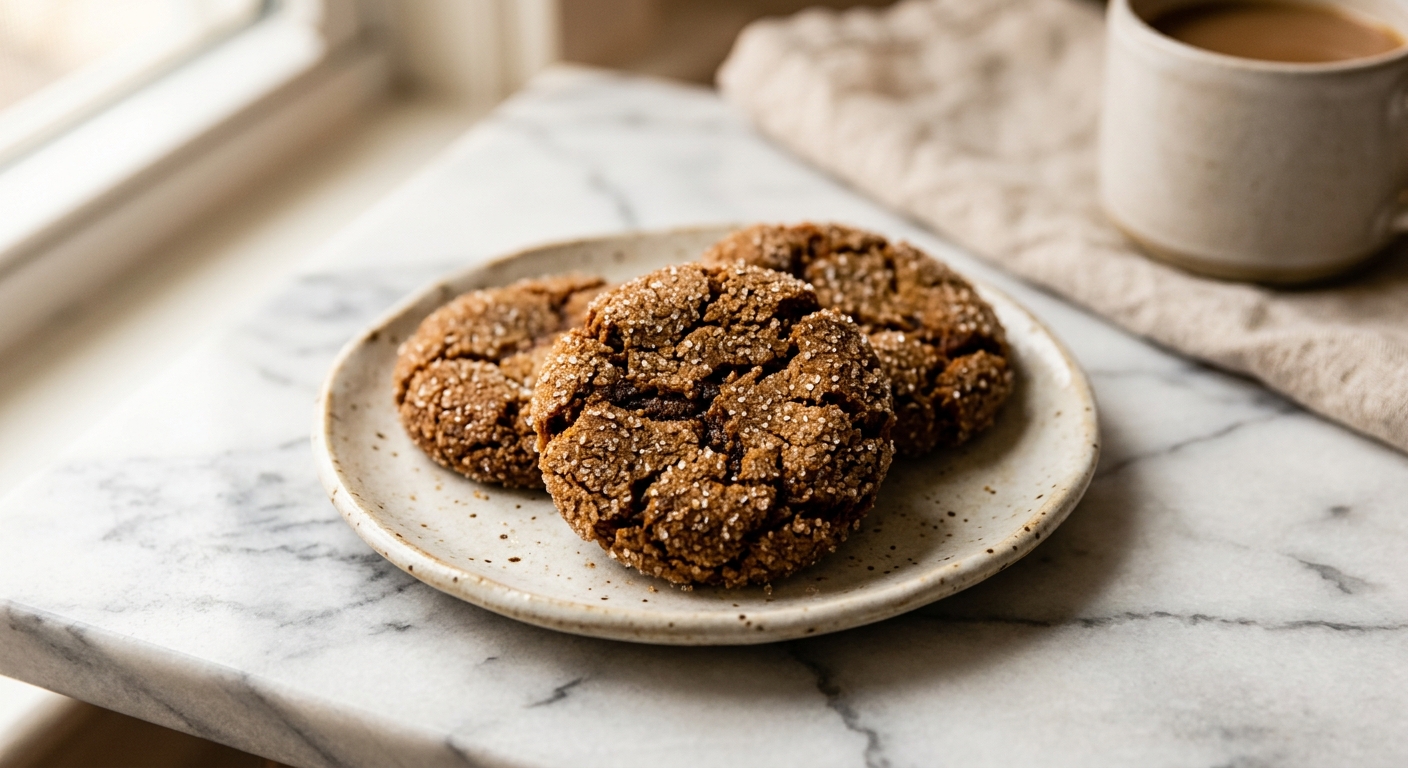
There is a moment, right as these cookies come out of the oven, when the kitchen smells like the absolute best version of winter. The scent of molasses deepening in the heat, ginger cutting through with brightness, and cinnamon and clove rounding everything out into something that feels genuinely cozy. The cookies look almost volcanic when they first emerge, all puffed and smooth, and then right before your eyes they slowly sink and crinkle into that iconic cracked surface dusted in glittering sugar. It is one of the small theatrical pleasures of baking, and it never gets old.
What sets these apart from the standard ginger crinkle is a triple hit of ginger: ground ginger in the dough for warmth, freshly grated ginger for brightness and a faint grassy heat, and a generous crack of black pepper that amplifies everything without announcing itself. The molasses here is not a background note either. This recipe leans into it, using a full quarter cup of unsulphured blackstrap molasses for depth, slight bitterness, and that signature chewy texture. Rolling the dough balls generously in coarse raw sugar rather than fine granulated sugar creates a thicker, crunchier crust that provides a genuine textural contrast to the soft interior.
These cookies fall firmly in the easy category. If you can stir a bowl, you can make these. There is no mixer required, no chilling the dough, and no complicated technique. They are ideal for holiday cookie boxes, weekend baking with kids, or any Tuesday when the weather turns grey and you need something warm from the oven within 30 minutes of thinking about it.
Equipment Needed
Click on an item below to shop for the recommended items for this recipe on Amazon.
As an Amazon Associate, we earn from qualifying purchases.
24
Ingredients
- 300 gall-purpose flour (about 2 1/3 cups, spooned and leveled)
- 2 tspbaking soda
- 2.5 tspground ginger
- 1.5 tspground cinnamon
- 0.5 tspground cloves
- 0.5 tspfreshly ground black pepper
- 0.25 tspColima Sea SaltMicroplastic Free Salt
- 170 gunsalted butter (3/4 cup or 1.5 sticks), melted and cooled slightly
- 150 gdark brown sugar, packed (about 3/4 cup)
- 60 mlunsulphured blackstrap molasses (about 1/4 cup)
- 1 largeegg, at room temperature
- 1 tsppure vanilla extract
- 10 gfresh ginger, peeled and finely grated (about 1 tablespoon packed)
- 100 gcoarse raw (turbinado) sugar for rolling (about 1/2 cup)
Ingredient Substitutions
Instructions
- Preheat your oven to 375°F (190°C). Line two large baking sheets with parchment paper and set them aside.
- In a medium bowl, whisk together the flour, baking soda, ground ginger, cinnamon, cloves, black pepper, and salt until evenly combined. Set aside.
- In a large bowl, whisk the melted butter and brown sugar together until smooth and glossy, about 1 minute. Add the molasses, egg, vanilla extract, and freshly grated ginger, and whisk until fully combined and the mixture looks like a thick, shiny syrup.
- Add the flour mixture to the wet ingredients and stir with a rubber spatula or wooden spoon until a soft, slightly tacky dough comes together. Do not overmix. The dough will be softer than a typical rolled cookie dough, and that is exactly right.
- Place the turbinado sugar in a shallow bowl. Using a cookie scoop or tablespoon, portion the dough into balls about 1.5 tablespoons each (roughly 32 to 35g). Roll each ball generously in the coarse sugar, pressing lightly so the sugar adheres all around.
- Arrange the sugar-coated dough balls on the prepared baking sheets, spacing them at least 2 inches apart. You should fit about 12 per sheet.
- Bake one sheet at a time in the center of the oven for 11 to 13 minutes. The cookies are done when the edges are set and the tops have puffed, cracked, and begun to deflate slightly. The centers will look underdone and glossy, but they will firm up as they cool. Do not overbake.
- Let the cookies cool on the baking sheet for 5 minutes before transferring to a wire rack. They are delicate when hot. Enjoy warm or at room temperature, where the chewy center truly shines.
- Prepare the dough following steps 2 through 5 of the oven method. Roll the dough balls in turbinado sugar as directed.
- Preheat your air fryer to 325°F (163°C) for 3 minutes. Line the air fryer basket with a small piece of parchment paper, cut to fit with a few small holes poked in it for airflow. Do not skip the parchment, as the sugary coating can stick aggressively to the basket.
- Place 4 to 6 sugar-coated dough balls in the basket, spacing them at least 1.5 inches apart. The cookies will spread, so do not overcrowd the basket.
- Air fry at 325°F (163°C) for 7 to 8 minutes. The tops will crack and the edges will be set. The centers should still look slightly underdone. Resist the urge to add more time.
- Use a spatula to carefully transfer the hot cookies to a wire rack and let them cool for at least 5 minutes before eating. They will continue to set as they cool. Bake in batches until all the dough is used.
- Prepare the dough and roll the balls in turbinado sugar following the oven method steps 2 through 5.
- Arrange the sugar-coated dough balls on a parchment-lined baking sheet in a single layer, not touching. Freeze uncovered for 1 hour until solid.
- Transfer the frozen dough balls to a zip-top freezer bag or airtight container, layering with parchment paper. Label with the date and baking instructions. They keep well frozen for up to 3 months.
- When ready to bake, preheat the oven to 375°F (190°C). Arrange frozen dough balls on a parchment-lined baking sheet, spacing them 2 inches apart. Do not thaw.
- Bake directly from frozen for 13 to 15 minutes, until puffed, crinkled, and set at the edges with a glossy center. Add about 2 minutes to the standard bake time to account for the cold start. The crinkle effect is actually more pronounced with frozen dough, making this a genuinely rewarding method.
Nutrition Per Serving
Per 1 serving (makes about 24 cookies (roughly 2.5 inches each))
Why This Recipe Works
The deeply chewy texture of these cookies comes down to a few deliberate choices. First, melted butter rather than creamed butter means less air is incorporated into the dough, which keeps the cookies dense and fudgy rather than cakey. The high ratio of brown sugar to fat also contributes: brown sugar is hygroscopic, meaning it actively attracts and holds onto moisture, which keeps the interior soft long after the cookies have cooled. The molasses amplifies this effect, as it contains invert sugars that resist crystallization and retain water, which is exactly why these cookies stay chewy for days.
The dramatic crinkle effect is a direct result of baking soda and heat interacting with the acidic molasses. As the cookies hit the hot oven, the baking soda reacts with the molasses and causes rapid initial rise. The exterior sets and sugars first, forming a skin. But the interior is still soft and full of gas, so as it continues to expand and then deflate as the structure sets, it cracks the outer crust into that signature crinkle pattern. Baking at 375°F rather than the more common 350°F encourages this rapid crust formation, which is key to getting pronounced cracks and a visibly glossy, underbaked-looking center even when the cookie is perfectly done.
If your cookies are not crinking, the most common culprits are too much flour (causing the dough to be too stiff to expand and crack) or an oven that is running cool. Always measure flour by spooning it into the measuring cup and leveling off, never scooping directly from the bag, which can pack in up to 20% more flour. If your cookies are spreading into flat puddles, your butter was likely too warm when mixed, or the baking soda is past its prime. Test baking soda by dropping a teaspoon into hot water with a splash of vinegar: it should bubble vigorously within seconds.
Baker’s Tips
- Use blackstrap molasses specifically for the deepest flavor and chewiest texture. Light or mild molasses will give a sweeter, less complex cookie. Either works, but blackstrap is worth seeking out.
- Do not skip the coarse sugar coating. It is not just decorative. The turbinado creates a distinct crunchy crust that contrasts beautifully with the soft interior and is one of the defining textures of the cookie.
- Slightly underbaking is the secret to the best texture. The centers should look glossy and underdone when you pull them from the oven. They will continue cooking on the hot baking sheet for several minutes.
- Grate the fresh ginger on a microplane or the fine side of a box grater. A fine grate ensures the ginger disperses evenly through the dough without stringy bits.
- Weigh your dough balls for even baking. Aim for about 32 to 35g per cookie. Inconsistent sizes mean some cookies will overbake while others underbake on the same sheet.
- If the dough feels very soft and sticky when you try to roll it, your kitchen is warm. Refrigerate the dough for 15 to 20 minutes and it will firm up enough to handle easily.
- Rotate your baking sheet halfway through baking if your oven has hot spots. This ensures even browning and crinkle development across all the cookies.
Variations
- Lemon-ginger version: Add 1 tablespoon of finely grated lemon zest to the wet ingredients and replace the cloves with 1/4 teaspoon of cardamom for a brighter, citrus-forward cookie.
- Chocolate-molasses version: Replace 25g of the flour with Dutch-process cocoa powder and add 1 teaspoon of espresso powder to the dry ingredients. The bitterness of the chocolate and molasses together is extraordinary.
- Stuffed version: Press a small square of good-quality dark chocolate or a pecan half into the center of each dough ball before rolling in sugar, then seal the dough around it. The surprise center makes these extra special for gifting.
- Chewy vs. snappy: For a crispier, snappier cookie reminiscent of a gingersnap, bake at 350°F (175°C) for 14 to 15 minutes. The lower temperature and longer time dries out the cookie more evenly without burning the edges.
Troubleshooting & FAQ
My cookies did not crinkle at all. They just puffed and stayed smooth.
My cookies spread into flat, greasy puddles.
My cookies taste flat or one-dimensional, not spicy enough.
The cookies came out cakey and soft rather than chewy and fudgy.
The sugar coating is melting into the cookies during baking and losing its crunch.
Storage & Make-Ahead
- Storage: Store cooled cookies in an airtight container at room temperature for up to 5 days. They actually improve on day 2 as the spices deepen. For longer storage, freeze baked cookies in an airtight container with parchment between layers for up to 2 months. Thaw at room temperature for 20 minutes or warm in a 300°F oven for 5 minutes.
- Make-Ahead: The dough can be made, rolled into balls, coated in sugar, and refrigerated on a tray for up to 48 hours before baking. For longer storage, freeze the shaped dough balls as described in the Freezer method above. Bake directly from frozen with an extra 2 minutes added to the bake time.