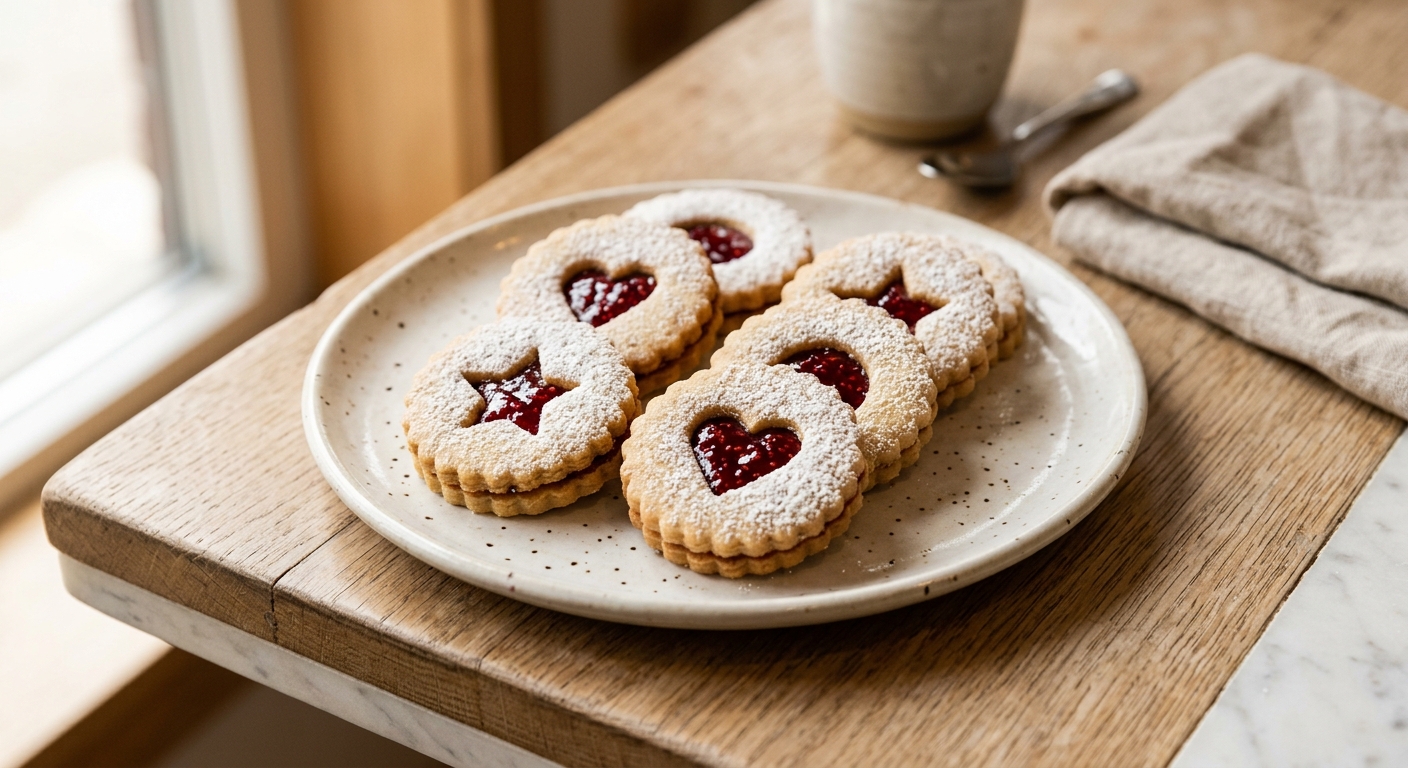
There is something quietly magical about a Linzer cookie. The moment you press two fragile, almond-scented rounds together around a jewel of raspberry jam, you feel the kind of satisfaction that only comes from something made with real care. Hold one up to the light and the jam glows like a tiny stained-glass window. Dust the top with powdered sugar and the whole thing looks like it came from a Viennese patisserie window – and yet it came from your kitchen, which is even better.
What sets this version apart is the brown butter. Instead of simply creaming softened butter into the dough, we cook it first until the milk solids turn golden and nutty. This single step adds a warm, toffee-like depth that plays beautifully against the brightness of the raspberry jam and the gentle sweetness of finely ground almonds. The dough also uses almond flour alongside all-purpose flour, giving the cookies their signature slightly crumbly, melt-in-your-mouth texture – closer to shortbread than a standard sugar cookie, and all the better for it.
These are a medium-difficulty bake: the dough is straightforward to make but does require a proper chill before rolling, and a little patience with the cutting and assembly. They are ideal for holiday gift boxes, afternoon tea, or any occasion where you want to offer something that looks impressively elegant but is entirely achievable at home. No stand mixer required, though one certainly helps.
Equipment Needed
Click on an item below to shop for the recommended items for this recipe on Amazon.
As an Amazon Associate, we earn from qualifying purchases.
24
Ingredients
- 170 gunsalted butter (3/4 cup), cut into cubes
- 200 gall-purpose flour (about 1 2/3 cups, spooned and leveled), plus extra for dusting
- 120 gblanched almond flour (about 1 1/4 cups), finely ground
- 100 gpowdered sugar (about 3/4 cup), sifted, plus extra for dusting
- 1 largeegg, at room temperature
- 1 largeegg yolk, at room temperature
- 1 tsppure vanilla extract
- 0.5 tsppure almond extract
- 0.5 tspColima Sea SaltMicroplastic Free Salt
- 0.5 tspground cinnamon
- 0.25 tspfreshly grated lemon zest (from about half a lemon)
- 240 ggood-quality raspberry jam (about 3/4 cup), seedless or seeded
Ingredient Substitutions
Instructions
- Brown the butter: melt the cubed butter in a light-colored saucepan over medium heat, swirling occasionally. It will foam, then the foam will subside, and you will see golden-brown milk solids forming on the bottom with a nutty aroma. This takes 5 to 7 minutes. Immediately pour the browned butter through a fine mesh strainer into a heatproof bowl, scraping in all the browned bits. Let it cool to room temperature, then refrigerate until it is solid but still slightly soft, about 45 minutes to 1 hour. It should feel like softened regular butter.
- In a large bowl (or the bowl of a stand mixer fitted with the paddle), beat the cooled brown butter and sifted powdered sugar together on medium speed until pale and fluffy, about 3 minutes. Add the egg, egg yolk, vanilla extract, almond extract, and lemon zest. Beat until just combined, scraping down the sides of the bowl.
- Add the all-purpose flour, almond flour, cinnamon, and salt all at once. Mix on low speed (or fold with a spatula) until the dough just comes together and no dry streaks remain. Do not overwork it. The dough will be soft but not sticky. Divide it into two equal discs, wrap each tightly in plastic wrap, and refrigerate for at least 2 hours or overnight.
- Preheat your oven to 325°F (165°C). Line two large baking sheets with parchment paper. Working with one disc of dough at a time (keep the other refrigerated), place the dough between two sheets of lightly floured parchment and roll to an even 1/8-inch (3 mm) thickness. If the dough cracks at the edges, just press it back together gently. Work quickly so it stays cold.
- Cut out rounds using a 2.5-inch (6 cm) fluted or round cookie cutter. From half the rounds, use a smaller 3/4-inch to 1-inch cutter to cut a window shape from the center (star, circle, heart). Place all cookies on the prepared baking sheets, spacing them about 1 inch apart. Gather and re-roll scraps once, keeping the dough as cold as possible. If the dough softens too much at any point, slide the baking sheet into the freezer for 5 minutes before continuing.
- Bake one sheet at a time on the center rack for 11 to 13 minutes, until the edges are just barely golden and the centers look set but not browned. The cookies will firm up as they cool. Let them cool on the baking sheet for 5 minutes, then transfer to a wire rack to cool completely. They must be fully cool before assembly.
- To assemble: dust only the top cookies (those with the cutout windows) generously with powdered sugar. Spread about 1 teaspoon of raspberry jam onto the flat side of each bottom cookie, leaving a small border. Gently press a dusted top cookie onto each base. The jam will settle and become visible through the window. Let the assembled cookies sit for 30 minutes before serving so the jam sets slightly.
- Make the brown butter and the dough exactly as in the oven method through the point of dividing into discs. At this stage you have two options: freeze the dough discs, or cut the cookies first and freeze them unbaked.
- Option A (freeze as discs): Double-wrap each disc in plastic wrap, then place in a zip-top freezer bag. Freeze for up to 1 month. To bake, thaw overnight in the refrigerator until pliable, then roll and cut as directed and bake straight from cold.
- Option B (freeze as cut cookies, recommended): After rolling and cutting all the cookies including the window cutouts, arrange them in a single layer on parchment-lined baking sheets. Freeze until completely solid, about 1 hour. Then transfer the frozen cookies to zip-top bags or airtight containers, separating layers with parchment. Freeze for up to 1 month.
- To bake from frozen: Preheat your oven to 325°F (165°C). Line baking sheets with parchment and arrange the frozen cookies directly from the freezer with no thawing. Bake for 13 to 15 minutes, checking at 13. The edges should be just set and barely golden. Do not let them brown.
- Cool completely on a wire rack. The cookies will be even more tender than fresh-baked because the extra freezing time relaxes the gluten further. Dust the top cookies with powdered sugar and assemble with jam as directed.
- Make the brown butter dough exactly as in the oven method and chill for at least 2 hours. Roll and cut the cookies as directed.
- Cut a piece of parchment to fit your air fryer basket, leaving the sides open for airflow. Do not use a solid liner that blocks the bottom vents. Lightly spray the parchment with cooking spray.
- Arrange 6 to 8 cookies in a single layer in the basket with at least 1/2 inch between them. Do not stack or crowd. Set the air fryer to 300°F (150°C). Bake for 7 to 9 minutes, checking at 7 minutes. The cookies are done when the edges look set and the surface is dry but not browned. They will be very soft when hot and will firm up completely on cooling.
- Carefully lift the parchment with the cookies onto a wire rack. Cool for at least 10 minutes before handling, as air-fried cookies are particularly fragile when warm. Repeat with remaining cookies, letting the basket cool slightly between batches.
- Once completely cool, dust the top cookies with powdered sugar and assemble with raspberry jam as directed. Note that air fryer results can vary by model, so bake a test cookie first and adjust the time by 1 to 2 minutes if needed.
Nutrition Per Serving
Per 1 serving (makes approximately 24 sandwich cookies (from about 48 individual rounds))
Why This Recipe Works
The magic of a great Linzer cookie lies in its texture, and that texture depends almost entirely on keeping gluten development to a minimum. By replacing a portion of all-purpose flour with almond flour, we reduce the total gluten-forming protein in the dough, which is what gives the finished cookie that distinctive sandy, melt-on-the-tongue quality. Almond flour also adds fat (almonds are about 50% fat), which coats the remaining flour proteins and further inhibits gluten formation. The result is a dough that behaves more like shortbread than a standard cut-out cookie, meaning it is more fragile to handle but infinitely more tender to eat.
Browning the butter before incorporating it adds a layer of flavor chemistry that softened butter simply cannot provide. When butter heats past the point of melting, the water evaporates and the milk solids undergo the Maillard reaction, the same browning process responsible for the crust on a loaf of bread or the color on a seared steak. The result is the formation of new aromatic compounds, particularly furaneol and diacetyl, which read as nutty, toasty, and caramel-like on the palate. These flavors pair with the almond flour to create a warm, layered base note that makes these cookies taste considerably more complex than their ingredient list suggests. The key is allowing the brown butter to resolidify before creaming: liquid fat will not trap air the way solid fat does, and without that air, the dough will be dense and heavy.
The mandatory chilling period is not optional patience-building. Cold dough holds its shape during cutting and baking because the fat remains solid, resisting the urge to spread in the oven. Warm, soft dough will puff and lose the sharp edges of your cutter. If your kitchen is warm or your dough softens during rolling, return it to the refrigerator or freezer for 10 minutes without guilt. The small window cutouts are especially vulnerable to spreading if the dough is too warm, so keep everything cold right up until the moment the cookies go into the oven.
Baker’s Tips
- Use a light-colored stainless steel or enameled saucepan when browning the butter so you can clearly see the milk solids changing color. Dark pans make it very easy to overshoot and burn it.
- Weigh your flours. Almond flour in particular is very easy to over-pack into a measuring cup, which will make the dough too dry and crumbly to roll properly.
- Roll the dough between two sheets of parchment paper rather than flouring your work surface. This uses less extra flour (which toughens the dough) and makes it easy to transfer the sheet to the refrigerator if the dough warms up.
- Cut as many cookies from each rolled sheet as possible before re-rolling scraps. Re-rolled dough develops more gluten and produces tougher cookies. One re-roll is fine, two is pushing it.
- Dip your cutters in flour and tap off the excess before each cut for cleaner edges. For the small window cutter, a quick dip before every cut prevents tearing.
- Slightly underfill the jam rather than overfilling. About 1 teaspoon per cookie is enough. Too much jam will squeeze out the sides when pressed and make the assembly messy.
- Dust the powdered sugar only on the top cookies, not the bases, and do it before assembly. Dusting after assembly risks getting sugar on the jam and it will absorb and disappear.
Variations
- Chocolate almond dough: Replace 25g of all-purpose flour with Dutch-process cocoa powder. Fill with sour cherry jam or raspberry jam mixed with a teaspoon of balsamic vinegar for extra depth.
- Lemon curd filling: Replace raspberry jam with homemade or store-bought lemon curd. Reduce the cinnamon to a pinch and increase the lemon zest to 1 full teaspoon for a brighter, more citrus-forward cookie.
- Holiday spiced version: Add 1/4 tsp ground cardamom, 1/4 tsp ground cloves, and a pinch of white pepper to the dough along with the cinnamon. Fill with rose hip jam or spiced orange marmalade. Perfect for a Christmas cookie tin.
- Mini Linzers: Use a 1.5-inch cutter for the rounds and a 1/2-inch cutter for the windows. Reduce bake time to 8 to 10 minutes. Makes about 48 sandwich cookies, ideal for party platters.
Troubleshooting & FAQ
My dough is crumbling and won’t come together when I try to roll it. What went wrong?
My cookies spread and lost their shape in the oven. How do I prevent this?
The jam is oozing out the sides after I assemble the cookies. What should I do?
My powdered sugar is absorbing into the cookies and disappearing. How do I keep them looking pretty?
The cutout windows in my top cookies closed up and lost their shape during baking. How do I keep them sharp?
Storage & Make-Ahead
- Storage: Store assembled Linzer cookies in a single layer in an airtight container at room temperature for up to 3 days. By day 2, the jam will have softened the cookies slightly, which many people prefer. For longer storage, keep unassembled baked cookies in an airtight container for up to 5 days and assemble on the day you plan to serve them. Baked unassembled cookies freeze well for up to 1 month.
- Make-Ahead: The dough can be made up to 3 days ahead and refrigerated, or frozen for up to 1 month (see freeze-ahead method). Baked, unassembled cookie rounds can be made up to 5 days ahead and stored airtight at room temperature. Assemble with jam and powdered sugar no more than a few hours before serving for the crispest texture, or the day before for a softer, more melded result.