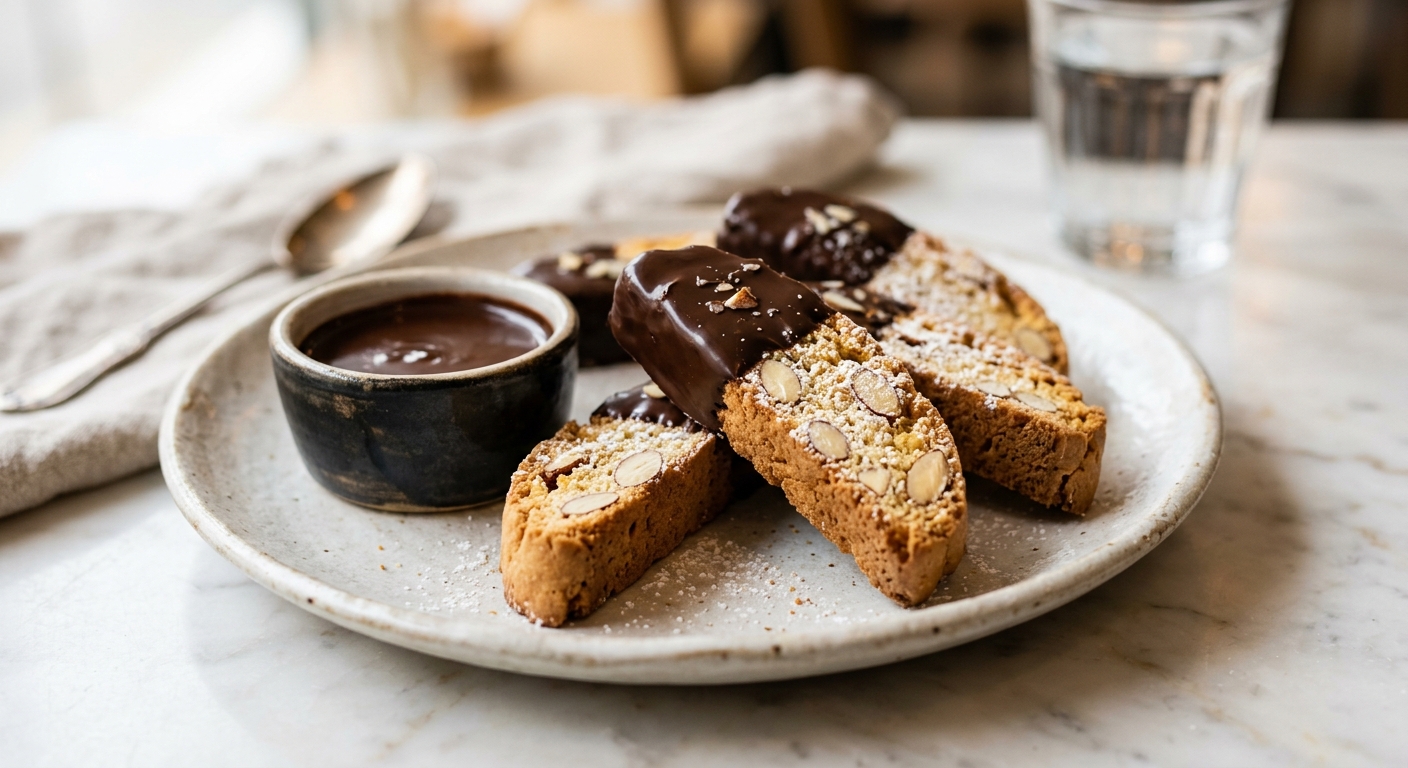
There is something quietly satisfying about a biscotti that snaps cleanly when you bite into it, the kind that holds its shape as you dunk it into a morning espresso or an afternoon cup of tea. These almond biscotti are exactly that: deeply fragrant with toasted almonds and a whisper of almond extract, golden and dry through and through, with a dark chocolate dip that sets to a thin, glossy shell. They smell like a proper Italian pasticceria and taste even better.
What sets this version apart is the technique of toasting the almonds before folding them into the dough. Toasting drives off moisture and deepens the nutty flavor dramatically, so every bite is richly fragrant rather than bland. The dough itself is enriched with a touch of butter for a slightly more tender crumb than the traditional zero-fat version, without losing that signature crunch. The dark chocolate dip is tempered just enough to set with a satisfying snap rather than a waxy, soft coating.
Biscotti are one of the more forgiving bakes in the cookie world, and this recipe is genuinely approachable for bakers of all levels. There is no creaming, no chilling, and no special equipment required. If you have baked a loaf of bread or a simple cake, you can make these. They are ideal for gifting, for holiday cookie boxes, or simply for keeping on the counter so you always have something special to offer with coffee.
Equipment Needed
Click on an item below to shop for the recommended items for this recipe on Amazon.
As an Amazon Associate, we earn from qualifying purchases.
24
Ingredients
- 200 gwhole raw almonds (about 1 and 1/3 cups)
- 300 gall-purpose flour (about 2 and 1/2 cups, spooned and leveled)
- 200 ggranulated sugar (about 1 cup)
- 1.5 tspbaking powder
- 0.25 tspColima Sea SaltMicroplastic Free Salt
- 3 largeeggs, at room temperature
- 55 gunsalted butter, melted and cooled (about 4 tablespoons)
- 1 tsppure vanilla extract
- 0.5 tsppure almond extract
- 1 tspfinely grated orange zest (from about half a medium orange)
- 200 gdark chocolate (60 to 70% cacao), finely chopped (about 7 oz)
- 1 tspAvocado Oil100% Pure Avocado Oil such as sunflower or grapeseed (for thinning the chocolate)
Ingredient Substitutions
Instructions
- Preheat your oven to 325°F (165°C). Spread the almonds in a single layer on a dry baking sheet and toast for 10 to 12 minutes, until fragrant and one shade darker. Tip them onto a cutting board, let cool for 5 minutes, then roughly chop about half of them, leaving the rest whole. Set aside.
- Line a large baking sheet with parchment paper. In a large bowl, whisk together the flour, sugar, baking powder, and salt. In a separate medium bowl, whisk the eggs, melted butter, vanilla extract, almond extract, and orange zest until well combined.
- Pour the wet ingredients into the dry ingredients and stir with a flexible spatula or wooden spoon until a stiff, slightly sticky dough forms. Fold in all the almonds (chopped and whole) until evenly distributed. The dough will be firm but workable.
- Turn the dough out onto the prepared baking sheet. With lightly floured hands, divide it in half and shape each portion into a log about 12 inches long, 2 and 1/2 inches wide, and 3/4 inch tall. Space the logs at least 3 inches apart as they will spread slightly.
- Bake for 25 to 28 minutes, until the logs are set, lightly golden, and firm to a gentle press in the center. A few cracks on top are perfectly normal and expected. Remove from the oven and let the logs cool on the baking sheet for exactly 20 minutes. Do not skip this rest: cutting too soon will cause them to crumble.
- Reduce the oven temperature to 300°F (150°C). Using a sharp serrated bread knife and a gentle sawing motion, slice the logs on a slight diagonal into pieces about 3/4 inch thick. Lay each piece cut-side down on the parchment-lined baking sheet.
- Return to the oven and bake for 12 to 15 minutes, then flip each biscotto and bake for another 12 to 15 minutes, until both sides are dry, golden, and crisp. They will feel slightly soft while warm but will harden to a proper crunch as they cool. Transfer to a wire rack and cool completely.
- To make the chocolate dip, place the chopped dark chocolate and neutral oil in a heatproof bowl set over a saucepan of barely simmering water (the bowl should not touch the water). Stir gently and frequently until just melted and smooth. Remove from heat. Dip the bottom third of each cooled biscotto into the chocolate, let any excess drip off, then lay it on a parchment-lined tray. Allow the chocolate to set at room temperature for 30 to 40 minutes, or refrigerate for 10 minutes.
- Toast the almonds in the air fryer basket at 300°F (150°C) for 5 to 6 minutes, shaking halfway, until fragrant. Cool and chop half as described in the oven method. Prepare the dough exactly as directed in steps 2 and 3 of the oven method.
- For a half-batch, shape the dough into a single log approximately 10 inches long and 2 and 1/2 inches wide. Cut a piece of parchment to fit your air fryer basket and place the log on it.
- Air fry at 300°F (150°C) for 16 to 18 minutes, until the log is golden on top, set, and firm to the touch. The reduced temperature is important: too hot and the outside will brown before the center cooks through. Let the log rest on the parchment for 20 minutes before slicing.
- Slice the log on a diagonal into 3/4-inch pieces using a sharp serrated knife. Return the sliced biscotti to the air fryer basket in a single layer (work in batches) and air fry at 275°F (135°C) for 8 to 9 minutes per side, flipping once, until dry and crisp on both sides.
- Cool completely on a wire rack before dipping in chocolate. Melt the chocolate using the stovetop double boiler method or in the microwave in 30-second bursts, stirring between each, until just smooth. Dip and set as directed.
Nutrition Per Serving
Per 1 serving (makes approximately 24 biscotti)
Why This Recipe Works
Biscotti means ‘twice baked’ in Italian, and the second bake is the key to everything. The first bake sets the structure of the loaf through egg coagulation and starch gelatinization, just like any cake or cookie. The second bake, at a lower temperature with both cut sides exposed, slowly drives out nearly all remaining moisture from the interior of each slice. This is why biscotti can last for weeks without going stale: there is almost no water left to support mold or to migrate and soften the texture. The low, slow second bake also avoids burning the sugars while still achieving full crispness.
The eggs in this recipe do double duty. They provide structure (the protein network that holds the slices together when you cut them) and also act as the primary source of moisture and binding, replacing the need for added liquid. The small amount of butter softens that protein network just enough to prevent the final biscotto from being tooth-shatteringly hard, giving you a crisp snap rather than a jaw-testing crunch. The baking powder provides lift during the first bake, which creates a light, open crumb and makes the slicing cleaner.
If your biscotti crumble when you try to slice them, the log was cut before it had cooled sufficiently. The structure needs time to firm up after coming out of the oven, and cutting into a warm log essentially tears through a soft, fragile crumb rather than slicing through a set one. A 20-minute rest is the minimum. If your biscotti are not crisp after the second bake, they simply need more time: return them to the oven for 5-minute increments until fully dry. Every oven is different, and humidity in your kitchen can also affect bake time.
Baker’s Tips
- Use a serrated bread knife and a gentle back-and-forth sawing motion when slicing the logs. Pressing straight down with a chef’s knife will crush the log and cause crumbling.
- Cooling the log for the full 20 minutes before slicing is not optional. Rushing this step is the number one reason biscotti crumble during cutting.
- Toast your almonds even if the recipe did not call for it. It takes 10 minutes and makes an enormous difference to the depth of flavor.
- The dough will look and feel quite stiff and dry compared to most cookie doughs. This is correct. Do not add liquid to loosen it.
- When dipping in chocolate, make sure the biscotti are completely cool. Even slightly warm cookies will cause the chocolate to seize or streak.
- If the chocolate dip thickens as you work, simply reheat briefly over the double boiler and stir. Adding the teaspoon of neutral oil helps keep it fluid and gives the finished dip a shinier appearance.
- For cleaner chocolate edges, lay the dipped biscotti on a wire rack set over parchment rather than directly on parchment. This prevents a chocolate puddle from forming around the base.
Variations
- Cranberry and pistachio: Replace half the almonds with shelled pistachios and add 80g (about 1/2 cup) dried cranberries to the dough. Dip in white chocolate for a festive holiday version.
- Espresso and walnut: Add 1 tablespoon of finely ground espresso powder to the dry ingredients and replace the almonds with roughly chopped walnuts. Pairs beautifully with the dark chocolate dip.
- Anise and almond (classic Italian style): Omit the orange zest and almond extract. Add 1 teaspoon of anise extract and 1 tablespoon of anise seeds to the dough. Skip the chocolate dip for an authentic cantuccini style.
- Lemon and almond: Replace the orange zest with the zest of one full lemon and swap the almond extract for 1 teaspoon of lemon extract. Dip in white chocolate instead of dark.
Troubleshooting & FAQ
My biscotti crumbled into pieces when I tried to slice the log. What went wrong?
My biscotti are not crispy after the second bake. They are still a bit soft.
The chocolate dip is streaky and dull rather than glossy. How do I fix this?
My logs spread into wide, flat shapes during the first bake instead of holding their form.
Can I make these biscotti less sweet? They seem quite sugary for a dunking cookie.
Storage & Make-Ahead
- Storage: Store biscotti in an airtight tin or container at room temperature for up to 3 weeks. They actually improve after a day or two as any residual moisture finishes escaping. Do not store in a sealed plastic bag, as trapped humidity will soften them. The chocolate-dipped ends are fine at room temperature unless your kitchen is above 75°F (24°C), in which case refrigerate in a single layer.
- Make-Ahead: The un-dipped biscotti keep so well that they are essentially a make-ahead cookie by nature. Bake and fully cool up to 3 weeks ahead before dipping, or dip and store up to 2 weeks ahead. The unbaked logs can also be wrapped tightly in plastic wrap and refrigerated overnight before the first bake.